Palacio Legislativo: Inside Uruguay's Seat of Power
The Palacio Legislativo is Uruguay's working parliament and one of Montevideo's most commanding architectural landmarks. Built in neoclassical style and opened in the early 20th century, it offers guided tours that reveal ornate interiors few visitors think to seek out.
Quick Facts
- Location
- Av. de las Leyes s/n, Barrio Aguada, Montevideo
- Getting There
- Multiple city buses serve the area; also a stop on Montevideo's Bus Turístico route
- Time Needed
- 1 to 1.5 hours including the guided tour
- Cost
- Approximately 140 UYU per person for foreigners; free for Uruguayan residents (verify locally before visiting)
- Best for
- Architecture enthusiasts, history buffs, and travelers curious about Uruguayan civic life
- Official website
- parlamento.gub.uy/sobreelparlamento/palacio
What the Palacio Legislativo Actually Is
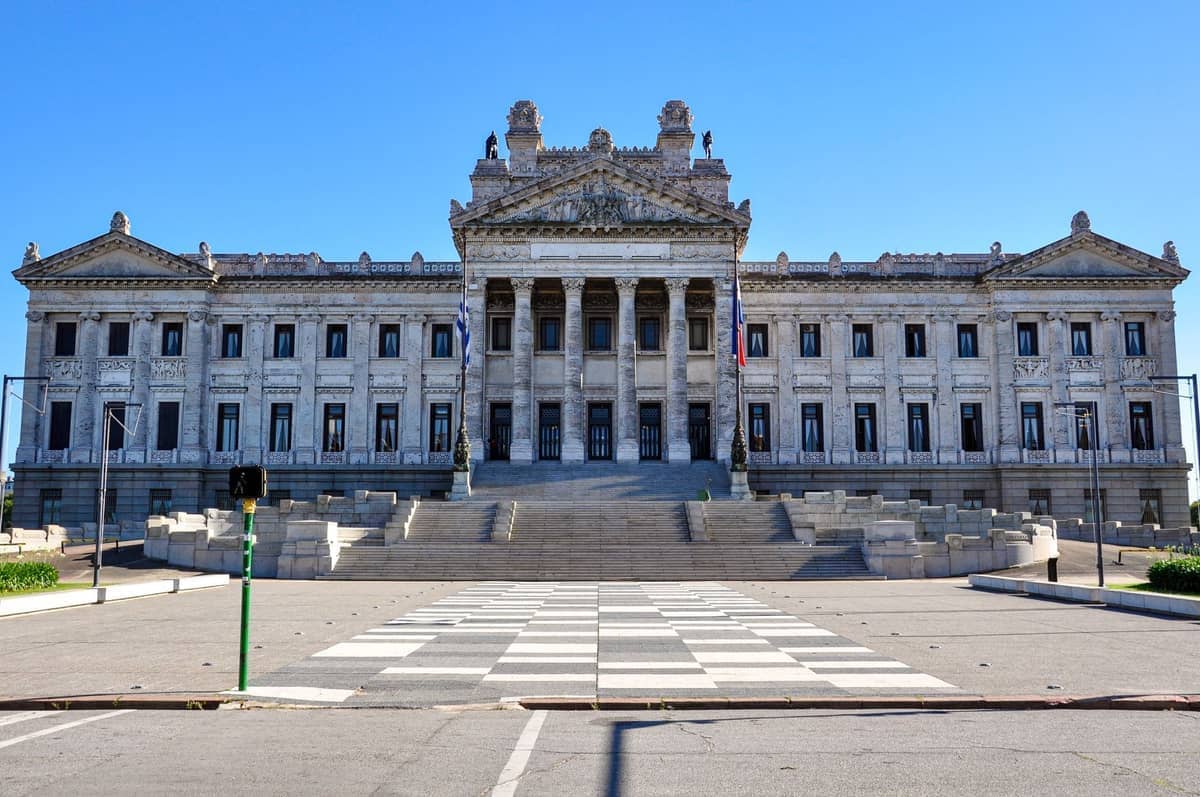
The Palacio Legislativo is Uruguay's functioning national parliament, the seat of the Asamblea General, and the most architecturally ambitious public building in Montevideo. Construction began in 1908 in a neoclassical style, and the finished palace remains one of the great monumental civic buildings in South America. It is not a ruin, a repurposed historic site, or a museum replica: lawmakers meet here, and the building operates as the real center of Uruguayan legislative power.
Located in the Aguada neighborhood, roughly 3 kilometers north of Plaza Independencia, the palace sits on a rise above the surrounding streets. From a distance, its massive stone facade and central dome dominate the skyline in a way that is easy to underestimate on a map. Up close, the scale becomes clear: the exterior columns are substantial, the marble is real, and the building was clearly designed to communicate permanence and institutional weight.
💡 Local tip
Guided tours are the only way to access the interior. They typically run Monday through Friday around 11:00 and 15:00, with seasonal schedules sometimes adjusted. Always confirm current times directly with the parliament before you go, as hours shift seasonally.
The Architecture: Why It Repays Attention
The Palacio Legislativo was built during a period when Uruguay was investing heavily in public infrastructure and civic institutions. The neoclassical style was a deliberate choice, borrowing the visual grammar of European parliamentary buildings to signal the country's democratic ambitions. The exterior stonework, columns, and symmetrical massing follow classical proportions with precision. The central dome is the most visible feature from the surrounding streets and appears in the background of countless photographs taken from the Avenida de las Leyes approach.
Inside, the materials are the real story. The floors and walls use multiple varieties of Uruguayan marble, which gives the interior a grounded, domestic quality despite the grand scale. Guides typically point out the different marble types and their regional origins, which turns an abstract architectural tour into something more specific and surprising. For anyone following Montevideo's architectural history, the Legislative Palace represents the clearest expression of the country's early-20th-century ambition in stone.
The legislative chambers themselves are formal and austere in the way working government rooms tend to be: good wood, serious lighting, minimal decoration compared to the ceremonial halls. Standing in a functioning chamber where real votes are cast gives the space a different quality than any museum recreation could. The guided tour frames the rooms in both architectural and political terms, which makes it more rewarding than a simple building walk-through.
Tickets & tours
Live prices and dates from our booking partner. If you book, we may earn a commission at no extra cost to you.
Guided Tour with Wine Tasting Experience at Bouza Winery
From 68 €Instant confirmationFree cancellationAirport to Hotel or Hotel to Airport Transfer in Montevideo
From 47 €Instant confirmationFree cancellationTasting and Lunch at Bodega Pizzorno in Montevideo
From 115 €Instant confirmationFree cancellationPunta del Este full-day guided tour from Montevideo
From 47 €Instant confirmationFree cancellation
How the Visit Actually Works
The Palacio Legislativo is not a drop-in attraction. Access is exclusively through organized guided tours, and because the building is actively used by parliament, tour availability can be affected by legislative sessions, national events, or official ceremonies. On days when parliament is in session, parts of the building may be restricted or tours shortened.
Tours typically last around 45 minutes to an hour and are conducted in Spanish. English-language tours may be available on request or with advance arrangement, but this is not guaranteed. Groups assemble at the entrance on Avenida de las Leyes. Arrive a few minutes early: the building has security checkpoints similar to any government facility, and you will need to show identification.
⚠️ What to skip
The admission price of approximately 140 UYU dates from sources published from 2024 onward. Given Uruguay's inflation and periodic updates, this figure should be verified directly before your visit. Uruguayan residents have historically entered free of charge.
Photography inside is generally permitted in public areas, but flash is typically discouraged and individual guides may restrict shooting in certain rooms. The building's interior lighting is soft and warm, so a camera that handles low light performs better than a phone camera in the deeper interior halls.
Best Time to Visit and How to Get There
Weekday mornings are the most reliable time for a tour. The 10:30 slot tends to attract fewer visitors than the afternoon tour, and the light on the building's south-facing exterior is better in the morning hours. Midweek days, particularly Tuesday through Thursday, are quieter than Mondays or Fridays when both tourists and official visitors tend to cluster.
The palace is about 3 kilometers from Plaza Independencia, which makes it walkable in 30 to 35 minutes along Avenida 18 de Julio. City buses cover the route frequently, and the Montevideo Bus Turístico includes a stop here, which makes it a natural add-on to a broader sightseeing day. Ride-hailing apps including Uber operate in Montevideo and offer a convenient alternative if you are combining this with other stops across the city.
Weather affects the experience mainly in terms of the exterior approach. The plaza and open ground in front of the building are exposed, so summer visits (December through February) can be hot in direct midday sun. Autumn and spring, when daytime temperatures sit between roughly 13 and 22 degrees Celsius, make the walk around the exterior and the exterior photography considerably more comfortable.
What the Surrounding Area Offers
The Palacio Legislativo sits in the Aguada neighborhood, which is part of the broader Centro district. This is not a tourist-heavy area, and that is actually part of its appeal. The streets around the palace are functional and low-key, which means the building stands out with more force than it would if surrounded by souvenir shops. There are cafes and small restaurants within a few blocks.
If you are building a half-day route, the palace pairs naturally with a walk south toward the Puerta de la Ciudadela and the Metropolitan Cathedral in Ciudad Vieja. The walk through Centro along the way offers a useful cross-section of the city's everyday character, away from the more curated historic zone.
Honest Assessment: Is It Worth Your Time?
For travelers interested in architecture, civic history, or how South American democracies present themselves through physical space, the Palacio Legislativo is genuinely rewarding. The marble interiors are striking, the scale is impressive, and the fact that it is a working institution rather than a preserved monument gives it a particular kind of gravity.
Travelers who are not especially interested in architecture or political history may find the tour interesting but not essential. If your time in Montevideo is limited to a day or two, the Ciudad Vieja, the Mercado del Puerto, and the Rambla will probably fill your time more naturally. But if you have three or more days, or if you want to see a side of Montevideo that most day-trippers skip, this is a worthwhile detour.
For those planning an efficient itinerary, the 2 days in Montevideo guide offers a practical framework that can help you decide where the palace fits relative to other priorities.
ℹ️ Good to know
The Palacio Legislativo is recognized as one of Uruguay's most important national monuments. A centenary of its inauguration has been marked with heritage events through the parliament's official program, underscoring its continued cultural significance.
Insider Tips
- Call or email the parliament's visitor services in advance if you want an English-language tour. It may be possible to arrange one with enough notice, though it is not a guaranteed standard offering.
- The exterior of the building, including the approach along Avenida de las Leyes and the open plaza area, is worth walking even if you do not take a tour. The proportions of the facade read best from about 100 meters away.
- On weekdays when parliament is not in session, tour groups tend to be smaller and guides have more time for questions. Avoid visiting during major national dates or when the Asamblea General has important votes scheduled.
- Bring your passport or national ID. The building operates with government-level security, and entry without identification is not possible.
- The Bus Turístico offers a convenient way to combine this stop with other landmarks spread across the city without having to figure out individual bus routes for each destination.
Who Is Palacio Legislativo For?
- Architecture and design enthusiasts who want to see neoclassical civic building at a serious scale
- History-focused travelers interested in Uruguay's political and institutional development
- First-time visitors to Montevideo with three or more days who want depth beyond the historic center
- Travelers who enjoy touring working government buildings and understanding how democracies function spatially
- Budget-conscious visitors: the entry cost is minimal and the experience is substantive
Nearby Attractions
Other things to see while in Centro:
- Auditorio Nacional del SODRE
The Auditorio Nacional Adela Reta is Uruguay's most important performing arts venue, a 25,000-square-metre complex in central Montevideo that reopened in 2009 after decades of reconstruction. Home to the SODRE symphony orchestra, ballet, and opera, it draws serious music lovers and curious visitors alike.
- Cementerio Central
Inaugurated in 1835, the Central Cemetery of Montevideo is one of South America's most architecturally rich burial grounds. Free to enter and loaded with marble mausoleums, neo-Gothic chapels, and the graves of presidents and artists, it rewards those willing to look slowly.
- Estadio Centenario
Built for the 1930 FIFA World Cup and declared a Monument of World Football, Estadio Centenario is one of the most historically significant sports venues in the Americas. The on-site Uruguayan Football Museum makes it worth visiting even on non-match days.
- Mirador de la Intendencia
The Mirador Panorámico de la Intendencia de Montevideo sits on the 22nd floor of the city's main municipal building, offering unobstructed 360-degree views across the capital, the Río de la Plata, and the surrounding neighbourhoods. Entry is completely free, but you need to book a slot in advance. Here is everything you need to plan a visit.
Planning a trip? Discover personalized activities with the Nomado app.