Estadio Centenario: Uruguay's Cathedral of Football
Built for the 1930 FIFA World Cup and declared a Monument of World Football, Estadio Centenario is one of the most historically significant sports venues in the Americas. The on-site Uruguayan Football Museum makes it worth visiting even on non-match days.
Quick Facts
- Location
- Av. Américo Ricaldoni, Parque Batlle, Montevideo (approx. 4–4.5 km east of Ciudad Vieja)
- Getting There
- Bus lines 115 and 143 from the city center; alight near Av. Dr. Américo Ricaldoni and Av. Italia
- Time Needed
- 1.5 to 2.5 hours for the museum and stadium viewpoint
- Cost
- Museum: UYU 400 for foreign visitors, UYU 200 for Uruguayan residents, UYU 90 for retirees, free for children under 12
- Best for
- Football history enthusiasts, architecture lovers, and anyone curious about Uruguay's national identity
- Official website
- estadiocentenario.com.uy
Why Estadio Centenario Matters
Estadio Centenario is not just a football ground. It is the venue where the entire concept of a FIFA World Cup became real. Built specifically for the inaugural 1930 World Cup, it hosted the final in which Uruguay defeated Argentina 4–2 before a crowd of 68,346 spectators. FIFA has since designated it a Monument of World Football, the only stadium in the world to carry that designation.
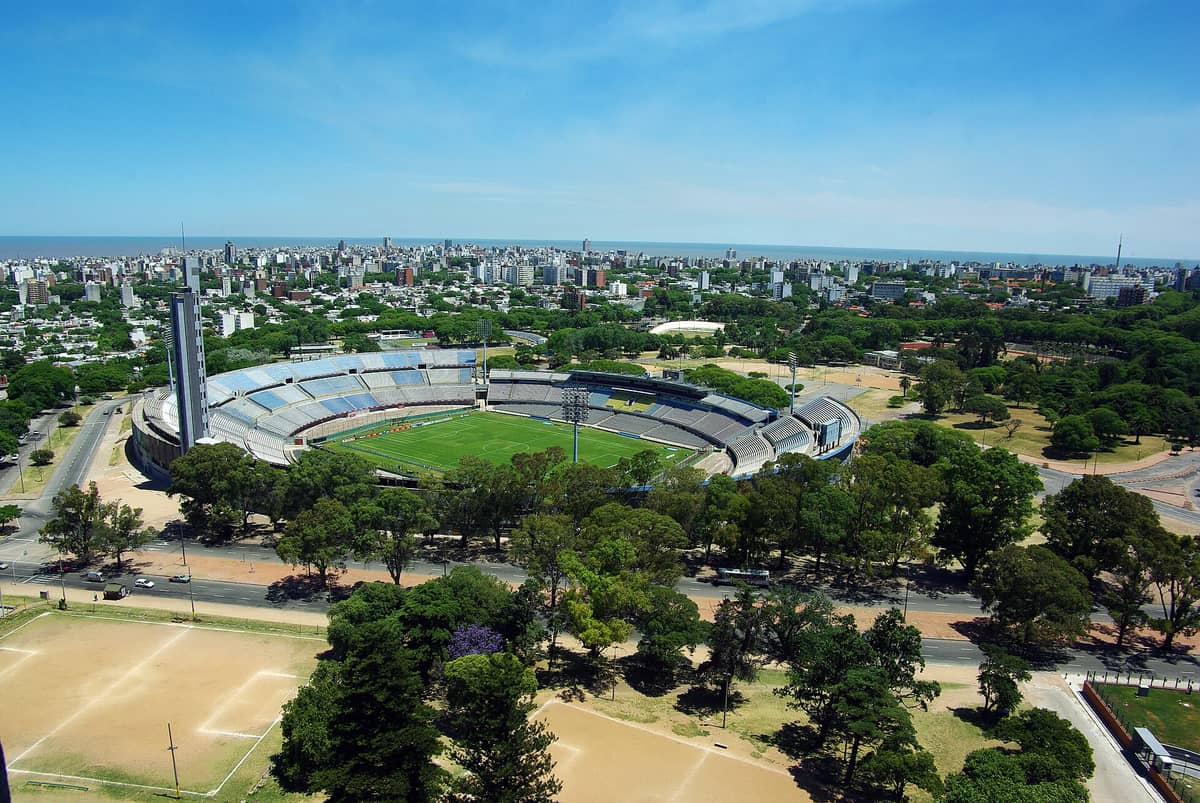
For Uruguayans, this place carries weight that goes beyond sport. Uruguay in 1930 was a small South American republic marking the centenary of the 1830 constitution, and the government commissioned the stadium as a symbol of national confidence. The architecture reflects that ambition: the Torre de los Homenajes, the Tower of Homages, rises above the stands like a declaration.
Even if you have no particular interest in football, the stadium rewards a visit with architectural drama, a surprisingly rich museum, and one of the better panoramic viewpoints over central Montevideo. The entry fee for foreign visitors is modest, making it one of the better-value stops in the city.
ℹ️ Good to know
The museum entrance is located at the Tribuna Olímpica (Olympic Stand), next to Gate 13 on Av. Dr. Américo Ricaldoni. Do not show up at the main stadium gates, which are only open for ticketed events.
The Architecture: What You Are Looking At
The stadium was designed by Juan Scasso, a Uruguayan architect, and completed in time for the 1930 World Cup with remarkable speed. The result is a structure that blends rationalist modernism with monumental civic ambition. Four distinct stands, each named after a different tribune, curve around a playing field that still hosts top-level matches today.
The Torre de los Homenajes is the defining feature. Rising above the Olympic Stand, it functions as both a visual landmark and, for visitors, a viewpoint. Climbing it involves stairs, so it is not suitable for everyone, but the perspective from the top over the Parque Batlle greenery and the surrounding neighborhoods is worth the effort on a clear day.
The stadium sits within Parque Batlle, a large public park that buffers it from the surrounding residential streets. Approaching on foot from the bus stop, you pass tree-lined paths and weekend joggers before the concrete mass of the stadium comes into full view. The scale is genuinely impressive up close, particularly given that it was constructed over nine decades ago.
Tickets & tours
Live prices and dates from our booking partner. If you book, we may earn a commission at no extra cost to you.
Guided Tour with Wine Tasting Experience at Bouza Winery
From 68 €Instant confirmationFree cancellationAirport to Hotel or Hotel to Airport Transfer in Montevideo
From 47 €Instant confirmationFree cancellationTasting and Lunch at Bodega Pizzorno in Montevideo
From 115 €Instant confirmationFree cancellationPunta del Este full-day guided tour from Montevideo
From 47 €Instant confirmationFree cancellation
Inside the Uruguayan Football Museum
The Uruguayan Football Museum, housed within the Olympic Stand, is the primary attraction for visitors on non-match days. It is a serious collection rather than a superficial trophy room, organized across multiple rooms covering the origins of football in Uruguay, the national team's history, and the 1930 World Cup in detail.
Expect jerseys, boots, match balls, trophies, and archival photographs. The 1930 World Cup section is the centerpiece, with original match programs, medals, and documentation that situate the event in its historical context. The displays are labeled in Spanish, but multilingual staff are on hand and can assist visitors in English, Portuguese, and French.
The museum is genuinely informative even for visitors with only a passing interest in football. It doubles as a document of Uruguayan social history: the crowds in the archival photos, the stadium's construction timeline, the political circumstances of the 1930s. Budget at least an hour here before heading up to the viewpoint.
⚠️ What to skip
On match days, the museum may be closed entirely. If your visit coincides with a Nacional or Peñarol fixture, or an international game, check the official site before traveling. Hours are Monday to Saturday 10:00–17:00 and Sunday 11:00–15:00 on regular non-match days.
What Changes by Time of Day
Midweek mornings are the quietest time to visit. Arriving around 10:30 on a Tuesday or Wednesday means the museum rooms are nearly empty, the staff have time to answer questions, and the walk through the stands to the tower viewpoint feels unhurried. The light from the east hits the concrete facades well in the morning hours.
Weekend afternoons bring more families and local visitors, particularly on Sundays when the shorter museum hours (11:00–15:00) concentrate foot traffic. The atmosphere is livelier, which has its own appeal, but expect more wait time at the viewpoint if a group tour is passing through. Saturdays tend to sit between these two extremes.
On days when a match is scheduled for the evening, the surrounding park starts filling in the early afternoon. Food sellers set up near the gates, families gather on the grass, and the whole area takes on a different energy. This is worth experiencing if your schedule allows, even if you do not have a ticket to the game. The approach to a sold-out Centenario, with the roar audible from outside the stands, is a sensory experience that no museum exhibit can replicate.
Getting There and Getting Around
The stadium is about 4.5 km east of Ciudad Vieja and roughly 3 km from the Plaza Independencia area. City buses are the most practical option. Lines 115 and 143 run from the city center toward Parque Batlle; ask the driver or check the stop nearest to Av. Ricaldoni and Av. Italia, from which the stadium entrance is a short walk.
Taxis and ride-hailing apps (including Uber, which operates in Montevideo) are straightforward alternatives. The fare from central Montevideo is modest, and the return trip is easily arranged from the stadium entrance or by app. If you are combining the visit with a walk through Parque Batlle, allow extra time to explore the park grounds, which are pleasant in their own right.
For context on navigating Montevideo's bus network more broadly, the getting around Montevideo guide covers routes, payment, and practical tips for first-time visitors.
Honest Assessment: Who Will Love It and Who Will Not
If you care about football history at any level, this is one of the most legitimate pilgrimage sites the sport has. The 1930 World Cup final was played here. Uruguay lifted the trophy on this ground. The weight of that is real, and the museum does not squander it with superficial presentation.
If football leaves you completely cold, the architectural visit and viewpoint are still worthwhile, but they alone probably do not justify a dedicated trip if your time in Montevideo is short. In that case, consider pairing the stop with a walk through Parque Batlle or a visit to the Museo Juan Manuel Blanes, which is nearby and gives a different dimension to the neighborhood.
Visitors who require step-free access should contact the stadium directly before visiting. The Tower of Homages viewpoint involves stairs, and the museum's layout across the Olympic Stand has not been confirmed as fully wheelchair accessible in publicly available documentation. The multilingual staff should be able to advise on what is feasible.
For those building a wider itinerary around Montevideo's sports culture, the Montevideo football guide covers attending live matches, club history, and the deeper context of football in Uruguayan life.
Insider Tips
- The museum staff can sometimes arrange access to the pitch-level area if the stadium is not in active use. Ask politely at the desk when you arrive. It is not guaranteed, but it happens more often than the official materials suggest.
- Photography inside the museum is generally permitted for personal use. The light in the archival photo sections is low, so bring or enable a camera with good low-light performance. The viewpoint from the tower offers a wide-angle shot of the stadium interior that is difficult to replicate from any other public vantage point.
- Admission prices are denominated in Uruguayan pesos. Carrying local currency makes the transaction smoother. As of the most recent official update, foreign visitor admission is UYU 400, but prices are subject to change and should be verified at the official site before your visit.
- If you want to attend an actual match, Nacional and Peñarol both use Centenario for major fixtures. Tickets are sold through each club's official channels and can sell out quickly for derbies. The atmosphere inside for a full house is genuinely extraordinary and nothing like the quiet museum visit.
- Combine the visit with a walk south through Parque Batlle to reach the Tres Cruces bus terminal area, where you can pick up connections across the city. The park walk takes around 15 minutes and is pleasant in any season except heavy rain.
Who Is Estadio Centenario For?
- Football history enthusiasts and anyone interested in the 1930 World Cup
- Architecture and modernist design visitors
- Travelers seeking an authentic, non-touristy Montevideo experience
- Families with older children who have an interest in sports
- Photographers looking for monumental civic architecture with minimal crowds
Nearby Attractions
Other things to see while in Centro:
- Auditorio Nacional del SODRE
The Auditorio Nacional Adela Reta is Uruguay's most important performing arts venue, a 25,000-square-metre complex in central Montevideo that reopened in 2009 after decades of reconstruction. Home to the SODRE symphony orchestra, ballet, and opera, it draws serious music lovers and curious visitors alike.
- Cementerio Central
Inaugurated in 1835, the Central Cemetery of Montevideo is one of South America's most architecturally rich burial grounds. Free to enter and loaded with marble mausoleums, neo-Gothic chapels, and the graves of presidents and artists, it rewards those willing to look slowly.
- Mirador de la Intendencia
The Mirador Panorámico de la Intendencia de Montevideo sits on the 22nd floor of the city's main municipal building, offering unobstructed 360-degree views across the capital, the Río de la Plata, and the surrounding neighbourhoods. Entry is completely free, but you need to book a slot in advance. Here is everything you need to plan a visit.
- Museo del Fútbol (Estadio Centenario)
Housed within the Tribuna Olímpica of the iconic Estadio Centenario, the Museo del Fútbol traces Uruguay's extraordinary football legacy from its earliest amateur roots to World Cup wins in 1930 and 1950. For anyone who takes football seriously, this is one of the most emotionally resonant sports museums in South America.
Planning a trip? Discover personalized activities with the Nomado app.