Parque Batlle: Montevideo's Grand Civic Park and the Stadium That Changed Football History
Officially named Parque José Batlle y Ordóñez, this sprawling urban park in central Montevideo combines open green space, public sculpture, sports facilities, and the legendary Estadio Centenario. Entry is free, the atmosphere shifts dramatically by hour and day, and there is far more here than a casual glance suggests.
Quick Facts
- Location
- Avenida Dr. Américo Ricaldoni, Parque Batlle, between Avenida Italia and Avenida Rivera, central Montevideo
- Getting There
- Multiple city bus lines run along Avenida Italia and Avenida Rivera; confirm current lines via Montevideo's public transport service
- Time Needed
- 1 to 3 hours depending on whether you visit the stadium or just walk the grounds
- Cost
- Free entry to the park; stadium tour tickets are sold separately
- Best for
- Afternoon walkers, football history enthusiasts, families, and anyone wanting open space in central Montevideo
- Official website
- montevideo.gub.uy/parques-de-montevideo/parque-batlle
What Parque Batlle Actually Is
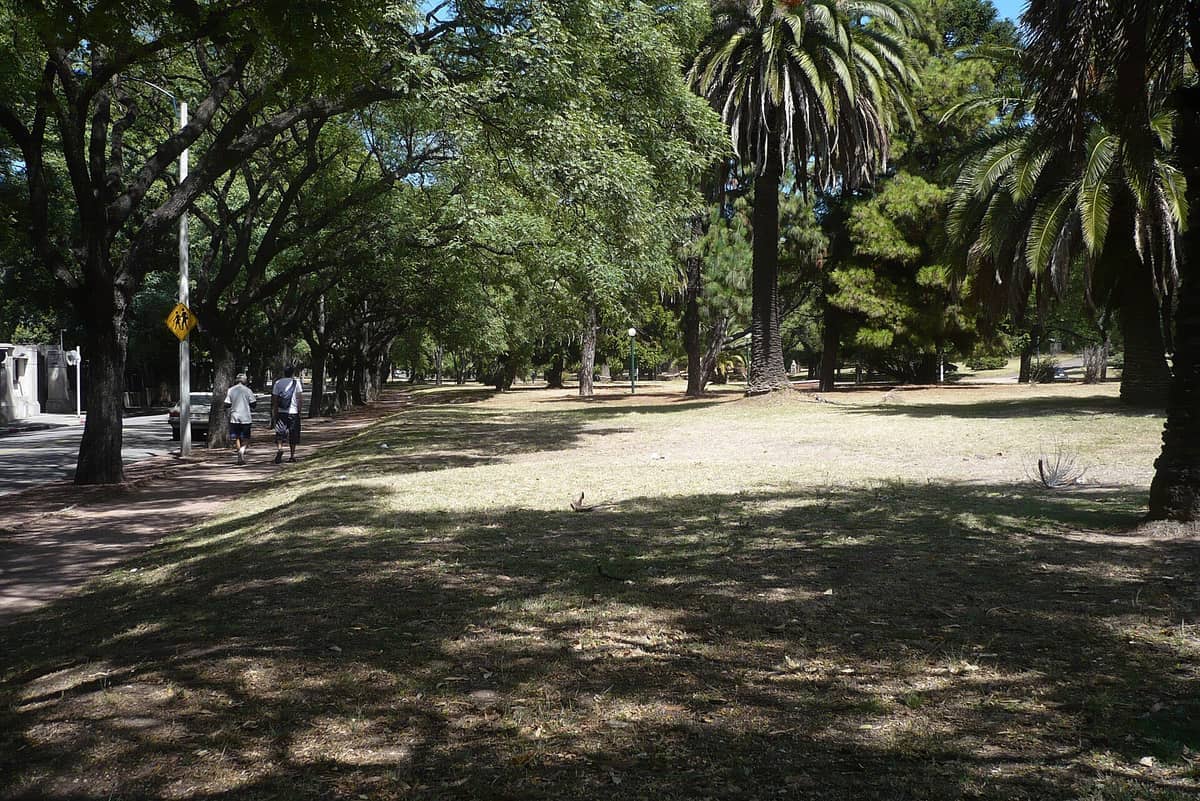
Parque José Batlle y Ordóñez, known to everyone in Montevideo simply as Parque Batlle, is one of the largest and most historically layered public parks in Uruguay's capital. It occupies a broad central swath of the city between Avenida Italia and Avenida Rivera, and its boundaries are generous enough that you can walk for twenty minutes without covering the same ground twice. The park is free to enter and, unlike many of Montevideo's smaller plazas, it functions differently at every hour of the day.
This is not a manicured showpiece park designed to impress from a distance. It is a working, lived-in civic space: jogging paths worn smooth by daily use, benches occupied by retirees at midday, students sprawled on the grass in late afternoon, and families spreading out blankets on weekend mornings. That ordinariness is part of what makes it worth visiting. You get a genuine cross-section of how montevideanos actually use their city.
ℹ️ Good to know
The park has been declared a National Historic Monument (Monumento Histórico Nacional) by Resolution 2100/975 and is also listed as a Departmental Heritage Asset.
A Landscape with a Deliberate History
The park's origins trace back to late‑19th‑century beautification plans for Montevideo, when the city first conceived a large central park for this area. The execution came later: in 1907 the park was formally created by law, and in 1911 Montevideo's mayor Ramón Benzano commissioned Argentine‑French landscape architect Carlos Thays to provide the technical direction, layout, and ornamentation for the new park. President José Batlle y Ordóñez approved the project on 26 July 1911.
The 1930 renaming of the park as Parque José Batlle y Ordóñez was deliberate and significant. It coincided with the inauguration of the Estadio Centenario, built to host the first FIFA World Cup, and cemented the park's identity as a place of national celebration. Batlle y Ordóñez himself had been one of Uruguay's most consequential presidents, associated with broad social reforms in the early twentieth century, and attaching his name to the park was both memorial and civic statement.
The park's physical character reflects Thays's approach: broad open lawns interspersed with mature tree plantings, radiating paths, and formal elements that give structure without rigidity. Visitors interested in the wider architectural legacy of central Montevideo will find useful context in this guide to Montevideo's architectural heritage.
Tickets & tours
Live prices and dates from our booking partner. If you book, we may earn a commission at no extra cost to you.
Guided Tour with Wine Tasting Experience at Bouza Winery
From 68 €Instant confirmationFree cancellationAirport to Hotel or Hotel to Airport Transfer in Montevideo
From 47 €Instant confirmationFree cancellationTasting and Lunch at Bodega Pizzorno in Montevideo
From 115 €Instant confirmationFree cancellationPunta del Este full-day guided tour from Montevideo
From 47 €Instant confirmationFree cancellation
The Estadio Centenario: The Park's Most Famous Resident
No description of Parque Batlle is complete without addressing the Estadio Centenario, which sits within the park complex and dominates its northeastern edge. Built for the 1930 FIFA World Cup, the stadium is one of football's most historically significant venues: it hosted the first World Cup final, in which Uruguay defeated Argentina 4-2. The stadium has been declared a Historical Monument of World Football by FIFA and still functions as Uruguay's primary international football ground.
From inside the park, the stadium's hulking concrete profile is visible across the green space, a reminder that Parque Batlle and Uruguayan football identity are inseparable. The Estadio Centenario offers stadium tours and contains the Museo del Fútbol, which is worth planning separately if football history is your focus.
For visitors with a serious interest in Uruguayan football culture, the nearby Museo del Fútbol is located within the stadium itself and covers the country's extraordinary football history in depth.
How the Park Changes Through the Day
Early mornings at Parque Batlle belong to runners and dog walkers. The air is cooler, the light is flat and soft, and the paths are quiet enough that you can hear birdsong from the tree canopy. This is one of the better windows for photography: the long shadows across the lawns and the near-empty paths make the park look almost formal, showing its designed structure most clearly.
By late morning, the character shifts. Parents arrive with children, older residents claim benches, and food vendors begin to appear at certain entry points. On weekdays, this is the quietest human window: active but not crowded. Midday in summer can be genuinely hot, with limited shade on the central open lawns. Bringing water is not optional in December through February, when afternoon temperatures regularly reach 27 to 28 degrees Celsius.
Afternoons on weekends are when the park is at its most social. Families spread across the grass, youth football games run on the open fields, and the atmosphere becomes noticeably louder. On match days at the Estadio Centenario, the surrounding streets and park perimeter fill with supporters hours before kickoff. If you are not there for football, those days are best avoided unless you actively enjoy the energy of a stadium crowd moving through public space.
💡 Local tip
Spring (September to November) and autumn (March to May) offer the most comfortable walking conditions: mild temperatures between 12 and 22 degrees Celsius, lower humidity than summer, and the park's trees at their most photogenic. Winter visits are entirely possible but bring a layer as temperatures can drop to 8 to 9 degrees at night.
Practical Walkthrough: Getting There and Around
Parque Batlle sits in central Montevideo, accessible from multiple directions. Avenida Italia forms its southern boundary and carries numerous bus routes; Avenida Rivera runs along the north. The park has pedestrian entrances at various points along Avenida Américo Ricaldoni, Avenida Lorenzo Mérola, and surrounding corners. There is no single main gate. Most visitors enter from the Avenida Italia side, which is closest to the surrounding residential and commercial streets.
Public buses are the most practical option for most visitors. Montevideo operates an extensive city bus network, and several routes pass along Avenida Italia. For broader advice on navigating the city without a car, the guide to getting around Montevideo covers buses, taxis, and ride-hailing options in detail.
The park itself is large enough that you will cover real ground on foot. Wear comfortable shoes. The paths are a mix of paved walkways and compacted gravel; some sections of lawn can be uneven. No detailed official information is available regarding wheelchair accessibility or step-free paths throughout, so visitors with mobility requirements should verify current conditions on-site or contact the Intendencia de Montevideo directly.
What Else Is in and Around the Park
Beyond the Estadio Centenario, the park contains sports facilities including athletics tracks, open courts, and fields used by local clubs. There are also public sculptures and monuments distributed across the grounds, consistent with the park's designation as a heritage site. The scale of the space means these are spread out rather than clustered, and you may come across them unexpectedly while walking.
The surrounding neighborhood of Parque Batlle merges into the broader Centro area, and within walking distance you will find the Jardín Botánico, which offers a quieter, more formally curated green space if Parque Batlle feels too open and unstructured for your tastes.
Visitors planning a full day around this part of the city might combine Parque Batlle with the nearby Parque Rodó neighborhood, which has its own park, museums, and a more relaxed, tree-lined residential character. The two areas are connected by bus or a reasonable walk along Avenida Italia.
Honest Assessment: Who Will Enjoy This, and Who Won't
Parque Batlle is not a polished tourist attraction with clear focal points, ticketed experiences, and interpretive signage at every turn. If you arrive expecting a European-style formal garden or a destination park with curated facilities, you will find it underwhelming. The park's appeal is in its scale, its everyday character, and its historical weight, not in any single spectacular feature.
Travelers with very limited time in Montevideo who need to prioritize should know that the park is best understood as context for the stadium visit rather than a destination in its own right. Conversely, anyone who values authentic urban green space over polished tourist infrastructure will find it entirely worthwhile. It is the kind of place that rewards time spent slowly, rather than a brisk walk with camera in hand.
If you are putting together a full itinerary and weighing how Parque Batlle fits against other options, the complete guide to things to do in Montevideo provides a useful broader framework for prioritizing your time.
Insider Tips
- Stadium match days transform the park perimeter into a loud, crowded approach route for supporters. Check the Estadio Centenario fixture calendar before visiting if you want the park quiet; or time your visit to coincide with a match if you want to experience Uruguayan football culture without buying a ticket.
- The park's tree canopy is most impressive in autumn (March to May), when the mature plane trees and eucalyptus show color. This is also when the lawns are softest underfoot and the light is most photogenic in late afternoon.
- Most visitors enter from the Avenida Italia side, so the interior paths toward the north and northwest are noticeably quieter even on busy weekend afternoons. If you want space to yourself, walk away from the stadium.
- Food vendors outside the park are typically more affordable than anything near the tourist-heavy areas around Ciudad Vieja. A midday walk through the park followed by lunch at a nearby parrilla on Avenida Italia is a practical and genuine local experience.
- The park's status as a National Historic Monument means large-scale alterations are restricted. The landscape design by Carlos Thays, conceived in 1911, remains broadly legible in the radiating path layout. Paying attention to that structure gives the space more meaning than treating it as a generic green area.
Who Is Parque Batlle For?
- Football history enthusiasts combining a park walk with a visit to the Estadio Centenario and Museo del Fútbol
- Families with children needing open space in central Montevideo without entrance fees
- Morning runners and walkers looking for a large, traffic-free circuit
- Travelers on a budget who want genuine local atmosphere without spending anything
- Architecture and urban history visitors tracing Montevideo's early twentieth-century civic development
Nearby Attractions
Other things to see while in Centro:
- Auditorio Nacional del SODRE
The Auditorio Nacional Adela Reta is Uruguay's most important performing arts venue, a 25,000-square-metre complex in central Montevideo that reopened in 2009 after decades of reconstruction. Home to the SODRE symphony orchestra, ballet, and opera, it draws serious music lovers and curious visitors alike.
- Cementerio Central
Inaugurated in 1835, the Central Cemetery of Montevideo is one of South America's most architecturally rich burial grounds. Free to enter and loaded with marble mausoleums, neo-Gothic chapels, and the graves of presidents and artists, it rewards those willing to look slowly.
- Estadio Centenario
Built for the 1930 FIFA World Cup and declared a Monument of World Football, Estadio Centenario is one of the most historically significant sports venues in the Americas. The on-site Uruguayan Football Museum makes it worth visiting even on non-match days.
- Mirador de la Intendencia
The Mirador Panorámico de la Intendencia de Montevideo sits on the 22nd floor of the city's main municipal building, offering unobstructed 360-degree views across the capital, the Río de la Plata, and the surrounding neighbourhoods. Entry is completely free, but you need to book a slot in advance. Here is everything you need to plan a visit.
Planning a trip? Discover personalized activities with the Nomado app.