Museo del Fútbol: Inside Uruguay's Temple of Football History
Housed within the Tribuna Olímpica of the iconic Estadio Centenario, the Museo del Fútbol traces Uruguay's extraordinary football legacy from its earliest amateur roots to World Cup wins in 1930 and 1950. For anyone who takes football seriously, this is one of the most emotionally resonant sports museums in South America.
Quick Facts
- Location
- Av. Dr. Américo Ricaldoni, Tribuna Olímpica (next to Gate 13), Estadio Centenario, Parque Batlle, Montevideo
- Getting There
- Multiple city bus routes along Av. Dr. Americo Ricaldoni and nearby avenues serve Parque Batlle. Taxis and ride-hailing apps (including Uber) are straightforward from the city centre.
- Time Needed
- 1 to 2 hours for the museum; add 30–45 minutes if you linger around the stadium exterior
- Cost
- Foreigners: UYU 400 | Uruguayan residents: UYU 200 | Retirees: UYU 90 | Children under 12: do not pay. Group rates available. Photography without flash is included in the ticket price.
- Best for
- Football fans, history enthusiasts, families with older children, architecture lovers
- Official website
- estadiocentenario.com.uy/en/football-museum
What Is the Museo del Fútbol?
The Museo del Fútbol is a private institution dependent on the Asociación Uruguaya de Fútbol (AUF), occupying a section of the Tribuna Olímpica inside the Estadio Centenario. Its mission is straightforward: to document and preserve Uruguay's football heritage, from the country's nineteenth-century sporting clubs through to its most recent international campaigns. The result is a focused, artifact-rich collection that delivers far more depth than its compact footprint suggests.
The museum is open Monday to Saturday from 10:00 to 17:00, and on Sundays from 11:00 to 15:00. These hours match the current schedule published by the museum, with Sunday hours noticeably shorter, so plan accordingly if that is your only free day.
💡 Local tip
Arrive between Tuesday and Friday before noon. Weekday mornings are consistently quieter, giving you time to read display text without other visitors crowding the cases. Weekends and match days in the wider Parque Batlle area bring noticeably more foot traffic.
The Stadium Itself: Why the Building Matters
You cannot separate the museum from the structure that contains it. The Estadio Centenario was built between mid-1929 and July 1930, constructed at remarkable speed to host the inaugural FIFA World Cup. It was inaugurated on 18 July 1930 and served as the venue for the final, in which Uruguay defeated Argentina 4-2 to claim the first World Cup title. In 1983 FIFA declared it a Monumento Histórico del Fútbol Mundial, the only football ground in the world to carry that designation.
Walking through the stadium's exterior before entering the museum is worth a few minutes of your time. The concrete curves of the Tribuna Olímpica, the tower rising above the stands, and the sheer scale of the bowl communicate something that a photo cannot: that Uruguay, a country of roughly 3.4 million people, once stood at the absolute centre of world football. You can read more about the stadium as an attraction in its own right on the Estadio Centenario attraction page.
Tickets & tours
Live prices and dates from our booking partner. If you book, we may earn a commission at no extra cost to you.
Punta del Este full-day guided tour from Montevideo
From 47 €Instant confirmationFree cancellationGuided Tour with Wine Tasting Experience at Bouza Winery
From 68 €Instant confirmationFree cancellationAirport to Hotel or Hotel to Airport Transfer in Montevideo
From 47 €Instant confirmationFree cancellationTasting and Lunch at Bodega Pizzorno in Montevideo
From 115 €Instant confirmationFree cancellation
Inside the Museum: What You Actually See
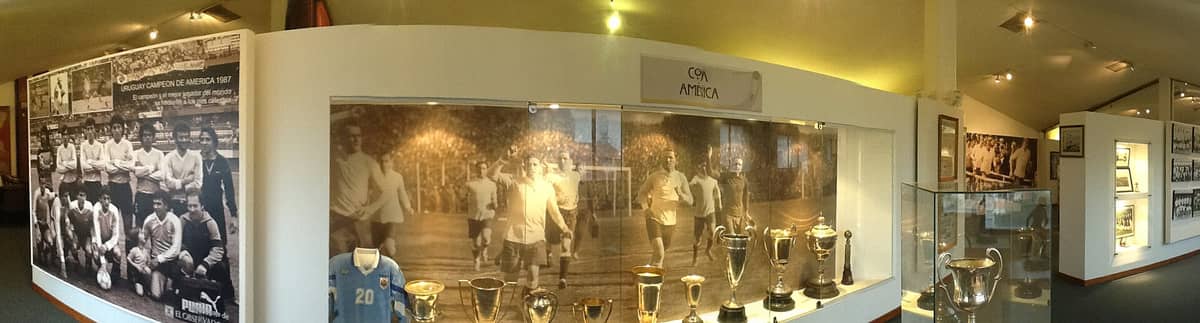
The collection is organized chronologically and thematically, moving from the formation of Uruguay's earliest football clubs in the late 1800s through the golden decades of the mid-twentieth century and into the modern era. Display cases hold original match programmes, medals, pennants, boots, and jerseys from key moments in Uruguayan football history. The materials feel genuinely historical rather than commercially reproduced, and the curatorial approach lets objects speak rather than filling every wall with explanatory panels.
The centrepiece of any visit is the section dedicated to the 1930 and 1950 World Cups. Uruguay's 1950 triumph at the Maracanã in Rio de Janeiro, when they defeated Brazil 2-1 in what Uruguayans call the Maracanazo, is documented with newspapers, photographs, and match-day ephemera that would be difficult to find anywhere else in a single collection. The emotional weight of these cases is difficult to overstate for anyone who understands what that result meant.
There are also dedicated sections covering Olympic gold medals (Uruguay won football gold at Paris 1924 and Amsterdam 1928), club football history, and the careers of individual players who shaped the Uruguayan game. Trophy replicas and original silverware are displayed in conditions that allow close inspection. The lighting inside the museum is warm and relatively low in some sections, creating a sense that you are looking at genuine archive material rather than a commercial exhibition.
ℹ️ Good to know
Photography without flash is permitted throughout the museum and is included in the admission price. If you want to photograph display cases, bring a phone with a good low-light camera, as artificial lighting varies across sections.
How the Experience Changes by Time of Day
Morning visits, particularly on weekdays, offer the most contemplative experience. The staff tend to be engaged and willing to share context if you show genuine interest and speak some Spanish. The ambient sounds at this hour are limited to the hum of the air conditioning and occasional noise drifting in from the stadium grounds.
By mid-afternoon, especially on weekends, the museum fills with local school groups and football tourists. The energy shifts: children gather around the trophy displays, Spanish conversation fills the rooms, and the pace quickens. This is not necessarily worse, but it changes the character of the visit. If you want to read every label and absorb the details of the 1930 World Cup archive, a weekday morning is your window.
On days when a major match is scheduled at the Estadio Centenario, the surrounding Parque Batlle district transforms significantly in the hours before kick-off. Vendors set up along the approach roads, noise levels rise, and the museum itself may be busier than usual. Visiting on a match day can add atmosphere, but the narrow corridors inside the museum become genuinely cramped if a large group is moving through.
Getting There and Practical Logistics
The museum entrance is located in the Tribuna Olímpica, next to Gate 13 of the Estadio Centenario. The stadium sits within Parque Batlle, a large public park in central Montevideo. Multiple city bus routes serve Av. Dr. Americo Ricaldoni directly. If you are travelling from the Ciudad Vieja or Centro, the journey takes roughly 20 to 30 minutes by bus and considerably less by taxi or ride-hailing app.
Parque Batlle is a pleasant park in its own right, and many visitors combine the museum with a walk through the park before or after. The area around the stadium is also well connected to other parts of central Montevideo, making it easy to incorporate into a longer day of sightseeing.
Accessibility information is not detailed on the official museum pages. Visitors with mobility needs or other accessibility requirements are advised to contact the museum directly before visiting, as the Tribuna Olímpica's internal configuration involves stairs in some sections. Contact details are listed on the official Estadio Centenario website.
⚠️ What to skip
Ticket prices are listed in Uruguayan pesos (UYU) and are subject to change. The figures above reflect the prices published on the official museum page as of mid-2026. Always confirm current prices on the Estadio Centenario website before your visit, as exchange rate fluctuations mean the USD or EUR equivalent shifts regularly.
Cultural Context: Why Football Means Something Different Here
Uruguay's relationship with football is not simply national pride; it is closer to a founding mythology. For a small country that achieved independence in 1828, the back-to-back Olympic golds of 1924 and 1928, followed by World Cup victory on home soil in 1930, gave Uruguay a form of global recognition that its size and population would not otherwise have earned. The Museo del Fútbol frames this history carefully, presenting football as a vehicle for Uruguayan identity rather than mere sporting achievement. If you want broader context on how sport functions in Uruguayan culture, the Montevideo football guide covers the full landscape of clubs, stadiums, and fan culture.
The museum's collection also reflects football's social dimensions in Uruguay. Early sections document how the sport spread through immigrant communities and working-class neighbourhoods in the late nineteenth and early twentieth centuries, shaping the character of clubs that still exist today. For visitors with no prior knowledge of Uruguayan football history, this context makes the trophy cases and match-day artefacts considerably more meaningful.
Honest Assessment: What the Museum Does Well and Where It Falls Short
The Museo del Fútbol is an excellent collection for anyone with a genuine interest in football history or South American sporting culture. The artefacts are authentic, the admission price is very reasonable, and the setting inside a FIFA-designated historic monument adds a layer of context that no standalone museum could replicate.
That said, the museum is compact. Visitors expecting the scale or multimedia production values of Europe's larger football museums, such as those at Camp Nou or Old Trafford, will find this a more modest experience. Display text is primarily in Spanish, with limited English explanation in some sections. If you do not read Spanish, some of the documentary depth will be inaccessible unless you research key moments in Uruguayan football history before arriving.
Visitors who are not particularly interested in football, or who are looking for a purely visual or design-led museum experience, may find the collection thin. In that case, Montevideo's broader museum circuit offers strong alternatives. The Museo Torres García and the Museo de Arte Precolombino e Indígena both offer richer visual and curatorial experiences for non-sport visitors.
Insider Tips
- Ask the museum staff about guided visits before assuming a self-guided tour is your only option. Group rates exist, and on quieter days staff have been known to accompany individual visitors informally through the key sections.
- Combine your visit with a walk around the exterior of Estadio Centenario before entering. Looking up at the Tribuna de Honor tower from pitch-side level, visible from outside the gates, gives you a sense of the stadium's architectural ambition that the museum interior alone does not convey.
- If you can read Spanish, pick up any printed materials available at the entrance desk. Institutional brochures and leaflets occasionally include historical context and photographs not displayed in the main collection.
- The surrounding Parque Batlle park has benches and open space where you can decompress after the museum. Bring water, especially in summer (December to February), as the area between the stadium and the park offers little shade.
- Check the Estadio Centenario's official website before visiting to confirm whether a match is scheduled on your chosen day. The museum remains open on match days, but the surrounding area changes character significantly in the hours before kick-off, which affects transport and parking.
Who Is Museo del Fútbol (Estadio Centenario) For?
- Football fans who want to understand the historical roots of South American football culture, not just collect stadium photos
- Travellers interested in how small nations construct national identity through sport
- Families with children over eight or nine who have some interest in football history
- Architecture enthusiasts visiting Estadio Centenario as a FIFA Historic Monument of World Football
- Budget-conscious travellers seeking substantive cultural content at a very low entry cost
Nearby Attractions
Other things to see while in Centro:
- Auditorio Nacional del SODRE
The Auditorio Nacional Adela Reta is Uruguay's most important performing arts venue, a 25,000-square-metre complex in central Montevideo that reopened in 2009 after decades of reconstruction. Home to the SODRE symphony orchestra, ballet, and opera, it draws serious music lovers and curious visitors alike.
- Cementerio Central
Inaugurated in 1835, the Central Cemetery of Montevideo is one of South America's most architecturally rich burial grounds. Free to enter and loaded with marble mausoleums, neo-Gothic chapels, and the graves of presidents and artists, it rewards those willing to look slowly.
- Estadio Centenario
Built for the 1930 FIFA World Cup and declared a Monument of World Football, Estadio Centenario is one of the most historically significant sports venues in the Americas. The on-site Uruguayan Football Museum makes it worth visiting even on non-match days.
- Mirador de la Intendencia
The Mirador Panorámico de la Intendencia de Montevideo sits on the 22nd floor of the city's main municipal building, offering unobstructed 360-degree views across the capital, the Río de la Plata, and the surrounding neighbourhoods. Entry is completely free, but you need to book a slot in advance. Here is everything you need to plan a visit.
Planning a trip? Discover personalized activities with the Nomado app.