Cementerio Central: Montevideo's Open-Air Museum of the Dead
Inaugurated in 1835, the Central Cemetery of Montevideo is one of South America's most architecturally rich burial grounds. Free to enter and loaded with marble mausoleums, neo-Gothic chapels, and the graves of presidents and artists, it rewards those willing to look slowly.
Quick Facts
- Location
- Av. Gonzalo Ramírez 1302, Barrio Sur/Palermo, Montevideo
- Getting There
- Bus lines 137, 396, and 300 stop nearby, serving the cemetery area.
- Time Needed
- 45 minutes to 2 hours depending on interest
- Cost
- Free. Night tours (private operator) typically around USD 10 per person.
- Best for
- Architecture lovers, history buffs, and slow walkers who notice details
What the Cementerio Central Actually Is
The Central Cemetery of Montevideo is the city's oldest and most historically significant public cemetery, inaugurated in November 1835. It sits on a large urban block between Avenida Gonzalo Ramírez and the Rambla República Argentina, with the Río de la Plata visible beyond its southern wall. What makes it worth visiting is not morbidity but architecture: the grounds function as a concentrated outdoor exhibition of 19th- and early 20th-century monumental stonework, from restrained neoclassical tombs to ornate Gothic revival chapels that would not look out of place in a European cathedral quarter.
Uruguay separated church and state earlier than most Latin American countries, and the cemetery reflects that secular tradition. It was established as a civil burial ground rather than a church-administered one, and it holds the remains of presidents, military leaders, artists, and political figures who shaped the country. Walking its central avenues gives a compressed sense of Uruguayan history that few museum collections can match.
ℹ️ Good to know
Visiting hours are Monday to Saturday, 09:00 to 17:00, with administrative offices open Monday to Saturday, 10:00 to 16:00. Entry is free. Confirm current hours on the Intendencia de Montevideo's official page before you go, as schedules can change.
The Experience on the Ground
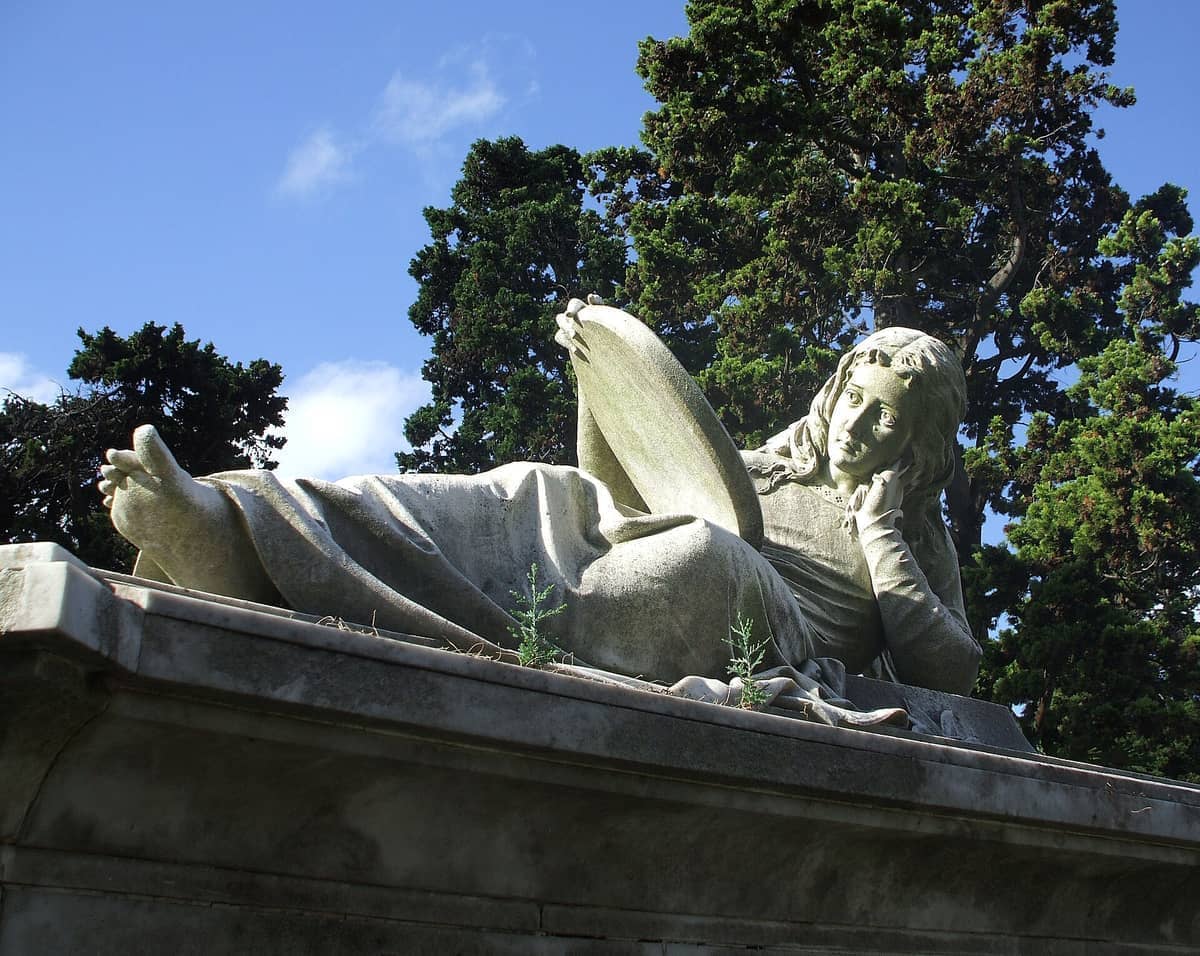
From outside, the cemetery presents a long stone wall broken by a formal entrance gate. Step through and the noise of the city drops noticeably. The main avenue runs straight ahead, lined with tall mausoleums on either side, their facades pressed close together like a dense city block scaled down to human height. Marble angels with eroded fingers, wrought-iron gates grown stiff with rust, family names etched in scripts that shift from ornate Victorian lettering to cleaner modernist typography as you move through different decades of construction.
The smell shifts depending on the season. In summer, flowering plants tucked against tomb bases add a faint sweetness that mixes with old stone and dry soil. In winter, when the humidity rises off the river, the stone surfaces darken and the cypress trees that punctuate the grounds release a resinous scent. The light behaves differently here than on the streets outside: in the morning, long shadows fall between the tall mausoleums, and the stone carvings read sharply. By midday everything flattens. Late morning, roughly 10:00 to 11:30, gives the best combination of shadow depth and comfortable temperature for exploring on foot.
Crowd levels are low by most tourism standards. On weekday mornings you may walk the main avenues for fifteen minutes without crossing another visitor. Locals sometimes enter on their lunch break to sit quietly, and maintenance staff work in the background. On weekends, small clusters of architecture enthusiasts and photographers appear, but the cemetery never feels congested.
Tickets & tours
Live prices and dates from our booking partner. If you book, we may earn a commission at no extra cost to you.
Airport to Hotel or Hotel to Airport Transfer in Montevideo
From 47 €Instant confirmationFree cancellationTasting and Lunch at Bodega Pizzorno in Montevideo
From 115 €Instant confirmationFree cancellationPunta del Este full-day guided tour from Montevideo
From 47 €Instant confirmationFree cancellationColonia guided city tour from Montevideo
From 71 €Instant confirmationFree cancellation
Architecture and Historical Significance
Poncini's 1835 design established a grid of avenues that allowed for orderly expansion as the city grew. The result is a layered visual record of changing tastes and economic fortunes. The oldest sections near the main entrance show restrained neoclassical influence: simple pediments, column pilasters, inscriptions in formal Latin. As you move deeper, the 19th-century prosperity of Uruguay's wool and cattle export economy shows up in increasingly ambitious funerary architecture: full chapel interiors with stained glass, bronze statuary, and imported Italian marble.
The cemetery is a point of reference for anyone tracing Montevideo's architectural heritage. Its concentration of stonework from the same period that produced Palacio Salvo and other landmark buildings gives context to how wealth and aesthetic ambition translated into the built environment across different typologies. The difference here is that the clients were families commissioning tombs rather than developers commissioning towers, which means individual expression is more legible.
Several notable Uruguayan political and cultural figures are buried here, including former presidents and key figures from the country's founding period. The cemetery's function as a civil rather than religious institution reflects Uruguay's progressive secularization: by the early 20th century, Uruguay had separated church from the state registry of births and deaths, abolished religious education in public schools, and established civil marriage. The cemetery is a physical expression of that broader cultural direction.
How to Navigate the Grounds
The main entrance on Avenida Gonzalo Ramírez puts you at the head of the primary avenue. There is no map handed out at the gate. The grid layout means you will not get lost, but you can miss entire sections if you stay on the main corridor. Turn off onto the lateral avenues after the first hundred meters to reach zones where the mausoleums are smaller, less photographed, and often more interesting in their weathered detail. Some of the most elaborate chapels are set back from the primary axis.
The ground surfaces vary. The main avenues are paved and manageable, but the secondary paths include uneven stone, compacted gravel, and in places raised slabs that form a trip hazard. Comfortable flat shoes are practical. The cemetery is large enough that if you attempt to cover the full perimeter you will walk for over an hour. A focused visit to the central avenues and one or two lateral sections takes about 45 minutes.
⚠️ What to skip
Visitors with mobility limitations should be aware that the historic layout includes uneven surfaces, raised kerb edges between sections, and no confirmed step-free route through all areas. Contact the Intendencia de Montevideo administration by phone before visiting to ask about accessible routes.
Photography Considerations
The cemetery is a legitimate subject for photography, but the setting calls for discretion. If other visitors are present who appear to be mourning or attending to a family grave, treat that as a signal to give space and lower the camera. On a quiet weekday morning with no other visitors present, the site is one of the more photogenic in Montevideo: the contrast between dark stone and bright southern sky, the texture of weathered marble, and the layering of objects in a confined space all reward a wide-angle lens or a careful phone camera.
Overcast days work well for detail photography because the diffuse light eliminates the harsh shadows that can obscure inscription text and carved relief work at midday. Sunny mornings before 11:00 produce dramatic directional light but require patience to position yourself to avoid blown-out backgrounds. The cypress trees along some avenues create strong vertical frames for composed shots.
The Night Tour Option
A private commercial operator called Necro Tours runs guided evening tours of the cemetery that have attracted attention in local media and on travel platforms. Priced at approximately USD 10 per person as of 2024 to 2025, these tours offer historical narration and a deliberately atmospheric experience after dark, when the site is otherwise closed. They are not affiliated with the municipal administration. If this format interests you, check current availability and pricing directly with the operator, as scheduling and prices are subject to change.
For those who prefer to explore Montevideo's history in a more conventional format, the Museo Histórico Cabildo on Plaza Matriz covers the colonial and independence period with artifacts and documents, and complements a cemetery visit well as a half-day pairing in the broader Centro area.
Getting There and Nearby Context
The cemetery sits at the edge of the Barrio Sur and Palermo neighborhoods, a short distance from the waterfront Rambla. Bus lines 137, 396, and 300 serve the area. If you are already visiting the Rambla de Montevideo, the cemetery is a ten to fifteen minute walk inland from the coastal path near Playa Ramírez. Taxis and ride-hailing services reach the gate directly.
The surrounding neighborhood warrants a walk before or after. Barrio Sur is one of Montevideo's historically Afro-Uruguayan neighborhoods and the geographic heart of candombe drum culture. The streets near the cemetery have a different texture from the tourist-facing areas of Ciudad Vieja: quieter, more residential, with peeling facade paint and corner stores. For context on the cultural traditions of this area, the guide to Montevideo's candombe explains the neighborhood's significance and what to look for.
If you are structuring a full day in this part of the city, the cemetery pairs logically with Plaza Independencia and the historic architecture of Centro, both reachable within a 20-minute walk to the north. The Ciudad Vieja walking tour guide maps out a route that can be extended south to include the cemetery as a final stop.
Who Should and Should Not Visit
If your interest in Montevideo is primarily beaches, restaurants, and nightlife, the Cementerio Central will likely feel like a detour that does not pay off. It requires a willingness to move slowly, read inscriptions, and find interest in stone surfaces and architectural details. That kind of attention is rewarded here; passive sightseeing is not.
Visitors traveling with young children may find the visit manageable in practical terms but limited in engagement value for kids below ten or eleven. The grounds are open and safe, but there is little to hold children's attention unless they have a specific interest in history or the site is framed deliberately as part of a conversation about history. It is not a space designed for families in the way a park or market is.
Insider Tips
- Arrive between 10:00 and 11:30 on a weekday. The directional morning light gives the carved stone faces and relief work their full depth, and you are unlikely to share the main avenues with more than a handful of other visitors.
- Turn left or right off the main avenue almost immediately after entering. The primary corridor is what most casual visitors cover; the lateral sections hold the cemetery's most interesting architectural variety and show wear patterns that make the stonework look genuinely old rather than restored.
- The southern wall near the Rambla end of the cemetery is worth reaching. From certain angles outside the fence on the Rambla side, the cypress tree canopy above the cemetery's perimeter creates an unusual contrast with the river beyond, and it is one of the better exterior photographs of the site.
- If you want information on who is buried in specific sections or the history of particular mausoleums, contact the administrative office on arrival (open 10:00 to 16:00 Monday to Saturday). Staff familiarity with visitor inquiries varies, but the office is the only on-site source of structured historical information.
- The Necro Tours night visits book up on weekends. If that format interests you, check availability mid-week for a Friday or Saturday slot rather than trying to book same-day.
Who Is Cementerio Central For?
- Architecture and urban history enthusiasts who want to see 19th-century monumental stonework outside a museum context
- Photographers looking for textured, low-traffic subjects with strong light and shadow potential in the morning hours
- Travelers building a half-day route through Centro and Barrio Sur who want to include something beyond standard sightseeing stops
- Anyone interested in Uruguay's secular political tradition and how it shaped public institutions differently from neighboring countries
- Slow travelers who prefer depth over coverage and are willing to spend time with a single place rather than checking items off a list
Nearby Attractions
Other things to see while in Centro:
- Auditorio Nacional del SODRE
The Auditorio Nacional Adela Reta is Uruguay's most important performing arts venue, a 25,000-square-metre complex in central Montevideo that reopened in 2009 after decades of reconstruction. Home to the SODRE symphony orchestra, ballet, and opera, it draws serious music lovers and curious visitors alike.
- Estadio Centenario
Built for the 1930 FIFA World Cup and declared a Monument of World Football, Estadio Centenario is one of the most historically significant sports venues in the Americas. The on-site Uruguayan Football Museum makes it worth visiting even on non-match days.
- Mirador de la Intendencia
The Mirador Panorámico de la Intendencia de Montevideo sits on the 22nd floor of the city's main municipal building, offering unobstructed 360-degree views across the capital, the Río de la Plata, and the surrounding neighbourhoods. Entry is completely free, but you need to book a slot in advance. Here is everything you need to plan a visit.
- Museo del Fútbol (Estadio Centenario)
Housed within the Tribuna Olímpica of the iconic Estadio Centenario, the Museo del Fútbol traces Uruguay's extraordinary football legacy from its earliest amateur roots to World Cup wins in 1930 and 1950. For anyone who takes football seriously, this is one of the most emotionally resonant sports museums in South America.
Planning a trip? Discover personalized activities with the Nomado app.