Rambla de Montevideo: Montevideo's 22 km Coastal Promenade
The Rambla de Montevideo is a free, open-access coastal avenue stretching over 22 km along the Río de la Plata shoreline. It connects the historic port to the eastern suburb of Carrasco, threading through neighborhoods, beaches, and parks. More than a scenic walk, it's the spine of Montevideo's daily outdoor life.
Quick Facts
- Location
- Coastal shoreline from Puerto de Montevideo to Arroyo Carrasco, spanning multiple neighborhoods
- Getting There
- City buses and taxis reach multiple access points; the Pocitos and Parque Rodó sections are easiest to reach from central Montevideo
- Time Needed
- 30 minutes for a short stroll; half a day to walk or cycle a significant stretch; the full 22 km takes most of a day
- Cost
- Free. No ticket, no entry requirement. Open 24/7 year-round
- Best for
- Early morning joggers, sunset watchers, families on weekends, cyclists, and anyone wanting to feel how Montevideo actually lives
What the Rambla Actually Is
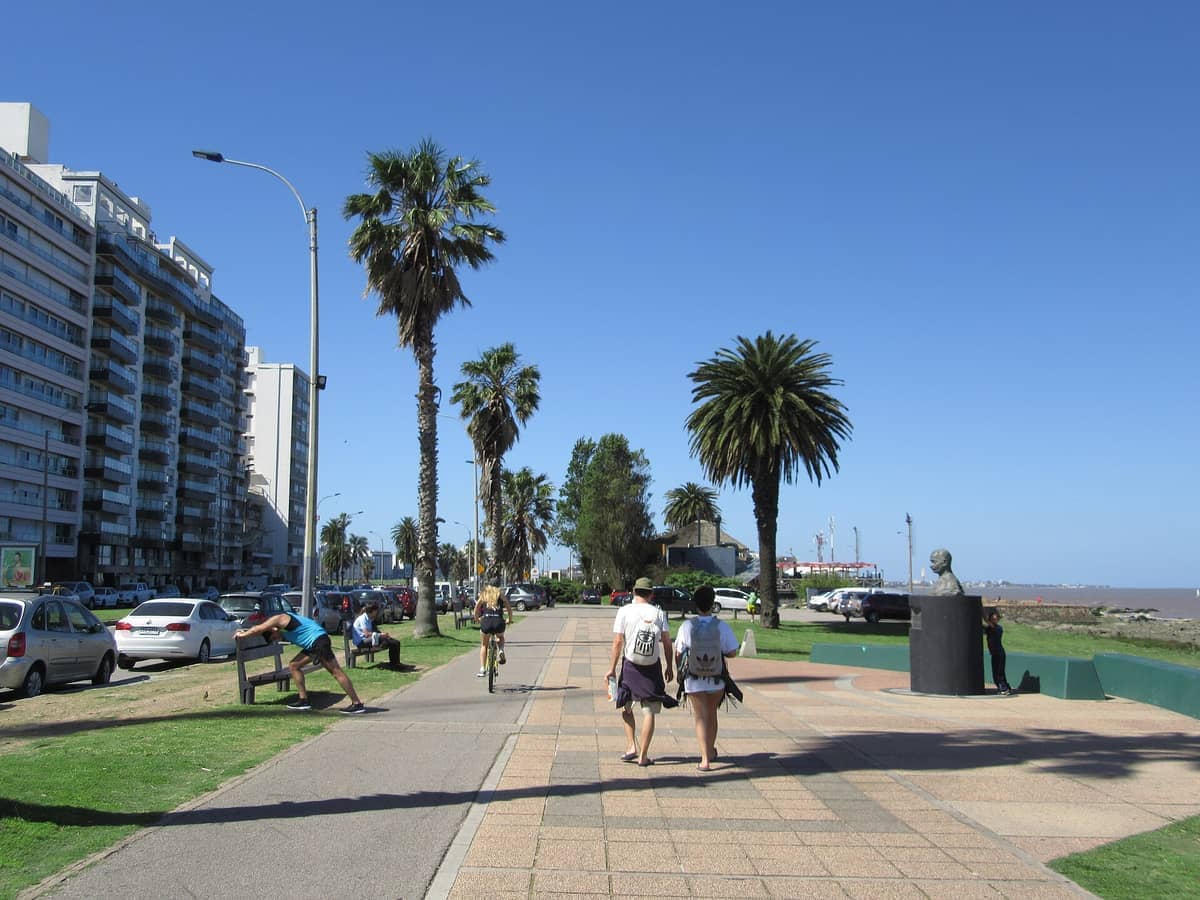
The Rambla de Montevideo is a continuous coastal avenue and pedestrian promenade running for over 22 km along the northern shore of the Río de la Plata. It begins near the Puerto de Montevideo in the west and follows the coastline through Parque Rodó, Pocitos, Buceo, Malvín, Punta Gorda, and Carrasco before terminating at Arroyo Carrasco in the east. At no point does it charge admission. There are no gates, no tickets, and no closing time.
In practical terms, the Rambla functions as a linear public park. On any given morning, you'll find retirees walking slowly with thermoses of mate, cyclists threading between joggers, and children on scooters. At weekends, families set up folding chairs facing the water. On weekday evenings, office workers decompress along the waterfront path. The Rambla does not put on a performance for tourists. It is simply where Montevideans go to be outside.
ℹ️ Good to know
The Rambla passes through or alongside nearly every major coastal neighborhood. If you're staying in Pocitos, Punta Carretas, or Parque Rodó, you can walk to it in minutes. If you're based in Ciudad Vieja or Centro, a short bus or taxi ride gets you there.
How the Rambla Changes Through the Day
Early morning, roughly 6:00 to 9:00, belongs to runners and cyclists. The air off the Río de la Plata carries a particular quality at this hour: cool, slightly saline, and noticeably still before the wind picks up. The light is low and flat, good for photography if you're pointing east toward the open water. Traffic on the avenue is light, and the pace of everyone moving along the path feels deliberate and unhurried.
By mid-morning, the character shifts. Dog walkers appear in numbers. Small kiosks and coffee vendors open along key sections, particularly near Pocitos and Parque Rodó. Mate-drinkers settle onto benches and low stone walls facing the river. On weekdays, foot traffic remains moderate through the late morning. On weekends, the pace accelerates sharply after 10:00 as families arrive with gear: picnic bags, beach chairs, and footballs.
Sunset is the Rambla's signature moment. The Río de la Plata faces west-southwest from the Pocitos and Punta Carretas sections, which means the light in the late afternoon descends directly over the water. The river turns copper, then deep orange. Locals time their walks to coincide with this. Benches fill up starting about 30 minutes before sundown, and the atmosphere is genuinely warm, in the social rather than meteorological sense. Arrive early if you want a bench.
After dark, the Rambla remains active, though the crowd thins and skews younger. Couples walk. Groups of young adults sit on the wall near the water. The avenue lighting is adequate for walking but not bright. As with any large urban promenade, exercise standard awareness at night, particularly in quieter western sections closer to Ciudad Vieja.
Tickets & tours
Live prices and dates from our booking partner. If you book, we may earn a commission at no extra cost to you.
Airport to Hotel or Hotel to Airport Transfer in Montevideo
From 47 €Instant confirmationFree cancellationTasting and Lunch at Bodega Pizzorno in Montevideo
From 115 €Instant confirmationFree cancellationPunta del Este full-day guided tour from Montevideo
From 47 €Instant confirmationFree cancellationColonia guided city tour from Montevideo
From 71 €Instant confirmationFree cancellation
The Neighborhoods It Connects
The Rambla's character changes as it moves east. The western sections near Ciudad Vieja and the port are the least polished, with the industrial working harbor nearby and fewer recreational users. This stretch is historically interesting but not where most visitors spend leisure time.
The section alongside Parque Rodó and into Pocitos is where the promenade becomes most recognizable and most photographed. The pedestrian path widens. Palm trees line the inland edge. The beach access points are marked with steps down to the sand, and the water here, while not the clearest in Uruguay, draws swimmers from November through March.
Further east through Buceo and toward Carrasco, the Rambla quiets down. The apartment towers of Pocitos give way to lower-rise residential buildings and, eventually, to the leafy streets and stately houses that characterize Carrasco. This eastern stretch is less visited by tourists but offers a cleaner, calmer experience of the promenade and a better sense of how Montevideo transitions between its different social registers.
Historical Context: A Promenade Built in Stages
The Rambla was not planned and built in one moment. It developed in sections across the twentieth century as the city expanded eastward and the municipal government progressively formalized what had been informal coastal access. The Rambla was not planned and built in one moment. It developed in sections across the twentieth century as the city expanded eastward and the municipal government progressively formalized what had been informal coastal access. The broader renaming and reorganization of the avenue's segments reflects a recurring tension in Uruguayan public life between commemorating international relationships and honoring local history. The broader renaming and reorganization of the avenue's segments reflects a recurring tension in Uruguayan public life between commemorating international relationships and honoring local history.
Today the promenade is administered by the Intendencia de Montevideo, the city government, Today the promenade is administered by the Intendencia de Montevideo, the city government, as a public waterfront space. Maintenance quality varies by section and budget cycle, but the core pedestrian infrastructure, the paved path, benches, and lighting, is intact along much of the length.
Practical Walkthrough: How to Approach a Visit
Most visitors do not walk the entire 22 km in a single outing, and there is no reason to. A more practical approach is to choose a section based on your base neighborhood and interests, then follow the path for an hour or two in either direction. The Pocitos-to-Parque Rodó stretch is about 3 km and hits most of the visual highlights: wide beach access, river views, green space, and consistent pedestrian activity.
Cyclists can cover significantly more ground. Bike rentals are available in the city at various points. The Rambla surface is smooth and mostly flat, making it approachable for all fitness levels. For families, the section near Pocitos is particularly convenient, with beach access and small vendors nearby.
💡 Local tip
Bring your own mate setup if you have one. You'll see hundreds of people carrying thermoses and the gourd along the promenade. There are hot water vendors at certain kiosks, but supply is inconsistent. Alternatively, grab a coffee from one of the small cafés near the Pocitos section.
Accessibility along the Rambla is generally good. The paved pedestrian path is continuous and level along most of its length, making it suitable for wheelchairs and strollers. Curb cuts and ramp access to beach level vary by section and are not uniformly present. If step-free access to the beach itself is a priority, check specific access points in advance.
Weather, Seasons, and What to Bring
Montevideo has a mild coastal climate, and the Rambla is fully exposed to wind off the Río de la Plata year-round. Summer (December through February) brings warm daytime temperatures that make the beaches appealing. This is the most crowded period on the Rambla, particularly at weekends. For detailed seasonal guidance, the guide covers this in full. This is the most crowded period on the Rambla, particularly at weekends. For detailed seasonal guidance, the best time to visit Montevideo guide covers this in full.
Winter (June through August) brings cooler daytime temperatures with a persistent wind chill from the river. The Rambla does not close and never empties completely, but beach use drops off entirely and the pedestrian crowd thins to mostly locals out for exercise. A wind-resistant layer is essential in winter, even on sunny days. Spring (September through November) and autumn (March through May) offer the most comfortable walking conditions, with mild temperatures and moderate wind. The Rambla does not close and never empties completely, but beach use drops off entirely and the pedestrian crowd thins to mostly locals out for exercise. A wind-resistant layer is essential in winter, even on sunny days. Spring (September through November) and autumn (March through May) offer the most comfortable walking conditions, with mild temperatures and moderate wind.
⚠️ What to skip
Wind along the Rambla can be deceptively strong, especially in winter and during storms. A jacket that blocks wind matters more than a heavy coat. Sun exposure is significant in summer even on overcast days due to reflection off the water.
Photography Along the Rambla
The Rambla offers clean, consistent shots of the Río de la Plata with an uncluttered horizon. The river is wide enough to look like open sea from most sections. The Pocitos beach area in late afternoon light produces the most reliable results: warm tones, silhouettes of walkers and cyclists, and the occasional fishing rod extending over the water.
For wider urban context shots that include the skyline and the promenade together, position yourself at one of the beach access points looking back toward the city. The high-rise profile of Pocitos photographs well at golden hour from this angle. Early morning mist over the water occasionally creates atmospheric conditions that are genuinely worth setting an alarm for.
What the Rambla Is Not
It is worth being direct: the Rambla de Montevideo is not a curated tourist attraction. It has no entrance, no exhibit, no narrative arc. If you are visiting Montevideo with limited time and want to check off major sights, the Rambla will feel like a pleasant walk rather than a destination. The urban beaches are not the clearest in Uruguay; for swimming in proper Atlantic-quality water, Punta del Este and the eastern coast are the comparison point.
Travelers who visit Montevideo primarily for its colonial architecture, museums, and cultural sites may find the Rambla is best treated as a connector rather than a centerpiece. That said, combining a walk along the Pocitos section with a visit to nearby attractions, such as the Museo Juan Manuel Blanes or the beaches of Playa Pocitos, turns it into a genuinely productive afternoon.
Insider Tips
- The Pocitos section between Avenida Brasil and Calle Solano García offers the densest concentration of benches facing the water and is the best spot for watching the sunset without fighting for space, provided you arrive 20 to 30 minutes before the sun drops.
- City buses run parallel to the Rambla on the inland avenue, making it easy to walk one direction and take the bus back. You can enter or exit the promenade at almost any cross street, so there is no obligation to return the way you came.
- Weekday mornings between 7:00 and 9:00 are the best time to photograph the Rambla without crowds. By 10:00 on any weekend, the main sections near Pocitos and Parque Rodó fill up considerably.
- If you plan to cycle the full length, consider starting from the Carrasco end in the morning and riding west so the wind, which typically comes from the southwest, is more favorable on the return leg.
- The kiosks along the Rambla The kiosks along the Rambla typically accept Uruguayan pesos. ATMs in the Pocitos neighborhood are a short walk inland from the promenade.
Who Is Rambla de Montevideo For?
- Joggers and cyclists looking for a flat, scenic route that can be extended or shortened at any point
- Families wanting outdoor space with easy beach access and minimal logistical complexity
- Photographers interested in river light, urban silhouettes, and candid street scenes
- Travelers who want to observe local daily life rather than consume a packaged tourist experience
- Anyone on a tight budget who needs a full half-day of engaging outdoor activity at zero cost
Nearby Attractions
Combine your visit with:
- Cerro de Montevideo
Standing at 132 metres above sea level, the Cerro de Montevideo is the city's literal high point, crowned by the Fortaleza General Artigas, a 19th-century fortress that once served as watchtower, military prison, and lazaretto. Today it houses a military museum and delivers some of the most expansive views in Uruguay. The visit rewards effort, but requires planning.
- Jardín Botánico de Montevideo
The Museo y Jardín Botánico 'Prof. Atilio Lombardo' is Montevideo's botanical garden and museum, set in the Prado neighborhood. Admission is free, the grounds open daily until 21:00, and the atmosphere shifts noticeably from meditative morning calm to afternoon family strolls. It rewards unhurried visitors with native plant collections, a small natural history museum, and a level of quiet you rarely find this close to the city centre.
- Mercado Agrícola de Montevideo (MAM)
The Mercado Agrícola de Montevideo is a beautifully restored early-20th-century market hall where fresh produce stalls, specialty food vendors, and sit-down restaurants coexist under a soaring iron-and-glass roof. Free to enter and open seven days a week from 9:00 to 22:00, it draws local shoppers in the morning and a gastronomy crowd into the evening hours.
- Museo de la Memoria (MUME)
The Museo de la Memoria (MUME) is Montevideo's dedicated space for confronting Uruguay's dictatorship period and honoring those who resisted it. Housed in a 19th-century country estate, it offers free admission and a sobering, carefully curated experience that rewards visitors willing to engage with difficult history.
Planning a trip? Discover personalized activities with the Nomado app.