Bur Dubai
Bur Dubai sits on the western bank of Dubai Creek, forming the older, more layered half of the city's original core. It combines genuine heritage architecture, working souks, and one of Dubai's most diverse residential communities into a neighborhood that feels fundamentally different from the glass towers further south.
Located in Dubai
Overview
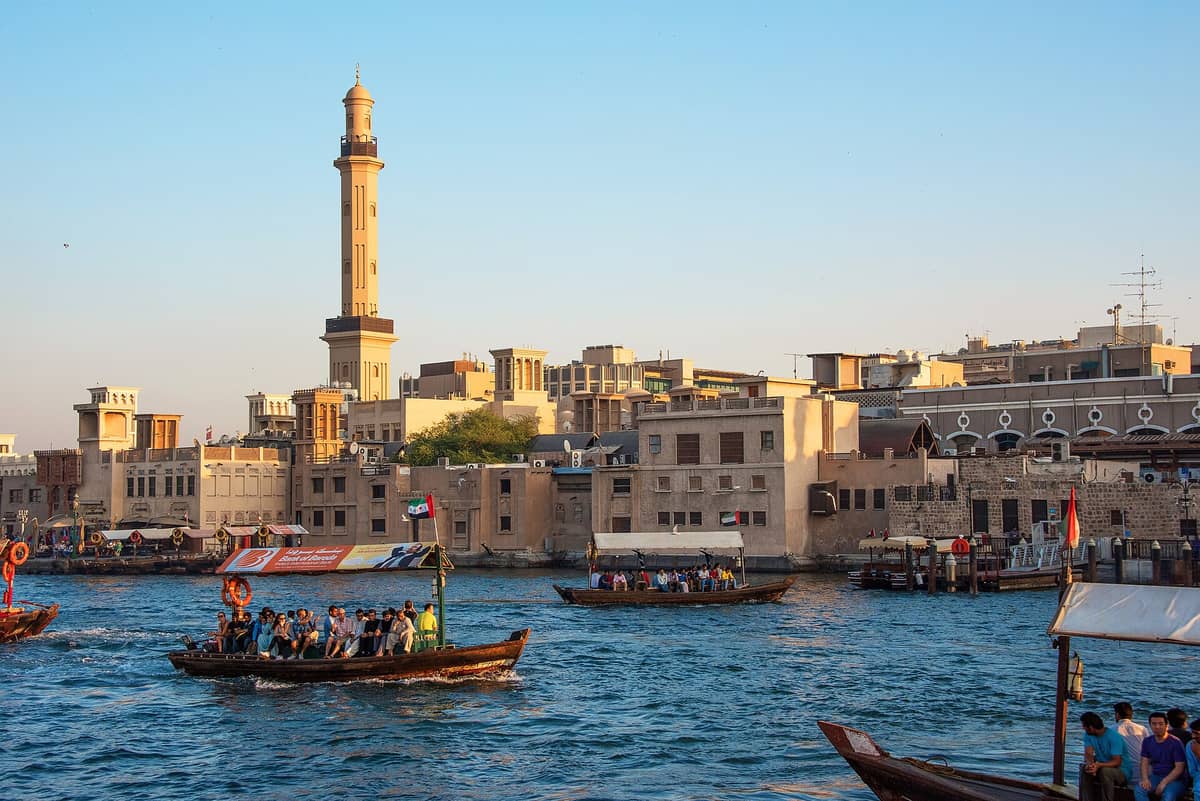
Bur Dubai is where Dubai's story actually begins: a creek-side district of wind-tower houses, textile markets, and streets where Arabic, Hindi, and Urdu mix in equal measure. It sits directly across the water from Deira and together the two form the city's historic spine, connected by abra ferries that have crossed this same stretch of creek for well over a century.
Orientation: Where Bur Dubai Sits
Bur Dubai occupies the southwestern bank of Dubai Creek, the natural inlet that originally defined the city's geography and commercial life. To the north, the district meets Port Rashid. To the west and south, it transitions into Al Jafiliya and edges toward the Dubai International Financial Centre. Across the water to the northeast is Deira, the other half of old Dubai, reachable in minutes by abra or via Al Ras or Baniyas Square metro stations.
The district is not a single street or precinct but a collection of sub-neighborhoods layered over one another. Al Fahidi and Al Souk Al Kabeer sit closest to the creek and contain most of the heritage architecture and market activity. Moving inland, Al Mankhool and Al Raffa are denser residential zones. Further south and east are Oud Metha, Umm Hurair, and Al Karama, each with its own street character and commercial focus. Al Jaddaf, on the outer edge, is a newer development area along the creek's southern bend.
Major roads define and divide the area: Sheikh Rashid Road runs through the district connecting northward toward the creek and southward toward Sheikh Zayed Road. Oud Metha Road and Al Khail Road handle the heavier traffic flows. For those arriving from Downtown Dubai, Bur Dubai is roughly 10 to 15 minutes by metro or road, making it an easy addition to any itinerary anchored in the city center.
Character and Atmosphere
Bur Dubai does not perform for tourists. That is what makes it worth visiting. In the early morning, before the heat accumulates, the streets around the textile souk and Al Fahidi fill with delivery workers, shopkeepers rolling up metal shutters, and men from the surrounding labor hostels picking up chai from corner teashops. The smell is specific: cardamom, fabric dye, and the faintly briny air drifting off the creek.
By midday, especially between May and September, the streets compress under the heat and most activity shifts indoors or underground into the air-conditioned malls and covered markets. Afternoons in the cooler winter months (November through March) are when the neighborhood reaches its best pitch: light falling golden across the wind-tower facades of Bastakiya, the abra jetties busy with commuters and curious visitors, and the lanes around the textile souk dense with activity. The crowd here is genuinely multicultural in a way few other parts of Dubai are. South Asian communities, East African traders, Emirati families, and travelers on tighter budgets all share the same pavements.
After dark, Bur Dubai shifts again. The tourist-facing restaurants along the creek waterfront stay busy into the late evening, and the streets around Al Karama remain lively well past 10pm with South Asian restaurants, grocery stores, and barbershops serving a residential crowd that keeps later hours than many Western cities. It is not a nightlife district in the way that Dubai Marina is, but it is far from quiet. The atmosphere is more neighborhood than scene: people going about their lives, which is its own kind of appeal.
💡 Local tip
Visit Al Fahidi Historical Neighbourhood in the late afternoon during winter months. The light is soft, the crowds thinner than at midday, and the wind-tower architecture photographs far better than it does in the harsh midday sun.
What to See and Do
The anchor of any visit to Bur Dubai is the Al Fahidi Historical Neighbourhood, known until recently as Bastakiya. This is a genuine surviving fragment of pre-oil Dubai: a cluster of courtyard houses and narrow lanes built mostly in the late 19th and early 20th centuries by Persian merchants who settled here to trade. The wind towers that rise above the rooflines were the original air conditioning, channeling breezes down into the interior rooms. Today the area houses art galleries, small museums, and cafés, and walking through it takes around 45 minutes if you do not rush.
Inside Al Fahidi is the Al Fahidi Fort, the oldest surviving building in Dubai, dating to around 1787. It historically housed the Dubai Museum. As of September 2026 the fort remains closed for rehabilitation, with reopening still pending an official announcement; you can view the exterior while the surrounding Al Fahidi lanes stay open.
From Al Fahidi, walk north toward the creek and you reach the abra station and the edge of the Textile Souk, which runs parallel to the waterfront. Bolts of fabric are stacked from floor to ceiling in the covered arcade, and the traders here are practiced at sizing up what you want before you have quite figured it out yourself. The souk is genuinely functional, not a tourist recreation. Tailors in the surrounding lanes can work from measurements given on a Monday and have a garment ready by the weekend.
The Dubai Creek itself is a major attraction. An abra crossing to Deira costs a few dirhams and takes five minutes, offering an unobstructed view of the working creek with wooden dhows moored on both banks. From Deira you can explore the Gold Souk and the Spice Souk before abra-ing back. The full loop, including wandering both souks, fits comfortably into a half-day.
- Al Fahidi Historical Neighbourhood (Bastakiya): 45-60 minute walk, free entry
- Al Fahidi Fort and Dubai Museum: currently closed for major restoration; allow time for an exterior visit only until reopening
- Textile Souk: open every day, best on weekday mornings before the heat builds
- Abra crossing to Deira: shared traditional abras run frequently from early morning until around midnight
- Al Seef waterfront promenade: new development blending creek views with café culture
- XVA Gallery: contemporary art inside a restored Bastakiya courtyard house
- Grand Mosque (exterior): one of Dubai's largest mosques, visible from the creek road
The Al Seef development, running along the creek waterfront between Al Fahidi and Al Ghubaiba, is a newer addition that has attracted mixed reactions. It is architecturally designed to evoke old Dubai in a polished way, and the creek-facing restaurants and cafés are pleasant in the evening. It is not the same thing as Bastakiya, but it makes the waterfront walkable in a way it was not before.
Eating and Drinking
Bur Dubai has one of the most diverse food scenes in Dubai, and it is mostly affordable. The large South Asian population means that Indian and Pakistani restaurants are the default, and many are genuinely excellent. The Al Karama area in particular is where locals go for biryani, nihari, and fresh-baked naan. Restaurants here are unpretentious, portions are large, and a full meal for two rarely exceeds 60 to 80 AED. Look for restaurants with handwritten menus in Urdu and Hindi alongside English: these tend to be the real ones.
Around Al Fahidi and the creek waterfront, the restaurant options become more tourist-oriented in presentation though not necessarily in quality. There are Arabic mezze restaurants serving fatteh, hummus, and grilled meats, and a scattering of Iranian establishments that reflect the historic Persian merchant community that helped build this part of Dubai. Prices step up slightly in the Al Seef waterfront zone, where you are paying for the setting as much as the food.
Coffee culture here leans toward small karak chai shops rather than specialty espresso bars, though a few third-wave cafés have opened inside the Bastakiya lanes catering to the gallery and heritage crowd. For cheap food on the go, the areas around the textile souk and Al Ghubaiba bus station have samosa stalls, fresh juice carts, and canteen-style restaurants serving full meals for under 20 AED.
ℹ️ Good to know
Alcohol is not widely available in Bur Dubai's restaurants, which are mostly unlicensed. For a drink, you will need to head to a hotel bar in the area or travel to other parts of the city. This is worth knowing if you are planning a dinner outing.
Getting There and Around
Bur Dubai is one of the best-connected neighborhoods in the city for public transport. The Dubai Metro's Green Line runs through the area with stations at Al Fahidi and Al Ghubaiba, which put you within a few minutes' walk of the souk district and the creek. BurJuman station, where the Red and Green lines intersect, is the main hub and gives direct access to Dubai International Airport (DXB) via the Red Line, typically around 20 to 25 minutes away. ADCB and Oud Metha stations serve the southern parts of the district.
Buses operate extensively through the area. The Al Ghubaiba bus station is one of Dubai's main bus terminals and has routes connecting Bur Dubai to most other parts of the city. Bus routes 83, 61D, X23, C1, and C3 are among those serving the neighborhood, though specific routes and fares are subject to RTA updates and should be confirmed before travel.
The abra is the most atmospheric way to cross between Bur Dubai and Deira, and at a few dirhams per crossing it is also one of the cheapest transit options in the city. Abra stations sit at Al Ghubaiba and near the textile souk. Careem and Uber both operate throughout Bur Dubai, and RTA taxis are easy to flag on the main roads. For those exploring the wider Deira area or planning to do the old Dubai circuit in one go, the combination of metro and abra is the most practical approach.
💡 Local tip
The Nol card (Dubai's reloadable transit card) works on metro, buses, and abra alike. Pick one up at any metro station ticket machine. It saves time at barriers and gives you the standard fare rather than the slightly higher single-journey price.
Getting to Bur Dubai from Dubai International Airport on the metro takes roughly 25 to 30 minutes to BurJuman station. From Dubai Marina, it is around 35 to 45 minutes by Red Line with a change at Union or BurJuman. Taxis from the airport to central Bur Dubai typically run 50 to 70 AED depending on traffic, though fares are metered and can vary. Always verify current fares and transit options before your trip, as RTA pricing is updated periodically.
Where to Stay
Bur Dubai offers a wider range of accommodation price points than most other central Dubai districts. Budget and mid-range hotels cluster around the Al Fahidi and Al Mankhool areas, where older three and four-star properties provide functional, well-located rooms for significantly less than equivalent locations in Downtown Dubai or the Marina. For travelers who want to be close to the old city's souks and heritage sites without paying premium prices, this is one of the better-value bases in Dubai.
The creek waterfront also has a handful of older four-star business hotels with creek-facing rooms that offer genuinely good value for the views. Rooms looking directly out over the dhow wharves and the Deira skyline across the water are a different experience from the glass-tower rooms further south. Booking early is advisable during peak season (November through March), when these properties fill quickly.
For luxury, Bur Dubai is not the right base. The high-end properties in the emirate are concentrated in Jumeirah and along the coast. If you are splitting time between the old city and the beach, consider staying in Bur Dubai for the first part of your trip and relocating. The where to stay in Dubai guide covers the full range of neighborhoods and what type of traveler each suits best.
Practical Notes and Honest Drawbacks
Bur Dubai is safe by any reasonable standard. It is a settled, family-oriented district and there are no specific crime concerns flagged by travel guides or government advisories. Standard urban precautions apply, as they do anywhere in a busy commercial area. The streets around the textile souk and Al Ghubaiba bus station can feel crowded and chaotic, particularly on weekends, but that is about sensory overload rather than safety.
The heat is the biggest practical challenge from May through September. Walking between sites during midday hours is genuinely unpleasant and potentially dangerous for those unaccustomed to 40-plus degree temperatures with high humidity. The metro is air-conditioned and the covered souks are manageable, but the gaps between them are not. In summer, structure your outdoor exploration for early morning or after sunset.
Dress modestly when visiting this part of Dubai. The Al Fahidi Historical Neighbourhood, the Grand Mosque, and the souk areas are conservative environments. Shoulders and knees should be covered, and this applies to all genders. The Dubai dress code guide has full details on what is expected where. If you are visiting during Ramadan, eating, drinking, and smoking in public during daylight hours is not permitted, and many restaurants open only after sunset. The Ramadan in Dubai guide explains how this affects day-to-day travel.
⚠️ What to skip
Photography around government buildings, police stations, and some residential areas is subject to restrictions in the UAE. In Bur Dubai, the density of consulates and official buildings means this comes up more often than in purely tourist zones. When in doubt, ask before photographing.
Summary
TL;DR
- Bur Dubai is the historic heart of old Dubai: creek-side, culturally layered, and genuinely different in character from the high-rise developments further south.
- Best for: travelers interested in heritage architecture, working souks, affordable food, and the kind of street-level urban life that feels organic rather than designed for visitors.
- Key attractions: Al Fahidi Historical Neighbourhood (Bastakiya), Al Fahidi Fort and Dubai Museum, the Textile Souk, abra crossings to Deira, and the Al Seef waterfront.
- Transport: one of the best-connected neighborhoods in Dubai, with Green and Red Line metro stations, the Al Ghubaiba bus terminal, and abra ferry access across the creek.
- Not ideal for: travelers prioritizing beach access, high-end nightlife, or luxury resort stays. The area is conservative and mostly unlicensed for alcohol.
- Best time to visit: November through March, when outdoor walking is comfortable. Summer visits require early morning or after-dark timing for any outdoor exploration.
Related Travel Guides
Related Travel Guides Bur Dubai are coming soon.