Deira
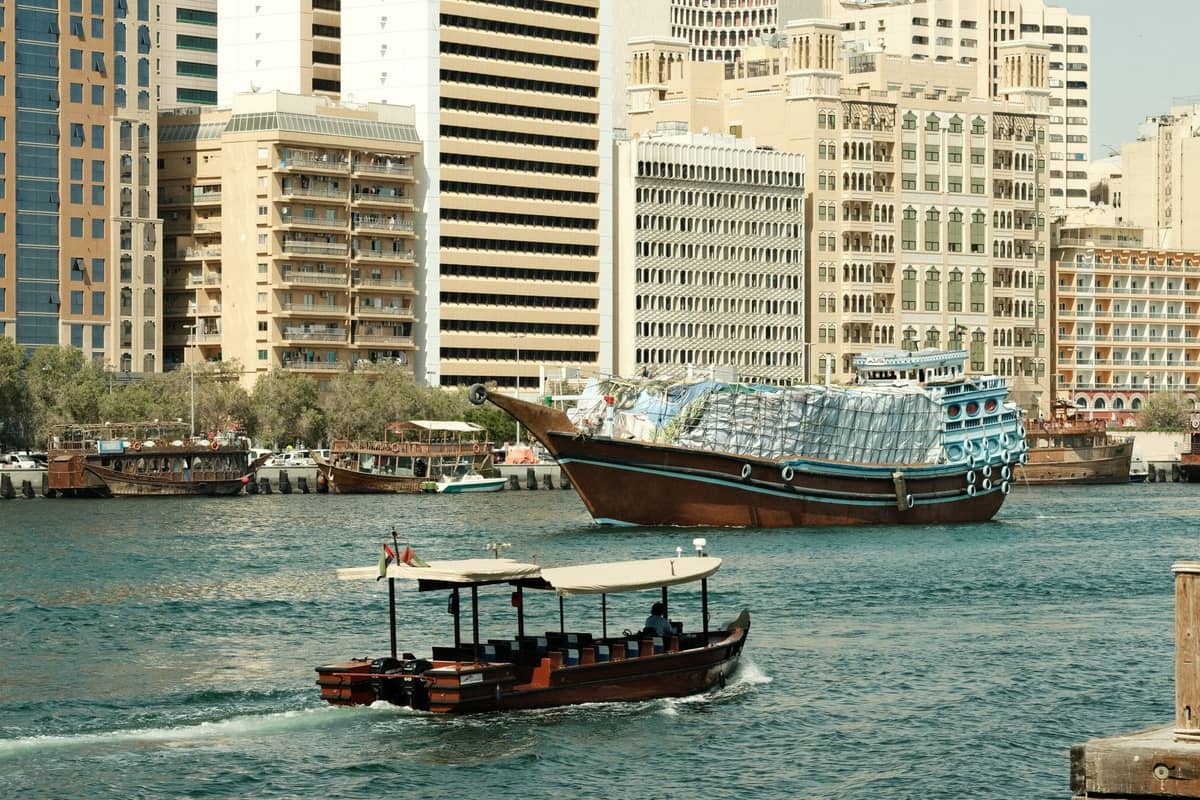
Deira sits on the northern bank of Dubai Creek and remains the most historically layered part of the city. Home to the Gold Souk, Spice Souk, and a waterfront lined with wooden dhows, it offers a version of Dubai that existed long before the towers went up on the other side of the creek.
Located in Dubai
Overview
Deira is the commercial heart of Old Dubai, a dense and unapologetically real district where traders have done business along Dubai Creek for centuries. Its narrow lanes pack more sensory detail into a square kilometer than almost anywhere else in the UAE, from the sweetly medicinal air drifting out of the Spice Souk to the glittering window displays of gold shops stacked three storeys high.
Orientation
Deira occupies the northern bank of Dubai Creek, forming the eastern half of what residents and guides collectively call Old Dubai. To the south, the creek separates Deira from Bur Dubai. To the east, the district shades into the emirate of Sharjah with no dramatic border, just a gradual change in street character. Dubai International Airport (DXB) fills most of the inland southern portion, which means Deira is effectively wedged between the water, the airport, and the Sharjah boundary. The Arabian Gulf coastline runs along the north, where residential and older commercial blocks give way to the corniche near Al Mamzar.
The district divides loosely into several sub-areas that each have a distinct function. Al Ras, closest to the creek mouth, is the historic core where the Gold Souk, Spice Souk, and heritage buildings cluster within walking distance of each other. Moving inland, Naif is a denser residential and market quarter built around the Naif Souk. Baniyas Square, now officially called Al Ittihad Square, serves as a central transport and commercial node. Al Rigga is the main mid-range hotel strip. Further east, Al Muteena and Al Qusais are more residential. Understanding this internal geography saves a lot of aimless walking.
Deira connects directly to Bur Dubai via the Maktoum Bridge and Al Shindagha Tunnel, and via the traditional abra ferry crossing the creek at Al Sabkha and Bur Dubai landing stations. The abra crossing costs 1 AED and takes under five minutes, making it one of the most useful and atmospheric transport links in the city. For context on how Deira fits into the wider city, the Old Dubai guide covers the full creek corridor in depth.
Character & Atmosphere
Deira does not perform for tourists. That is its defining quality. The streets around the Gold Souk and Spice Souk are busy because real trade happens here, not because footfall has been engineered by a developer. You share the pavement with wholesale buyers loading trolleys, shop assistants calling out prices in a mix of Arabic, Hindi, Urdu, Tagalog, and English, and delivery workers navigating the lanes on motorbikes. The population in this part of Dubai is extraordinarily diverse, dominated by South Asian, Southeast Asian, and Arab expatriate communities who have lived and worked here for decades.
In the early morning, roughly from 7am until 9am, the souk district is quiet enough that you can appreciate its architecture. The old covered market lanes, with their wooden lattice roofing and warm light filtering through, look more like Zanzibar or coastal Oman than the Dubai of glass towers. Shop owners are setting out goods, tea boys are doing rounds, and the smell from the Spice Souk reaches you before you see it: cardamom, dried rose petals, incense resins, and something sharper that might be dried lemons or tamarind. This is the best time to photograph the area and to have actual conversations with shop owners.
By midday the lanes are at full intensity. The Gold Souk in particular becomes genuinely crowded between noon and 4pm, and the heat outside the covered sections is significant between May and September. Late afternoon and early evening, after 5pm, is when the area reaches its loudest point. The dhow wharves along the Deira corniche are active until well after dark as crews load cargo by floodlight, and the creek promenade draws people for evening walks. After 10pm, the souk areas thin out quickly, though restaurants and some tea houses stay open late.
💡 Local tip
The best window for the Gold Souk is weekday mornings before 10am. Prices are fixed in most shops but negotiation is expected in smaller stalls. Bring a reference price from home if you are buying significant pieces.
What to See & Do
The Gold Souk is the obvious starting point and genuinely lives up to its reputation. Around 300 retailers occupy a covered arcade stretching through Al Ras, selling gold jewelry, diamonds, and precious stones. The total weight of gold on display at any given time is reported to be in the tonnes. It is not a museum piece or a tourist reconstruction: wholesale buyers from across the region shop here, and the prices for gold by weight are competitive with international rates. The souk operates on a combination of fixed-price wholesale and negotiable retail, and you should not feel obligated to buy.
A five-minute walk from the Gold Souk brings you to the Spice Souk, which is smaller but arguably more atmospheric. Sacks of saffron, dried limes, sumac, frankincense, and henna powder line the stalls. The vendors here are more overtly oriented toward tourists than the gold traders, but the goods are real and the prices are reasonable for bulk spice purchases. The Perfume Souk runs along a nearby stretch of Al Khor Street, specializing in Arabic oud attars and bakhoor incense that you would struggle to find in the duty-free halls at the airport.
The waterfront along Dubai Creek on the Deira side is one of the most interesting stretches of older urban Dubai. The dhow wharves north of the Al Sabkha abra station are working cargo docks where traditional wooden vessels load refrigerators, electronics, vehicle parts, and textiles for ports along the Gulf, the Horn of Africa, and the Indian subcontinent. You can walk along the corniche and watch operations up close. Further into Al Ras, Al Ahmadiya School (dating to 1912 and widely regarded as Dubai's first formal school) and the adjacent Heritage House are open to visitors and provide genuine historical grounding that most of the city's newer museums cannot match.
- Gold Souk: 300-plus retailers in a covered arcade in Al Ras
- Spice Souk: sacks of regional spices and wholesale herbs near the waterfront
- Perfume Souk: Arabic attar and bakhoor specialists along Al Khor Street
- Dhow wharves: working cargo docks along the Deira corniche, active until late
- Al Ahmadiya School and Heritage House: early 20th-century educational and domestic heritage in Al Ras
- Naif Souk: indoor market for clothing, household goods, and everyday items in the Naif district
- Deira Clocktower: the roundabout landmark that marks the gateway to old Deira from the airport road
If you want to extend the day across the creek, the Al Seef waterfront development on the Bur Dubai bank offers a more curated heritage experience with cafes and boutiques in a reconstructed old-town setting. The abra from Al Sabkha station makes the connection in minutes. The Shindagha Heritage District is also a short walk from the Bur Dubai abra landing and contains the Sheikh Saeed Al Maktoum House among other restored structures.
Eating & Drinking
Deira's food scene is one of the most varied and affordable in Dubai, precisely because it serves a large working population rather than a transient hotel crowd. The area around Baniyas Square and Al Rigga is dense with South Asian restaurants, particularly Indian, Pakistani, and Sri Lankan establishments where a full meal costs between 20 and 50 AED. The food is calibrated for people who eat here every day, not visitors looking for an experience, which generally means it is very good.
For breakfast, the area around the Gold Souk and Al Ras has several old-style Emirati and Iranian teahouses serving karak chai, small sandwiches, and pastries. These are typically unmarked or modestly signed, operating from early morning until early afternoon. Iranian restaurants, a legacy of Deira's long trading connections with the Persian coast, are a particular strength of the district: expect flatbreads baked in a wood-fired oven, generous lamb stews, and herb-heavy rice dishes.
Along Al Rigga Street and around Deira City Centre, the food options broaden into international fast food chains and mid-range restaurants catering to the hotel corridor. These are fine but represent neither the best value nor the most interesting eating in the district. For seafood, the area near the creek waterfront has restaurants serving hammour (a local grouper) and other Gulf fish. The former Deira Fish Market operations have relocated to the modern Waterfront Market on Al Khaleej Road, which sells fresh catch from early morning and is worth visiting even if you are not cooking.
ℹ️ Good to know
Deira has a low density of licensed bars compared to Dubai's hotel-heavy districts. Alcohol is served in the bars and restaurants of licensed hotels, including several on Al Rigga Street and near Deira City Centre, but the street-level food scene is almost entirely alcohol-free. This is worth knowing if you are planning an evening that includes drinking.
Getting There & Around
Deira is well connected by Dubai Metro. The Green Line runs directly through the historic district with stations at Union, Baniyas Square, Al Ras, and several further east, while Al Ghubaiba lies just across the creek in Bur Dubai. These stations are the most useful for the souk area. The Red Line serves the eastern part of Deira, with Al Rigga (R17) and Deira City Centre (R16) stations covering the hotel strip and the mall. Union station is an interchange between the two lines and functions as the main transport hub for the whole district, with a major bus terminus attached.
From Dubai International Airport, the Red Line metro connects to the Deira City Centre and Al Rigga stations in roughly 10 to 15 minutes, making Deira one of the easiest neighborhoods in Dubai to reach directly from the airport without a taxi. Under the current timetable, the metro generally runs from about 5:00am to midnight on most weekdays, with extended hours until around 1:00am on Fridays and a later start on Sundays.
Within the souk district itself, walking is the most practical option. The Gold Souk, Spice Souk, Perfume Souk, and the creek waterfront form a compact area that most people cover on foot in two to three hours. The abra ferry from Al Sabkha station crosses to Bur Dubai for 1 AED per person and runs continuously during daylight hours and into the evening, connecting Deira directly to the Al Fahidi historical neighborhood on the opposite bank. Ride-hailing via Careem or Uber is straightforward from Deira, though traffic around Baniyas Square and the souk approach roads can be slow during peak hours. The getting around Dubai guide covers the full metro map, Nol card system, and bus network in detail.
⚠️ What to skip
The lanes inside the Gold Souk and Spice Souk are not on most ride-hailing app maps with precision. Set your pickup pin to a nearby main road rather than inside the market alleys to avoid confusion. Al Khor Street and Old Baladiya Street are reliable pickup points near the souk cluster.
Where to Stay
Deira is not a luxury hotel district. The accommodation here runs from budget guesthouses and serviced apartments around the Naif and Baniyas Square area to mid-range business hotels on Al Rigga Street and near Deira City Centre mall. For visitors whose priority is easy access to old Dubai, the souks, and the creek, staying in Deira makes practical sense and often costs significantly less than equivalent rooms in Downtown Dubai or Dubai Marina.
Al Rigga is the most comfortable sub-area for first-time visitors: it has a walkable street with cafes, pharmacies, supermarkets, and restaurants, and the metro station puts the whole city within reach. The area around Baniyas Square is cheaper and more centrally located for the souks but noisier, particularly from street traffic and early morning market activity. Visitors who are sensitive to noise should factor this in when booking. Several international chain hotels operate near Deira City Centre, offering the most predictable standard in the district.
For travelers trying to decide between Deira and other parts of the city, the where to stay in Dubai guide provides a full neighborhood comparison across different budgets and travel styles.
Practical Notes
Deira operates on the UAE's conservative public conduct norms. Dress modestly when walking through the souk areas: covered shoulders and knees are appropriate and will make you less conspicuous. The district is dense and genuinely crowded during peak hours, and the combination of narrow lanes, busy traders, and heavy foot traffic means standard city awareness applies: keep bags closed and in front of you in the busiest market sections.
Summer visits between June and September require planning. Temperatures regularly exceed 40°C and the humidity near the creek is considerable. The covered souk lanes provide shade but not air conditioning throughout. Most visitors to Deira during summer do so in the early morning or after sunset. For timing your Dubai visit overall, the best time to visit Dubai guide explains the seasonal trade-offs in detail. Currency is the UAE dirham (AED), accepted everywhere. English signage is standard throughout the district, though Arabic is the official language and speaking even a few words is appreciated.
💡 Local tip
The Deira Fish Market’s successor, the Waterfront Market on Al Khaleej Road near Hamriya Port, is a wholesale and retail fish hall worth visiting in the early morning (before 9am) for the full spectacle of the catch coming in. It is completely separate from the souk district geographically, so plan it as a standalone detour.
Quick Verdict
TL;DR
- Deira is the most historically grounded neighborhood in Dubai, offering direct access to the Gold Souk, Spice Souk, Perfume Souk, and working dhow wharves in a compact, walkable area.
- Best suited for travelers who want to understand Dubai before the oil boom, enjoy real market culture, and prefer affordable accommodation close to the city's commercial core.
- The metro Green Line runs directly through the historic district, making it easy to reach without a car, and the airport connection via the Red Line is faster than from most other neighborhoods.
- Not the right base for visitors whose priorities are beaches, nightlife, or luxury hotels: those are better served by Dubai Marina, Jumeirah, or Downtown.
- Visit the souk district in the early morning or evening to avoid peak heat and crowds, and allocate at least half a day to do the area justice.
Related Travel Guides
Related Travel Guides Deira are coming soon.