Al Shindagha Heritage District: Dubai's Creekside Past, Preserved
Al Shindagha Heritage District occupies the peninsula where Dubai was born, stretching along the southern mouth of Dubai Creek. At its core is the Al Shindagha Museum, a multi-pavilion complex set among more than 162 restored historic houses that trace the city's transformation from a pearl-diving settlement to a global trading hub.
Quick Facts
- Location
- Al Shindagha Historic District, Dubai Creek, Bur Dubai, Dubai, UAE
- Getting There
- Al Ghubaiba Metro Station (Green Line); Al Ghubaiba Bus Station and Ferry Terminal nearby
- Time Needed
- 2 to 3 hours for the museum; allow half a day if walking the full district
- Cost
- Adults AED 50 | Students (5–24) AED 20 | Groups (5+) AED 40 pp | Under 5 free | People of Determination free | ICOM cardholders free | UAE seniors (60+) free
- Best for
- History lovers, architecture enthusiasts, families, solo travelers on a budget
- Official website
- alshindagha.dubaiculture.gov.ae/en/pages/default.aspx
What Al Shindagha Actually Is
Al Shindagha Heritage District is not a single building. It is a restored creekside quarter on the Bur Dubai side of Dubai Creek, centered on the Al Shindagha Museum, a complex of themed pavilions set within a neighborhood of over 162 historic houses. Dubai Culture, the government authority responsible for its management, has spent years converting what was a largely derelict peninsula into one of the most coherent heritage experiences in the UAE.
The district sits at the southwestern mouth of Dubai Creek, the saltwater inlet that defined the city's geography and economy for centuries. This particular stretch of shoreline was the original home of the ruling Al Maktoum family and the senior merchant class. Walking through it today, you are walking through the founding neighborhood of modern Dubai, not a reconstructed theme park version of it.
ℹ️ Good to know
Opening hours: Daily 10:00 to 20:00. Last ticket sold at 19:00. Admission is free for children under 5, People of Determination, ICOM cardholders, and UAE nationals and residents aged 60 and over. Verify prices at the official site before visiting, as fees are subject to change.
The Museum Pavilions: What You Will Actually See
The Al Shindagha Museum is organized into distinct themed pavilions rather than one continuous exhibition. Each pavilion occupies a restored or reconstructed structure and focuses on a specific aspect of pre-oil Dubai life. Common subjects include the pearl diving industry that sustained the economy before the 1930s collapse of the natural pearl market, the trade winds and dhow routes that connected Dubai to East Africa, India, and Iran, and the domestic life of a Creek-side household in the early twentieth century.
The production values inside are high by regional museum standards. Expect immersive audiovisual installations, recreated interiors, and Arabic and English labeling throughout. The content is genuinely informative rather than decorative, and the pacing works well for adults and older children alike. Younger children may lose interest in text-heavy panels but tend to engage with the sensory elements: recorded sounds of the Creek, textured wall displays, and scaled models of dhows and fishing tools.
The historic house of Sheikh Saeed Al Maktoum, the grandfather of the current ruler, stands within the district and is separately managed as the Sheikh Saeed Al Maktoum House. It is worth factoring into your visit, as it provides a complementary perspective on the ruling family's domestic life during the Creek's commercial peak.
How the Experience Changes by Time of Day
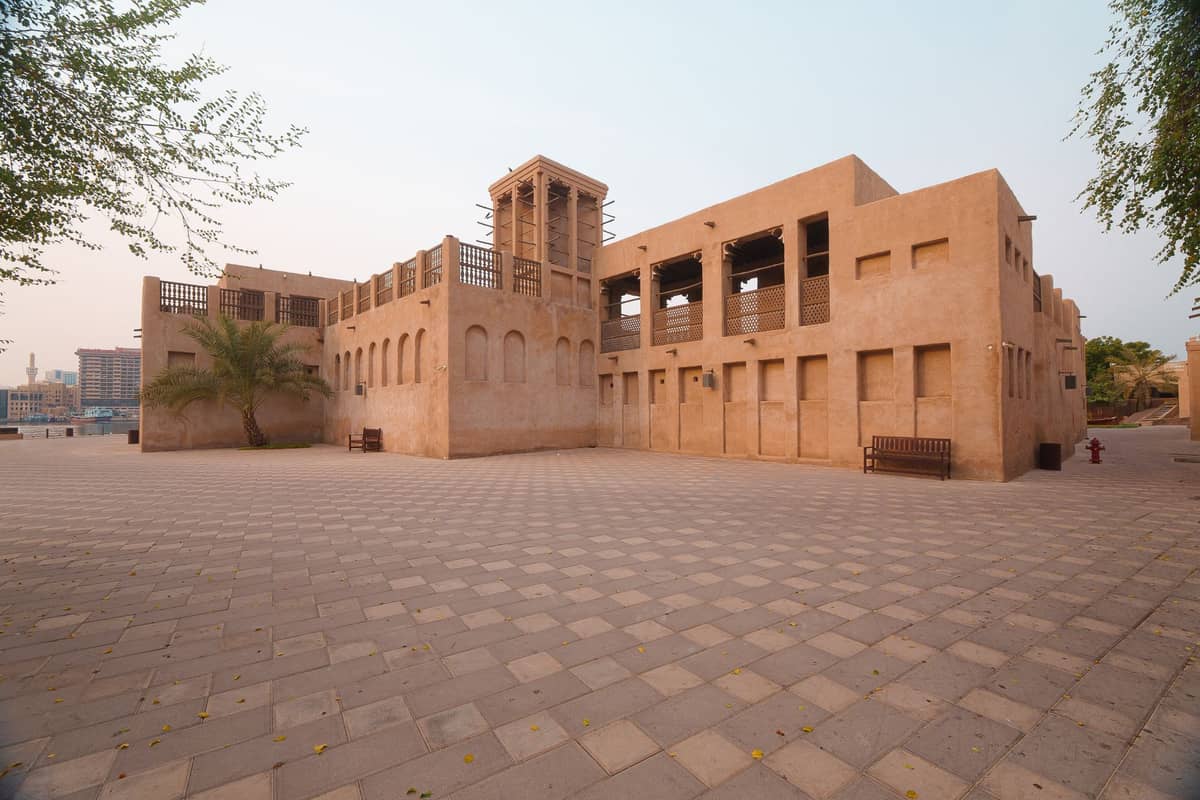
Morning visitors, arriving between 10:00 and 12:00, get the cooler air off the Creek and quieter interiors. The light at this hour hits the pale coral-and-lime plaster facades at a low angle, making the district's architecture read clearly and photographically. School groups occasionally book morning slots on weekdays, so if you arrive and see a coach outside, the early afternoon may be calmer.
The late afternoon, from around 15:30 onward, brings a different quality entirely. The Creek turns copper as the sun drops toward the Deira skyline, and the outdoor walkways between pavilions become noticeably cooler. The water traffic on the Creek picks up at this hour, with abras and water taxis crossing in both directions. If you are planning to photograph the district's waterfront, the hour before sunset produces the most dramatic results.
Visiting in summer (June through September) requires realistic expectations. Even with air-conditioned pavilion interiors, walking between buildings under direct sun at midday is genuinely uncomfortable, with temperatures regularly exceeding 40 degrees Celsius. The November to March window is by far the most pleasant for outdoor portions of the visit, with daytime highs typically between 24 and 31 degrees Celsius.
💡 Local tip
The outdoor walkways facing the Creek catch a reliable breeze in the late afternoon. If you visit in the warmer months, time your outdoor sections for after 16:00 and use the air-conditioned pavilions during the midday heat.
Historical Context: Why This Place Matters
The Al Shindagha peninsula was where Dubai effectively began as a settled community. In the early nineteenth century, a breakaway group of the Bani Yas tribe relocated from Abu Dhabi and established a fishing and pearling village here, on the narrow tongue of land where the Creek met the sea. The ruling Al Maktoum family, which has governed Dubai since 1833, built their residences in Al Shindagha precisely because of its strategic position at the Creek mouth, controlling access to the waterway that made Dubai a trading port.
The pearl trade was the economic engine of this world until the 1930s, when Japanese cultured pearls collapsed global demand almost overnight. The oral histories preserved in the museum's pavilions capture what this collapse felt like at the household level. Dubai's subsequent pivot to trade and, later, oil revenues is a story told here with unusual honesty about what was lost and what was improvised.
Al Shindagha sits at one end of the broader Dubai Creek corridor, which connects this historic district northward to the souks of Deira. The Creek itself is the geographical thread that ties together centuries of the city's economic life, from pearl diving to the dhow trade that continues today.
Getting There and Getting Around the District
The most practical public transport option is the Dubai Metro Green Line to Al Ghubaiba station, from which the district is a short walk. The Al Ghubaiba Bus Station and Ferry Terminal are directly adjacent, giving you the option of arriving by water taxi from Deira or the Bur Dubai abra station, which adds a fitting layer of context before you enter a museum about Creek-side maritime life. Public parking is available on Al Khaleej Street for visitors arriving by car.
If you are combining this visit with a day in Bur Dubai, the district connects naturally on foot to the Al Fahidi Historical Neighbourhood, the Textile Souk, and the waterfront promenade along the Creek. A half-day itinerary combining Al Shindagha in the morning with the Al Fahidi area after lunch is very manageable.
💡 Local tip
Arrive by abra from the Deira side of the Creek. The five-minute water crossing costs around AED 1 per person and drops you close to the district, giving you an immediate sense of the waterway's scale before you start exploring its history.
Photography, Accessibility, and Practical Details
Photography is generally permitted throughout the district and inside the museum pavilions. The most compelling exterior shots involve framing the wind towers and coral-plaster walls against the Creek's water, particularly in the late afternoon. The Perfume Pavilion, if included in your visit, uses warm amber lighting that photographs well even without specialist equipment.
The district sits close to the Gold Souk and the Spice Souk on the Deira side of the Creek, making it straightforward to combine a heritage visit here with time in the traditional market district across the water.
Accessibility provision is above average for the region. Free admission is extended to People of Determination, and the proximity to metro, bus, ferry, and surface parking gives visitors with mobility requirements multiple arrival options. The restored buildings do include some historic thresholds and uneven surfaces in outdoor areas, so it is worth checking with the museum directly if step-free access through specific pavilions is a requirement.
Dress modestly. This is a cultural heritage site managed by a government authority, and the standard Dubai convention of covered shoulders and knees applies. The outdoor areas are exposed to sun, so lightweight layers and a hat are practical additions from March through October.
Honest Assessment: Who Will Love It and Who Might Not
Al Shindagha Heritage District delivers genuine historical depth in a city that often prioritizes scale over substance. The Al Shindagha Museum is one of the few attractions in Dubai where you leave knowing something concrete about how this place actually developed, rather than simply how impressive it has become. For travelers interested in pre-oil Gulf culture, maritime history, or urban heritage, it is among the most rewarding stops in the emirate.
That said, visitors looking for spectacle or entertainment in the conventional Dubai sense will find this understated. There are no extreme experiences, no restaurants with views, and no shopping beyond a small museum store. The outdoor walking portions between pavilions are unremarkable in summer without significant heat mitigation. Very young children may find the exhibition content too text-heavy to sustain interest for the full duration.
For those building a broader picture of the emirate's past, pairing this visit with the Al Fahidi Fort and the Etihad Museum creates one of the most coherent historical itineraries available in Dubai.
Insider Tips
- Buy your ticket at the entrance rather than trying to pre-book online if your schedule is flexible. Walk-in availability is generally good outside of public holidays and school group days (typically weekday mornings).
- The Perfume House pavilion, focused on the history of oud and Arabic fragrance, is a highlight that gets overlooked in shorter visits. Budget at least 20 minutes here specifically.
- The Creek waterfront walkway outside the museum is free to walk at any time, even without a museum ticket. If you are on a tight budget, the architectural streetscape of the district itself is worth the detour from Al Fahidi.
- Combined ticketing options with other Dubai Culture sites sometimes become available. Check the official website before you visit, as bundled deals change periodically.
- If you cross the Creek by abra from Bur Dubai Abra Station rather than Al Ghubaiba Ferry Terminal, you arrive slightly further from the district but pass through the Textile Souk, which is a worthwhile detour.
Who Is Al Shindagha Heritage District For?
- History and culture travelers who want context behind Dubai's modern scale
- Architecture enthusiasts interested in Gulf vernacular design, wind towers, and coral construction
- Families with children aged 8 and above who engage with interactive and audiovisual museum content
- Budget-conscious visitors seeking substantive experiences at low cost
- Photographers working the Creek corridor in the late afternoon golden hour