Dubai Creek: Where the City's Story Begins
Dubai Creek is a 14-kilometre natural saltwater inlet that has shaped the emirate's identity for centuries. Free to visit at any hour, it offers abra rides across the water, traditional souks on both banks, and a rare window into the Dubai that existed long before the skyscrapers arrived.
Quick Facts
- Location
- Separates Bur Dubai (south) from Deira (north), central Dubai, UAE
- Getting There
- Al Ghubaiba, Al Fahidi, or Al Ras Metro Station, then a short walk to the waterfront
- Time Needed
- 2–4 hours for a waterfront walk and abra crossing; half a day if exploring both banks
- Cost
- Free to walk; shared abra crossing AED 1 per person; Dubai Creek Park entry AED 5
- Best for
- History seekers, photographers, budget travelers, and anyone curious about pre-boom Dubai
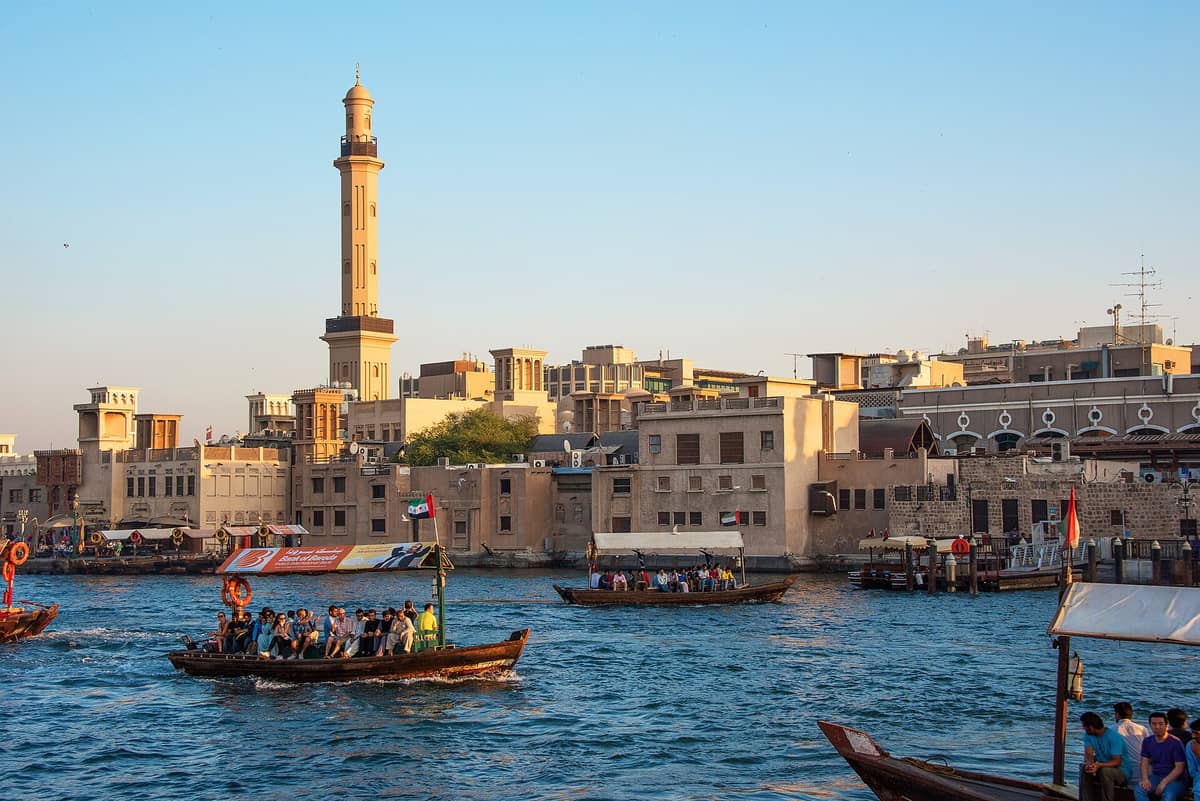
What Dubai Creek Actually Is
Dubai Creek, known in Arabic as Khor Dubai, is a natural saltwater inlet of the Arabian Gulf cutting roughly 14 kilometres into the heart of the city. It is listed on UNESCO's tentative World Heritage List and widely cited as a key geographic feature in Dubai's early development. For most of the 19th and early 20th centuries, this waterway was Dubai's economy: dhow captains loaded and unloaded pearls, spices, and textiles along its banks, and the two communities that grew on either side, Deira to the north and Bur Dubai to the south, were linked almost entirely by small wooden boats.
Today the Creek remains a working waterway. Wooden dhows still moor along the Deira waterfront at night, loaded with goods bound for Iran, India, and East Africa. Abras, the traditional wooden water taxis, shuttle passengers across for AED 1. The souks that flank the Creek, gold, spices, textiles, perfume, are still operating. The view from the promenade has changed significantly with cranes and towers on the horizon, but the smell of salt water, engine oil, and cardamom at the spice souk remains constant.
💡 Local tip
The shared abra crossing between the Bur Dubai and Deira abra stations costs AED 1 per person and runs frequently throughout the day. It is the most atmospheric and practical way to cross the Creek, and takes about five minutes. Private abra hire costs considerably more and must be negotiated directly with the boatmen.
How the Creek Changes Through the Day
Early morning, before 8am, is when the Creek feels most authentic. The dhow crews are active: ropes are coiled, goods are stacked under tarpaulins, and the smell of strong tea drifts from small stalls near the docks. The light is soft and workable for photography, and the waterfront has not yet filled with tourists. This is the window when you see the Creek as a port rather than a heritage attraction.
By mid-morning the souk districts on both sides pick up, with shopkeepers rolling up shutters and the gold souk in Deira filling with both buyers and browsers. Late afternoon brings a second wave of activity as temperatures ease and the promenade fills with strolling families. The hour before sunset is the most photogenic: the old wind tower architecture of the Al Fahidi neighbourhood glows amber, dhows cast long reflections on the water, and the abras move back and forth in silhouette.
After dark, the Creek takes on a different character. Illuminated dhow cruise boats depart from both banks, tourist restaurants open along the waterfront, and the gold souk continues trading well into the evening. The Deira promenade in particular stays active late, especially on weekends.
⚠️ What to skip
From June through September, daytime temperatures in Dubai regularly exceed 40°C with high humidity. Walking exposed sections of the Creek promenade between 10am and 4pm in summer is genuinely uncomfortable and potentially hazardous. If visiting in summer, plan Creek walks for early morning or after sunset.
The Two Banks: What to Do on Each Side
Bur Dubai: Heritage and Calm
The Bur Dubai side is the quieter, more heritage-focused bank. The Al Fahidi Fort, which now houses the Dubai Museum, sits a short walk from the waterfront and is the oldest surviving building in the city. The surrounding Shindagha Heritage District has been significantly restored in recent years and contains the Sheikh Saeed Al Maktoum House and several small specialist museums focused on the emirate's pearl diving and maritime history.
The textile souk runs parallel to the waterfront along a covered arcade, selling fabrics at prices well below what you would pay at a shopping mall. A few hundred metres further along the promenade, the Al Seef development sits directly on the waterfront, offering a blend of reconstructed heritage architecture and modern cafes and restaurants. Al Seef is a pleasant place to take a break and is noticeably cooler than the exposed waterfront walkway.
Deira: Commerce and Sensory Overload
Cross to the Deira side and the atmosphere shifts immediately. This is the older trading district of Dubai, denser and louder, with the Gold Souk about ten minutes' walk from the abra landing. The covered market displays an estimated 10 tonnes of gold jewellery at any given time and is one of the largest gold markets in the world. You are under no obligation to buy, and browsing is entirely normal.
Nearby, the Spice Souk occupies a compact grid of lanes where sacks of dried rose petals, frankincense, turmeric, and dried limes are stacked at street level. The smell hits before you arrive. Prices here are generally negotiable, and vendors are accustomed to both serious buyers and curious visitors. The adjacent Perfume Souk sells concentrated Arabic attars and oud-based fragrances, many of which are not available in duty-free or international retail.
Historical and Cultural Significance
The Creek was not just a trading route; it was the reason Dubai existed as a distinct settlement at all. In the early 19th century, a branch of the Bani Yas tribe relocated from Abu Dhabi to the Creek's mouth, recognising its natural harbour as ideal for fishing, pearling, and trade. By the late 1800s, Dubai's ruler had actively courted foreign traders, particularly from the Persian coast and the Indian subcontinent, by reducing customs taxes. This early free-trade instinct turned the Creek into one of the Gulf's most significant commercial ports before any oil had been discovered.
The Creek's strategic importance only grew in the 20th century. Dredging works in the late 1950s deepened the channel, allowing larger vessels to navigate further inland and cementing the port's commercial viability. The revenue from creek-side trade funded the early infrastructure of what would become modern Dubai. The 2016 extension of the waterway southward through the Dubai Water Canal to the Arabian Gulf added roughly 10 kilometres to the inland waterway system, though this newer section has a distinctly different, contemporary character.
Getting There and Moving Around
The Al Ghubaiba, Al Fahidi, or Al Ras Metro Station on the Red and Green lines places you within walking distance of the Bur Dubai abra station. From there, follow signage toward the waterfront, which takes about 10 to 15 minutes on foot through streets lined with small shops and fabric retailers. Taxis from anywhere in central Dubai are inexpensive and can drop you directly at the Bur Dubai waterfront or at the Deira abra station, depending on which side you want to start.
If you are combining the Creek with a broader exploration of old Dubai, the Old Dubai guide maps out an efficient walking route that connects Al Fahidi, the heritage district, and the souk circuit on both banks without excessive backtracking. Most visitors cover both sides comfortably in half a day, though you could fill a full day if you slow down in the souks.
ℹ️ Good to know
There is no single entry point or ticketing booth for Dubai Creek. The waterfront is fully open. The only payment you will make is the AED 1 abra fare (cash, given directly to the boatman), or AED 5 if you want to enter the adjacent Dubai Creek Park.
Photography Tips and Practical Notes
The Creek rewards photographers who show up at two specific times: just after sunrise, when the dhow crews are working and the light is directional without being harsh; and in the 30 minutes following sunset, when the waterfront lights up but the sky still holds colour. The wind tower rooftops of Al Fahidi visible from the Bur Dubai promenade are particularly striking in late afternoon light.
Photographing people in the souks or on the abras requires sensitivity. Many of the traders and workers along the Creek are from South Asia and East Africa, and while most are happy to be photographed, asking first is both respectful and tends to produce better portraits. Photography inside the mosques adjacent to the souks is generally not permitted.
Wear comfortable, closed footwear. The older souk lanes and the abra boarding areas involve uneven stone and wooden surfaces. Women should carry a light scarf as a precaution near religious sites. The promenades on both banks have drinking water fountains in places, but carrying a bottle is sensible, particularly in warmer months.
Honest Assessment: Is It Worth Your Time?
Dubai Creek is one of the few places in Dubai where the city's commercial and cultural depth is visible without purchasing anything or booking anything in advance. It is not a polished attraction in the resort sense: the abras are basic, the souks can be pushy, and the dock area near Deira smells of diesel and fish. These are not flaws. They are the signs of a place that still functions as it did 100 years ago.
Visitors who expect the air-conditioned comfort of Dubai Mall or the manicured waterfront of the marina will find the Creek raw by comparison. But anyone travelling to understand what Dubai actually is, rather than just what it has become, will find the Creek essential. It is the city's origin point, and it still shows.
Those with severe mobility limitations should note that the abra boarding involves stepping down into a moving wooden boat with no handrails. The promenades are largely paved and accessible, but the souk interiors have narrow alleys and uneven surfaces that can be difficult with a wheelchair or pram.
Insider Tips
- Take the abra from Bur Dubai to Deira first thing in the morning, before 8am, when dhow crews are loading goods and the waterfront has almost no tourists. The crossing itself takes five minutes but the atmosphere at that hour is worth extending into a 30-minute waterfront walk on the Deira side before the souks open.
- The textile souk on the Bur Dubai side has no fixed prices. Starting at roughly 50 to 60 percent of the first quoted price and negotiating calmly is standard practice and expected. Walking away often results in a counter-offer.
- If you want a longer creek experience on the water without paying for a full dhow cruise, private abra hire for an hour-long waterway journey can be negotiated directly with boatmen at either abra station. Agree on the price and duration clearly before boarding.
- The Ras Al Khor Wildlife Sanctuary sits at the southern end of the Creek and is one of the only flamingo habitats inside a major city. Entry is free but opening hours are limited. It makes a logical add-on to a Creek visit if you have transport.
- Friday mornings are the quietest time across the entire Creek area. The souks open later, the waterfront is calm, and the abra crossing is rarely crowded. This is the single best time for photography without crowds in the frame.
Who Is Dubai Creek For?
- History and culture travelers who want context beyond the modern skyline
- Budget travelers, since the core experience costs almost nothing
- Photographers looking for authentic urban and maritime scenes
- First-time visitors to Dubai who want to understand the city's origins before exploring the newer districts
- Shoppers interested in gold, spices, and textiles at prices below retail mall rates