Al Fahidi Historical Neighbourhood
Al Fahidi Historical Neighbourhood is Dubai's most intact pre-oil residential quarter, a compact labyrinth of mud-brick courtyard houses, wind towers, and narrow shaded lanes along Dubai Creek in Bur Dubai. Covering roughly 38,000 square metres, it holds the city's oldest fort, a cluster of small museums, and some of the most considered gallery spaces in the UAE. It offers a rare counterpoint to the glass-and-steel Dubai that dominates most postcards.
Located in Dubai
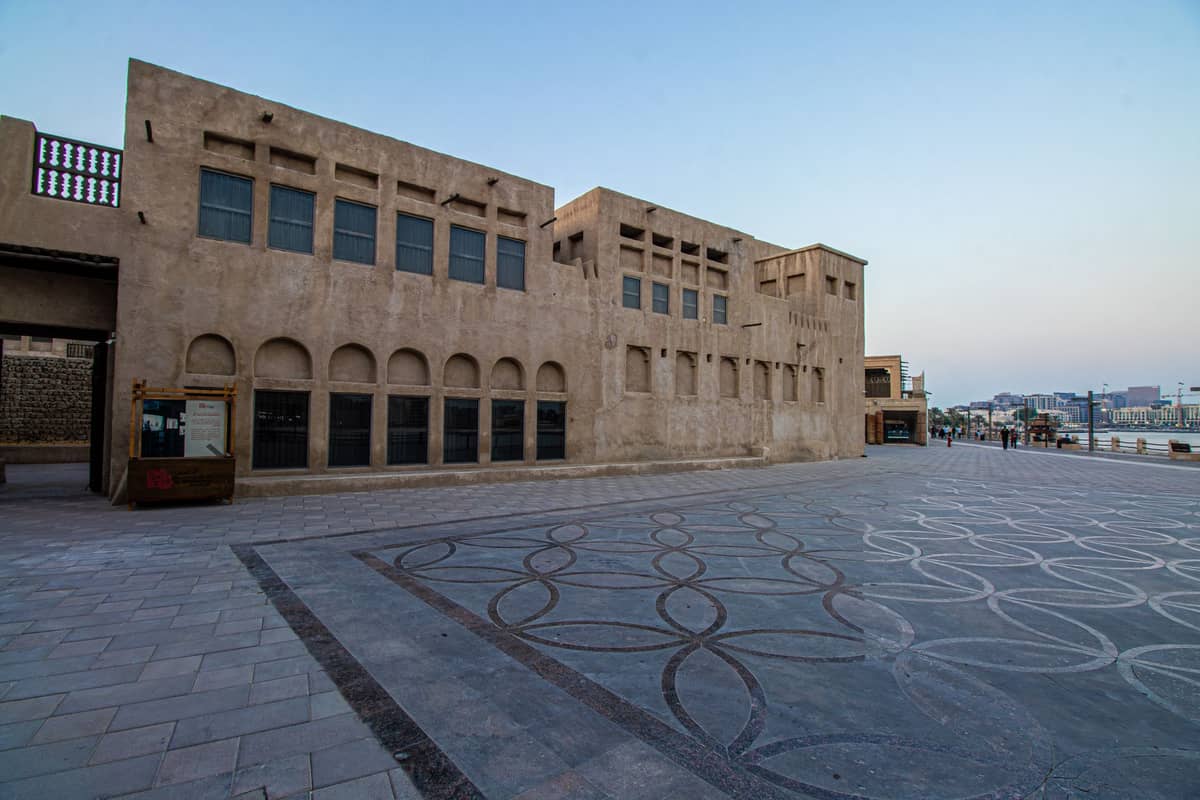
Overview
Al Fahidi is where Dubai's story begins. A compact quarter of wind-tower houses, shaded alleys, and courtyard museums pressed up against Dubai Creek, it is the city's oldest surviving residential district and the clearest window into what this trading port looked like before the oil era transformed everything around it.
Orientation
Al Fahidi Historical Neighbourhood sits in the Bur Dubai district, on the southern bank of Dubai Creek. The district covers roughly 38,000 square metres, stretching approximately 300 metres along the creek waterfront and about 200 metres inland. Its boundaries are loosely defined by Al Fahidi Street to the south, the creek corniche to the north, and the wider Bur Dubai commercial zone to the east and west.
Mentally, Al Fahidi sits at the exact hinge point between old and new Dubai. Cross the creek by abra (traditional wooden water taxi) from the Bur Dubai Abra Station at the northern edge of the neighbourhood and you arrive in Deira within minutes, stepping into the spice and textile souk corridors on the opposite bank. Walk south from Al Fahidi along Al Musallah Street and within ten minutes the architecture shifts completely, replaced by concrete commercial blocks and the broader Bur Dubai grid.
The neighbourhood connects directly to Al Seef, the reconstructed heritage waterfront promenade that runs east along the creek from the abra station. Al Seef is newer and more polished, but it gives Al Fahidi a logical eastern extension for a half-day walk. To the west, the Shindagha heritage corridor continues the creek-side cultural trail toward the old mouth of the creek near the Gulf.
ℹ️ Good to know
Al Fahidi is officially part of the Al Souq Al Kabeer sub-district within Bur Dubai. On maps and in ride-hailing apps, searching 'Al Fahidi Historical Neighbourhood' or 'Al Fahidi Fort' will get you to the right spot. The nearby BurJuman area is a separate commercial zone to the south and should not be confused with the heritage quarter.
Character and Atmosphere
At seven in the morning, Al Fahidi belongs almost entirely to the neighbourhood itself. The low winter sun pushes long shadows down the narrow lanes between the mud-brick and gypsum walls, and the air carries the creek's faint salt-and-diesel smell from the abra station nearby. A few cats occupy the warm patches of pavement. The alleys are cool and quiet at this hour, the wind-tower houses casting deep shade before the day's heat builds.
By mid-morning, tour groups arrive, guided by SMCCU (Sheikh Mohammed Centre for Cultural Understanding) staff or independent guides. The lanes fill with the sound of Arabic explanations and the click of cameras aimed upward at the barjeel wind towers, those square chimney-like structures that once caught prevailing winds and funnelled cooling air into living rooms below. Even with visitors present, the scale of the place keeps it from feeling overwhelmed: the alleys are genuinely narrow, forcing people to move in single file and slowing everything down.
The afternoon is the hardest time to be here in summer, when the heat radiating off the pale walls can feel punishing between approximately May and September. In the cooler months from November to March, the afternoon light turns the ochre walls golden and the courtyard galleries are at their most pleasant. By late afternoon, the abra station at the creek edge gets busy again with commuters crossing between Bur Dubai and Deira, and the waterfront takes on a more working-city character alongside the tourist layer.
After dark, Al Fahidi quiets significantly. The museums close, the lanes empty, and the neighbourhood reverts to something closer to its residential character. A few cafes near the main entrances stay open, and the creek promenade lights up, but this is not a nightlife area. That combination of daytime culture and evening calm is part of what makes it distinctive in Dubai's landscape: it is a place that rewards morning visits above all else.
💡 Local tip
Arrive before 9am on a weekday for the best experience: the lanes are quiet, the light is extraordinary for photographs, and the courtyard interiors of the XVA Gallery and the Coffee Museum are cool and unhurried. Weekends and mid-morning slots are significantly more crowded.
What to See and Do
The anchor of the neighbourhood is the Al Fahidi Fort, Dubai's oldest standing structure, built around 1787. It served as the ruler's residence, a garrison, and a prison before becoming the Dubai Museum in 1971. As of September 2026 the Dubai Museum inside the fort remains closed for rehabilitation, with reopening still awaiting an official date; the outer walls and towers are still worth seeing from outside, and the surrounding lanes give useful context for pre-oil Dubai.
The XVA Gallery is the neighbourhood's most internationally recognised cultural institution. Set inside a restored courtyard house, it operates as both an art gallery showing contemporary Arab and South Asian artists and a boutique hotel with rooms arranged around the central courtyard. Even if you are not staying here, the gallery is open to visitors and represents one of the more considered exhibition spaces in the region.
The Sheikh Mohammed Centre for Cultural Understanding, known locally as the SMCCU, runs guided walking tours of the neighbourhood and hosts cultural breakfasts and lunches inside a restored wind-tower house. These meals include traditional Emirati dishes and an open question-and-answer session with Emirati hosts, designed to explain local customs, religion, and daily life. Booking in advance is strongly recommended, as sessions fill quickly during the November-to-March high season.
- Al Fahidi Fort and Dubai Museum: the city's oldest building and its founding museum
- XVA Gallery: contemporary art in a restored courtyard house
- Sheikh Mohammed Centre for Cultural Understanding: guided tours and cultural meals
- Coffee Museum: a small collection tracing the history of Arabic coffee culture
- Coin Museum: specialist numismatic collection in a heritage house setting
- Majlis House: a restored meeting room demonstrating traditional Emirati social spaces
- Abra crossing at Bur Dubai Abra Station: the creek water taxi linking to Deira
The neighbourhood also connects logically to the wider Shindagha Heritage District a short walk west along the creek, where the Sheikh Saeed Al Maktoum House and the Etihad Museum sit. Plan a half-day that covers both districts moving west from Al Fahidi toward Shindagha, and you cover the most concentrated stretch of Dubai's pre-modern history in one continuous walk.
Eating and Drinking
Al Fahidi's food scene is small but specific. The neighbourhood itself has a handful of cafes tucked into restored courtyard houses, and the wider Bur Dubai area immediately surrounding it offers a dense and genuinely diverse eating landscape, particularly strong on South Asian and Levantine food.
Inside the historical neighbourhood, the XVA Gallery cafe is the most atmospheric option: vegetarian food served in the courtyard, with strong Arabic coffee and a menu that leans toward Lebanese and regional mezze-style dishes. Prices are moderate by Dubai standards, roughly 40 to 80 AED for a main. The SMCCU cultural meals are a worthwhile experience for Emirati food specifically, dishes like harees (slow-cooked wheat and meat), machboos (spiced rice with meat or fish), and luqaimat (sweet fried dough balls) served family-style. These meals are structured cultural experiences rather than casual dining, and cost around 120 to 150 AED per person.
Stepping outside the immediate neighbourhood boundary, the streets of central Bur Dubai are excellent for budget eating. The area around Al Fahidi Street and further east toward Meena Bazaar has a concentration of South Asian restaurants and cafes, many open from early morning, serving dosas, biryanis, and chai at prices that sit well under 30 AED per person. If you are building a full day around exploring old Dubai, lunch in one of these spots is both economical and genuinely good.
💡 Local tip
Arabic coffee (qahwa) flavoured with cardamom and saffron is served throughout the neighbourhood's cultural venues. The Coffee Museum on Al Fahidi Street offers tastings and sells roasted beans. It is a good place to understand the role of coffee in Emirati hospitality before joining a SMCCU cultural session.
Alcohol is not available anywhere inside Al Fahidi's heritage lanes. If you are looking for a drink after exploring, the nearest licensed venues are in hotels in the broader Bur Dubai area, though the neighbourhood itself keeps a dry, conservative character consistent with its heritage setting.
Getting There and Around
The Dubai Metro does not have a station directly inside Al Fahidi, but two options keep the walk manageable. The Al Fahidi Metro Station on the Green Line is the closest, placing you about a 10-minute walk from the historical neighbourhood's main entrance near Al Fahidi Fort. The BurJuman Metro Station, served by both the Red and Green Lines, is slightly further south, around a 12 to 15-minute walk, but useful if you are coming from Downtown Dubai, Deira, or the airport.
Buses serving the Bur Dubai area stop along Al Ghubaiba Road and near the Bur Dubai Abra Station, with routes connecting to Deira and other central districts. The Sharaf DG Metro Bus Stop serves as an interchange point for several routes. For most visitors, a combination of Metro and a short walk is the simplest approach.
Taxis and ride-hailing via Careem or Uber work well for reaching Al Fahidi from any part of the city. From Downtown Dubai the drive is typically 10 to 15 minutes outside peak hours. From Dubai International Airport (DXB), expect 20 to 30 minutes by taxi depending on traffic, at a metered fare of approximately 50 to 70 AED (verify current fares before travel, as these are subject to change).
Once inside the neighbourhood, everything is on foot. The lanes are not navigable by car, which is partly what preserves the character of the place. The district is compact enough that you can walk its full extent in about 20 minutes without stopping, so navigation inside is straightforward. Heading north through the lanes brings you toward the creek and the abra station; heading south returns you to the main Al Fahidi Street.
ℹ️ Good to know
The Bur Dubai Abra Station at the creek edge is a five-minute walk north from Al Fahidi Fort. A one-way abra crossing to Deira costs 1 AED per person in cash and takes around 5 minutes, giving access to the Gold Souk, Spice Souk, and Deira's historic commercial district. This crossing is one of Dubai's great low-cost experiences and fits naturally into any Al Fahidi visit.
Where to Stay
Accommodation directly inside Al Fahidi Historical Neighbourhood is extremely limited by design. The XVA Gallery operates a small boutique hotel within its restored courtyard house, with rooms priced in the upper-mid to boutique range. Staying here puts you inside the heritage district itself, a genuinely unusual experience in Dubai where almost all accommodation is in contemporary towers, but availability is limited and advance booking is essential.
For visitors who want to stay near the neighbourhood without paying boutique rates, the wider Bur Dubai area has a range of mid-range hotels clustered along Khalid Bin Al Waleed Road and near BurJuman Mall, walkable to Al Fahidi in 15 to 20 minutes. This part of the city is practical for anyone focused on old Dubai sightseeing, with good Metro access and lower room rates than Downtown or Dubai Marina. Check the broader where to stay in Dubai guide to compare Bur Dubai with other neighbourhoods before booking.
Al Fahidi suits independent travellers, culture-focused visitors, and anyone who finds the glass-tower districts of Dubai too uniform. It is not suited to travellers who prioritise beach access, nightlife, or resort-style amenities: for those priorities, Bur Dubai in general is a base of convenience rather than atmosphere.
Practical Notes and Honest Assessment
Al Fahidi is genuinely impressive as a preserved historic district, particularly given how completely the rest of Dubai has been rebuilt. The wind-tower architecture is specific to the Gulf and rarely survives in such concentration anywhere. The cultural institutions are well maintained, the lanes are photogenic at almost any hour, and the creek proximity adds a working-city layer that the purely touristic parts of old Dubai lack.
The drawbacks are real but manageable. In summer (June through September), the heat inside the enclosed lanes is intense and humidity from the creek adds to the discomfort: early morning is the only comfortable outdoor window during those months. The neighbourhood can feel thin on content if you are not specifically interested in architecture, local history, or cultural exchange. If you have covered Al Fahidi Fort, XVA Gallery, and the SMCCU in a morning, there is not much reason to linger beyond lunch. Pair it with Al Seef, a walk to Shindagha Heritage District, and an abra crossing to Deira's souks and you have a full and coherent day in old Dubai.
Dress modestly when visiting: covered shoulders and knees are appropriate and expected at the SMCCU and in the heritage houses. Photography of the architecture and public spaces is welcome, but ask before photographing people. The neighbourhood is safe at all hours; it attracts a mainstream tourist and expat crowd during the day and is quiet rather than threatening at night. For more on what to wear and how to navigate Dubai's cultural expectations, the Dubai dress code guide is a useful reference.
⚠️ What to skip
During Ramadan, some cultural venues adjust their hours and the SMCCU's meal schedule changes significantly. Al Fahidi is one of the more rewarding parts of Dubai to visit during Ramadan if you are respectful of the atmosphere, but verify opening hours directly with each venue before visiting. See the Ramadan in Dubai guide for full context.
TL;DR
- Al Fahidi Historical Neighbourhood is Dubai's best-preserved pre-oil quarter, covering around 38,000 square metres of wind-tower houses, narrow lanes, and courtyard museums in Bur Dubai along Dubai Creek.
- Best visited in the cool months from November to March, and specifically in the early morning when the lanes are quiet and the light is at its best.
- Key institutions include Al Fahidi Fort (Dubai Museum — closed for rehabilitation as of September 2026; confirm reopening), XVA Gallery, and the Sheikh Mohammed Centre for Cultural Understanding (SMCCU). Budget two to four hours for a thorough visit of the lanes and remaining open sites.
- Access is straightforward via the Al Fahidi or BurJuman Metro stations, with a short walk to the neighbourhood. The 1 AED abra crossing to Deira is a natural extension of any visit.
- Best suited to culture-focused, independent, and architecture-interested travellers. Not a nightlife or beach destination; pairs best with a full old Dubai day that also covers Al Seef, Shindagha, and a Deira souk walk.
Related Travel Guides
Related Travel Guides Al Fahidi Historical Neighbourhood are coming soon.