Dubai Marina
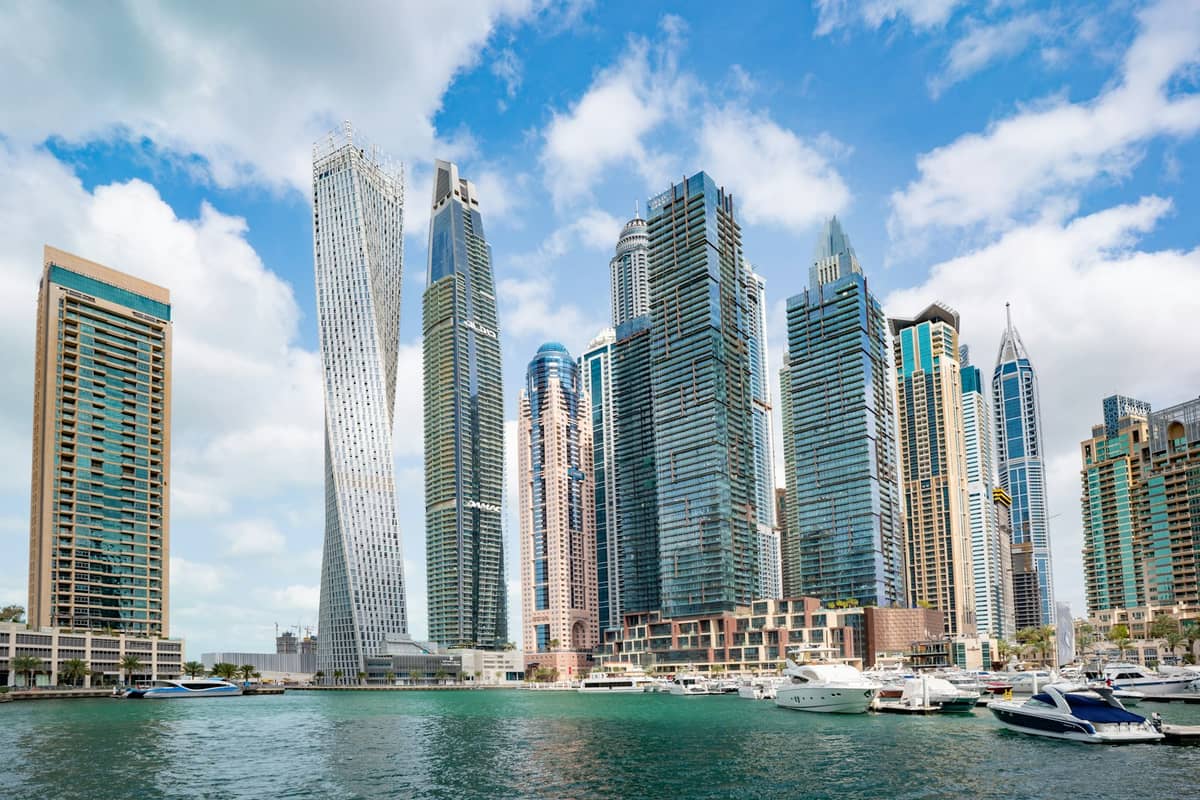
Dubai Marina is a purpose-built canal city within a city, wrapping around a 3.5 km man-made waterway lined with residential skyscrapers, yacht berths, and a continuous waterfront promenade. It sits at the western end of Dubai's coastline and offers some of the most walkable, transit-connected urban living in the emirate.
Located in Dubai
Overview
Dubai Marina is where Dubai's appetite for scale meets actual street life. Built around a man-made canal ringed by over 200 towers, it functions as a self-contained waterfront district with genuine pedestrian energy, reliable metro and tram access, and enough restaurants, bars, and beaches to fill several days without ever leaving the neighborhood.
Orientation
Dubai Marina sits in the western reaches of Dubai, roughly 30 km from the historic creek districts of Deira and Bur Dubai. It was built from scratch in the early 2000s around a dredged canal that loops inland from the Arabian Gulf, creating a sheltered body of water lined with residential towers, hotel blocks, and marina berths. The result is a dense, walkable urban quarter that feels physically separate from the sprawling freeway corridors surrounding it.
Sheikh Zayed Road (E11), the main arterial highway running the length of Dubai, forms the eastern boundary. On the other side of that highway sits Jumeirah Lake Towers (JLT), a cluster of commercial and residential towers that is often confused with Dubai Marina but is a distinct district. To the west and south, the marina transitions into Jumeirah Beach Residence (JBR), the open beachfront strip. To the north, Dubai Media City and Dubai Internet City begin within a few minutes' drive, giving the area a professional-class residential population that commutes to those tech and media campuses.
The marina canal itself is the organizing structure of the whole neighborhood. Marina Walk, the promenade that runs the full circumference of the water, acts as a spine connecting hotels, restaurants, and residential lobbies. Just offshore, connected by a short bridge, sits Palm Jumeirah, visible from almost anywhere along the waterfront. The Ain Dubai observation wheel on Bluewaters Island is also immediately adjacent, adding another visual landmark to the western skyline.
Character & Atmosphere
Early mornings in Dubai Marina belong to the residents. By 6am in the cooler months, the Marina Walk fills with joggers, dog walkers, and cyclists moving at a deliberate pace around the canal loop. The light is soft and flat, the water catches it cleanly, and the towers cast long shadows across the promenade. Coffee shops in the residential podiums open early to catch the pre-commute crowd, and for an hour or two the neighborhood feels genuinely local rather than tourist-facing.
By mid-morning the character shifts. Tour groups arrive, hotel guests spill out toward the water, and the outdoor restaurant terraces start setting up for lunch. The scale of the towers becomes more apparent as the sun climbs: 73-storey Cayan Tower, identifiable by its helical twist that rotates 90 degrees from base to top, reads differently depending on where you stand. From the inner canal it looms close; from JBR beach it becomes part of a compressed skyline that is genuinely arresting.
Afternoons in summer are brutal. Between June and September, temperatures regularly exceed 40°C and humidity off the water makes outdoor movement punishing after about 10am. The Marina Walk empties out and the malls, air-conditioned restaurants, and hotel lobbies absorb all activity. This is not a neighborhood that pretends summer away: most of its outdoor appeal simply suspends until October. In winter, however, the afternoons are the best time to be here. The light goes golden by 4pm, the promenade fills again, and the yachts reflect in still water before the sun drops behind the Palm.
After dark, Dubai Marina is one of the liveliest districts in the city. The waterfront restaurants switch on their lighting, the rooftop bars fill, and the Marina Walk sees a genuine mix of nationalities: South Asian families on evening strolls, European expats having sundowners, tourists navigating toward JBR. It is not a late-night district in the way that some parts of DIFC are, but the energy runs comfortably until midnight on weekends, and several bars and rooftop venues push later than that.
ℹ️ Good to know
Dubai Marina is primarily a residential neighborhood that happens to have strong tourist infrastructure. The majority of people you see on the Marina Walk on a weekday morning are not visitors. That residential density is what gives the area its genuine urban feel compared to more overtly tourist-facing districts.
What to See & Do
The most straightforward activity in Dubai Marina is walking or running the full loop of Marina Walk. The promenade covers roughly 7 km if you trace the full circumference of the canal, though most visitors do shorter sections between the key clusters of restaurants and hotels. It is flat, well-maintained, and illuminated at night, making it accessible at almost any time outside the summer heat window.
Directly adjacent to Dubai Marina, Bluewaters Island is connected by a pedestrian bridge from JBR and hosts Ain Dubai, which at 250 metres is the world's largest observation wheel. A standard cabin ride takes about 38 minutes and offers clear-day views stretching to the Burj Khalifa, the Palm, and the Hajar Mountains in the distance. It is a genuine spectacle rather than a gimmick, and the gondola format makes it suitable for most ages.
The beach adjoining Dubai Marina is accessed through JBR. The Walk at JBR is a wide beachfront boulevard with retail, food stalls, and a public beach that is free to use. It is one of the more democratically accessible stretches of Dubai's coastline, without a beach club entry fee required to access the sand. The water is clean and supervised, and the beach runs for over a kilometre.
For those interested in yacht charters, fishing trips, or sunset cruises, Dubai Marina is the primary departure point in Dubai. Multiple operators berth at the marina and offer everything from hour-long canal circuits to full-day Gulf crossings. Prices range considerably, and it is worth comparing a few operators directly at the dock rather than booking through hotel concierges who add a margin.
- Walk the Marina Walk promenade at dusk for the best combination of light and temperature
- Take the pedestrian bridge to Bluewaters Island for Ain Dubai and waterfront dining away from the main crowds
- Access JBR beach for free public swimming without a beach club fee
- Book a sunset yacht or dhow cruise from the marina berths
- Browse Dubai Marina Mall for a quieter, more local alternative to the megamalls
💡 Local tip
If you want beach access without paying a beach club fee, head to the public beach section north of The Walk at JBR. It has facilities, lifeguards during the cooler months, and a good view back toward the Marina towers.
Eating & Drinking
Dubai Marina has one of the highest concentrations of waterfront restaurants in the city, which is both a strength and a trap. The restaurants directly on the Marina Walk promenade tend to be mid-range international chains and hotel outlets optimized for tourist foot traffic. The views are good, the menus are safe, and the pricing is higher than the food typically justifies. That is not a criticism unique to Dubai Marina: it is the premium charged for water views everywhere in the world.
The more interesting food options tend to cluster inside the residential tower podiums and along the streets slightly set back from the main promenade. Here you find a broader range of South Asian, Filipino, and Levantine restaurants catering to the expat residents rather than passing tourists. Portions are larger, prices are more reasonable, and the atmosphere is less performative. The streets running between the towers in the northern section of the marina are worth exploring specifically for this.
Dubai Marina Mall has a food court that serves as a reliable fallback for affordable lunches and quick bites, and its ground-floor restaurant strip includes a decent spread of international options. For a full account of Dubai's food scene and what to prioritize, the guide to what to eat in Dubai covers the full range from street-level shawarma to fine dining.
For drinks, Dubai Marina has a good selection of licensed hotel bars and rooftop venues. The Dubai rooftop bars guide includes several options in and around the Marina, where the elevation of the towers translates directly into views. Alcohol is available at licensed hotel venues and some standalone restaurants; prices are high by international standards, with cocktails typically starting at 65-80 AED. The Dubai nightlife guide provides more detail on which venues are worth the spend.
⚠️ What to skip
Alcohol is only served at licensed venues in Dubai, which are almost exclusively attached to hotels or specific club venues. You cannot buy alcohol in supermarkets in most areas, and unlicensed restaurants are dry. This applies across Dubai Marina as everywhere in Dubai.
Getting There & Around
Dubai Marina is one of the best-connected neighborhoods in Dubai for public transit, which is not something you can say about many parts of the city. The combination of the Red Line metro and the Dubai Tram makes it possible to reach the marina from Dubai International Airport (DXB) without a car, a significant advantage for visitors who want to avoid taxi costs.
The Dubai Metro Red Line has two stations serving the area. Sobha Realty station (formerly DAMAC Properties / Dubai Marina station, coded R36) sits at the northern end of the marina cluster and provides the most direct access to the Marina Walk and Dubai Marina Mall. DMCC station (R37) is just across Sheikh Zayed Road in JLT but is well-connected to the tram network and a short walk from the southern end of the marina. Both stations connect to the Dubai Tram, which makes the final distribution within the neighborhood significantly more convenient.
The Dubai Tram runs along the outer edge of the marina and into JBR, with stops at Jumeirah Beach Residence 1 and 2, Marina Towers, Mina Seyahi, and the interchange stops at DMCC and Sobha Realty. It covers the stretch that would otherwise require a 20-minute walk in summer heat, and it connects to the metro at both ends. The tram uses the same Nol card as the metro, so one card covers both modes.
RTA marine transport operates ferry and water bus stops along the marina itself, including Dubai Marina Walk Station, Marina Terrace Station, Marina Promenade Station, and the Dubai Marina Mall–Bluewaters connection points. These are useful for reaching other coastal areas and for the scenic approach to the neighborhood from the water side. Bus routes 8, 84, and night bus N55 also serve the area, with stops co-located near tram stations.
From Dubai International Airport, the Red Line metro runs directly to Sobha Realty station. The journey takes approximately 45-55 minutes depending on origin terminal and interchange time, and costs roughly 7-8 AED with a Nol card. Taxis from DXB to Dubai Marina cost approximately 70-100 AED depending on traffic and precise destination, with the journey taking 25-45 minutes. Uber and Careem are both active in the area.
💡 Local tip
Get a Nol card (the RTA transit card) from any metro station ticket machine on arrival. It works across metro, tram, bus, and marine ferry services, and costs 25 AED including 19 AED credit. Paying cash on buses is technically possible but slower and more expensive per journey. Verify current fares at the RTA website before travel as prices are subject to change.
Where to Stay
Dubai Marina makes a strong base for visitors who prioritize walkability, waterfront access, and transit connections over proximity to the historic city. It suits the beach-and-towers style of Dubai visit better than those who want to spend time in the older districts around Deira or Bur Dubai. From Dubai Marina, getting to Downtown Dubai takes about 20-25 minutes by metro, which is manageable but not quick.
Hotel options in the neighborhood range from five-star waterfront properties with private beach access to apartment-style hotels that cater to longer stays. The hotel strip along the JBR beachfront offers the most direct beach access and the closest proximity to The Walk. Mid-range options exist inside the residential tower blocks as serviced apartments, which can offer significantly more space for comparable or lower prices compared to traditional hotel rooms.
Families with beach-focused itineraries often find Dubai Marina and JBR the most convenient base in Dubai, since the beach is walkable and the tram connects to the wider transit network. Couples on a city trip who want landmark access may prefer Downtown Dubai for the Burj Khalifa proximity. For a broader comparison of where to base yourself, the guide to where to stay in Dubai maps out the trade-offs across all major neighborhoods.
The best-positioned hotels for avoiding noise while maintaining promenade access tend to be on the northern and western sides of the marina canal, away from the main cluster of entertainment venues near the JBR junction. The inner marina-facing rooms in hotels on the water tend to be quieter than street-facing rooms, particularly on weekends when the Walk area carries pedestrian and vehicle noise late into the night.
Honest Drawbacks
Dubai Marina is not a neighborhood for everyone. The tower density creates a canyon effect in parts of the inner marina where natural light is partially blocked for much of the day. Traffic congestion on the roads around the marina, particularly on weekends and during events at JBR, can make even short car journeys frustratingly slow. Parking is genuinely difficult, and anyone arriving by car rather than transit will feel that friction immediately.
The tourist-facing strip along the Marina Walk and JBR has a generic quality that can disappoint travelers hoping for authentic local character. Many of the restaurants could be transplanted to any waterfront development in any city. If you want to experience the older, more layered side of Dubai, including the gold and spice souks, the heritage district at Al Fahidi, or the creek itself, Dubai Marina is a 30-minute metro ride from that world.
Summer heat is a genuine constraint. Between June and September, the outdoor attractions that define the neighborhood's appeal become effectively inaccessible during daylight hours. Travelers visiting in those months should assess honestly whether a marina district is the right base, or whether staying closer to malls and indoor attractions makes more sense. The best time to visit Dubai guide makes the case for November through March as the window when the outdoor city actually opens up.
TL;DR
- Dubai Marina is the right base for travelers who want walkable waterfront access, good transit connections, and proximity to JBR beach without needing a car.
- The Red Line metro and Dubai Tram give genuine access to the rest of the city, including Downtown Dubai in roughly 20-25 minutes.
- The neighborhood is at its best from October to April; summer heat makes the outdoor promenade and beach largely unusable during daylight hours.
- Food and drink on the main Marina Walk promenade skews tourist-priced and international; better value and more variety is found a few streets back in the residential zones.
- It is not the place to experience historical or traditional Dubai. For that, you will need to take the metro to Al Fahidi or Deira. Dubai Marina is firmly the modern, high-rise, yacht-and-beach side of the city.
Related Travel Guides
Related Travel Guides Dubai Marina are coming soon.