Jumeirah
Jumeirah is Dubai's most recognizable coastal district, stretching along the Arabian Gulf from Jumeirah 1 near the creek to Jumeirah 3 at Kite Beach. It trades skyscraper density for beachfront space: wide lanes lined with villas, beach clubs, neighborhood cafes, and a string of landmark hotels that define Dubai's shoreline identity.
Located in Dubai
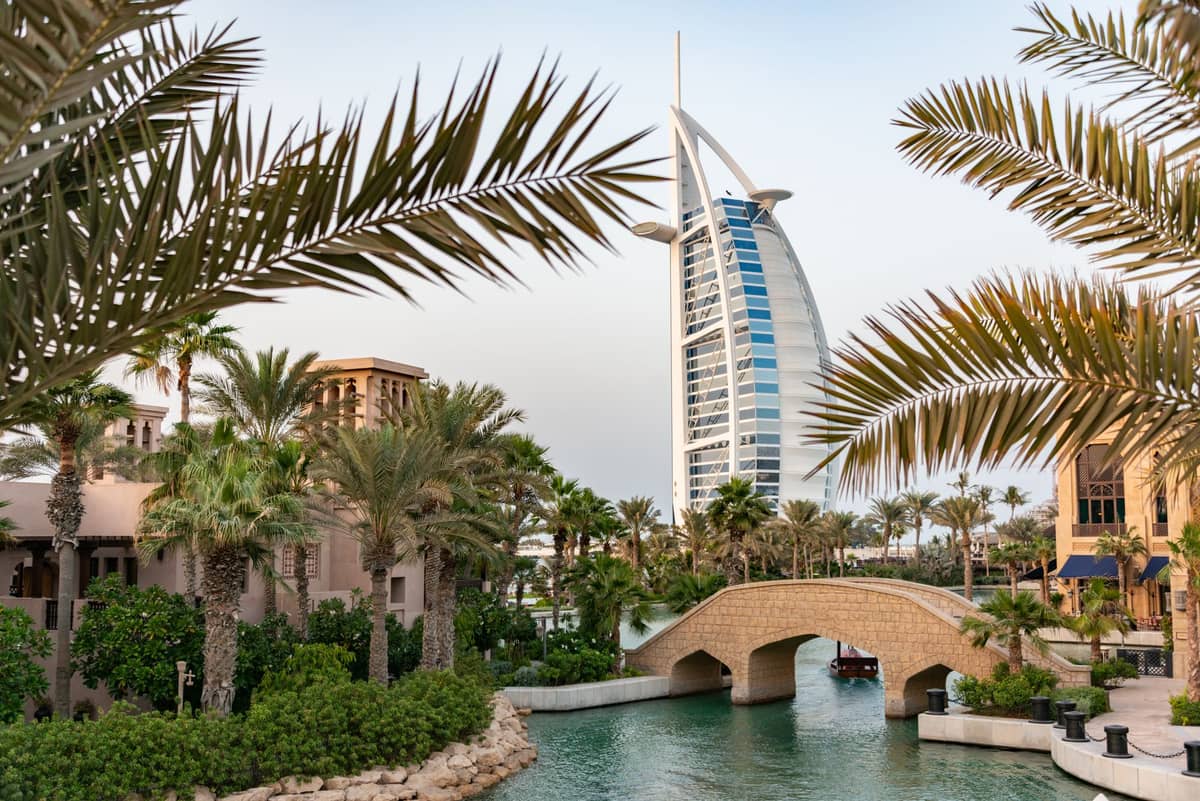
Overview
Jumeirah is where Dubai slows down. Spread across three sub-districts along the Arabian Gulf coast, it trades the tower blocks of Downtown and Dubai Marina for wide residential streets, white-sand beaches, and a pace that feels genuinely liveable rather than performative. This is the neighborhood that gave the world the Burj Al Arab's silhouette, yet much of its daily life plays out in beach cafes, neighborhood mosques, and family parks rather than luxury lobbies.
Orientation: Where Jumeirah Sits in Dubai
Jumeirah occupies a long coastal strip on the western side of Dubai, running roughly 10 kilometres along the Arabian Gulf shoreline. It is divided administratively into three zones: Jumeirah 1 to the northeast, closest to the older city; Jumeirah 2 in the middle; and Jumeirah 3 to the southwest, adjacent to Umm Suqeim. The neighbourhood sits between two very different worlds: to the north and east, the historic commercial districts of Bur Dubai and Al Satwa; to the south and west, the hotel corridor of Umm Suqeim and the developments farther along the coast.
The boundaries are fairly legible on a map. Sheikh Zayed Road (the main highway running parallel to the coast) forms the southeastern edge. The coastline itself is the northwestern boundary, while Umm Suqeim Road separates Jumeirah 3 from the districts beyond. Jumeirah Beach Road is the central artery threading through all three sub-districts, running the full length of the neighbourhood parallel to the sea.
Geographically, Jumeirah is close to more places than it might initially seem. Jumeirah 1 is roughly 4 kilometres from the historic waterfront at Dubai Creek and the old trading districts of Bur Dubai. Downtown Dubai and the Burj Khalifa are around 8 kilometres inland from the Jumeirah Beach Road. Dubai Marina and JBR sit approximately 15 kilometres to the southwest along the coast road.
Character and Atmosphere
Jumeirah's defining quality is its horizontality. While much of Dubai competes vertically, this neighbourhood stays low: villas behind garden walls, two-storey shopping strips, beach clubs spread across generous plots of sand. The scale is human in a way that very few parts of Dubai manage. Walking along Jumeirah Beach Road in the morning, you pass families jogging past bougainvillea-draped walls, Filipino domestic workers buying groceries at small supermarkets, and delivery drivers weaving between the parked SUVs that are an unavoidable constant here.
The morning hours are the neighbourhood's best. Between 6am and 9am, the beaches fill with swimmers and walkers before the Gulf sun turns brutal. The light at this time is soft and golden, the water genuinely inviting, and the beach promenades feel like a different city from the commercial Dubai of midday. By noon in summer, the streets are largely empty of pedestrians, and the heat between June and September makes walking anywhere without shade a serious undertaking. Jumeirah is a neighbourhood that largely retreats indoors from around noon to 4pm for much of the year.
By late afternoon, particularly from October through April, the district comes back to life. The beach clubs fill up again after 4pm. Jumeirah Beach Road sees steady traffic from families heading to the coast and diners heading to restaurants. After dark, the neighbourhood is calm rather than lively. There is no nightlife strip in the conventional sense. Restaurants stay busy until around 10 or 11pm, the beach remains accessible, and the residential streets are quiet. It feels like a wealthy suburb, because in large part that is exactly what it is.
ℹ️ Good to know
Jumeirah is primarily a residential district. Its population is a mix of Emirati families in older villa compounds, long-term Western expatriates, and Arab expats. The neighbourhood has genuine local character that coexists with its tourist infrastructure.
The atmosphere shifts noticeably between the three sub-districts. Jumeirah 1, nearest the city, is the most varied: it includes the La Mer beachfront development, Al Diyafah Street's restaurants, and blocks that transition between older Arabic commercial strips and newer brunch-and-fitness culture. Jumeirah 2 is the quietest, dominated by villas and relatively few tourist draws. Jumeirah 3, around Kite Beach and approaching Umm Suqeim, has the most outdoor-recreation energy, with watersports, beachside food trucks, and the approach road to the Burj Al Arab visible just beyond.
What to See and Do
The beach is the primary reason most visitors come to Jumeirah, and the district does not disappoint. Jumeirah Beach is one of the best-maintained public stretches of sand in Dubai: clean, well-lifeguarded, with changing facilities and reasonable parking. The public beach section in Jumeirah 1 is particularly accessible, drawing a genuinely mixed crowd of residents and tourists.
Kite Beach at the Jumeirah 3 end is worth the extra few kilometres. It is broader, has more food options along its stretch, and the view of the Burj Al Arab rising from its artificial island to the southwest is one of the most photographed angles in all of Dubai. On weekends, the beach fills with kite-surfers, stand-up paddleboarders, and beach volleyball players in a scene that feels genuinely recreational rather than staged for tourism.
The Jumeirah Mosque on Jumeirah Beach Road is one of the few mosques in Dubai that actively welcomes non-Muslim visitors. The Sheikh Mohammed Centre for Cultural Understanding runs guided tours most mornings, offering an opportunity to understand Islamic architecture and practice in a genuinely educational, non-commercial setting. The mosque's white stone facade and twin minarets are one of the neighbourhood's most recognisable images.
The Burj Al Arab technically sits in Umm Suqeim, just past the Jumeirah 3 boundary, but it is so visually and conceptually tied to this coastline that no guide to Jumeirah can ignore it. Non-guests cannot enter without a reservation for dining or afternoon tea, which comes at a significant premium. The best views are actually free: from Kite Beach or from the public walkway near the Jumeirah Beach Hotel, the sail-shaped structure is extraordinary against the Gulf water.
- Jumeirah Beach: public beach with full facilities in Jumeirah 1
- Kite Beach: outdoor recreation hub with views of the Burj Al Arab
- Jumeirah Mosque: open to non-Muslim visitors via guided tours
- J1 Beach: beachfront retail and dining development in Jumeirah 1
- Safa Park: large green park near the Sheikh Zayed Road boundary, popular with families
- Al Diyafah Street (2nd December Street): restaurant strip at the Jumeirah 1 / Satwa border
Safa Park sits at the inland edge of Jumeirah, bordering Sheikh Zayed Road. It is one of Dubai's older and more genuinely local parks: less manicured than some newer facilities, more lived-in, with football pitches, a boating lake, and large shaded areas that fill with families on Friday evenings. It is not a tourist attraction in the conventional sense, which is precisely what makes it interesting.
Eating and Drinking
Jumeirah's food scene reflects its demographics: a mix of Lebanese and Arabic restaurants serving the large Arab expatriate population, brunch-focused cafe culture catering to Western residents, and hotel dining at the upper end of the price spectrum. It is not particularly experimental or cutting-edge by Dubai standards, but it is consistent and the quality-to-price ratio in the mid-range is reasonable.
Al Diyafah Street in Jumeirah 1 is the neighbourhood's most approachable dining strip. It runs along the northern boundary near Al Satwa, and its restaurants operate late, serve large portions, and skew heavily toward Middle Eastern food: shawarma joints, Lebanese grill restaurants, Iranian bakeries selling fresh barbari bread. A full meal at one of the traditional Arabic restaurants here rarely exceeds 60 to 80 AED per person, making it one of the better-value options in an otherwise expensive neighbourhood.
Jumeirah Beach Road itself has a string of cafes and restaurants that cater more to the brunch crowd. Expect avocado toast, flat whites, and smoothie bowls alongside shakshuka and labneh. Prices here are higher than Al Diyafah Street, in line with the residential clientele who treat weekend brunch as a social institution. Several neighbourhood spots have built loyal followings over years, serving the villa community rather than relying on tourist footfall.
La Mer adds a more tourist-facing dimension, with a curated collection of casual restaurants, ice cream shops, and chain outlets in a beach-town aesthetic. It is pleasant enough but more expensive than it needs to be. The beach clubs scattered through the neighbourhood typically require a minimum spend for daytime access, which includes food and beverage credit, making them a practical if pricey option for a beach day with meals included.
💡 Local tip
For the most affordable and authentic meal in the neighbourhood, walk to Al Diyafah Street in the evening. The Lebanese and Iranian restaurants here are open until well past midnight, the food is excellent, and you will be eating alongside residents rather than tourists.
Alcohol is available at hotel bars and licensed restaurants within Jumeirah, but the neighbourhood has fewer standalone bar venues than Dubai Marina or DIFC. The Burj Al Arab adjacent properties and the larger beach hotels have proper bar setups, but if nightlife is a priority, Jumeirah is not the right base. The drinking culture here is quiet: a glass of wine with dinner rather than a late-night scene.
Getting There and Around
Jumeirah is one of Dubai's more challenging neighbourhoods to navigate without a car or taxi. The Dubai Metro Red Line does not have a station directly on Jumeirah Beach Road: the closest Red Line stations are Business Bay and World Trade Centre, both of which require a bus or taxi connection to reach the coast. This is a genuine practical limitation that affects how the neighbourhood functions for car-free visitors.
Several RTA bus routes connect Jumeirah to the wider city. Routes 8, 81, and 88 run along or near Jumeirah Beach Road, connecting points in Jumeirah to major transit hubs. Route F55A also serves the area. Bus travel works well for connections to those transit hubs, but the frequency varies and summer waits at exposed stops can be unpleasant.
The practical reality is that most visitors use taxis, Careem, or Uber to get around Jumeirah. From Downtown Dubai, a taxi to Jumeirah Beach Road typically takes 15 to 25 minutes depending on traffic. From Dubai Marina, the journey is usually a short ride. Taxis are plentiful and easy to hail, and ride-hailing apps work reliably throughout the neighbourhood. For those travelling from Dubai International Airport, the metro to World Trade Centre followed by a short taxi is a reasonable and affordable option. Check the getting around Dubai guide for full transit details across the city.
Within the neighbourhood itself, Jumeirah Beach Road is walkable in the cooler months between November and March. The stretch from La Mer down through Jumeirah 1 and 2 covers several kilometres, which is a comfortable morning walk with the Gulf to your right. Kite Beach adds another few kilometres to the south. In summer, walking any significant distance along exposed roads between roughly 10am and 5pm is not advisable, and virtually no residents do it.
⚠️ What to skip
Jumeirah has no Metro station within easy walking distance of the beach. Plan your journeys assuming you will need a taxi or ride-hailing app for the final leg, and budget accordingly. This is one reason the neighbourhood suits visitors with car access or a comfortable taxi budget better than those relying entirely on public transport.
Where to Stay
Jumeirah is not a neighbourhood with a dense hotel district, which is either a drawback or an advantage depending on what you want. The accommodation here is either at the high end, in large beachfront hotels, or in villa-style apartments and holiday rentals scattered through the residential streets. There is very little in between.
The beachfront hotels cluster around Jumeirah 1 and the Jumeirah 3 to Umm Suqeim boundary. Staying in one of these puts you directly on the water with full beach access, pools, and dining on-site. The trade-off is cost: room rates at the major properties here are among the higher end of the Dubai market, and you are somewhat removed from the walkable city if that matters to you.
Holiday apartments and short-term villa rentals have become increasingly popular in Jumeirah, particularly through platforms like Airbnb. These can offer significantly more space for families or groups at competitive rates compared to hotels, while giving you a genuine sense of the residential neighbourhood rather than the hotel bubble. For context on how Jumeirah compares with other areas for accommodation, the where to stay in Dubai guide covers the full spectrum of neighbourhoods and price points.
Jumeirah suits travellers who want beach access as a priority, who prefer a quieter residential atmosphere to the density of Downtown or Dubai Marina, and who are comfortable relying on taxis for most journeys. Families, couples on a relaxed itinerary, and longer-stay visitors who want to feel rooted in a neighbourhood rather than passing through tend to find it appealing. Solo budget travellers and those who want walkable access to nightlife will likely find it too spread out and too quiet.
ℹ️ Good to know
Dubai operates on Gulf Standard Time (GST), which is UTC+4 with no daylight saving adjustments. The UAE dirham (AED) is the currency; all prices here are in AED. The country dialling code is +971 and the local emergency number is 999.
Nearby Neighbourhoods and Day Trips
Jumeirah's position along the coast makes it a logical base for exploring the wider shoreline and nearby districts. The old city is closer than many visitors expect: the historic trading district of Deira and the heritage quarter of Al Fahidi Fort are reachable in under 30 minutes by taxi. In the other direction, Dubai Marina and the waterfront at Marina Walk are around 20 to 25 minutes by road, connecting the neighbourhood to a more animated evening scene if that is what you need.
For a full day out from Jumeirah, Downtown Dubai is the obvious choice: the Burj Khalifa, the Dubai Fountain, and the Dubai Mall are all within a single taxi ride. Alternatively, the desert is genuinely accessible: operators running Dubai desert safaris pick up from Jumeirah hotels regularly, and the drive to the dune areas takes under an hour from the neighbourhood.
Practical Considerations
Jumeirah is a family-friendly district with no particular safety concerns. Dubai is a city with low crime and high police visibility, and Jumeirah is a well-serviced, fully lit residential and tourist area with no unusual risks at any hour. The standard Dubai rules for tourists apply throughout: modest dress is expected when away from beach areas, public displays of affection should be restrained, and alcohol is only available in licensed venues.
On the beach itself, swimwear is perfectly appropriate. Away from the sand and beach clubs, it is advisable to cover up when walking through residential streets or entering shops and restaurants. The what to wear in Dubai guide has specific guidance on navigating the dress code question across different contexts.
The best time to visit Jumeirah, as with Dubai broadly, is November through March when daytime temperatures are generally pleasant and outdoor time at the beach is comfortable. The best time to visit Dubai guide covers how the city's calendar, including events and pricing, shifts through the year.
TL;DR
- Jumeirah is Dubai's best coastal residential neighbourhood for those who want beach access, a lower-rise pace, and proximity to the city without the density of Downtown or Dubai Marina.
- The neighbourhood divides into three zones: Jumeirah 1 (closest to the old city, most accessible), Jumeirah 2 (quietest, most residential), and Jumeirah 3 (Kite Beach, most outdoor-recreation focused).
- Getting around requires a taxi or ride-hailing app as the Metro does not reach the beach; this is a practical disadvantage for car-free travellers on a tight budget.
- Food options range from affordable Lebanese and Iranian restaurants on Al Diyafah Street to pricier beach-club dining; hotel bars cover alcohol, but nightlife is limited.
- Best suited for: families, couples seeking a quieter base, beach-focused travellers, and longer-stay visitors who want a neighbourhood feel. Less suited to budget travellers or those prioritising nightlife and walkable Metro access.
Related Travel Guides
Related Travel Guides Jumeirah are coming soon.