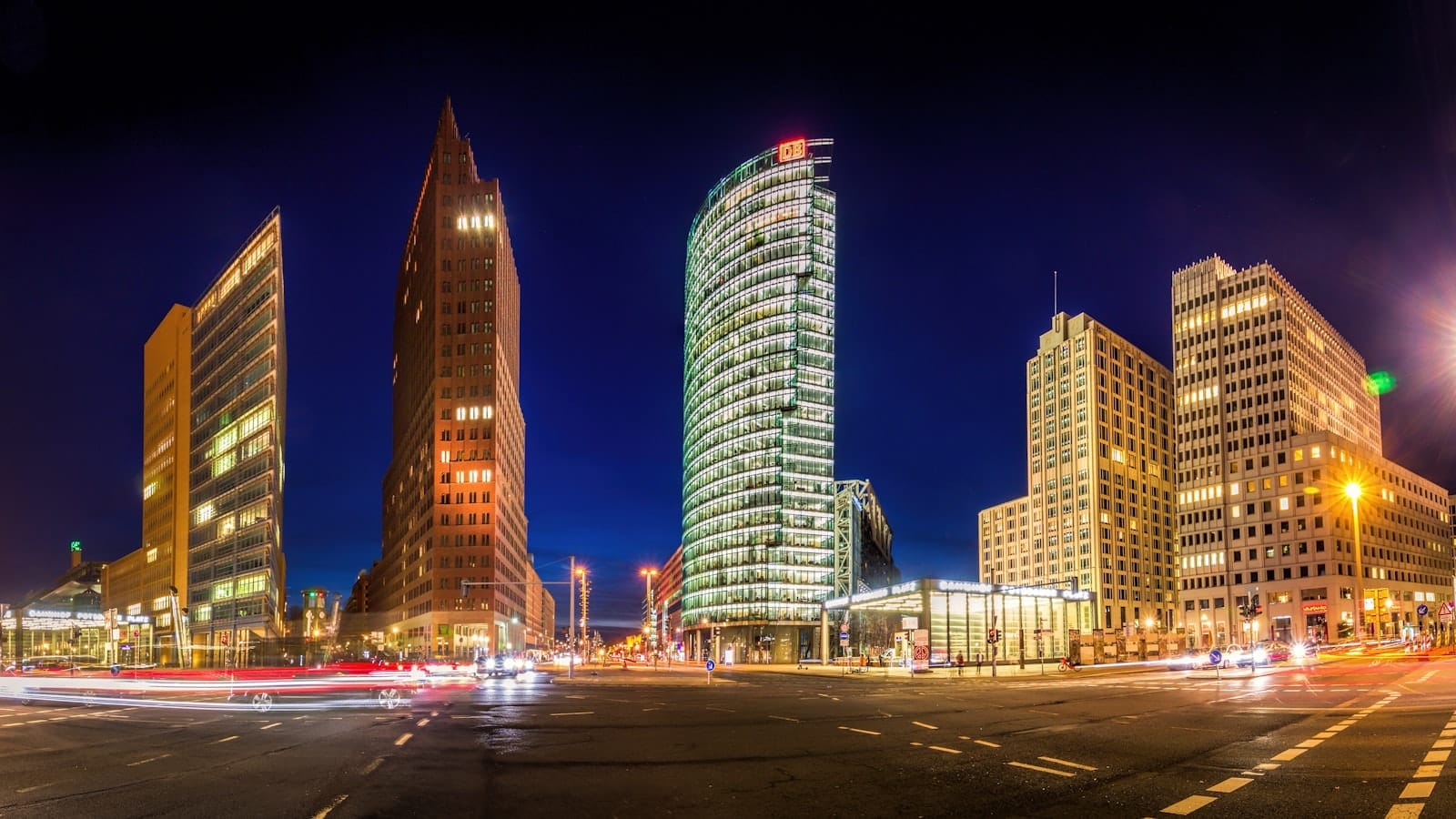
Potsdamer Platz sits at the heart of Berlin, where Cold War emptiness gave way to one of Europe's most ambitious urban redevelopment projects. Today it anchors a cluster of cinemas, world-class museums, high-rise offices, and shopping centers, all within walking distance of the Brandenburg Gate and Tiergarten.
Potsdamer Platz is Berlin's great reinvention story: a square that was once Europe's busiest traffic hub, then a barren strip of no-man's land divided by the Berlin Wall, and now a purpose-built modern quarter of glass towers, cultural institutions, and commercial energy. It is not a neighborhood in the traditional Berlin sense, with corner bars and leafy side streets, but it is one of the city's most historically loaded and logistically central places to base yourself or pass through.
Orientation
Potsdamer Platz sits roughly 1 kilometer south of the Brandenburg Gate, anchoring the southeastern edge of the Tiergarten and marking a kind of hinge point between several of Berlin's most important districts. To the north, Unter den Linden and the government quarter stretch toward the Reichstag. To the west, the Tiergarten park opens up into green space. To the south, the Kulturforum cultural campus and Schöneberg begin. To the east, the land slopes toward Checkpoint Charlie and Kreuzberg.
In strict geographic terms, Potsdamer Platz is the square itself and the adjacent Leipziger Platz, but the name is commonly applied to the entire redevelopment zone that grew up around them after German reunification. This wider area is defined by Potsdamer Straße to the west, Stresemannstraße to the east, the Tiergarten's southern tree line to the north, and the Kulturforum complex to the south. Marlene-Dietrich-Platz, in front of the Berlinale Palast, is another defining public space within this cluster.
The area sits administratively within the Mitte district, which also encompasses Museum Island, Alexanderplatz, and most of Berlin's historic core. Travelers already exploring Mitte will find Potsdamer Platz a natural extension, though the atmosphere here is distinctly different from the baroque grandeur further east: this is post-reunification Berlin, built from scratch in the 1990s and early 2000s.
Character & Atmosphere
At 8am on a weekday, Potsdamer Platz is pure commuter transit. Workers stream out of the S+U-Bahn station exits with coffees in hand, office towers cast long morning shadows across the plaza, and the Deutsche Bahn headquarters complex is already humming. The glass canopy of the Sony Center reflects thin early light, and the few tourists who are already here look slightly lost among the purposeful foot traffic.
By midday, the character shifts. The Playce shopping center and the surrounding restaurant terraces fill with office workers on lunch breaks, tour groups cluster near the preserved sections of the Berlin Wall embedded in the pavement, and the Panorama Punkt observation elevator at the Kollhoff Tower begins drawing a steady line. The light in summer is strong and direct here, with few of the lime tree canopies that shade Unter den Linden, so the plaza can feel exposed and a little stark on hot afternoons.
Evenings bring a different crowd. The Sony Center's inner courtyard, covered by its famous oval steel-and-glass roof, becomes a social gathering point. The cinemas there and at the CinemaxX draw evening audiences, restaurants on Marlene-Dietrich-Platz fill up, and the area takes on a more relaxed pace. During the Berlin International Film Festival, held here each February, the entire zone transforms: red carpets, searchlights, and crowds in formal wear make it one of the most dramatic public spectacles the city offers.
ℹ️ Good to know
Potsdamer Platz is not a typical Berlin Kiez. There are no corner bakeries, no Spätis with plastic garden chairs, no decades-old regulars propping up bar stools. It is a planned commercial and cultural district that feels distinctly unlike Prenzlauer Berg or Kreuzberg. Knowing this before you arrive means you'll appreciate what it actually offers rather than feel disappointed by what it doesn't.
History: From Crossroads to Wasteland to Skyline
For anyone trying to understand Berlin, Potsdamer Platz is an essential stop. In the 1920s this was reportedly one of the busiest traffic intersections in all of Europe. The square was ringed with department stores, hotels, and entertainment venues, and the city's first traffic light was installed here in 1924. It was the commercial and social beating heart of Weimar-era Berlin.
The war erased most of it. Allied bombing and the final battle of Berlin reduced the area to rubble. Then the Wall turned the ruins into a border zone: a no-man's-land of weeds, guard towers, and death strips that sat virtually untouched for almost three decades. After reunification in 1990, Potsdamer Platz became the world's largest construction site, with Renzo Piano, Helmut Jahn, and Hans Kollhoff among the architects commissioned to rebuild it. The result is a coherent if somewhat corporate modern district. Fragments of the Berlin Wall remain embedded in the pavement as markers, and a small preserved section stands near the Weinhaus Huth, one of the few original buildings to survive. For the full story of how the Wall shaped this space, the Berlin Wall guide covers the broader context across the city.
The Cold War history is also palpable at the adjacent Topography of Terror, a free outdoor and indoor documentation center just a short walk east along Niederkirchnerstraße. Built on the site of the former SS and Gestapo headquarters, it is one of the most important historical sites in the entire city and should not be skipped if you are spending time in this part of Berlin.
What to See & Do
The Sony Center is the architectural centerpiece of the area. Designed by Helmut Jahn and completed in 2000, its inner atrium is covered by a tensile roof structure that recalls a circus tent crossed with a spacecraft. The space is open to the public and free to walk through at any hour. The surrounding buildings house cinemas, restaurants, the Museum für Film und Fernsehen, and the LEGOLAND Discovery Centre Berlin. The atrium itself is one of the more successful public spaces in modern Berlin, with enough visual drama to hold attention.
For a view over the city, the Panorama Punkt at the top of the Kollhoff Tower offers one of the fastest elevator rides in Europe and a panoramic platform that sweeps across the Tiergarten, the Reichstag, the TV Tower to the east, and the Schöneberg rooftops to the south. It is a legitimate alternative to the better-known TV Tower observation deck and is far less crowded.
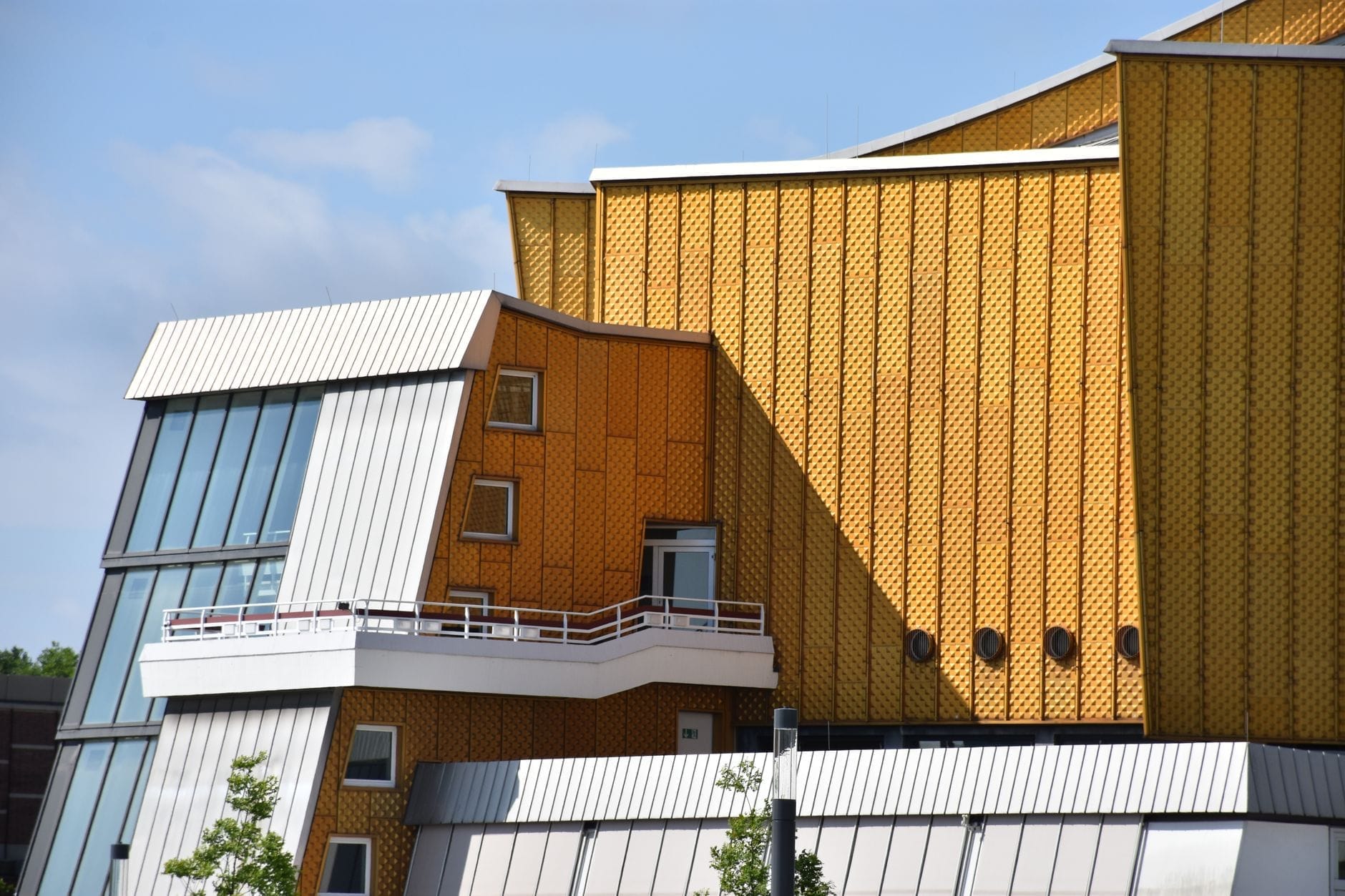
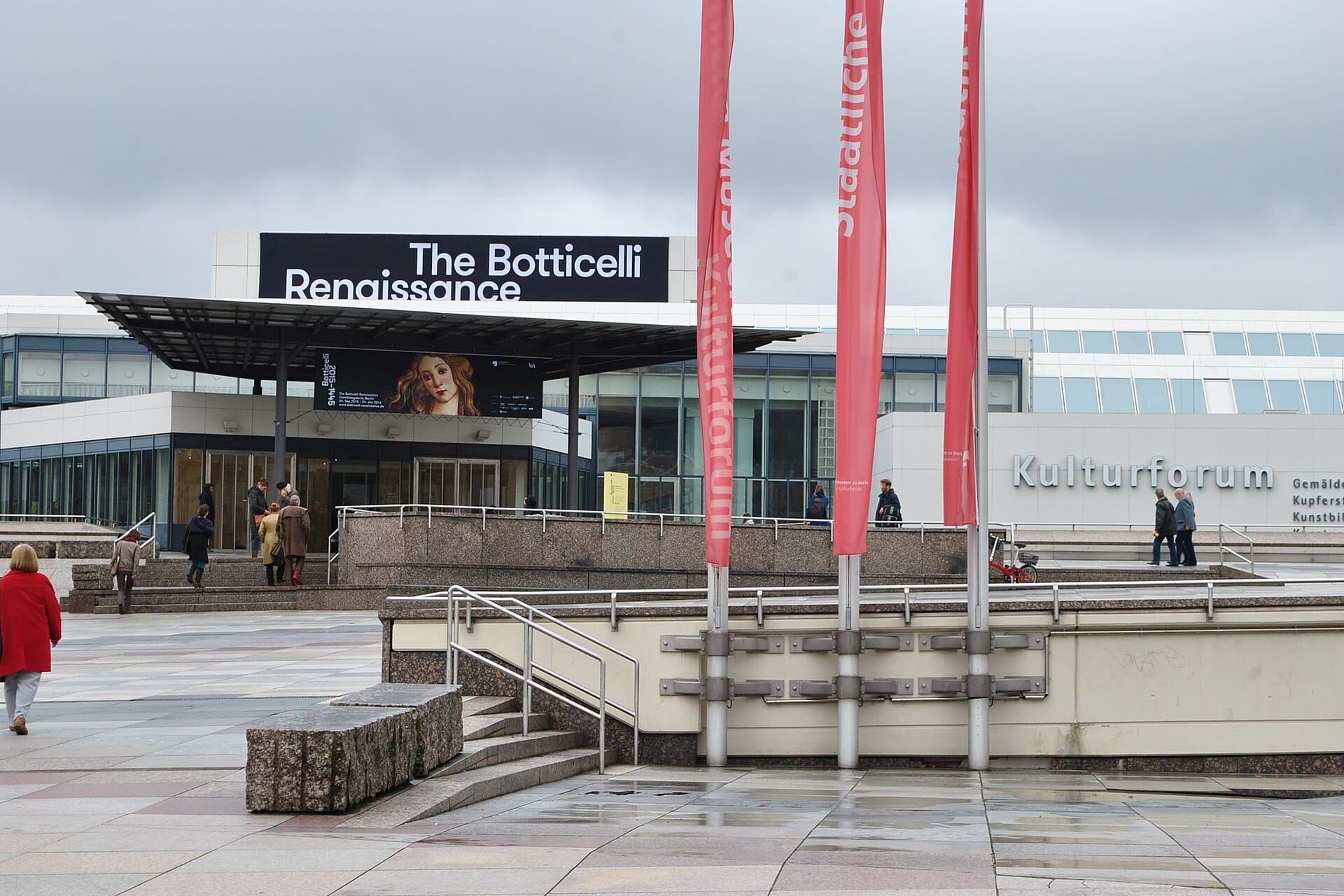
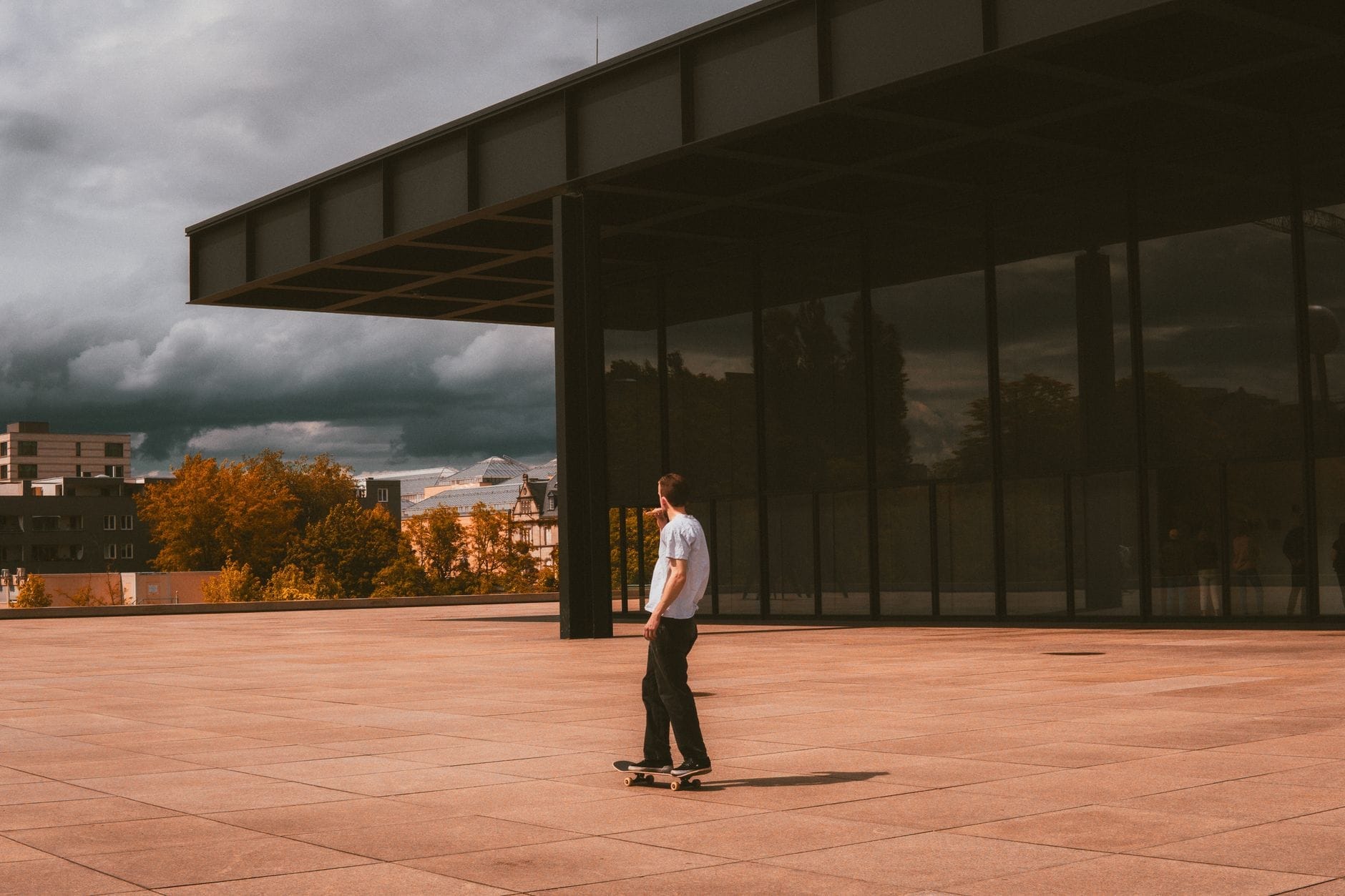
The Kulturforum, immediately southwest of the main plaza, is where the serious cultural weight sits. This campus of interconnected institutions includes the Gemäldegalerie, home to one of Europe's finest collections of Old Masters, and the Neue Nationalgalerie, Mies van der Rohe's glass-box masterpiece housing 20th-century art. The Berliner Philharmonie sits at the northern edge of this cluster: Hans Scharoun's vineyard-style concert hall is both architecturally significant and one of the best places in Europe to hear orchestral music. Even if you are not attending a concert, it is worth examining the building from the outside.
Sony Center atrium: free entry, 24 hours, photogenic at night
Panorama Punkt on the Kollhoff Tower: paid admission, verify current opening hours before visiting
Film Museum Berlin: inside the Sony Center, covers German film history from silent era to present
Preserved Berlin Wall segments near the Weinhaus Huth: free, outdoor
Gemäldegalerie: one of the world's great painting collections, often overlooked in favor of Museum Island
Neue Nationalgalerie: Mies van der Rohe building, 20th-century European art
Berliner Philharmonie: architecture and world-class concerts
Topography of Terror: free documentation center on Niederkirchnerstraße, essential for understanding this area's history
💡 Local tip
The Kulturforum museums are undervisited compared to Museum Island and offer a much more relaxed viewing experience. The Gemäldegalerie in particular can feel almost private on a weekday morning, which is extraordinary given the quality of its Rembrandt, Vermeer, and Caravaggio holdings.
Eating & Drinking
Potsdamer Platz is not where locals go for a quiet dinner. The restaurant landscape here is dominated by chains, hotel restaurants, and terrace venues aimed primarily at tourists and office workers. Prices tend to run higher than in Kreuzberg or Neukölln, and the atmosphere is more corporate than convivial. That said, there are enough options across price ranges to eat well without traveling far.
The Playce mall and the Sony Center both contain a range of cafés and fast-casual dining options. For something slightly more considered, the restaurants around Marlene-Dietrich-Platz have outdoor seating that works well in summer. Hotel restaurants attached to the Ritz-Carlton and Hyatt Regency, both of which face the Tiergarten side of the square, offer polished European cooking at significant cost.
For a better food experience, the surrounding area rewards a short walk. The wider Berlin food scene begins to open up as you move south into Schöneberg along Potsdamer Straße, where independent restaurants, wine bars, and galleries have clustered over the past decade. Walking 15 minutes east brings you into Kreuzberg, which has a far denser and more interesting eating and drinking landscape at lower prices.
⚠️ What to skip
Avoid the sit-down tourist restaurants immediately adjacent to the main square without checking reviews first. Overpriced pasta and mediocre schnitzel have a strong presence here, particularly on the ground floors of the Sony Center facing the street. The terrace seating can be pleasant, but the value often does not match the setting.
Getting There & Around
Potsdamer Platz has one of the best transit connections of any point in the city. The S+U Potsdamer Platz station sits directly beneath the square and is served by S-Bahn lines S1, S2, S25, and S26 (running through the North-South tunnel), as well as U-Bahn line U2. Regional trains FEX and RE20 also stop at Berlin Potsdamer Platz station, making it a direct connection point for travelers arriving from other German cities or from Berlin Brandenburg Airport (BER).
Bus lines M41, 200, 300, M48, M85, and night bus N2 also serve the area, with stops on Potsdamer Straße and Leipziger Straße. The 200 bus is particularly useful: it runs through the Tiergarten and connects directly to the Zoo station in Charlottenburg to the west. For a practical overview of how to use Berlin's BVG and S-Bahn network, the getting around Berlin guide covers tickets, zones, and transit apps.
On foot, Potsdamer Platz is within comfortable walking distance of several key destinations: roughly 10 minutes north to the Brandenburg Gate and Holocaust Memorial, 5 minutes east to the Topography of Terror, 15 minutes east to Checkpoint Charlie, and 10 minutes west into the Tiergarten park. Walking between these points is not just practical but worthwhile: the street-level transitions between different eras of Berlin architecture tell a coherent story.
The Holocaust Memorial is a 10-minute walk north and can be combined easily with a visit to Potsdamer Platz in the same half-day. Similarly, the Tiergarten park is immediately accessible on foot from the square's west side, offering a complete change of pace and atmosphere.
Where to Stay
Potsdamer Platz is one of the better choices in Berlin for travelers who prioritize transit access and central location over neighborhood character. The area has a concentration of four and five-star hotels that are easier to find here than in residential districts like Prenzlauer Berg or Neukölln. The Ritz-Carlton Berlin faces the square directly, with views toward the Tiergarten. The Grand Hyatt sits steps from the Sony Center. Slightly lower price points are available in surrounding streets and within the adjacent Kulturforum area.
The trade-off is that this is not a neighborhood with a street life that rewards aimless wandering late at night. Once the restaurants and cinemas close, the plaza quiets quickly. Travelers who want immediate access to Berlin's nightlife scene are better placed in Friedrichshain or Kreuzberg. But for families, business travelers, or those focusing on major cultural institutions and historical sites, Potsdamer Platz offers unmatched transit connections and a very manageable walking range to the Brandenburg Gate, Kulturforum, Tiergarten, and the main Mitte landmarks. For a full accommodation overview, the where to stay in Berlin guide compares all major neighborhoods.
💡 Local tip
Hotels here often price competitively outside summer and the Berlinale film festival period in February. If you are visiting in late autumn or winter, room rates at upmarket hotels can drop significantly compared to Mitte or Charlottenburg equivalents.
TL;DR
Potsdamer Platz is Berlin's most dramatic urban reinvention: rebuilt from Cold War rubble into a modern commercial and cultural district with direct historical layers you can read at street level.
Best for: travelers who want excellent transit connections, easy walking access to major sites, and proximity to the Kulturforum museums, without needing a residential neighborhood atmosphere.
The Kulturforum institutions (Gemäldegalerie, Neue Nationalgalerie, Berliner Philharmonie) are world-class and consistently less crowded than Museum Island equivalents.
Not ideal for: travelers seeking classic Berlin Kiez atmosphere, affordable casual dining, or proximity to nightlife. Kreuzberg and Friedrichshain serve those needs far better.
Transit is excellent: S-Bahn, U-Bahn, regional rail, and multiple bus lines all converge here, making it a viable base for day trips and connections across the wider city.
Three days in Berlin is enough to cover the essential history, art, and culture of Germany's capital, but only if you plan smartly. This day-by-day itinerary groups attractions by location, cuts the tourist traps, and gives you the practical details to make every hour count.
Berlin runs 80 to 100+ Christmas markets each season, spread across dozens of neighbourhoods with wildly different characters. This guide covers the best markets, when to go, what things cost, how to get around, and what to skip.
Berlin's flea markets are a city institution, drawing locals and visitors every Sunday to browse vintage clothing, vinyl records, GDR curiosities, and handmade goods. This guide covers the best markets across the city, from the massive and famous to the small and locals-only.
Berlin's food scene is unlike anywhere else in Germany. It mixes post-war street food traditions with Turkish culinary heritage, international market culture, and a thriving modern restaurant scene. This guide covers what to eat, where to find it, and how much to pay.
Summer in Berlin runs from June through August and offers long daylight hours, warm temperatures, open-air events, and easy access to lakes and river cruises. This guide covers what the weather is actually like, the best outdoor activities, where locals spend their time, and what to pack.
Berlin in winter is colder, darker, and quieter than summer — but that's exactly what makes it compelling. From Advent Christmas markets to uncrowded museum halls and budget-friendly hotels, this guide covers what to expect, what to skip, and how to make the most of the season.
Berlin is surrounded by dozens of swimmable lakes, many reachable by S-Bahn in under 30 minutes. This guide covers the best spots for a beach day, a forest swim, or a full lake day trip, from classic lidos to quieter shores.
Berlin has one of the world's most established and expansive queer scenes, rooted in over a century of LGBTQ+ history. This guide covers the best neighborhoods, bars, clubs, cultural institutions, Pride events, and practical tips for LGBTQ+ travelers visiting Berlin.
Berlin holds more memorials per square kilometer than almost any city on earth. This guide covers the essential sites across the city, from Nazi-era documentation centers to Cold War border crossings, with practical advice on making the most of each visit.
Berlin's after-dark scene is unlike anywhere else in the world. This guide covers the top clubs, bar districts, door policy realities, seasonal shifts, and practical logistics so you spend less time queuing and more time on the dancefloor.
Berlin remains one of Europe's more affordable capitals, but prices have risen. This guide breaks down realistic daily budgets, the cheapest ways to get around, free and low-cost attractions, and where to eat well without spending much — all updated for 2026.
The Reichstag Dome is one of Berlin's most iconic experiences, and entry is completely free. But you cannot simply walk up and go in. This guide covers the registration process, opening hours, seasonal closures, guided tour options, and the best times to visit, so you arrive prepared and don't waste a trip.
Berlin is one of Europe's most visited cities, and for most travelers it is perfectly safe. But petty theft, transit scams, and a few recurring tourist traps are real. This guide covers what the risks actually look like, where they are concentrated, and exactly how to avoid them.
Berlin is one of the world's great open-air galleries, with significant clusters of murals and graffiti across Friedrichshain, Kreuzberg, Mitte, and beyond. This guide covers the best locations, iconic individual pieces, the URBAN NATION museum, Teufelsberg, and everything you need to plan a serious street art itinerary.
The Berlin to Prague train is one of Europe's most rewarding rail journeys: direct EuroCity service, around 4 hours, and fares starting from €25 if you book ahead. This guide covers schedules, prices, booking platforms, seat reservations, and what to expect on board.
Berlin rewards those who go high. Whether you climb a Cold War listening station, ride a lift to 203 meters, or sip a drink on a rooftop above the Ku'damm, the city looks extraordinary from above. This guide covers the best viewpoints and rooftop bars in Berlin, with practical advice on tickets, timing, and what to expect.
Berlin is one of the world's great walking cities, where every street corner carries a layer of history. This guide covers the top attractions to include on guided tours and self-guided walks, from the monumental boulevards of Mitte to the Wall memorials of Friedrichshain.
The Berlin Wall divided a city and defined an era. This guide covers every major surviving site, the history you need to understand what you're looking at, practical visitor information, and honest advice on how to make the most of your time.
The Berlin WelcomeCard promises unlimited public transport and discounts at 170+ attractions. But it only makes financial sense for certain types of visitors. This guide breaks down both versions, the real math behind the savings, and who should skip it entirely.
Berlin is one of Europe's most family-friendly cities, with world-class museums, vast parks, excellent public transport, and enough hands-on attractions to keep children genuinely engaged. This guide covers the best activities, practical logistics, and honest advice for travelling to Berlin with kids.
Berlin has around 175 museums, from ancient civilizations on Museum Island to Cold War surveillance headquarters in Friedrichshain. This guide cuts through the noise and picks the museums worth your time, organized by theme so you can plan your days efficiently.
Berlin rewards visitors in every season, but not equally. This guide breaks down what to expect month by month, from summer festival heat to winter market charm, so you can choose the trip that actually matches your priorities.
Berlin preserves more Cold War history than almost any city on earth. This guide covers the essential sites, from the Berlin Wall Memorial to the Stasi prison in Hohenschönhausen, with honest assessments of what's worth your time and what's overrated.
Berlin's position at the heart of northern Germany makes it one of Europe's best bases for day trips. Within an hour by train you can reach a Rococo palace, a former concentration camp, a vast lake, or a Cold War spy station. This guide covers the best excursions from the city, with practical travel advice for each.
Berlin is one of Europe's most rewarding cities for budget travelers. From world-class memorials and open-air galleries to vast parks and free museums, here are 20 genuinely free experiences that showcase the best of the German capital.
Berlin has one of Europe's most comprehensive public transport networks, but it comes with its own rules, zones, and quirks. This guide covers everything from ticket prices and fare zones to night buses, cycling, and getting in from the airport — so you spend less time figuring out logistics and more time actually exploring the city.
Museum Island is one of Europe's great cultural concentrations: five world-class museums on a sliver of land in the heart of Berlin, all within a UNESCO World Heritage Site. This guide covers every practical detail you need to make the most of a visit, from tickets and timing to which collections are worth your time.
Berlin rewards curious travelers with an extraordinary range of experiences, from free Cold War memorials and five-museum island complexes to legendary nightlife and Sunday flea markets. This guide cuts through the noise with specific prices, honest assessments, and practical logistics to help you plan the city your way.
Berlin's food scene runs deeper than döner kebab and currywurst. This guide covers where to eat in Berlin across every budget and neighborhood, from legendary street food institutions to world-ranked fine dining, with practical advice on reservations, prices, and what to skip.
Choosing where to stay in Berlin shapes your entire trip. This guide breaks down the city's main neighborhoods by traveler type, budget, and priorities, so you can find the right base without second-guessing your booking.