Brandenburg Gate: Berlin's Most Recognizable Monument
The Brandenburg Gate stands at the heart of Berlin as both a Neoclassical architectural landmark and a symbol of the city's turbulent modern history. Free to visit at any hour, it rewards early risers with quiet grandeur and rewards night visitors with dramatic floodlighting. Here is everything you need to make the most of your visit.
Quick Facts
- Location
- Pariser Platz 1, 10117 Berlin (Mitte district)
- Getting There
- S+U Brandenburger Tor (S1, S2, S25, S26, U5); Bus 100, M41 (Reichstag/Bundestag stop), 300 (Behrenstr./Wilhelmstr.)
- Time Needed
- 30–60 minutes at the gate; allow 2–3 hours if combining with Unter den Linden and Tiergarten
- Cost
- Free — no ticket required
- Best for
- History lovers, architecture enthusiasts, first-time Berlin visitors
What the Brandenburg Gate Actually Is
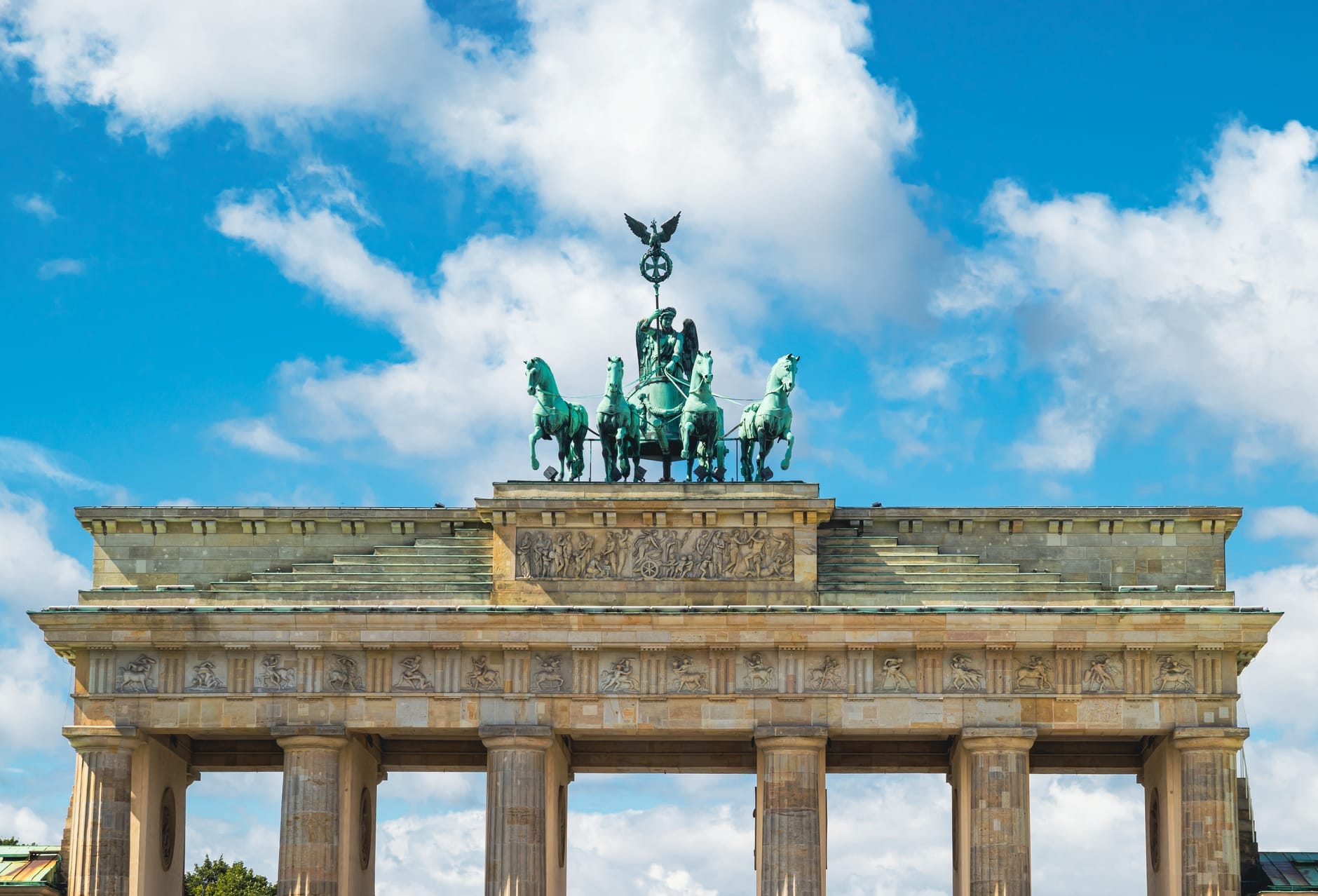
The Brandenburg Gate (Brandenburger Tor) is a Neoclassical triumphal arch built between 1788 and 1791, designed by Prussian architect Carl Gotthard Langhans. At approximately 26 metres tall, 62.5 metres wide, and 11 metres deep, with 12 Doric columns forming five passageways, it is the only surviving city gate of Berlin's 18th-century fortifications. It stands on Pariser Platz at the western terminus of Unter den Linden boulevard, at the edge of the Tiergarten park.
Langhans drew directly from the Propylaea, the gateway to the Acropolis in Athens, making the gate one of Germany's earliest examples of Greek Revival architecture. Crowning the structure is the Quadriga, a bronze chariot drawn by four horses and guided by Victoria, the Roman goddess of victory. The sculpture has its own complicated history: Napoleon had the Quadriga removed to Paris in 1806 after defeating Prussia, and it was only returned to Berlin in 1814 after his defeat.
ℹ️ Good to know
The Brandenburg Gate is an outdoor monument with no closing time and no admission fee. You can walk through it at 3 a.m. or 3 p.m. — it is always open and always free.
The Gate's Role in German History
Few structures in the world carry as much compressed historical meaning as this one. For most of the Cold War, the Brandenburg Gate stood in the no-man's land at the border between East and West Berlin, inaccessible to citizens on either side. It became the involuntary backdrop for one of the defining political speeches of the 20th century when U.S. President Ronald Reagan stood at the Western side in June 1987 and called on Soviet leader Mikhail Gorbachev to tear down the Berlin Wall.
On 22 December 1989, weeks after the Wall fell, the gate was reopened as a crossing point. The images of crowds streaming through its five passageways became a defining visual record of German reunification. Today the gate functions as the ceremonial centrepiece of unified Berlin, used for state events, New Year's Eve celebrations, and major public gatherings.
Understanding this history gives the visit real weight. For a deeper look at the broader narrative of division and reunification, the Berlin Wall guide covers the full geography of the former barrier, while the Cold War Berlin guide puts the gate's decades of closure into political context.
Tickets & tours
Hand-picked options from our booking partner. Prices are indicative; availability and final rates are confirmed when you complete your booking.
Self-guided digital scavenger hunt in Neubrandenburg
From 13 €Instant confirmationPrivate Bike Tour from Berlin Zoo to Alexanderplatz
From 35 €Instant confirmationFree cancellationBerlin Wall walking tour from Checkpoint Charlie to Brandenburg Gate
From 20 €Instant confirmationFree cancellationSkip-the-line ticket for Gemaldegalerie Berlin
From 14 €Instant confirmation
How the Experience Changes by Time of Day
The Brandenburg Gate is one of Berlin's most photographed sites, and the time of day you visit will determine whether your experience is contemplative or chaotic. Crowd levels fluctuate significantly, and the quality of light shifts the entire atmosphere.
Early Morning (7–9 a.m.)
This is the best window for a quiet visit. Pariser Platz is nearly empty, the tour buses have not yet arrived, and the pale morning light falls directly on the gate's eastern face. The Quadriga is sharp against a pale sky. You can stand directly beneath the columns and hear nothing but pigeons and the distant hum of early commuter traffic on Ebertstraße. This is the time for photographs without strangers in the frame and for actually reading the stone without being jostled.
Midday and Afternoon (10 a.m.–6 p.m.)
Expect crowds. Tour groups converge on Pariser Platz from mid-morning onward, and by midday the square can feel uncomfortably packed in summer. Street performers, bicycle taxi drivers, and souvenir sellers occupy the perimeter. The gate itself is still accessible and free to walk through, but the atmosphere is closer to a transit hub than a monument. If this is the only time you can visit, focus on the architectural details at close range rather than trying to get a crowd-free photo.
Evening and Night (After 8 p.m.)
After sunset, the gate is floodlit in warm amber tones and Pariser Platz quiets down noticeably. The Quadriga glows against a dark sky. Couples and late-evening walkers replace the tour groups. This is the second-best time to visit, and the floodlit composition photographs differently from the daytime structure — the columns cast deep shadows and the bronze chariot catches the light in a way that daylight photographs rarely show.
💡 Local tip
Arrive before 8:30 a.m. on any day of the week for the best combination of soft light and thin crowds. On summer weekends, by 9:30 a.m. the square is already busy with visitors.
Getting There and Getting Around
The gate sits at the junction of several transit lines, making it one of the most accessible points in Berlin. The station S+U Brandenburger Tor serves the U5 underground line and the S-Bahn lines S1, S2, S25, and S26; from the station exit it is roughly a two to three minute walk to the gate itself. Bus lines 100 and M41 stop at Reichstag/Bundestag, a short walk north, and line 300 stops at Behrenstr./Wilhelmstr. to the southeast.
The gate is also well-positioned for walking tours. Unter den Linden runs directly east from the gate toward Museum Island, and Tiergarten park begins immediately to the west. A flat, walkable route connects the gate to the Reichstag Building to the north in under five minutes. The site is described as barrier-free by the city's official portal, meaning step-free access is available for wheelchair users.
If you are planning a day in this part of Mitte, the Berlin walking tours guide maps out several self-guided routes that start or finish at the gate.
What to Look At: Architectural Details Worth Noticing
Most visitors walk through the gate, take a photograph from the western side, and move on. That misses some of the most interesting details. Stand back far enough from the eastern face to see the full Quadriga — the sculpture is about 5 metres tall and sits on a 6-metre-high attic block, meaning it is easy to underestimate its scale from street level.
Look at the frieze panels between the outer columns on each face. They depict scenes from Greek mythology, specifically the labours of Hercules and a procession of the goddess of peace, Eirene. The Doric order Langhans used is deliberately austere: no base below the columns, minimal ornamentation, and a strong horizontal emphasis. Compared to the Baroque extravagance of many 18th-century European monuments, the gate reads as consciously restrained.
The central passageway is the widest of the five and was historically reserved for the Prussian royal family. The two outer passageways were for pedestrians, the next two for carriages. Today all five are open to walkers.
💡 Local tip
Walk through to the western (Tiergarten) side and turn around. The gate looks slightly different from the west, and you will have a cleaner photographic angle with fewer people in the frame during the middle of the day.
What Brandenburg Gate Is and Isn't
The Brandenburg Gate rewards visitors who arrive with historical context. On its own, as a piece of stone and bronze, it is an impressive but not enormous structure. Its power comes from what it represents: two centuries of Prussian, German, and European history condensed into a single address. Visitors who make a quick stop for a photograph and move on will leave underwhelmed. Visitors who spend time understanding its position at the fault line of the Cold War will leave with a different feeling entirely.
The surrounding area has depth worth exploring. The Holocaust Memorial is a five-minute walk to the south, the Reichstag Building is visible from the northern side of the square, and the Topography of Terror documentation centre is within walking distance to the southeast. Together, this cluster makes for one of the most historically concentrated half-days available in any European city.
Who should skip it: travelers with very limited time who have already seen extensive Cold War and WWII history sites may find the gate adds little beyond a photograph. Visitors seeking an interactive museum experience will find none here — the gate is a monument, not a gallery. There is no audio guide, no indoor exhibit, and no guided interpretation at the structure itself.
ℹ️ Good to know
The Berlin Tourist Information Centre at the Brandenburg Gate is a separate facility on Pariser Platz, open daily 10:00–18:00. It is useful for picking up transit maps, WelcomeCard information, and event listings.
Insider Tips
- The gate faces east-west, which means the eastern face is in morning shadow and the western face is backlit. For photographs of the Quadriga from below, the western (Tiergarten) side in late afternoon light gives the sharpest detail on the bronze horses.
- New Year's Eve at the Brandenburg Gate draws very large crowds for an outdoor concert and fireworks. If you are in Berlin over that period, expect street closures and dense crowds from the afternoon onward. It is spectacular but requires patience and early positioning.
- The square on the eastern side, Pariser Platz, was heavily damaged in World War II and rebuilt in the 1990s and 2000s. The embassies and hotel facades you see flanking the gate are recent reconstructions, not historic buildings — worth knowing before you spend time photographing them.
- Bus line 100 passes near the gate on a route that also serves the Reichstag, Tiergarten, the Victory Column, and Charlottenburg Palace. It functions as an informal sightseeing route at standard BVG fare, with no premium ticket required.
- If you visit in winter, fog occasionally settles over Pariser Platz in the early morning, which creates an atmospheric scene around the gate that almost no standard tourist photograph captures. Worth the early start between November and February.
Who Is Brandenburg Gate For?
- First-time visitors to Berlin who want to anchor their trip in the city's central landmark
- History and architecture enthusiasts interested in Neoclassical design and 20th-century political history
- Photographers looking for strong architectural subjects at different times of day and lighting conditions
- Travelers building a walking route through central Mitte connecting the Reichstag, Holocaust Memorial, and Unter den Linden
- Anyone visiting Berlin at New Year's Eve who wants to experience the city's main public celebration
Nearby Attractions
Other things to see while in Mitte:
- Alexanderplatz
Alexanderplatz sits at the geographical and historical heart of former East Berlin, a vast open square with roots going back to the 13th century. Today it's a free, always-open crossroads of transit, Cold War monuments, and everyday Berlin life — chaotic, fascinating, and impossible to avoid.
- Berlin Cathedral (Berliner Dom)
The Berlin Cathedral, or Berliner Dom, is Germany's largest Protestant church and one of the most architecturally striking buildings in the city. Built between 1894 and 1905, it anchors Museum Island with a dome you can climb, a royal crypt below ground, and a nave that rewards slow, unhurried attention.
- Berlin TV Tower (Fernsehturm)
Standing 368 metres above central Berlin, the Berliner Fernsehturm is the tallest structure in Germany and the tallest publicly accessible building in Europe. Its observation deck at 203 metres delivers an unobstructed 360-degree panorama of the city. This guide covers what you actually see up there, when crowds are worst, and whether the ticket price is justified.
- Berlin Victory Column (Siegessäule)
Rising from the centre of the Großer Stern roundabout in Tiergarten, the Siegessäule is one of Berlin's most recognisable monuments. At around 67 metres tall, it offers a sweeping panorama over the city's forest-park heart — but you earn the view with 285 steps and no lift.