Reichstag Building: Inside Berlin's Most Storied Parliament
The Reichstag Building is the seat of Germany's federal parliament and one of Berlin's most visited landmarks. Its glass dome, designed by Norman Foster, offers a 360-degree rooftop panorama that is completely free to visit — though advance registration is required. The building carries more than a century of turbulent history, from imperial grandeur to wartime ruin to postwar resurrection.
Quick Facts
- Location
- Platz der Republik 1, 10557 Berlin
- Getting There
- U-Bahn Bundestag (U5) — about 200 m; S+U Brandenburger Tor (U5 + S-Bahn) — about 400 m; Bus 100 and M41 nearby
- Time Needed
- 1.5 to 2.5 hours including queuing, dome walk, and roof terrace
- Cost
- Free — advance registration required via the Bundestag website or on-site service centre
- Best for
- Architecture lovers, history buffs, first-time Berlin visitors, panorama seekers
- Official website
- www.bundestag.de/en/visittheBundestag/dome/registration-245686
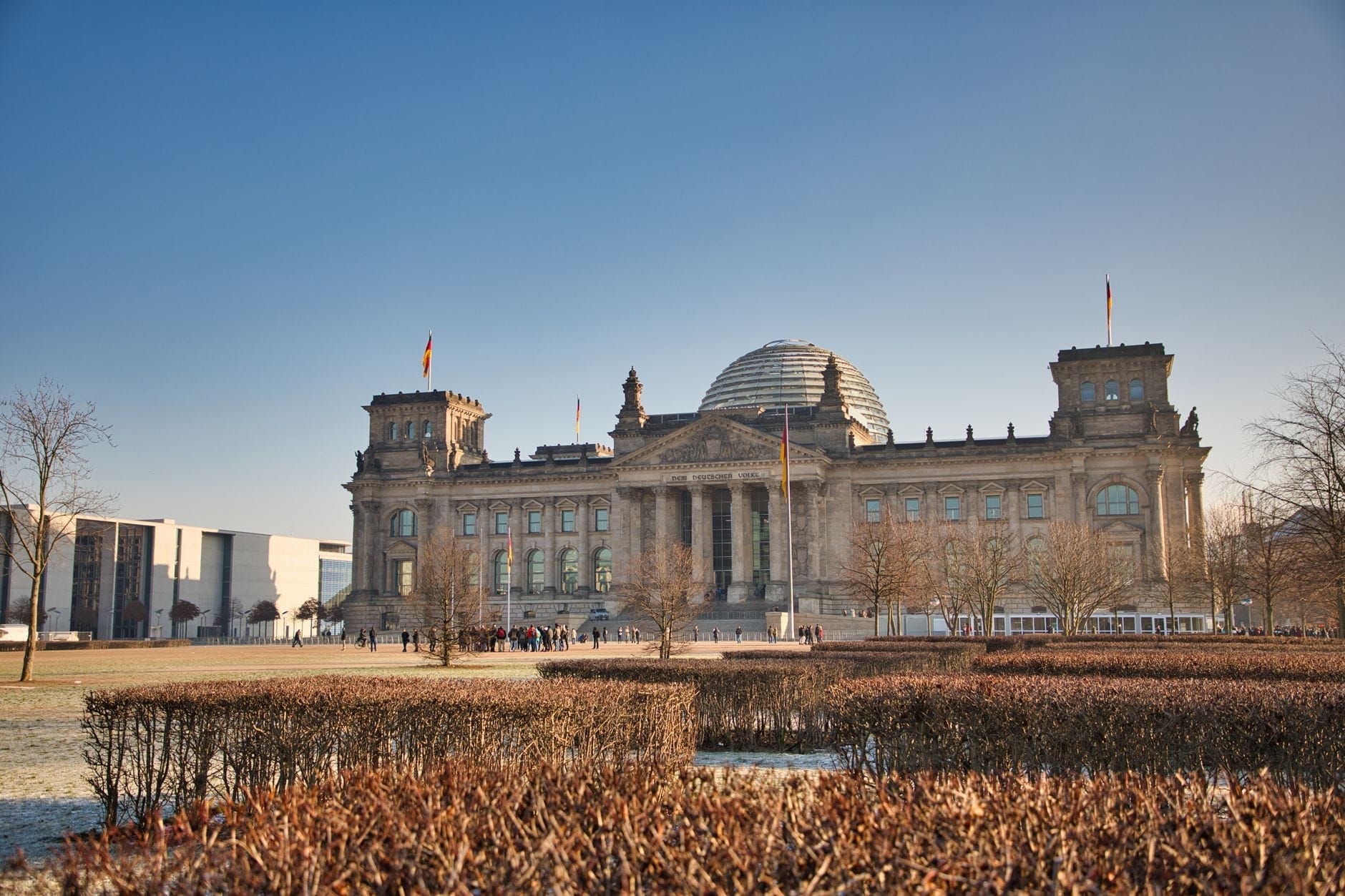
What the Reichstag Actually Is
The Reichstag Building is not a museum, not a monument, and not a photo backdrop — though it functions as all three in practice. It is a working parliament building, the seat of the German Bundestag, where Germany's 630 elected representatives meet and vote. This is a detail worth holding onto as you queue outside: the building beneath your feet is actively governing a country of 84 million people.
That said, the visitor experience is centred on the glass dome and roof terrace, which are opened to the public daily from 8:00 to midnight (last admission 22:00, with slots every 15 minutes). Admission is completely free. The building is closed all day on 24 December and from 16:00 on 31 December.
The Reichstag sits at the northern edge of the Tiergarten district, just west of Brandenburg Gate and a short walk from Berlin Hauptbahnhof. It anchors the western end of the government district — the broad lawns of the Platz der Republik stretch out in front of it, used regularly for outdoor events and, in summer, for picnics.
⚠️ What to skip
Advance registration is mandatory. Walk-ups without a booking are turned away at the entrance. Register free on the Bundestag website, or visit the on-site service centre about 150 metres from the building on Platz der Republik. Slots fill weeks in advance during peak summer months — book as early as possible.
A Building That Has Survived Everything
Construction began in 1884 under architect Paul Wallot, and the building was completed in 1894 in a neo-Renaissance style. Its inscription above the main portal — Dem Deutschen Volke, meaning 'To the German People' — was not actually added until 1916, years after the building opened, after a long political debate over whether the people deserved such a dedication.
The building served as the seat of the Imperial Diet from 1894 to 1933. On the night of 27 February 1933, a fire gutted the interior. The fire became a political turning point: it was used as a pretext by the Nazi government to suspend civil liberties. The question of who started the fire remains historically contested, though Dutch communist Marinus van der Lubbe was convicted at the time.
During World War II the building was badly damaged. Soviet soldiers famously raised a flag over the ruins in May 1945 — one of the defining images of the war's European end. Through the Cold War, the building sat in West Berlin, close to the Wall but effectively bypassed by both governments. The West German parliament sat in Bonn. The Reichstag was left partially restored but underused, occasionally hosting exhibitions.
After German reunification in 1990, the decision was made to return parliament to Berlin. British architect Norman Foster won the redesign commission, completing the renovation in 1999. His signature addition was the glass dome — a transparent inverted cone of steel and glass rising above the historic sandstone shell. The Bundestag moved back in on 19 April 1999. For more on the political history of the city's transformation, the German Historical Museum on Unter den Linden provides essential context.
Tickets & tours
Hand-picked options from our booking partner. Prices are indicative; availability and final rates are confirmed when you complete your booking.
Berlin and National Socialism: Berlin under Nazism
From 18 €Instant confirmationFree cancellationSkip-the-line ticket for Gemaldegalerie Berlin
From 14 €Instant confirmationPanoramapunkt Berlin ticket with skip-the-line option
From 9 €Instant confirmation1-Hour Berlin Spree River Cruise with On-Board Guide
From 21 €Instant confirmationFree cancellation
The Glass Dome: What You Actually See
The dome is 40 metres in diameter and rises 47 metres above street level. Inside, two intertwined ramps spiral upward in opposite directions, allowing a continuous flow of visitors without creating bottlenecks. The central cone is covered with 360 mirrored surfaces that direct natural light down into the plenary chamber below. Looking down through the glass floor at the centre of the dome, you can see the parliamentary chamber where legislation is debated — a deliberate design choice, symbolising citizens overseeing their government.
The audio guide, included with admission, triggers automatically as you move around the dome. It explains the view and the political geography below: the Chancellery to the northwest, the Tiergarten spreading south, and on clear days the entire sweep from the Teufelsberg hills in the west to the television tower at Alexanderplatz in the east.
From the roof terrace, the view west over Tiergarten park is particularly striking — a flat green lung in the middle of the city. The park's formal axis runs toward the Berlin Victory Column, visible as a golden glint in good weather.
How the Experience Changes by Time of Day
Morning slots (8:00 to 10:00) are the most practical for families and light-sensitive photographers. The crowds are thinner, the air is cooler, and the low angle of morning light hits the dome's mirrors at a shallow angle that produces interesting patterns on the floor. The city below is still waking up — less traffic noise drifts up, and the Platz der Republik is nearly empty.
Midday and afternoon (11:00 to 17:00) are the busiest periods. The dome fills with tour groups, the ramps feel narrower, and the audio guide competes with multilingual conversation. If your registration lands in this window, arrive a few minutes early and move at a steady pace rather than stopping repeatedly on the ramps — the flow works better that way.
Evening visits, particularly between 19:00 and 22:00, offer a different experience entirely. Berlin's summer twilight stretches past 21:00, and the sky shifts through shades of gold and deep blue while the city lights below come on gradually. The dome's glass captures this colour beautifully. In winter, darkness falls earlier, so even a 19:00 slot means a fully lit cityscape — the parliamentary district glowing beneath you, the Chancellery floodlit, the Brandenburg Gate lit up to the east.
💡 Local tip
For photography: evening slots in summer (20:00 to 22:00) give you the so-called 'blue hour' from the roof. Bring a compact tripod if you want sharp shots — camera shake is noticeable at the dome's curved glass. Smartphones perform well in the evening light here because the illuminated interior provides consistent ambient brightness.
Getting There and Arrival Logistics
The closest U-Bahn stop is Bundestag on the U5 line, a two-minute walk from the building's main entrance. Brandenburger Tor station (served by both the U5 and several S-Bahn lines) is a slightly longer walk but useful if you are combining the visit with nearby attractions. Bus lines 100 and M41 stop in the immediate area.
Security is taken seriously. Bags go through airport-style screening. Visitors arriving with large backpacks, luggage, or certain prohibited items (including sharp objects and liquids above standard limits) may be turned away or asked to leave items in a cloakroom. Arrive with a compact bag and leave wheeled suitcases at your accommodation.
The Bundestag's service centre on Platz der Republik, about 150 metres from the building's entrance, handles walk-in registrations if online slots are unavailable. Same-day availability is not guaranteed. The centre also provides accessible services for visitors with mobility needs — the dome route uses lifts and is navigable by wheelchair, though contacting the Bundestag's Visitors' Service in advance is recommended for detailed assistance arrangements.
Practical Considerations and What to Bring
The roof terrace is exposed. Wind is a constant companion even on warm days, and in winter it can be biting despite the dome's partial shelter. A jacket or wind layer is worth having regardless of the season. Rain does not cancel visits — the dome is enclosed — but wet weather softens the panoramic view significantly, particularly in the direction of Spandau and the western suburbs.
There is a small café on the roof terrace. The food is unremarkable and priced for a captive audience, but a coffee at the railing on a clear evening is not a bad way to spend twenty minutes. For a proper meal before or after, the streets around Unter den Linden and the government district have improved in recent years, though the area remains primarily institutional. Better dining options are a short U-Bahn ride toward Mitte or further into the city.
ℹ️ Good to know
The Reichstag is occasionally closed for parliamentary sessions or security events on short notice. Closures are posted on the Bundestag website. If your visit coincides with a major state occasion, check the schedule a day or two before. Your registration confirmation will note if a closure affects your slot.
Is the Reichstag Dome Worth the Effort?
For most first-time visitors to Berlin, yes. The registration requirement filters out casual walk-ups, which actually improves the experience — the dome rarely feels dangerously crowded. The panorama is legitimately useful for orienting yourself in the city, especially if you arrive early in your trip. The historical weight of the building is hard to manufacture, and standing in Norman Foster's dome above a functioning parliament while looking down at the chamber where laws are being made is a genuine experience, not a simulated one.
Repeat visitors who have already done the dome and primarily want to understand the political and social history of the German capital may find more intellectual value at the German Historical Museum or the Topography of Terror, both of which cover the Reichstag's turbulent history in greater depth. The building itself, as an interior experience, offers relatively little beyond the dome and the rooftop.
If panoramic views are your primary goal, Berlin has multiple options. The Berlin TV Tower at Alexanderplatz offers a higher vantage point without the registration requirement, though it charges admission. For a guide to comparing the city's rooftop options, see the Berlin viewpoints guide.
Insider Tips
- Register online the moment you decide to visit Berlin — popular summer evening slots disappear weeks ahead. Set a reminder and book on the same day you fix your travel dates.
- The audio guide activates automatically based on your position in the dome. Walking slowly means you hear more commentary per stop; moving quickly gets you to the top faster if you want to spend time on the open terrace rather than the enclosed ramp.
- The plenary chamber below the dome is visible through the glass floor at the dome's centre. If parliament is in session during your visit, you can watch the proceedings live — the Bundestag publishes session schedules on its website.
- Security queues at the entrance move faster if you remove your belt, laptop, and anything metal before reaching the scanner, just as you would at an airport. Groups that are unprepared add several minutes to the line for everyone behind them.
- If you miss your registration slot by more than 15 minutes, you may be turned away. Factor in transit delays and security time when planning your arrival — aim to be at the entrance 10 minutes before your slot.
Who Is Reichstag Building For?
- First-time visitors to Berlin who want to orient themselves with a panoramic overview of the city
- Architecture enthusiasts interested in how Norman Foster's modern glass dome integrates with Paul Wallot's 1894 neo-Renaissance exterior
- History-focused travellers tracing the arc of German history from the Imperial era through the Nazi period, the Cold War, and reunification
- Photographers looking for a sunset or blue-hour rooftop view that costs nothing beyond advance planning
- Families with older children who can handle the security process and appreciate the political context
Nearby Attractions
Other things to see while in Mitte:
- Alexanderplatz
Alexanderplatz sits at the geographical and historical heart of former East Berlin, a vast open square with roots going back to the 13th century. Today it's a free, always-open crossroads of transit, Cold War monuments, and everyday Berlin life — chaotic, fascinating, and impossible to avoid.
- Berlin Cathedral (Berliner Dom)
The Berlin Cathedral, or Berliner Dom, is Germany's largest Protestant church and one of the most architecturally striking buildings in the city. Built between 1894 and 1905, it anchors Museum Island with a dome you can climb, a royal crypt below ground, and a nave that rewards slow, unhurried attention.
- Berlin TV Tower (Fernsehturm)
Standing 368 metres above central Berlin, the Berliner Fernsehturm is the tallest structure in Germany and the tallest publicly accessible building in Europe. Its observation deck at 203 metres delivers an unobstructed 360-degree panorama of the city. This guide covers what you actually see up there, when crowds are worst, and whether the ticket price is justified.
- Berlin Victory Column (Siegessäule)
Rising from the centre of the Großer Stern roundabout in Tiergarten, the Siegessäule is one of Berlin's most recognisable monuments. At around 67 metres tall, it offers a sweeping panorama over the city's forest-park heart — but you earn the view with 285 steps and no lift.