Berlin Cathedral (Berliner Dom): What to Know Before You Visit
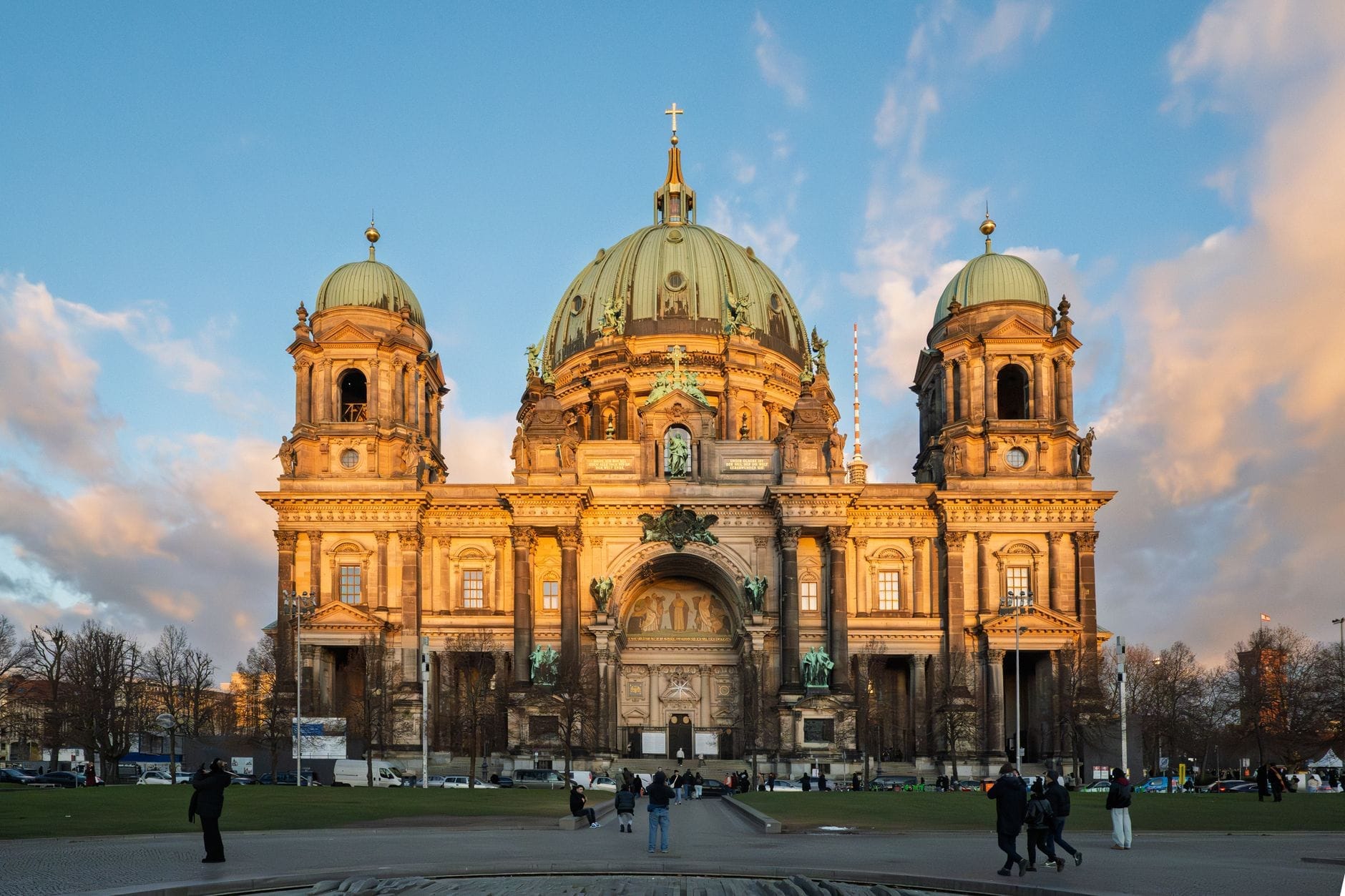
The Berlin Cathedral, or Berliner Dom, is Germany's largest Protestant church and one of the most architecturally striking buildings in the city. Built between 1894 and 1905, it anchors Museum Island with a dome you can climb, a royal crypt below ground, and a nave that rewards slow, unhurried attention.
Quick Facts
- Location
- Am Lustgarten, 10178 Berlin (Museum Island, Mitte)
- Getting There
- Tram M4/M5/M6 to Spandauer Str./Marienkirche (5–10 min walk); S-Bahn S3/S5/S7/S9 to Hackescher Markt (10 min walk); Bus 100/200 to Spandauer Str./Marienkirche
- Time Needed
- 1.5 to 2.5 hours
- Cost
- Approx. €15 adult (includes dome, crypt, museum); verify current prices at berlinerdom.de
- Best for
- Architecture lovers, history enthusiasts, city views, first-time visitors to Berlin
- Official website
- www.berlinerdom.de/en
What the Berlin Cathedral Actually Is
The Berliner Dom, formally the Evangelische Oberpfarr- und Domkirche zu Berlin, is the largest Protestant church in Germany and the ceremonial church of the Hohenzollern dynasty, the royal family that shaped Brandenburg-Prussia and later the German Empire. It stands on Museum Island in the Mitte district, bordered by the Spree River and Lustgarten park, making it impossible to miss on any central Berlin walk.
Despite the word 'Dom' in the name, this is not a Catholic cathedral and never was. It is a Protestant parish and court church, built at the height of Wilhelmine ambition to rival the great churches of Rome and Vienna. Kaiser Wilhelm II commissioned the current Neo-Renaissance building, which was completed in 1905. The church history on this site stretches back to 1451, but everything you see today dates from that late-imperial construction campaign.
The building suffered serious damage in World War II and was left partially in ruins for decades during the division of Berlin. Reconstruction began in the 1970s and continued after reunification, with the cathedral reopening in its current state in 1993. You can still see signs of that long reconstruction if you look carefully at the stonework — some sections are noticeably lighter than others.
ℹ️ Good to know
Opening hours change based on the liturgical calendar. On Sundays and during services, tourist visits are restricted or delayed (typically from 12:00). Always check the current day's schedule at berlinerdom.de before you arrive.
The Interior: What You Actually See
Walking through the main entrance, the first thing that hits you is scale. The central dome rises around 75 metres above the floor, and the interior proportions feel deliberately imperial rather than intimate. The light inside varies dramatically by time of day. On a clear morning, the stained glass windows on the east side send coloured light across the marble floor in a way that photographs rarely capture accurately. By afternoon, the light is more diffuse and the golden mosaics on the dome's interior become the dominant visual feature.
The organ is one of the largest in Berlin, with over 7,200 pipes, and on weekday mornings you can sometimes hear it being rehearsed. That low, resonant sound filling the space is a detail no brochure mentions but most visitors remember. If organ music is a draw for you, check the cathedral's concert schedule in advance.
The main church also contains several notable sculptural monuments, including a marble memorial to Kaiser Friedrich III and his wife, Victoria, by Reinhold Begas. These are easy to walk past without stopping, but they represent some of the most significant 19th-century funerary sculpture in Germany.
Tickets & tours
Hand-picked options from our booking partner. Prices are indicative; availability and final rates are confirmed when you complete your booking.
Skip-the-line ticket for Gemaldegalerie Berlin
From 14 €Instant confirmationPanoramapunkt Berlin ticket with skip-the-line option
From 9 €Instant confirmation1-Hour Berlin Spree River Cruise with On-Board Guide
From 21 €Instant confirmationFree cancellationSamurai Experience Berlin skip-the-line ticket
From 15 €Instant confirmation
The Hohenzollern Crypt: Berlin's Royal Burial Site
Beneath the main church, the Hohenzollern Crypt holds close to 100 sarcophagi and burial monuments spanning five centuries. This is one of the most significant dynastic burial sites in Europe and arguably the most underrated part of the cathedral visit. Many visitors skip it entirely, mistakenly assuming it is morbid or dull.
The crypt is anything but dull. The coffins range from ornate 17th-century baroque cases with elaborate metalwork to simpler, later boxes. The oldest sarcophagus belongs to Johann Cicero, Elector of Brandenburg, who died in 1499. The newest burials are from the 20th century. Walking through the crypt, you move through the entire arc of Prussian and German imperial history in a single underground room.
💡 Local tip
Spend at least 20 minutes in the crypt. It is included in your ticket, rarely crowded, and genuinely informative. English-language information panels are present throughout.
The Dome Walkway: Practicalities and Payoff
The climb to the dome's exterior walkway is 270 steps on a circular staircase that narrows toward the top. There is no elevator for standard visitors. The staircase is manageable for most people in reasonable fitness, but it is not suitable for anyone with mobility difficulties, young children in strollers, or people with a fear of enclosed spiral staircases. Budget roughly 15 minutes each way.
The view from the top is legitimate. You look directly across to the Humboldt Forum (the reconstructed Berlin Palace), down the length of the Spree, and northwest toward Unter den Linden. On a clear day, you can pick out the Berlin TV Tower to the east and the green ribbon of the Tiergarten to the west. It is not the highest viewpoint in Berlin, but the angle over Museum Island is one that the TV Tower cannot replicate.
Photographers should note that the dome walkway faces all directions, so there is no single 'best' side. Morning light favours the western view toward the old city; afternoon light works better for the eastern and northern views. The railing height means a wide-angle lens pressed against the glass panels works better than shooting from a distance.
⚠️ What to skip
The dome walkway can be cold even in summer, and wind picks up significantly at the top. Bring a light jacket regardless of the temperature at ground level.
When to Visit and What the Experience Feels Like
Weekday mornings between 09:00 and 11:00 are consistently the quietest period. Tour groups typically arrive from mid-morning onward and the building can feel congested by 11:30. If you arrive just after opening, you may have the nave almost to yourself for 20 or 30 minutes, which is the best possible way to experience the space.
Saturday mornings are busier than weekdays but still manageable before noon. Sundays are complicated. Morning religious services run until around midday, and tourist visits do not begin until noon at the earliest. If your only option is Sunday, come in the early afternoon rather than late, when the post-service crowds have thinned.
In winter, the light inside is dimmer and the building feels colder, but the crowds drop significantly after October. If you are visiting Berlin in colder months, the cathedral pairs well with a morning on Museum Island and is a natural shelter on a wet afternoon. In summer, the dome walkway offers views over a green, leafy city, which is more appealing than the grey winter version. Check our guide on the best time to visit Berlin if you are still planning your trip dates.
Getting There and Practical Notes
The cathedral is at Am Lustgarten, 10178 Berlin. The most direct approach by public transit is tram lines M4, M5, or M6 to the Spandauer Str./Marienkirche stop, which deposits you a short walk from the building. From Hackescher Markt S-Bahn station, it is about a 10-minute walk south along the Spree. Bus lines 100 and 200, which run along the main tourist corridor from Alexanderplatz to the Tiergarten, also stop at Spandauer Str./Marienkirche.
Tickets are available at the door and online. Adult admission is currently around €15 and covers the main church, museum, crypt, and dome walkway. Confirm current pricing on the official website before arrival, as prices are subject to change.
Photography is permitted inside without a tripod. Flash is not allowed. The interior is large enough that most phone cameras will struggle with the low light in the crypt and dome interior — bring a camera with good low-light performance or accept that some shots will be dark.
This attraction is not ideal for visitors with significant mobility limitations. The dome climb is stairs only for standard visitors, and parts of the crypt also involve steps. The main floor of the nave is accessible at ground level and worth seeing even if the dome climb is not possible.
ℹ️ Good to know
The Berlin Cathedral is an active Protestant church, not just a museum. Dress modestly out of respect — bare shoulders and very short shorts are out of place, though there is no formal enforced dress code.
Insider Tips
- Arrive within the first 30 minutes of opening on a weekday. The nave is dramatically quieter and the morning light through the east windows is worth the early start.
- Do not skip the museum level between the ground floor and the dome. It contains original architectural drawings, historical photographs of the war-damaged building, and details about the decades-long reconstruction. Most visitors bypass it entirely and miss important context.
- The Lustgarten park directly outside is a good place to photograph the cathedral's exterior. The reflection pool in front gives a clean, unobstructed view of the facade that you cannot get from the adjacent pavement.
- Concert tickets for evening organ recitals and choral events are sold separately from standard admission and are often a better value for visitors who want a memorable rather than just a sightseeing experience. Check the events calendar on berlinerdom.de.
- If you are combining the cathedral with Museum Island, do the cathedral first and the Pergamon or Neues Museum after. The cathedral requires less time and the morning light inside is better — the museum queues also tend to be shorter earlier in the day.
Who Is Berlin Cathedral (Berliner Dom) For?
- First-time Berlin visitors wanting an overview of the city's imperial and religious history in one building
- Architecture and design enthusiasts interested in late 19th-century Neo-Renaissance construction at civic scale
- Photographers seeking a city viewpoint that most guides overlook in favour of the TV Tower
- History-focused travellers interested in Prussian and Hohenzollern dynastic history
- Visitors who want a quiet, covered experience on a rainy afternoon in central Berlin
Nearby Attractions
Other things to see while in Mitte:
- Alexanderplatz
Alexanderplatz sits at the geographical and historical heart of former East Berlin, a vast open square with roots going back to the 13th century. Today it's a free, always-open crossroads of transit, Cold War monuments, and everyday Berlin life — chaotic, fascinating, and impossible to avoid.
- Berlin TV Tower (Fernsehturm)
Standing 368 metres above central Berlin, the Berliner Fernsehturm is the tallest structure in Germany and the tallest publicly accessible building in Europe. Its observation deck at 203 metres delivers an unobstructed 360-degree panorama of the city. This guide covers what you actually see up there, when crowds are worst, and whether the ticket price is justified.
- Berlin Victory Column (Siegessäule)
Rising from the centre of the Großer Stern roundabout in Tiergarten, the Siegessäule is one of Berlin's most recognisable monuments. At around 67 metres tall, it offers a sweeping panorama over the city's forest-park heart — but you earn the view with 285 steps and no lift.
- Brandenburg Gate
The Brandenburg Gate stands at the heart of Berlin as both a Neoclassical architectural landmark and a symbol of the city's turbulent modern history. Free to visit at any hour, it rewards early risers with quiet grandeur and rewards night visitors with dramatic floodlighting. Here is everything you need to make the most of your visit.