Humboldt Forum Berlin: The Reconstructed Palace That Divides Opinion
Housed in the meticulously rebuilt Berlin Palace on Museum Island, the Humboldt Forum is one of the most ambitious and controversial cultural projects in modern German history. It brings together ethnological collections, Asian art, and the history of Berlin itself under baroque façades that didn't exist 30 years ago.
Quick Facts
- Location
- Schloßplatz 1, 10178 Berlin (Mitte, Museum Island)
- Getting There
- U5 Museumsinsel; tram and bus stops nearby (including Lustgarten and Berliner Schloss)
- Time Needed
- 2 to 4 hours depending on exhibitions
- Cost
- Building entry free; some exhibitions and roof terrace require tickets (check official site for current prices)
- Best for
- History lovers, architecture enthusiasts, world cultures collections
- Official website
- www.humboldtforum.org/en
What the Humboldt Forum Actually Is
The Humboldt Forum is a cultural centre covering roughly 30,000 square metres inside the reconstructed Berlin Palace, a building that was demolished by East Germany in 1950 and rebuilt from scratch over decades of political debate before opening digitally in December 2020 and to the public in July 2021. The name honours the Humboldt brothers: Alexander, the naturalist, and Wilhelm, the linguist and education reformer, both central figures of the German Enlightenment.
Inside, the building is shared between several institutions: the Ethnological Museum and the Museum of Asian Art (both relocated from Dahlem), the Berlin Exhibition presenting the city's own history, and Humboldt University. The result is less a single museum and more a complex of overlapping exhibitions, public spaces, a library reading room, cafés, and event halls, all wrapped in faithful baroque stonework on three sides.
ℹ️ Good to know
The Humboldt Forum is closed on Tuesdays. Hours are generally 10:30–18:30 Monday and Wednesday through Sunday. Always confirm on the official website before visiting, as hours can shift for special events.
The Forum sits in the centre of Mitte, directly across the Spree from the Berlin Cathedral and within easy walking distance of the rest of Museum Island. Its position at the physical and symbolic centre of historic Berlin is both its greatest asset and the source of ongoing controversy.
The Architecture: A Reconstruction Worth Understanding
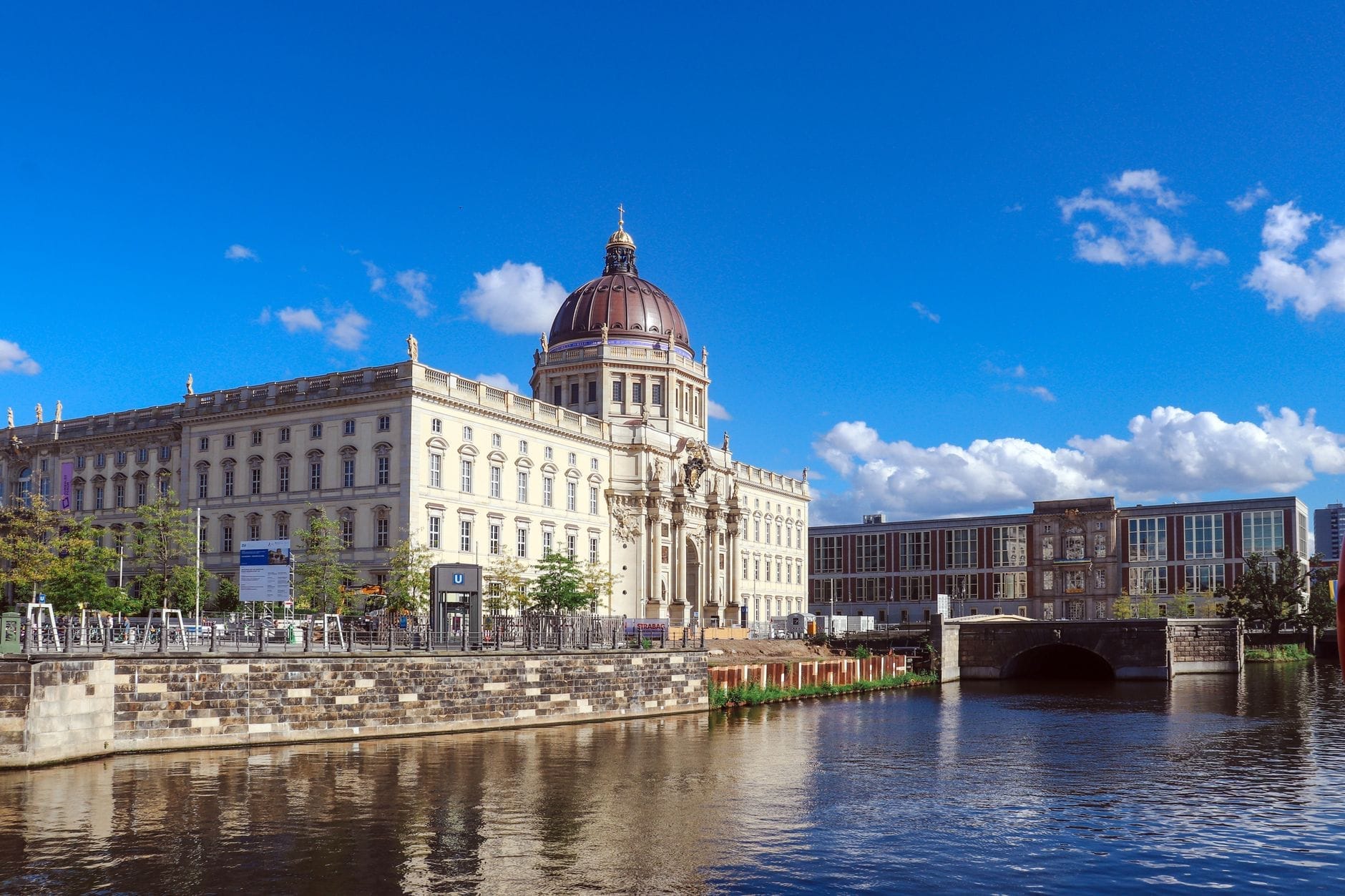
The building's exterior on the north, south, and west sides is a near-exact baroque reconstruction of the former Royal Palace, with sandstone ornamentation, dome, and portal details recreated to 18th-century specifications. The east side, however, is contemporary: a flat, modernist facade in copper and glass designed by Italian architect Franco Stella, making the building legible as both homage and new construction rather than historical fakery.
This architectural honesty matters because the building's history is uncomfortable. The original palace was badly damaged in World War II, then cleared by East Germany as a symbol of Prussian imperialism. Its replacement, the Palast der Republik (which housed the East German parliament), was itself demolished in 2006 to make way for this reconstruction. Each layer of demolition and rebuilding tracks a different chapter of German political history, and the building absorbs all of that complexity.
From street level, the dome is the most legible feature, particularly when approaching from Unter den Linden. In early morning light, the baroque stone facade reads as pale honey; by midday it turns almost white. Visitors who arrive expecting a seamless historical palace will notice the tonal difference between restored stone and newly carved material, but from any distance the building has genuine presence.
Tickets & tours
Hand-picked options from our booking partner. Prices are indicative; availability and final rates are confirmed when you complete your booking.
Skip-the-line ticket for the Kulturforum Berlin
From 10 €Instant confirmationSkip-the-line ticket for Gemaldegalerie Berlin
From 14 €Instant confirmationPanoramapunkt Berlin ticket with skip-the-line option
From 9 €Instant confirmation1-Hour Berlin Spree River Cruise with On-Board Guide
From 21 €Instant confirmationFree cancellation
What to Expect Inside: The Exhibitions
The most substantial collections are from the Ethnological Museum and the Museum of Asian Art, which together occupy large areas across two floors. These are serious, world-class collections with objects from Africa, the Americas, Oceania, and across Asia, accumulated over more than a century. The scope is vast enough that selective visiting by region or theme is the practical approach for anyone with less than a full day.
The provenance debate is real and should not be glossed over. A significant portion of the ethnological collection was assembled during the colonial era, and the question of repatriation is actively discussed in the museum's own programming. The Benin Bronzes held here, for example, have been at the centre of extended negotiations with Nigeria. The Humboldt Forum has made an effort to address this transparently through dedicated display texts and public events, though critics argue the pace of restitution is too slow. Visitors who engage with these displays will leave with a fuller picture of what museums do and what they owe.
The Berlin Exhibition on the ground floor is more accessible for general visitors and covers the city's history from its founding to the present day, with exhibits on the Wall, division, and reunification that complement what you can see outdoors at the
The Berlin Exhibition on the ground floor is more accessible for general visitors and covers the city's history from its founding to the present day, with exhibits on the Wall, division, and reunification that complement what you can see outdoors at the Berlin Wall Memorial or the German Historical Museum a short walk up Unter den Linden.
💡 Local tip
Free admission covers much of the building, but specific special exhibitions and the roof terrace require separate tickets. Check the official website for current pricing before your visit rather than assuming everything is included.
How the Experience Changes by Time of Day
Midday on weekends brings the heaviest crowds, particularly around the central atrium and ground-floor lobby. Tour groups tend to concentrate in these areas, and the noise level rises considerably. If you want contemplative time with the collections, arriving at 10:30 when the doors open gives a noticeably quieter 60–90 minutes before the main rush.
Friday and Saturday evenings, when special events often take place from around 19:00, offer a different character entirely. Visitor numbers thin out after around 19:00, the light inside shifts warm, and the ethnological galleries in particular take on a different mood. These evenings sometimes include live music or programming in the public spaces, so checking the events calendar before a Friday visit is worth the two minutes it takes.
The exterior is worth seeing regardless of your museum plans. The square in front of the south portal, facing the Spree, has good sight lines to the cathedral and is a natural rest point on any walk through central Berlin. Early mornings before the building opens, the plaza is nearly empty and the dome reflection in the river is clear.
Getting There and Practical Logistics
The most direct public transport option is the U5, which has a stop called Museumsinsel opened specifically to serve this area. From Alexanderplatz, it is two stops and around 3–4 minutes. The U2 stop at Hausvogteiplatz is a short walk to the south, and multiple tram and bus lines serve the Cathedral and Palace area. Cycling is practical: the route along the Spree banks from either direction is flat and pleasant.
The Humboldt Forum is fully step-free with lifts throughout, and the official site details accessibility services including assistance for visitors with sensory or mobility needs. If you are building a broader day on Museum Island, note that the Forum is included in the Museum Island visitor flow but it requires a separate visit and is not covered by the Museum Island day pass.
There is a cloakroom for bags and coats, which is useful if you are combining this with a longer day out. The ground floor café and the rooftop terrace (when open) are reasonable places to pause, though neither offers exceptional value compared to the surrounding neighbourhood.
Who This Attraction Suits, and Who Should Think Twice
The Humboldt Forum rewards visitors who come with a specific interest: in world cultures collections, in the architectural history of Berlin, or in the cultural politics of colonial-era collecting. It is also genuinely worth visiting for anyone spending more than a couple of days in Berlin who wants to understand the city beyond its 20th-century narrative.
Visitors on a short itinerary who need to choose between this and the Pergamon, the Neues Museum, or the Jewish Museum Berlin should think carefully about priorities. The Humboldt Forum is large and can feel diffuse: it lacks the single clear narrative of those institutions. First-time visitors to Berlin with limited time often find it less immediately satisfying than its neighbours.
Families with children will find some engaging displays, particularly in the ethnological sections where objects are visually striking, but there are no dedicated children's areas in the conventional sense. The space is large enough that the building itself, with its courtyards and varied floor levels, keeps younger visitors interested for longer than a conventional white-cube museum would.
Insider Tips
- The roof terrace offers some of the best elevated views of central Berlin, including direct lines to the Cathedral and Television Tower and long views towards the government district. It requires a separate ticket, but for photographers the late-afternoon angle is particularly strong.
- The interior courtyard of the palace, enclosed and covered by a glass roof, is a working public space where the building's baroque detailing is closest and most legible. Spend a few minutes there even if you skip the upper-floor exhibitions.
- Friday and Saturday evenings after 19:00 are genuinely quieter. The regular-ticket exhibitions are accessible with fewer crowds, and the building's lighting scheme changes noticeably from daytime.
- Pick up a free printed floor guide at the entrance rather than relying solely on the app. The building's multiple institutions and floor levels can disorient visitors who navigate only by signage.
- The Humboldt Forum runs a regular public programme of talks, screenings, and performances, many of which are free or low-cost. Checking the events calendar before your visit can add a layer to the experience that standard exhibition touring doesn't provide.
Who Is Humboldt Forum For?
- History and architecture enthusiasts who want to understand Berlin's layered past beyond the Cold War era
- Visitors with a specific interest in ethnological collections or Asian art at a serious museum level
- Travellers combining a full Museum Island day who want to understand the Forum's distinct position in that cluster
- Those interested in the ongoing global debate about colonial-era museum collections and restitution
- Photographers looking for elevated city views and baroque architectural detail in one location
Nearby Attractions
Other things to see while in Mitte:
- Alexanderplatz
Alexanderplatz sits at the geographical and historical heart of former East Berlin, a vast open square with roots going back to the 13th century. Today it's a free, always-open crossroads of transit, Cold War monuments, and everyday Berlin life — chaotic, fascinating, and impossible to avoid.
- Berlin Cathedral (Berliner Dom)
The Berlin Cathedral, or Berliner Dom, is Germany's largest Protestant church and one of the most architecturally striking buildings in the city. Built between 1894 and 1905, it anchors Museum Island with a dome you can climb, a royal crypt below ground, and a nave that rewards slow, unhurried attention.
- Berlin TV Tower (Fernsehturm)
Standing 368 metres above central Berlin, the Berliner Fernsehturm is the tallest structure in Germany and the tallest publicly accessible building in Europe. Its observation deck at 203 metres delivers an unobstructed 360-degree panorama of the city. This guide covers what you actually see up there, when crowds are worst, and whether the ticket price is justified.
- Berlin Victory Column (Siegessäule)
Rising from the centre of the Großer Stern roundabout in Tiergarten, the Siegessäule is one of Berlin's most recognisable monuments. At around 67 metres tall, it offers a sweeping panorama over the city's forest-park heart — but you earn the view with 285 steps and no lift.