Museum Island (Museumsinsel) Berlin: The Complete Visitor Guide
Museum Island (Museumsinsel) in Berlin's Mitte district is one of Europe's most ambitious cultural sites: five major museums built between 1824 and 1930 on a narrow island in the Spree River, collectively inscribed as a UNESCO World Heritage Site in 1999. A single-day ticket grants access to all five, but most visitors need more than one visit to do it justice.
Quick Facts
- Location
- Bodestraße 1–3, 10178 Berlin (Mitte district)
- Getting There
- S-Bahn Hackescher Markt (~400 m); Tram M1/M5 (~200–300 m)
- Time Needed
- Half day minimum; full day to cover all five museums seriously
- Cost
- Museum Island Ticket: €24 (adult), €12 (reduced); under 18 free
- Best for
- Ancient history, European art, architecture, serious museum-goers
- Official website
- www.smb.museum/en/plan-your-visit/prices-tickets
What Is Museum Island and Why Does It Matter?
Museum Island (Museumsinsel) is not simply a cluster of museums. It is a 19th and early 20th-century statement about what a city owes its citizens: access to world history, gathered in one place. The five institutions here, the Altes Museum, Neues Museum, Alte Nationalgalerie, Bode-Museum, and Pergamonmuseum, were built across a span of just over a century (largely between 1824 and 1930) by leading Prussian architects, each one reflecting the museum design thinking of its era. UNESCO recognized the ensemble as a World Heritage Site in 1999, not just for its individual buildings but for what they represent as a collective idea.
The island itself is the northern tip of the Spreeinsel, a thin sliver of land split by a branch of the Spree River that runs through central Mitte. From the outside, the ensemble reads as a dense row of neoclassical facades pressing against the water. Walking across one of the bridges onto the island, with the dome of the Berlin Cathedral visible to the south and the columned portico of the Altes Museum ahead, gives a strong sense of deliberate civic grandeur. These buildings were designed to impress, and they still do.
💡 Local tip
Buy the Museum Island Ticket (€24 adult, €12 reduced) online in advance via smb.museum. It covers all five museums for one day and lets you skip the ticket queue at the James-Simon-Galerie entrance pavilion.
The Five Museums: What Each One Offers
Altes Museum (Old Museum)
Completed in 1830 and designed by Karl Friedrich Schinkel, the Altes Museum is the oldest building on the island and architecturally the most refined. Its 18-column Ionic facade, modeled loosely on ancient Greek stoas, faces the Lustgarten park. Inside, the rotunda, inspired by the Pantheon in Rome, still stops most visitors cold. The permanent collection focuses on ancient Greek and Roman art: sculptures, ceramics, bronzes, and coins arranged chronologically. It is a calmer museum than its neighbors, and a useful starting point before tackling the scale of the Pergamonmuseum.
Neues Museum (New Museum)
The Neues Museum holds the Egyptian Museum and Papyrus Collection, as well as the Museum of Prehistory and Early History. Its most visited object is the 3,300-year-old painted limestone bust of Nefertiti, which draws long queues within the museum even when the rest of the galleries are quiet. The building itself is worth examining: severely damaged in World War II, it was reconstructed by architect David Chipperfield in a process completed in 2009 that deliberately preserved war damage as part of the fabric. Exposed brick, filled shell craters, and ghostly wall murals that survived the bombing coexist with Chipperfield's clean insertions. It is one of the most thoughtfully restored buildings in Europe.
Alte Nationalgalerie (Old National Gallery)
A temple-form building on a high podium, the Alte Nationalgalerie focuses on 19th-century European painting and sculpture, with particular strength in German Romanticism and French Impressionism. Caspar David Friedrich's landscapes and works by Adolph Menzel are highlights. The building is quieter than the Neues Museum on most days, which makes it easier to stand with a single painting for several minutes without pressure.
Bode-Museum
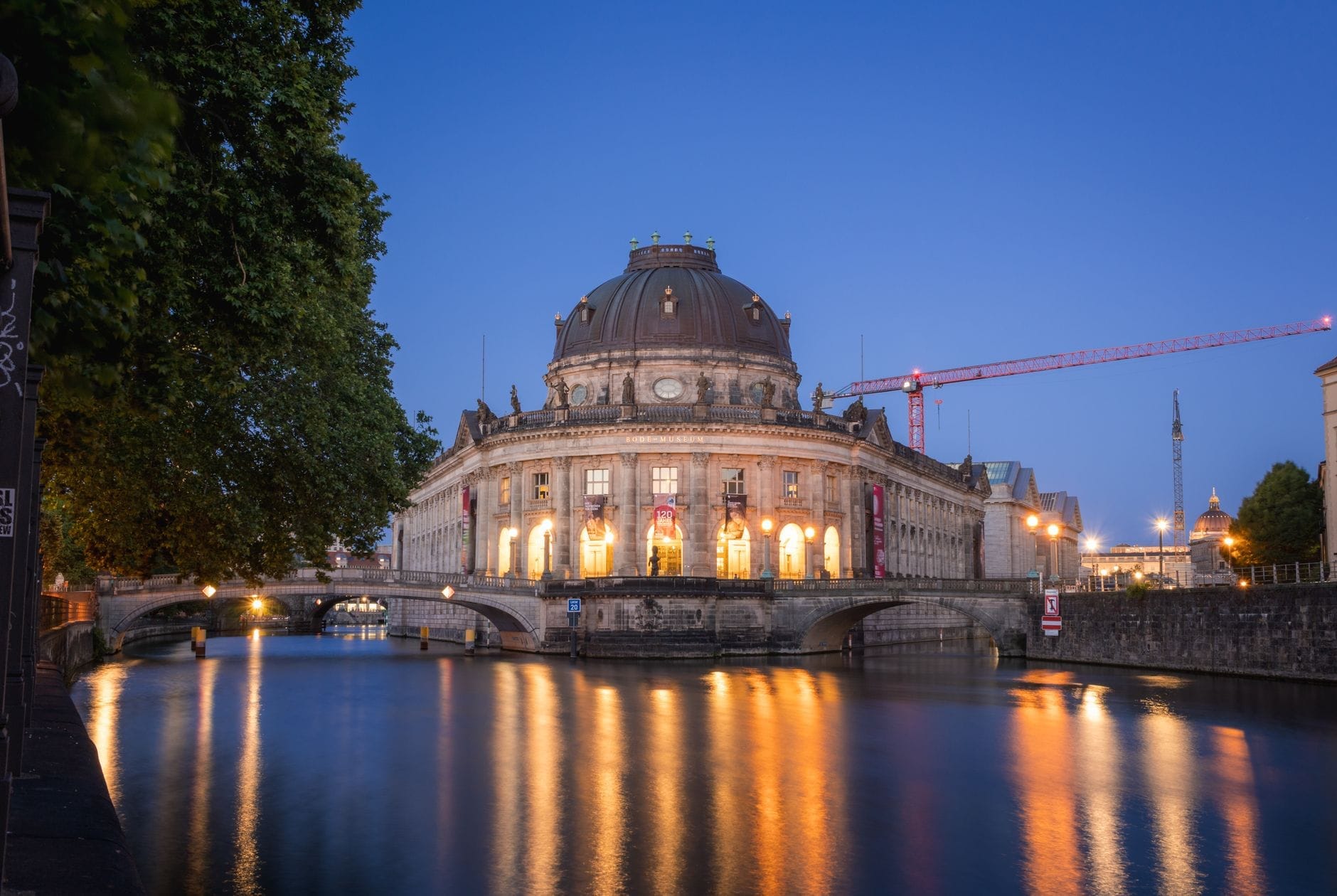
Occupying the northern tip of the island, the Bode-Museum is the most photogenic from the outside, its baroque dome rising directly from the Spree. Inside, it holds Byzantine art, a large sculpture collection, and a numismatic collection of coins and medals. Crowds here are noticeably thinner than at the Neues or Pergamon. If you want to move slowly through medieval European sculpture and Byzantine mosaics without elbowing past tour groups, this is where to come.
Pergamonmuseum
The Pergamonmuseum is the reason many visitors come to Museum Island at all. It houses reconstructed architectural monuments of ancient civilizations: the Ishtar Gate and Processional Way from ancient Babylon (currently partially on view while renovation continues), and the Market Gate of Miletus, among others. These are not replicas. They are original fragments assembled in situ within purpose-built gallery halls. Standing at the base of the Ishtar Gate, a deep-blue glazed brick structure over 14 meters tall, is genuinely disorienting in the best sense. Note that major renovation work is underway on sections of the Pergamonmuseum; check current access restrictions before your visit, as some galleries may be closed.
⚠️ What to skip
The Pergamonmuseum is undergoing a phased renovation. The hall containing the Pergamon Altar is currently closed and will remain so for several years. Confirm which galleries are open before your visit at smb.museum.
Tickets & tours
Hand-picked options from our booking partner. Prices are indicative; availability and final rates are confirmed when you complete your booking.
Skip-the-line ticket for Gemaldegalerie Berlin
From 14 €Instant confirmationPanoramapunkt Berlin ticket with skip-the-line option
From 9 €Instant confirmation1-Hour Berlin Spree River Cruise with On-Board Guide
From 21 €Instant confirmationFree cancellationSamurai Experience Berlin skip-the-line ticket
From 15 €Instant confirmation
How the Experience Changes by Time of Day
Museum Island is most crowded between 10 am and 2 pm, particularly on weekends and during school holidays. The Neues Museum, thanks to the Nefertiti bust, and the Pergamonmuseum are the busiest of the five at any given hour. Arriving when the James-Simon-Galerie opens gives you 45 minutes to an hour before the first tour groups work their way through the galleries.
Afternoons on weekdays are noticeably quieter in the Altes Museum and the Bode-Museum. By 4 pm, even the Neues Museum thins out considerably, and the light through its upper-floor windows, which face west, shifts to a warm late-afternoon tone that falls across the reconstructed frescoes in a way that photographs well. The island itself, meaning the bridges, the colonnaded walkway, and the Kupfergraben canal on the western edge, is pleasant at any hour for a short walk between museums.
In winter, expect shorter daylight hours and colder temperatures (Berlin averages around 0°C in January), but indoor comfort and smaller crowds can make the experience more focused. The Berlin in winter period also brings fewer tourists overall, which is a real advantage on an island this heavily visited in summer.
Getting There and Getting Around the Island
The most direct public transit connections are the S-Bahn lines stopping at Hackescher Markt, about a 400-meter walk south along the Spree. Tram lines M1 and M5 have stops roughly 200 to 300 meters from the island entrance. The neighborhood is also walkable from Alexanderplatz in about 15 minutes on foot along Unter den Linden or Karl-Liebknecht-Strasse.
All five museums on Museum Island are wheelchair accessible. The James-Simon-Galerie, which opened in 2019 and serves as the central visitor hub connecting the Neues Museum, Pergamonmuseum, and Altes Museum via underground passages, has lift access throughout. Partial orientation aids are also available for visually impaired, hearing-impaired, and deaf visitors. For those who prefer guided access, Berlin walking tours that include Museum Island stops are widely available and can be booked in advance.
ℹ️ Good to know
The James-Simon-Galerie (the glass and stone entrance pavilion by David Chipperfield, opened 2019) connects the Neues Museum, Altes Museum, and Pergamonmuseum underground. Enter here, collect your ticket, and plan your route before entering the galleries.
Historical and Cultural Context
The idea behind Museum Island was formulated in the early 19th century by Prussian officials who wanted to create what they described as a sanctuary for art and science — a public institution in an era when most significant collections were locked inside royal palaces. Karl Friedrich Schinkel's Altes Museum (1830) was the first purpose-built public museum in Prussia. The subsequent buildings, each added by a different architect across the following century, trace the evolution of museum architecture from neoclassical to historicist to early modern.
World War II caused severe damage to all five buildings. Reconstruction was complicated further by Berlin's division: the island fell within East Berlin, and the DDR undertook its own restoration work with limited resources. Reunification opened the path to a 20-year master plan, developed in the 1990s, which is still ongoing. The goal is to connect all five museums with underground passages and shared facilities, making the island function as a single institution while preserving each building's individual character.
For deeper context on the city's historical layers, the best museums in Berlin guide covers how Museumsinsel fits within the broader cultural landscape, alongside institutions like the German Historical Museum just a short walk away on Unter den Linden.
Practical Planning: What to Know Before You Go
The Museum Island Ticket at €24 for adults (€12 reduced, free for under 18s) covers all five museums for one calendar day. Given the scale of the collections, most visitors will not cover all five in a single visit, so prioritize before you arrive. If you are visiting Berlin for several days, the Berlin Museum Pass (three days, multiple institutions across the city) may offer better value — verify current pricing and terms at smb.museum before booking.
Photography without flash is permitted in most permanent galleries, though some temporary exhibitions restrict it. The Nefertiti bust in the Neues Museum is frequently photographed, but staff do move visitors along if crowds build. Comfortable shoes matter: the island involves significant walking and standing on stone and marble floors, and a full day here will cover several kilometers.
For families, Museum Island can work well with children who are engaged by ancient civilizations or large-scale reconstructed structures. The Pergamonmuseum's monumental gates tend to hold younger visitors' attention longer than painting galleries. A dedicated guide to planning Berlin with kids covers which museum experiences are most suitable for different age groups.
Museum Island is not the right destination for visitors who want a quick 45-minute cultural tick-box. If your interest in ancient history or European art is limited, the open-air walk around the island, crossing its bridges and viewing the facades from the Kupfergraben canal side, costs nothing and delivers genuine architectural pleasure. The free things to do in Berlin guide includes the exterior walk as one of the most underrated no-cost experiences in Mitte.
Insider Tips
- The colonnade walkway (Kolonnadenhof) between the Neues Museum and the Alte Nationalgalerie is one of the quietest outdoor spaces on the island. Sit here between museums rather than queuing at the cafe inside the James-Simon-Galerie.
- For the Nefertiti bust, go directly to that gallery first when the museum opens. By mid-morning, the room is dense with tour groups and individual photography becomes difficult.
- The Bode-Museum is consistently the least crowded of the five, even on peak summer weekends. If you want space to move slowly through a world-class collection, start there and work south.
- The view of the Bode-Museum dome from the Monbijoubrücke (the small bridge at the northern tip of the island) is one of the best architectural photographs in central Berlin. Early morning, before 8 am, gives you clean light and no pedestrians.
- Under-18s enter all Staatliche Museen zu Berlin institutions for free, including all five on Museum Island. No proof of age is typically checked for young children, but teenagers may be asked for documentation.
Who Is Museum Island (Museumsinsel) For?
- Travelers with a serious interest in ancient Egyptian, Greek, Roman, or Near Eastern civilizations
- Architecture enthusiasts interested in 19th-century neoclassical and historicist design, and post-war reconstruction
- Families with children aged 8 and up who respond well to monumental-scale artifacts
- Visitors spending multiple days in Berlin who want one major cultural anchor in Mitte
- Art history students and researchers seeking access to major European painting and sculpture collections
Nearby Attractions
Other things to see while in Mitte:
- Alexanderplatz
Alexanderplatz sits at the geographical and historical heart of former East Berlin, a vast open square with roots going back to the 13th century. Today it's a free, always-open crossroads of transit, Cold War monuments, and everyday Berlin life — chaotic, fascinating, and impossible to avoid.
- Berlin Cathedral (Berliner Dom)
The Berlin Cathedral, or Berliner Dom, is Germany's largest Protestant church and one of the most architecturally striking buildings in the city. Built between 1894 and 1905, it anchors Museum Island with a dome you can climb, a royal crypt below ground, and a nave that rewards slow, unhurried attention.
- Berlin TV Tower (Fernsehturm)
Standing 368 metres above central Berlin, the Berliner Fernsehturm is the tallest structure in Germany and the tallest publicly accessible building in Europe. Its observation deck at 203 metres delivers an unobstructed 360-degree panorama of the city. This guide covers what you actually see up there, when crowds are worst, and whether the ticket price is justified.
- Berlin Victory Column (Siegessäule)
Rising from the centre of the Großer Stern roundabout in Tiergarten, the Siegessäule is one of Berlin's most recognisable monuments. At around 67 metres tall, it offers a sweeping panorama over the city's forest-park heart — but you earn the view with 285 steps and no lift.