German Historical Museum (Deutsches Historisches Museum): The Complete Visitor Guide
Berlin's national history museum occupies two architecturally striking buildings on Unter den Linden: the baroque Zeughaus arsenal and I.M. Pei's striking glass annex. Spanning more than 2,000 years of German and European history, the Deutsches Historisches Museum is one of the most ambitious permanent collections in the country. Here is what to expect before you arrive.
Quick Facts
- Location
- Hinter dem Gießhaus 3, 10117 Berlin (Mitte)
- Getting There
- Museumsinsel (U5); Bus 100 and 200 stop at Unter den Linden / Staatsoper nearby
- Time Needed
- 2 to 3 hours for the Pei-Bau; allow a full half-day if exhibitions are dense
- Cost
- €7 standard / €3.50 reduced / Free under 18. Combined ticket €10 / €5 reduced
- Best for
- History enthusiasts, architecture lovers, rainy-day visits, school-age children and upward
- Official website
- www.dhm.de
What the German Historical Museum Actually Is
The Deutsches Historisches Museum (DHM) is Germany's national history museum, founded in 1987 in connection with the 750th anniversary of Berlin. Its mandate is broad: to document and contextualize German and European history from antiquity to the present day. That sounds abstract until you are standing in front of a Roman votive column and then, twenty minutes later, reading the fine print on a 1933 election poster. The collection's chronological sweep is genuine, not just marketing.
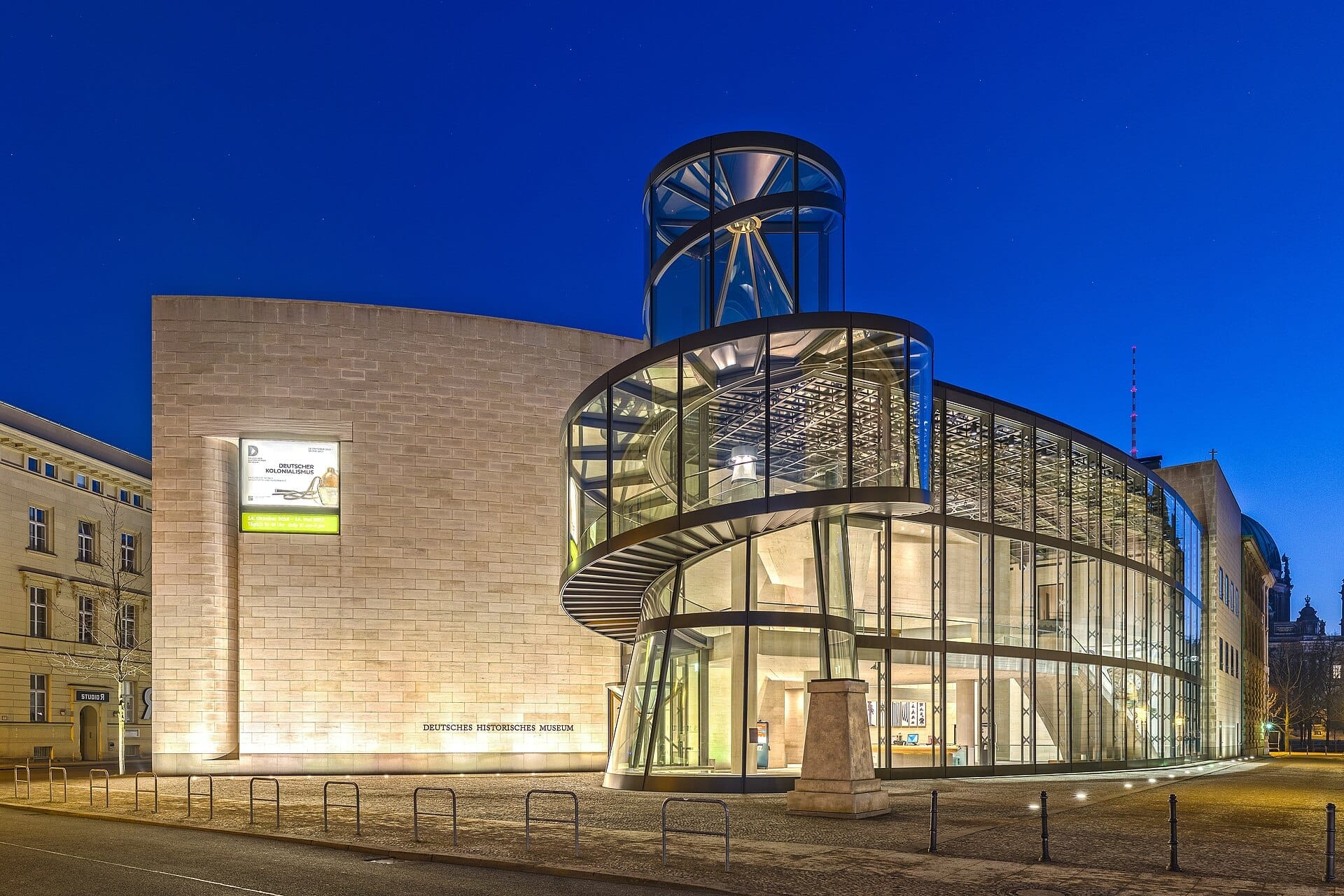
The museum occupies two very different buildings on and near the central boulevard Unter den Linden. The primary historic structure is the Zeughaus at Unter den Linden 2, Berlin's oldest surviving baroque building, completed in 1706 and originally built as a royal arsenal. The second is the Pei-Bau on Hinter dem Gießhaus, a purpose-built annex designed by I.M. Pei and completed in 2003. At present, the Zeughaus is closed for structural renovation and sanitation works. The Pei-Bau remains open daily and houses the museum's changing temporary and thematic exhibitions.
⚠️ What to skip
The Zeughaus main building and its permanent overview exhibition are currently closed for renovation. Before visiting, check dhm.de to confirm which exhibitions are running in the Pei-Bau, as the temporary program rotates and schedules change.
The Two Buildings: Baroque Arsenal and Pei Glass Tower
Even when the Zeughaus interior is off-limits, the exterior is worth pausing at. The building faces Unter den Linden and presents a long, stone facade decorated with carved sandstone warrior masks, the famous Schlüter masks of dying soldiers designed by Andreas Schlüter around 1696. These faces, contorted in pain and resignation, sit just above eye level along the inner courtyard walls and carry an unintentional weight that feels appropriate for a history museum. The courtyard itself cannot usually be viewed from the exterior gate while the building is closed for renovation.
The Pei-Bau sits immediately behind the Zeughaus, connected by a glass-roofed spiral staircase that is itself one of the more photographed architectural features in Mitte. Pei's design is a four-story cylindrical tower of glass and white concrete with triangular floor cuts that allow natural light to fall through multiple levels simultaneously. It is quietly spectacular in a way that only reveals itself once you are inside. The geometry changes as you move up the stairs, and the view back through the glass toward the Zeughaus dome and the Spree canal beyond is one of those accidental Berlin compositions that rewards slow visitors.
The Pei-Bau is on the same block as Unter den Linden, the historic boulevard that connects the Brandenburg Gate to Museum Island. If you are walking this axis as part of a day in Mitte, the museum fits naturally into the route without requiring a detour.
Tickets & tours
Hand-picked options from our booking partner. Prices are indicative; availability and final rates are confirmed when you complete your booking.
German Spy Museum Berlin skip-the-line tickets
From 23 €Instant confirmationFree cancellationLife in Nazi Germany exploration game and tour in Berlin
From 12 €Instant confirmationFree cancellation1-hour historical Spree river cruise in Berlin
From 40 €Instant confirmationFree cancellationBerlin Wall and Cold War Bike Tour in German
From 34 €Instant confirmationFree cancellation
What to Expect Inside the Pei-Bau
The Pei-Bau's exhibition spaces are distributed across four floors connected by that helical staircase and supplemented by elevators. The rooms are clean and well-lit, with the kind of thoughtful label writing that signals a museum taking its educational role seriously. Text panels appear in German and English, which is not guaranteed at every Berlin museum.
Exhibitions in the Pei-Bau tend to be large in scope. Past programs have covered topics such as the history of fashion as a political document, the visual culture of the Weimar Republic, and the legacy of German colonialism. These are not lightweight shows. The depth of primary source material on display, letters, propaganda posters, uniforms, film reels, everyday objects, rewards visitors who budget enough time to read rather than just look.
Practically speaking: the entry desk is staffed and generally efficient, even on busy weekend afternoons. The coat check is useful if you are carrying a large bag. The museum shop near the entrance stocks a solid selection of serious history books and exhibition catalogs, including titles in English. The in-house café provides a functional break point, particularly on the glass-covered lower level where the light through Pei's geometry makes for an unusual lunch environment.
💡 Local tip
If you are visiting with school-age children, ask at the desk about the museum's guided tours in plain language (Leichte Sprache). The DHM also offers dedicated programs for deaf visitors and tours for blind and visually impaired guests — contact the museum in advance to arrange.
Historical and Cultural Context
The DHM's founding in 1987 was itself a political act. West German Chancellor Helmut Kohl championed the project as a way of anchoring a coherent national historical identity at a time when that identity remained politically charged and geographically split. The reunification of Germany three years later fundamentally changed what kind of museum the DHM needed to be. A national history museum in a divided country is a different institution than one in a reunified state still working through the legacies of two dictatorships in a single century.
That complicated inheritance shows in the collection's willingness to sit with difficult material without reducing it to easy narrative. The permanent exhibition, when the Zeughaus reopens, does not skip the Nazi period or the GDR years. It treats them as continuous German history, not as aberrations from an otherwise coherent national story. That framing is considered and deliberate, and it reflects decades of curatorial debate within German historical institutions.
For visitors who want to build a deeper understanding of Berlin's twentieth-century history, the DHM works well alongside the Topography of Terror documentation center and the Jewish Museum Berlin, both of which focus on specific periods and themes in greater forensic detail.
Visiting by Time of Day
The museum opens at 10:00 and the first hour tends to be the quietest, with a mix of early-arriving individual visitors and occasional school groups that have not yet settled into the galleries. By 11:30 on a weekend, the entrance hall and staircase see more foot traffic, particularly from tourists walking the Unter den Linden corridor who add the DHM to their route after the Brandenburg Gate.
Midafternoon on weekdays is often the most comfortable window: school groups have typically finished and the pre-dinner tourist rush has not begun. The Pei-Bau's upper floors tend to be less crowded than the ground-level exhibition spaces regardless of the time of day, since many visitors do not ascend past the first or second floor. If you want the best light through Pei's glass cone, aim for a clear morning when the low-angled sunlight cuts into the atrium.
The museum closes at 18:00 daily.
Getting There and Practical Logistics
The address is Hinter dem Gießhaus 3, which sits just behind the Zeughaus on the canal side. The main visitor entrance to the Pei-Bau is from this street, not from Unter den Linden itself, which confuses some first-time visitors who arrive at the Zeughaus facade and cannot find the door. The entrance is clearly signposted once you turn the corner.
The nearest U-Bahn stop is Museumsinsel on the U5 line. Bus lines 100 and 200, which run the length of Unter den Linden and connect to Alexanderplatz and the Tiergarten, stop within a two-minute walk. If you are exploring Museum Island on the same day, the DHM is a natural extension of that visit, as it is a short walk across the Schlossbrücke bridge.
Accessibility is well-handled. The museum confirms step-free access throughout the Pei-Bau and states that all exhibition rooms are reachable via wheelchair-accessible elevator. Wheelchairs and mobile seats can be borrowed at the information desk at no charge.
ℹ️ Good to know
Tickets: €7 standard / €3.50 reduced / Free for visitors under 18. A combined ticket covering both buildings costs €10 (€5 reduced). The Pei-Bau is open daily 10:00–18:00. The Zeughaus is currently closed for renovation with reopening now expected no earlier than 2031 — check dhm.de before your visit for the current status.
Who This Museum Is Not For
The DHM rewards visitors who come prepared to read and think. If you are looking for an immersive, multimedia-led experience or a short loop through highlight objects, this is probably not the right stop. The exhibition design is rigorous rather than theatrical. Object labels are informative but not dramatized. There is no film loop playing in every room or interactive screen at every turn.
Visitors with very young children will find the museum manageable in terms of physical access but may find the content density and text-heavy approach difficult to sustain for long. Older children with an existing interest in history, roughly secondary school age and above, tend to get considerably more from the visit.
If you are primarily interested in Cold War Berlin specifically, the Stasi Museum in Lichtenberg or the DDR Museum (which is more interactive and aimed at a broader audience) may be a better first stop, with the DHM as a follow-up for deeper historical framing.
Insider Tips
- The Pei-Bau staircase is one of Berlin's underappreciated architectural experiences. Take the stairs rather than the elevator at least once, and stop at each landing to look back down through the glass cone. It reads completely differently on the way down than on the way up.
- Free admission for under-18s makes this one of the few major Berlin museums with no cost barrier for younger visitors. Reduced tickets apply to students, people with disabilities, and holders of certain Berlin discount cards — bring documentation.
- The museum bookshop stocks serious academic titles and exhibition catalogs that you will not easily find in general Berlin bookstores. If the current temporary exhibition interests you, the catalog is usually available at a reasonable price and makes a more substantive souvenir than most.
- The Zeughaus courtyard is currently not accessible while the building and its courtyard are closed for renovation. The Schlüter warrior masks in the inner courtyard are worth seeing up close once access is possible again.
- Bus 100 runs from the Reichstag and Brandenburg Gate area along Unter den Linden to Alexanderplatz, stopping near the museum. Using it as a slow sightseeing loop at the start or end of your museum visit covers a significant stretch of central Berlin landmarks without extra cost beyond a standard transit ticket.
Who Is German Historical Museum (Deutsches Historisches Museum) For?
- History enthusiasts who want serious engagement with German and European history across a long chronological range
- Architecture lovers drawn to the contrast between I.M. Pei's modernist glass annex and the 18th-century baroque Zeughaus
- Rainy-day visitors looking for a full half-day of sheltered, substantive activity in central Mitte
- Secondary school-age students and adult learners with prior interest in German history, the World Wars, or the Cold War era
- Museum Island visitors who want to extend their day with a different curatorial approach and time period
Nearby Attractions
Other things to see while in Mitte:
- Alexanderplatz
Alexanderplatz sits at the geographical and historical heart of former East Berlin, a vast open square with roots going back to the 13th century. Today it's a free, always-open crossroads of transit, Cold War monuments, and everyday Berlin life — chaotic, fascinating, and impossible to avoid.
- Berlin Cathedral (Berliner Dom)
The Berlin Cathedral, or Berliner Dom, is Germany's largest Protestant church and one of the most architecturally striking buildings in the city. Built between 1894 and 1905, it anchors Museum Island with a dome you can climb, a royal crypt below ground, and a nave that rewards slow, unhurried attention.
- Berlin TV Tower (Fernsehturm)
Standing 368 metres above central Berlin, the Berliner Fernsehturm is the tallest structure in Germany and the tallest publicly accessible building in Europe. Its observation deck at 203 metres delivers an unobstructed 360-degree panorama of the city. This guide covers what you actually see up there, when crowds are worst, and whether the ticket price is justified.
- Berlin Victory Column (Siegessäule)
Rising from the centre of the Großer Stern roundabout in Tiergarten, the Siegessäule is one of Berlin's most recognisable monuments. At around 67 metres tall, it offers a sweeping panorama over the city's forest-park heart — but you earn the view with 285 steps and no lift.