Stasi Museum Berlin: Inside the Secret Police Headquarters
The Stasi Museum occupies the actual former headquarters of East Germany's feared Ministry for State Security. Housed in House 1 — the former office of Stasi chief Erich Mielke — it preserves the surveillance apparatus of a totalitarian state in chilling, unaltered detail.
Quick Facts
- Location
- Normannenstraße 20, Haus 1, 10365 Berlin (Friedrichshain-Lichtenberg)
- Getting There
- U5 to Magdalenenstraße (~10 min walk); approx. 15 min from Alexanderplatz
- Time Needed
- 2–3 hours for a thorough visit
- Cost
- Adults €12 / Reduced €9 / Children (12+) €6; guided tours €5 per person plus admission
- Best for
- Cold War history, political history, architecture of authoritarian power
- Official website
- www.stasimuseum.de/en/enindex.htm
What the Stasi Museum Actually Is
The Stasi Museum — formally the Forschungs- und Gedenkstätte Normannenstraße — is not a conventional history museum. It is the real, preserved headquarters of the Ministry for State Security (Ministerium für Staatssicherheit, or MfS), the institution that monitored, controlled, and repressed the population of East Germany from 1950 until the fall of the Berlin Wall in 1989. The building has been operating as a research and memorial center since 1990, opened by former political prisoners and civil rights activists just months after the Stasi's collapse.The specific building you enter, House 1, was built in 1960–61 and served as the official workspace and residence of Erich Mielke, the Stasi's longest-serving minister. Mielke ran the ministry from 1957 until November 1989, the month the Wall fell. This is not a reconstruction. The furniture, the phones, the carpets, the private bathroom — all of it is original. That distinction matters enormously when you're standing inside it.
ℹ️ Good to know
Opening hours: Mon–Fri 10:00–18:00; Sat, Sun & public holidays 11:00–18:00. Last entry at 17:30. Closed 24 Dec and 31 Dec. Open 25–26 Dec from 11:00.
The Architecture of Control
The Normannenstraße complex covers several city blocks in the Lichtenberg district, a part of eastern Berlin that saw little of the postwar reconstruction that transformed more central areas. The GDR-era apartment blocks, prefabricated concrete towers, and flat commercial facades surrounding the museum compound have changed less than anywhere else in the city. That architectural continuity is part of what makes the visit feel unsettling in a way that more touristy sites do not.
House 1 itself is a plain, functional building — beige, institutional, unremarkable from the outside. At its peak, the wider Normannenstraße complex employed thousands of people. The sheer scale of that bureaucracy, dedicated entirely to surveilling its own citizens, becomes clearer once you are inside the building. The layout mirrors the Stasi's obsessive logic: secure corridors, controlled access points, layers of administrative space designed to separate and compartmentalize.
For broader architectural and urban context in this part of Berlin, the nearby Karl-Marx-Allee — the GDR's grand socialist boulevard — gives a strong sense of how the regime wanted to project power through urban planning, which contrasts sharply with the deliberately invisible, bureaucratic footprint of the Stasi compound.
Tickets & tours
Hand-picked options from our booking partner. Prices are indicative; availability and final rates are confirmed when you complete your booking.
Skip-the-line ticket for Gemaldegalerie Berlin
From 14 €Instant confirmationPanoramapunkt Berlin ticket with skip-the-line option
From 9 €Instant confirmation1-Hour Berlin Spree River Cruise with On-Board Guide
From 21 €Instant confirmationFree cancellationSamurai Experience Berlin skip-the-line ticket
From 15 €Instant confirmation
What You Actually See Inside
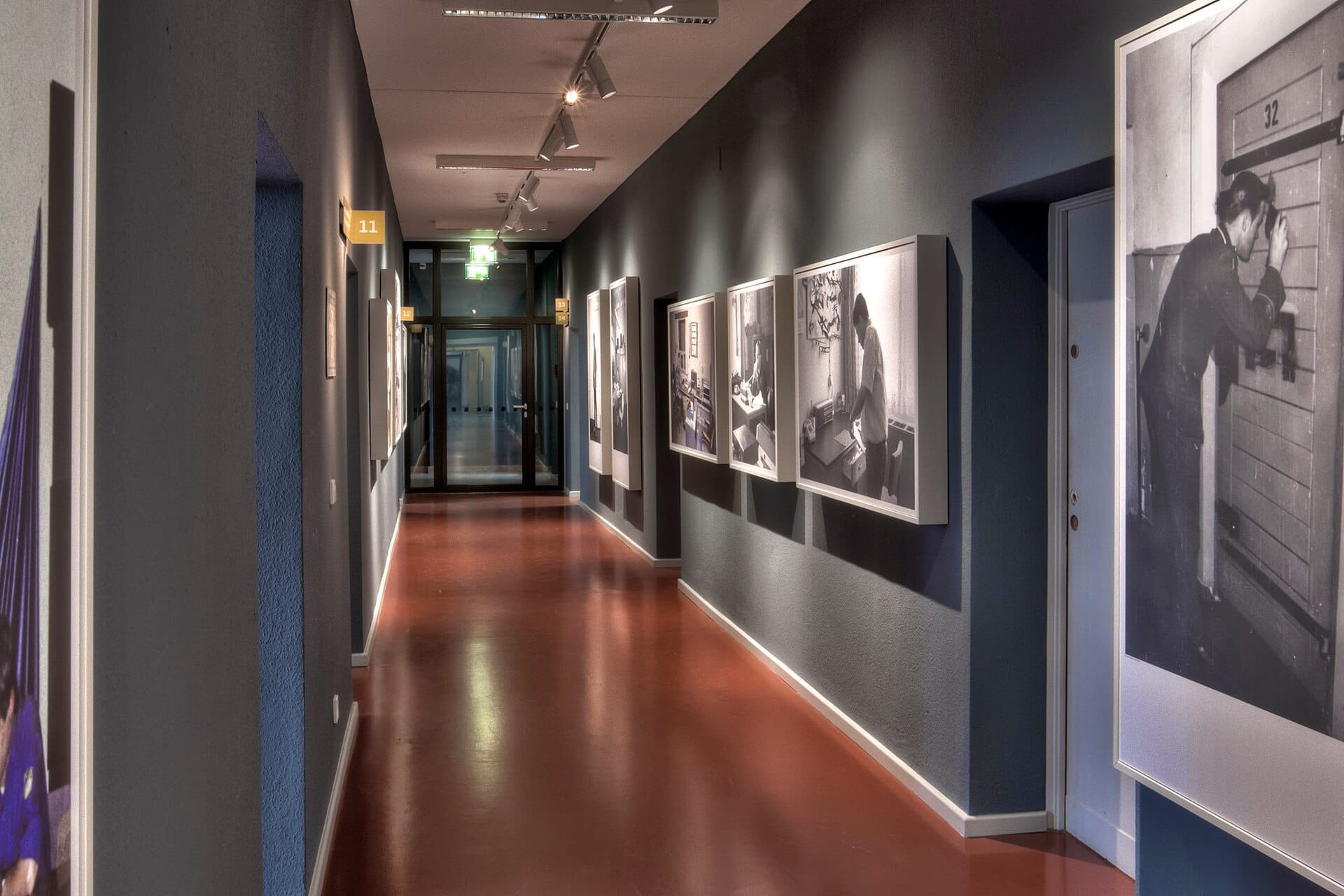
The museum is spread across multiple floors and covers both the personal spaces of Mielke and the operational infrastructure of the ministry. Mielke's private office suite is the centerpiece: a room preserved precisely as it looked in 1989, with original furniture, personal objects, and the particular aesthetic of GDR officialdom — heavy wood paneling, practical carpeting, a mix of functional Soviet-bloc design and the small personal touches of a man who held the same job for three decades.
The surveillance technology on display is one of the museum's most arresting aspects. Cameras hidden inside watering cans, microphones embedded in ties and buttons, the apparatus of concealed recording that the Stasi industrialized at a scale unmatched by any other secret police force in history. The GDR had roughly one Stasi officer or informant for every 63 citizens. The exhibits make that statistic tangible rather than abstract.
Exhibition rooms cover the organizational structure of the MfS, its methods of psychological intimidation (a practice known as Zersetzung, or 'decomposition'), the network of unofficial informants (Inoffizielle Mitarbeiter), and the Stasi's foreign intelligence operations. English-language information is available throughout, though some of the more detailed documentary panels remain primarily in German. An audio guide is the recommended way to navigate for non-German speakers.
💡 Local tip
Book a public guided tour (€5 per person, plus admission) to unlock full context — a knowledgeable guide brings the personal and political dimensions to life in a way that self-guided visits only partially achieve. Tours run on selected days; check the official website for current schedules.
How the Visit Feels at Different Times of Day
The Stasi Museum is quiet compared to Berlin's central attractions. Mornings on weekdays are the least crowded: you can stand in Mielke's office for several minutes without another visitor entering, which is the right way to absorb what you're looking at. Weekend afternoons bring larger groups, particularly in the warmer months, and the corridor spaces can feel congested.
The building has no natural drama — no dramatic atrium, no sweeping views. Light enters the offices through standard double-glazed windows overlooking the compound's interior. In winter, the grey concrete courtyard visible from the upper floors reinforces the institutional bleakness of the setting in a way that makes the experience more immediate. In summer, the contrast between the brightness outside and the preserved interior feels slightly stranger and arguably more disorienting. Neither season is wrong for a visit.
Plan at minimum two hours. Three is better if you read exhibition text carefully or take a guided tour. There is a small gift shop and a research library on-site, though the library requires advance contact for access.
Getting There and Practical Logistics
Take the U5 line to Magdalenenstraße station, exit at Ruschestraße, and walk approximately ten minutes northeast. The museum entrance is clearly marked at Normannenstraße 20, House 1. The total journey from Alexanderplatz takes around 15 minutes by U-Bahn. From Potsdamer Platz, allow approximately 30 minutes via public transit.
The neighborhood around the museum is residential and quiet — very different from the tourist density of Mitte or the activity around East Side Gallery. There are a handful of cafés and local restaurants within a five-minute walk, but no concentrated tourist infrastructure. Bring water and anything you might need.
Accessibility: the museum is fully accessible. Visitors with mobility needs should use the accessible entrance to the left of the main entrance, where staff can assist. Accessible toilets are available on the ground floor and on the 4th floor.
⚠️ What to skip
Photography policy: personal photography is generally permitted in the exhibition spaces, but flash photography may be restricted in specific rooms. Tripods are not permitted. Always check with staff on arrival, as policies can be updated.
Historical Context: Why This Site Matters
The Stasi's reach extended far beyond political dissidents. By the time the MfS was dissolved in 1990, it had amassed files on approximately 6 million East German citizens — in a country of around 16 million people. Understanding this institution is fundamental to understanding the GDR and, by extension, the reunification challenges that followed 1989. For a broader picture of the Cold War landscape in Berlin, the Cold War Berlin guide provides essential context that connects the Stasi Museum to sites like the Berlin Wall Memorial and Checkpoint Charlie.
The decision to preserve the headquarters as a memorial site — rather than demolish or convert it — was made by citizens who occupied the building on 15 January 1990 to prevent the destruction of evidence. That act of civic intervention is part of the museum's own history. The institution is run by the Bürgerkomitee 15. Januar e.V. (Citizens' Committee of 15 January).
The Stasi Museum complements other memory sites in the city that address state-sponsored oppression. The Topography of Terror documents the earlier Nazi security apparatus on its original site, and taken together, the two museums trace a long arc of authoritarian surveillance in German history. The Palace of Tears at Friedrichstraße station offers a more intimate, personal complement to the institutional scale of the Stasi Museum.
Who Might Want to Skip This
Visitors looking for a rapid, emotionally engaging attraction with strong visual impact and short dwell times may find the Stasi Museum slow. It rewards careful reading and sustained attention. The exhibition is text-heavy in places, and the building itself is not dramatic. If your Berlin itinerary is already crowded and you have only a passing interest in Cold War history, the Berlin Wall Memorial or the DDR Museum might be a more efficient use of your time.
Families with young children will find limited interactive elements, and the subject matter requires a level of historical grounding to fully resonate. The museum is generally suited for adults and older teenagers. Visitors who read German will get substantially more out of the detailed archival panels than those relying solely on English translations or audio guides.
Insider Tips
- Mielke's private office suite is the most impactful room in the building — allocate time specifically for it rather than letting it become the tail end of an exhausted tour.
- The museum sells a range of research publications and original archival reproductions in its shop, including document facsimiles that are not widely available elsewhere. These make for more meaningful souvenirs than the typical tourist fare.
- If you are visiting on a weekday morning, aim to arrive close to the 10:00 opening. By mid-morning, school groups from Berlin and Brandenburg regularly fill the corridor spaces, and the pace of the experience changes significantly.
- The U5 now provides straightforward access from Alexanderplatz, making the Magdalenenstraße stop easy to reach from most central hotels.
- The outdoor compound between the museum buildings is accessible and worth a slow walk before or after your visit — the scale of the administrative complex becomes clearer when you can see multiple buildings in relation to each other.
Who Is Stasi Museum (Normannenstraße) For?
- Travelers with a serious interest in Cold War history and the mechanics of authoritarian states
- Visitors who have already seen the central memorial sites and want to go deeper into GDR history
- History students, researchers, and journalists covering German reunification or surveillance history
- Architecture enthusiasts interested in how ideological power is expressed through institutional design
- Anyone who has recently read or watched content about the Stasi — the Normannenstraße site transforms abstract knowledge into physical reality
Nearby Attractions
Other things to see while in Friedrichshain:
- Berghain / Panorama Bar
Housed in a former DDR-era power plant near Ostbahnhof, Berghain / Panorama Bar is the nucleus of Berlin's techno scene and one of the most discussed nightclubs on earth. This guide covers what the experience is actually like, how the door works, and who should probably skip it.
- East Side Gallery
The East Side Gallery is a 1,316-metre stretch of the former Berlin Wall painted by 118 artists from 21 countries in 1990. Free to visit at any hour, this protected memorial in Friedrichshain is the longest surviving section of the Wall and one of the most significant open-air art sites in the world.
- Karl-Marx-Allee
Karl-Marx-Allee is Karl-Marx-Allee is a 2.3-kilometre stretch of monumental East German architecture running through Friedrichshain and Mitte, built between 1949 and 1961 as a showcase of socialist urbanism. as a showcase of socialist urbanism. Free to walk at any hour, it offers one of the most intact and visually striking examples of Stalinist classicism outside Russia, with wide sidewalks, ornate residential towers, and landmarks like Kino International still operating today.
- Oberbaumbrücke
Oberbaumbrücke is a double-deck brick bridge over the River Spree, connecting Friedrichshain and Kreuzberg since 1896. Its neo-Gothic towers, resident U-Bahn line, and position on the former Berlin Wall border make it one of the city's most historically loaded and visually striking crossings. Entry is free, and it's open around the clock.