Checkpoint Charlie: Berlin's Most Famous Cold War Border Crossing
Checkpoint Charlie was the only crossing point between East and West Berlin open to Allied personnel and foreigners during the Cold War. Today the reconstructed guardhouse and outdoor exhibits stand on Friedrichstraße at the corner of Zimmerstraße in Mitte, free to visit at any hour.
Quick Facts
- Location
- Friedrichstraße 43–45, 10117 Berlin
- Getting There
- U Kochstr.; U Stadtmitte (U2/U6); Bus M29, 200, N6
- Time Needed
- 20–45 minutes for the outdoor site; 2–3 hours if visiting the Haus am Checkpoint Charlie museum
- Cost
- Free (outdoor site); the adjacent private Haus am Checkpoint Charlie museum charges a separate entry fee — verify current price before visiting
- Best for
- Cold War history, photography, context-setting before deeper memorial visits
What Is Checkpoint Charlie?
Checkpoint Charlie was the Allied military designation for the crossing point on Friedrichstraße at Zimmerstraße in central Berlin. From August 1961, when the Berlin Wall sealed the city in two, until German reunification in 1990, this narrow strip of asphalt was the only place where non-German Allied personnel, diplomats, and foreign nationals could cross between the American sector in the west and the Soviet-controlled east. Its name followed the NATO phonetic alphabet: Alpha and Bravo marked other Berlin crossings; Charlie was the third.
The crossing became globally symbolic almost immediately. In October 1961, just weeks after the Wall went up, Soviet and American tanks faced each other at close range here for sixteen hours in one of the most tense standoffs of the Cold War. Neither side fired. The episode illustrated just how volatile the division of Berlin was, and how much geopolitical weight this single intersection carried.
ℹ️ Good to know
The outdoor checkpoint area is publicly accessible and free to visit. The reconstruction you see today is not the original booth: the actual 1961 guardhouse was removed on 22 June 1990 and is now preserved at the Allied Museum in Zehlendorf.
What You Actually See at the Site
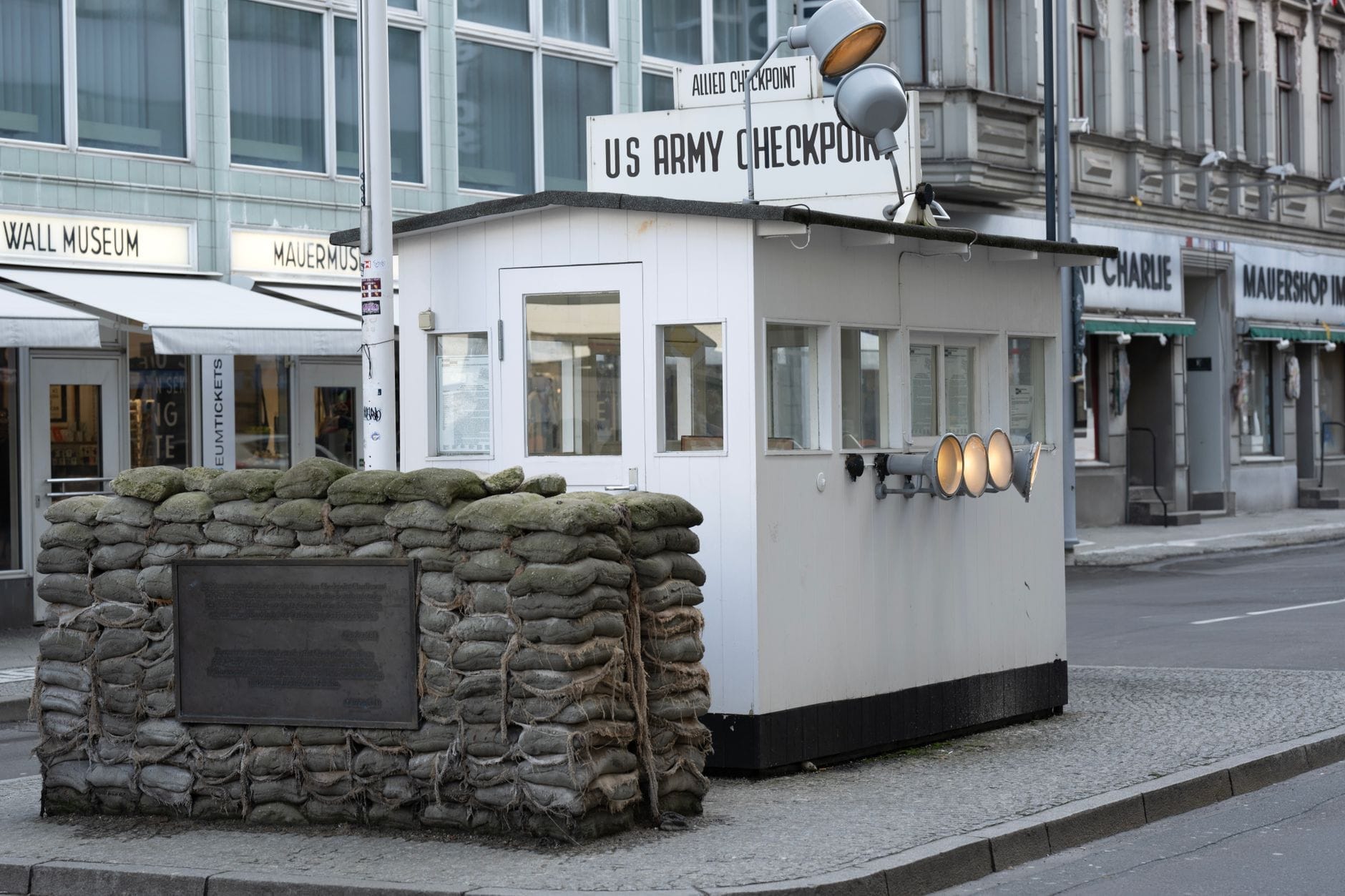
The centrepiece is a replica of the Allied guardhouse, a small white booth no bigger than a bus shelter, flanked by sandbags and a sign reading 'YOU ARE LEAVING THE AMERICAN SECTOR' in four languages. Actors dressed in American military uniforms offer paid photographs beside the booth. This is worth knowing in advance: the soldiers are a commercial arrangement, not an official historical presentation, and the pose-for-photos atmosphere can feel jarring if you arrive expecting solemnity.
Alongside the replica, a row of large outdoor information panels lines the pavement. These are genuinely informative, covering the history of the Wall, the mechanics of how the crossing operated, and documented escape attempts. Reading them takes about fifteen minutes and provides real context. The panels weather reasonably well but can be hard to read in direct midday sun.
The centrepiece is a replica of the Allied guardhouse, a small white booth no bigger than a bus shelter, flanked by sandbags and a sign reading 'YOU ARE LEAVING THE AMERICAN SECTOR' in four languages. Actors dressed in American military uniforms offer paid photographs beside the booth. This is worth knowing in advance: the soldiers are a commercial arrangement, not an official historical presentation, and the pose-for-photos atmosphere can feel jarring if you arrive expecting solemnity.Immediately adjacent stands the Haus am Checkpoint Charlie, a private museum that has operated at this site since 1963. Its collection of escape vehicles, forged documents, and personal testimonies is extensive, though the presentation is dated and the admission price is high relative to Berlin's many world-class free or subsidised museums. It remains useful for visitors who want deep detail in a single visit rather than splitting time across multiple sites.
For a more rigorous and emotionally considered account of how the Wall functioned, the Berlin Wall Memorial on Bernauer Straße offers preserved sections of the original fortification system, a documentation centre, and open-air exhibits — all free. Most serious visitors to Cold War Berlin treat Checkpoint Charlie as an orientation point and Bernauer Straße as the main event.
Tickets & tours
Hand-picked options from our booking partner. Prices are indicative; availability and final rates are confirmed when you complete your booking.
Berlin Red Sightseeing hop-on hop-off 24 or 48h bus
From 0 €Instant confirmation2-Hour Third Reich and Cold War Guided Walking Tour
From 20 €Instant confirmationFree cancellationBerlin Red Sightseeing hop-on hop-off 24 or 48h bus
From 0 €Instant confirmationBerlin hidden spots and street art guided bike adventure
From 40 €Instant confirmationFree cancellation
How the Experience Changes by Time of Day
Mornings before 9 am are noticeably different from any other hour. The tour coaches have not yet arrived, the actors in uniform are not yet on duty, and the intersection feels like a regular city corner with a curious booth on it. The early light from the east catches the information panels well. This is the best window for photographs without crowds in the frame.
By mid-morning, and consistently through the afternoon, Checkpoint Charlie becomes one of Berlin's most congested tourist spots. The narrow pavement fills quickly. Friedrichstraße is a working city street with active traffic, so movement is constrained. If you arrive between 11 am and 4 pm on a weekend or in summer, expect to wait for clear sightlines. The commercial atmosphere peaks at this time: souvenir stalls, photographers, and queues for the museum.
Evening visits have a different quality. After 7 pm in summer, the tour groups thin out and the site settles into something quieter. The booth is illuminated at night, and the contrast of the small white structure against the surrounding glass office buildings that now dominate this stretch of Friedrichstraße makes for a photograph that communicates the strangeness of the location more clearly than any daytime shot.
Historical and Urban Context
Checkpoint Charlie sits in Berlin-Mitte, the district that contains the largest concentration of the city's significant Cold War and World War II sites. Within walking distance to the north is the Topography of Terror, the open-air documentation centre built on the former site of the SS and Gestapo headquarters. A fifteen-minute walk takes you to the Holocaust Memorial and beyond it to the Brandenburg Gate.
What makes this intersection historically unusual is the density of the transformation. In 1961, this was a live military installation with armed guards, searchlights, and the machinery of a totalitarian border regime. By 1991, it was a building site. Today it is surrounded by the headquarters of multinational companies, a luxury hotel, and a McDonald's. The architectural contrast is not subtle, and for many visitors it provokes more reflection than the booth itself.
If you want to understand the Cold War geography of Berlin more fully, the Cold War Berlin guide covers the key sites in order of historical depth, including the Palace of Tears transit hall, the Stasi Museum in Lichtenberg, and the Soviet War Memorial at Treptow.
Getting There and Getting Around
The most direct route is U-Bahn line U6 to Kochstraße (Checkpoint Charlie), which puts you at the intersection a very short walk away. The station name includes 'Checkpoint Charlie' in signage, and U2 or U6 to Stadtmitte puts you a few minutes' walk away.
Bus lines M29, 200, and N6 (night) stop nearby. If you are travelling from Kreuzberg or approaching from the south, the bus is often more direct than navigating the U-Bahn interchange.
The site is at street level with no steps or barriers. The pavement on Friedrichstraße is wide and generally smooth, though the crowds during peak hours make it difficult to move freely with a pram or wheelchair. The museum building itself has stairs; check directly with Haus am Checkpoint Charlie for current accessibility provisions.
Photography Notes and What to Bring
The booth photographs best from the south side of Zimmerstraße, looking north along Friedrichstraße, with the city visible behind. This angle captures the sign in full. A wide-angle lens or phone camera is sufficient; there is no distance involved.
In winter, the site gets direct light only briefly around midday. In summer, the eastern morning light is ideal, and the longer days give you a second usable window around 7–8 pm. Rain does not close the outdoor site, but the information panels become harder to read when wet, and the booth's photogenic quality drops sharply under grey skies.
💡 Local tip
Skip paying the uniformed actors for a photo. The sign itself, the booth, and the bilingual notice board are the historically significant elements. Save your attention (and money) for those.
Is Checkpoint Charlie Worth Your Time?
The honest answer is: yes, briefly. The site takes twenty minutes to absorb properly if you read the outdoor panels and observe the location. It earns its place on a Berlin itinerary as a legible, well-located introduction to the Cold War division of the city. The booth is immediately recognisable from countless photographs and films, and standing at the actual intersection where the tank standoff occurred in 1961 does carry weight.
What Checkpoint Charlie does not do is provide a deep or emotionally resonant experience on its own. It is a commercial site in a busy city intersection, and it has been that way for decades. Visitors who expect quiet contemplation or museum-grade presentation will be disappointed. Those who treat it as one piece of a broader day of Cold War sites, beginning here and continuing to Bernauer Straße or Topography of Terror, will find it earns its half-hour.
Travellers building a longer Berlin itinerary can find structured suggestions in the 3 days in Berlin guide, which routes the Cold War sites efficiently across two days.
⚠️ What to skip
The Haus am Checkpoint Charlie museum charges a separate admission fee that is high by Berlin standards. Research current prices and read recent visitor reviews before committing to entry. The outdoor site provides substantial context for free.
Insider Tips
- Arrive before 9 am to photograph the booth without crowds or the commercial actors in frame. The early morning light from the east is the best light of the day here.
- The information panels along the pavement are free and underused. Most visitors walk past them toward the booth, but the panels cover escape attempts, the 1961 tank standoff, and the crossing's operational history in detail.
- U6 Kochstraße is the closest stop, but if you are walking from the Holocaust Memorial or Brandenburg Gate, you can reach Checkpoint Charlie on foot in about fifteen minutes through quiet Mitte side streets.
- The neighbourhood around Zimmerstraße has changed significantly since reunification. Walking one block in any direction reveals how thoroughly the death strip and border zone have been built over with commercial office space, which is itself a form of historical information.
- If visiting in summer, combine the stop with the Topography of Terror, which is an eight-minute walk northwest. Both sites are free, and the combination makes for a coherent half-day on the history of totalitarian Berlin.
Who Is Checkpoint Charlie For?
- First-time visitors to Berlin who want a quick orientation to the city's Cold War geography
- History travellers building a full Cold War Berlin day before or after the Berlin Wall Memorial and Topography of Terror
- Photographers looking for an instantly recognisable Berlin image, particularly at dawn or in the late evening
- Families with older children who benefit from a legible, outdoor, zero-cost introduction to Berlin's division before visiting more detailed sites
Nearby Attractions
Other things to see while in Mitte:
- Alexanderplatz
Alexanderplatz sits at the geographical and historical heart of former East Berlin, a vast open square with roots going back to the 13th century. Today it's a free, always-open crossroads of transit, Cold War monuments, and everyday Berlin life — chaotic, fascinating, and impossible to avoid.
- Berlin Cathedral (Berliner Dom)
The Berlin Cathedral, or Berliner Dom, is Germany's largest Protestant church and one of the most architecturally striking buildings in the city. Built between 1894 and 1905, it anchors Museum Island with a dome you can climb, a royal crypt below ground, and a nave that rewards slow, unhurried attention.
- Berlin TV Tower (Fernsehturm)
Standing 368 metres above central Berlin, the Berliner Fernsehturm is the tallest structure in Germany and the tallest publicly accessible building in Europe. Its observation deck at 203 metres delivers an unobstructed 360-degree panorama of the city. This guide covers what you actually see up there, when crowds are worst, and whether the ticket price is justified.
- Berlin Victory Column (Siegessäule)
Rising from the centre of the Großer Stern roundabout in Tiergarten, the Siegessäule is one of Berlin's most recognisable monuments. At around 67 metres tall, it offers a sweeping panorama over the city's forest-park heart — but you earn the view with 285 steps and no lift.