Memorial to the Murdered Jews of Europe: What to Know Before You Visit
The Memorial to the Murdered Jews of Europe, commonly known as the Holocaust Memorial, is one of the most powerful and architecturally distinctive commemorative sites in the world. Covering 19,000 square metres in central Berlin, its 2,711 concrete stelae and free underground Information Centre demand more than a passing glance. This guide tells you exactly what to expect.
Quick Facts
- Location
- Cora-Berliner-Straße 1, 10117 Berlin-Mitte, one block south of the Brandenburg Gate
- Getting There
- S-/U-Bahn Brandenburger Tor (S-Bahn, U5) – approx. 300 m; U-Bahn Anton-Wilhelm-Amo-Straße (U2) – approx. 400 m
- Time Needed
- 45–90 min for the field alone; add 60–75 min for the Information Centre
- Cost
- Free. Field of Stelae open 24/7. Information Centre: Tue–Sun 10:00–18:00, closed Mon, closed 1 Jan, 24–26 Dec, open 31 Dec 10:00–16:00
- Best for
- History-focused travelers, first-time visitors to Berlin, architecture enthusiasts, educational visits
- Official website
- www.stiftung-denkmal.de/en
What the Memorial Actually Is
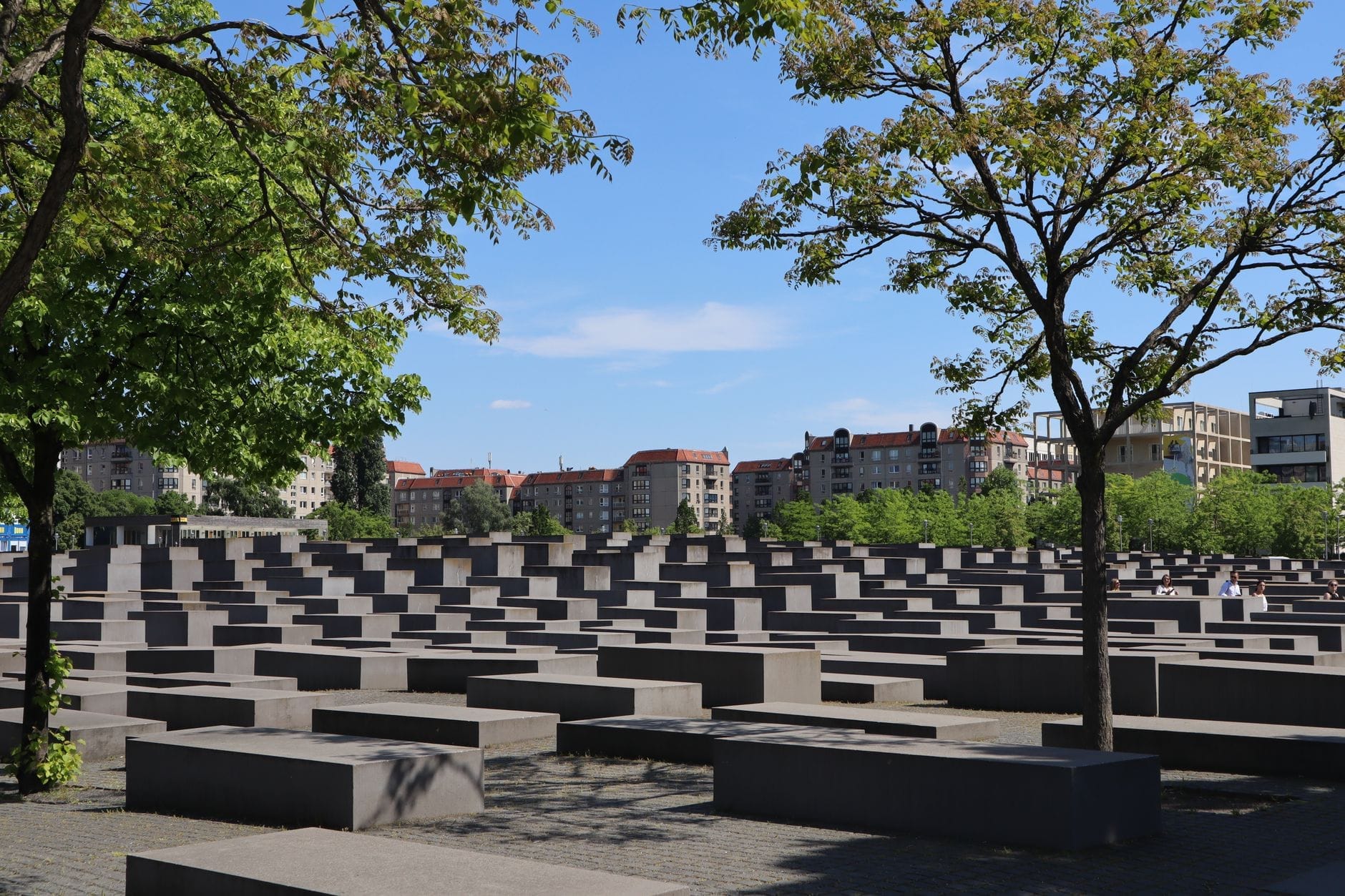
The Memorial to the Murdered Jews of Europe (German: Denkmal für die ermordeten Juden Europas) is not a museum in the traditional sense, and it is not a garden. It is a field of 2,711 grey concrete blocks, known as stelae, arranged in a grid across a gently undulating 19,000-square-metre site in the heart of Berlin-Mitte. Some stelae stand only ankle-high at the edges; others, deep inside the grid, rise to 4.5 metres. The ground shifts beneath your feet as you walk the narrow corridors between them, and the sky narrows to a strip of grey or blue above.
Designed by American architect Peter Eisenman with structural engineering by Buro Happold, construction began in April 2003 and was completed in December 2004. The memorial was inaugurated on 10 May 2005, opened to the public two days later, and has since received millions of visitors. Beneath the field, accessed from the northeast corner, the free Information Centre documents the systematic murder of approximately six million Jewish men, women, and children by the Nazi regime. The two parts of the memorial serve different but complementary purposes: the field is experiential and abstract; the underground exhibition is factual and personal.
ℹ️ Good to know
The Information Centre is closed on Mondays and on 1 January, 24–26 December. It closes at 16:00 on 31 December. Last entry is 45 minutes before closing. The field of stelae itself is open at all hours, every day of the year.
Walking the Field: What the Experience Feels Like
The first thing most visitors notice is disorientation. You enter from any of the four sides, the concrete rows pull you inward, and within thirty seconds of walking toward the centre, the city disappears. Traffic sounds from the nearby Ebertstraße fade. Voices from other visitors echo strangely between the blocks. The stelae are close enough together that two people can pass, but not comfortably. The grey concrete is cool to the touch in the morning and absorbs warmth by mid-afternoon. Some blocks are stained with years of weathering; others show the faint residue of anti-graffiti coating applied to the surface after the site's opening.
Eisenman has deliberately resisted assigning a singular symbolic interpretation to the structure. The number 2,711 does not correspond to any documented historical figure. The irregular, wave-like ground plan creates a subtle but persistent sense of unsteadiness. Some visitors find this deeply affecting; others feel uncertain about what they are supposed to feel or do. That ambiguity is intentional. The memorial refuses to deliver a clean emotional resolution, which is arguably more honest than one that does.
Children sometimes run through the corridors. Tourists take photographs. The memorial is not guarded, and there is no formal code of behaviour enforced inside the field, though a small notice at the perimeter requests respectful conduct. If this troubles you, visit early on a weekday morning, when the field is largely empty and the contrast between the exposed, windswept exterior rows and the enclosed centre is at its most pronounced.
Tickets & tours
Hand-picked options from our booking partner. Prices are indicative; availability and final rates are confirmed when you complete your booking.
Sachsenhausen Concentration Camp Memorial in Berlin by Bus
From 60 €Instant confirmationFree cancellationNazi Resistance and Holocaust Tour of Berlin
From 35 €Instant confirmationFree cancellationExcursion to Sachsenhausen concentration camp by train from Berlin
From 0 €Instant confirmationFree cancellationExcursion to Sachsenhausen concentration camp by train from Berlin
From 0 €Instant confirmationFree cancellation
Time of Day: How the Memorial Changes
Early morning, before 9:00, the field is mostly quiet. Light enters the corridors at a low angle and creates long shadows across the concrete surface. In winter, frost collects on the tops of the stelae and the ground underfoot can be slick, particularly on the sloped central sections. Bring appropriate footwear if visiting between November and March.
By mid-morning on weekends, particularly in summer, the site fills steadily with visitors. School groups arrive in organized clusters and are typically guided through a structured route before heading to the Information Centre. The atmosphere shifts noticeably: more conversational, more photographic, occasionally more chaotic near the exterior edges where the stelae are low and the perimeter is visible. The centre of the field remains quieter because the tall stelae and narrow pathways naturally filter foot traffic.
At dusk, especially in summer, a different quality of light falls across the concrete. The memorial stays technically open all night, and some visitors return after dark when the site is lit by ambient city light rather than direct sun. This is one of the few instances where a central Berlin memorial genuinely rewards a second visit at a different hour.
💡 Local tip
For a quieter experience, visit on a weekday before 10:00 or after 17:00. Saturday and Sunday between 11:00 and 15:00 are the busiest periods. The Information Centre is easiest to enter calmly on a Tuesday or Wednesday morning.
The Information Centre: What You Will Find Underground
The underground Information Centre sits below the northeast corner of the field. The entrance is marked clearly, and the space is accessible to wheelchair users and visitors with mobility limitations. Inside, four permanent exhibition rooms document different aspects of the Nazi genocide of European Jews: the historical chronology, the impact on individual Jewish families across Europe, the sites of murder, and the names and biographies of known victims. The fourth room, the Room of Names, reads aloud the names and biographical details of Jewish Holocaust victims in a continuous cycle.
The exhibition is carefully calibrated in its use of imagery. It is not gratuitously graphic, but it is direct and detailed. Some visitors find certain sections difficult, particularly the family portraits and letters presented alongside documentation of deportation and murder. Families with young children should be aware of this before entering.
Audio guides are available in multiple languages. Plan for at least 60 minutes in the exhibition if you intend to read the text panels carefully rather than pass through quickly. The centre is not large, but the material is dense and deserves time. Rushing through it misses the point.
If you want to situate the Holocaust Memorial within a broader tour of Berlin's memorial landscape, the Berlin memorials guide covers related sites including the Topography of Terror, the Jewish Museum, and the New Synagogue, many of which are walkable from this location.
Getting There and Getting Around
The memorial is exceptionally well connected. The S-Bahn and U5 station Brandenburger Tor places you roughly 300 metres from the site. The U2 station Anton-Wilhelm-Amo-Straße is slightly further at around 400 metres. Bus line 100, one of Berlin's most useful tourist routes, stops nearby at Platz des 18. März, directly at the Brandenburg Gate.
The memorial sits in one of Berlin's most historically concentrated areas. Within a ten-minute walk you can reach the Brandenburg Gate, the Reichstag Building, and the northern edge of Tiergarten park. This makes it a natural anchor point for a half-day walking tour of central Berlin-Mitte.
If you are planning a full day in this part of the city, the 3-day Berlin itinerary includes a logical sequence for combining this memorial with the Reichstag, Unter den Linden, and Museum Island.
Context: Why This Memorial Stands Where It Does
The location was not accidental. The site is near where the former Reich Chancellery and Hitler's bunker once stood, and directly adjacent to the pre-war diplomatic quarter. The decision to place a memorial of this scale in the geographical and political centre of reunified Germany, rather than at a camp site or on the periphery of the city, was a deliberate act of national reckoning. Planning and debate about the memorial spanned more than a decade, from the late 1980s through the mid-1990s, before the German Bundestag formally approved the project in 1999.
That history of debate is itself significant. Questions about who should be memorialized, how, and where were contested fiercely in public discourse. The result reflects a country grappling with how to acknowledge an atrocity at the heart of its own capital, not displacing it to the margins. For visitors interested in how societies confront historical guilt, the memorial is as interesting for its political history as for its physical form.
The broader history of divided and reunified Berlin shapes nearly every major public space in this part of the city. The Cold War Berlin guide provides useful context for understanding how this district looked during the decades when the Wall ran through its edges.
What the Memorial Does and Doesn't Do
The Memorial to the Murdered Jews of Europe is not overhyped in terms of its physical impact. The field genuinely produces a disorienting, contemplative experience that photographs do not fully convey. Standing at the centre, surrounded by concrete blocks taller than your head, with the city invisible and the sound of traffic muffled, is an experience that earns its reputation.
However, visitors expecting an emotionally guided experience with clear narrative structure should know that the field itself provides none. The abstraction is the point, but it can feel confusing or even cold to someone who arrives without any context. If you visit the field without spending time in the Information Centre, you may leave having had an interesting architectural encounter without fully understanding what you have been standing inside. The two elements need each other.
There are also visitors who find the field uncomfortable for different reasons: the uneven ground makes it physically challenging for anyone with significant mobility limitations, even with accessible paths marked around the perimeter. The interior is fully accessible via designated routes, but navigating the uneven central sections requires steady footing. The elevator in the Information Centre is functional and the exhibition itself is fully wheelchair accessible.
⚠️ What to skip
The central section of the field has uneven, sloping ground between the stelae. It is not suitable for pushchairs or wheelchairs. Accessible paths are marked around the perimeter, and the Information Centre below is fully accessible via elevator. Wear flat, closed shoes.
Insider Tips
- The northeast corner entrance to the Information Centre is where the queue forms on busy days. Arrive at opening time (10:00 Tuesday–Sunday) to enter immediately. Groups with advance bookings can bypass the general queue.
- The central stelae reach over 4 metres. For the most immersive spatial experience, walk directly into the centre of the field rather than circling the edges. The perimeter, where the stelae are low, gives a completely different impression than the interior.
- Photography inside the field is unrestricted, but photographing the exhibition inside the Information Centre is not permitted. Check signage at the entrance.
- The Topography of Terror documentation centre is a 10-minute walk south along Niederkirchnerstraße and is also free. Combining both in a single morning provides one of the most historically complete accounts of Nazi governance and its consequences available anywhere in the world.
- On cold or overcast days, the grey concrete and low light create an atmosphere that many visitors find more appropriate to the site's subject than the same space on a bright summer afternoon. Consider the seasonal visit a feature rather than a drawback.
Who Is Memorial to the Murdered Jews of Europe For?
- First-time visitors to Berlin who want to understand the city's relationship with its 20th-century history
- History and architecture students with an interest in how built form can carry meaning
- Travelers combining this with a broader Mitte itinerary including the Reichstag and Brandenburg Gate
- Anyone seeking a free, year-round site with significant depth that rewards slow, attentive engagement
- School and educational groups: the Information Centre offers structured educational programmes
Nearby Attractions
Other things to see while in Mitte:
- Alexanderplatz
Alexanderplatz sits at the geographical and historical heart of former East Berlin, a vast open square with roots going back to the 13th century. Today it's a free, always-open crossroads of transit, Cold War monuments, and everyday Berlin life — chaotic, fascinating, and impossible to avoid.
- Berlin Cathedral (Berliner Dom)
The Berlin Cathedral, or Berliner Dom, is Germany's largest Protestant church and one of the most architecturally striking buildings in the city. Built between 1894 and 1905, it anchors Museum Island with a dome you can climb, a royal crypt below ground, and a nave that rewards slow, unhurried attention.
- Berlin TV Tower (Fernsehturm)
Standing 368 metres above central Berlin, the Berliner Fernsehturm is the tallest structure in Germany and the tallest publicly accessible building in Europe. Its observation deck at 203 metres delivers an unobstructed 360-degree panorama of the city. This guide covers what you actually see up there, when crowds are worst, and whether the ticket price is justified.
- Berlin Victory Column (Siegessäule)
Rising from the centre of the Großer Stern roundabout in Tiergarten, the Siegessäule is one of Berlin's most recognisable monuments. At around 67 metres tall, it offers a sweeping panorama over the city's forest-park heart — but you earn the view with 285 steps and no lift.