Topography of Terror: Inside Berlin's Most Sobering Historical Site
Built on the ruins of the Gestapo and SS headquarters, the Topography of Terror is a documentation center and outdoor monument that confronts the machinery of Nazi terror with unusual directness. Entry is free, the indoor exhibition runs daily until 20:00, and the site includes a preserved section of the Berlin Wall. This is not a comfortable visit, but it is one of the most important you can make in Berlin.
Quick Facts
- Location
- Niederkirchnerstraße 8, 10963 Berlin (Mitte district)
- Getting There
- S-Bahn/U-Bahn Potsdamer Platz (S1, S2, S25, S26, U2) or S-Bahn Anhalter Bahnhof (S1, S2, S25, S26)
- Time Needed
- 1.5 to 3 hours depending on depth of engagement
- Cost
- Free admission, year-round
- Best for
- History learners, students, anyone seeking to understand how state terror operates
- Official website
- www.topographie.de
What Is the Topography of Terror?
The Topography of Terror documentation center sits on one of the most historically charged plots of land in Europe. From 1933 to 1945, this block on the former Prinz-Albrecht-Straße in central Berlin housed the command structures of the Nazi terror apparatus: the Gestapo headquarters, the SS leadership, the SD (Security Service), and from 1939, the Reich Security Main Office. Decisions made in the buildings that once stood here sent millions of people to their deaths. Nothing survives of those structures above ground, but the site itself, and what has been built to document it, carries enormous weight.
The Topography of Terror Foundation was established by the Berlin Senate on 28 January 1992, and the current documentation center building opened ceremonially in May 2010. The building, designed by architect Ursula Wilms with landscape architecture by Heinz W. Hallmann, is deliberately understated: a long, low glass-and-concrete structure that makes no attempt to compete with the history it documents. It does not try to be a monument. It tries to be a record.
ℹ️ Good to know
Opening hours: Daily 10:00–20:00 (indoor exhibition). Outdoor areas open until nightfall, at the latest 20:00. Closed 1 January, 24 December, and 31 December. Admission is free.
The Indoor Exhibition: What You Will Encounter
The main indoor exhibition runs along the interior of the documentation center in a long, corridor-like hall. Panels are arranged chronologically, covering the rise of the SS and Gestapo, the structure of Nazi terror, the persecution of political opponents, Jews, Roma, people with disabilities, and others, the occupation of Europe, and the implementation of mass murder. The language is precise and unsentimental. Photographs, documents, and facsimiles are used throughout. There are no dramatic lighting effects or cinematic flourishes. The exhibition trusts the material to do the work.
Most visitors move through the exhibition in 60 to 90 minutes, but the volume of documentary material is substantial enough to occupy three hours if you read carefully. Audio guides are available on site. The exhibition is presented in both German and English, and additional language materials are available at the information desk.
The atmosphere inside is quiet, almost uniformly so. Visitors tend to speak in low voices or not at all. Groups sometimes arrive with educators or guides, but even large school groups tend to fall into the register the space demands. If you come mid-morning on a weekday, you may have long stretches of the hall nearly to yourself.
💡 Local tip
Weekday mornings between 10:00 and 12:00 offer the most reflective experience. Weekend afternoons can draw large tour groups that slow movement through the exhibition panels.
Tickets & tours
Hand-picked options from our booking partner. Prices are indicative; availability and final rates are confirmed when you complete your booking.
Skip-the-line ticket for Gemaldegalerie Berlin
From 14 €Instant confirmationPanoramapunkt Berlin ticket with skip-the-line option
From 9 €Instant confirmation1-Hour Berlin Spree River Cruise with On-Board Guide
From 21 €Instant confirmationFree cancellationSamurai Experience Berlin skip-the-line ticket
From 15 €Instant confirmation
The Outdoor Site: Ruins, Terrain, and the Berlin Wall
The outdoor terrain walkway is a separate and equally important element of the site. Fifteen information stations guide visitors across the ground-level landscape, which includes the exposed remains of the Gestapo 'house prison,' where thousands of people were detained and interrogated. You walk on gravel paths between foundation remnants, low retaining walls, and open-air panels. The ground itself has been deliberately left uneven and unfinished, a choice that keeps the site feeling archaeological rather than commemorative.
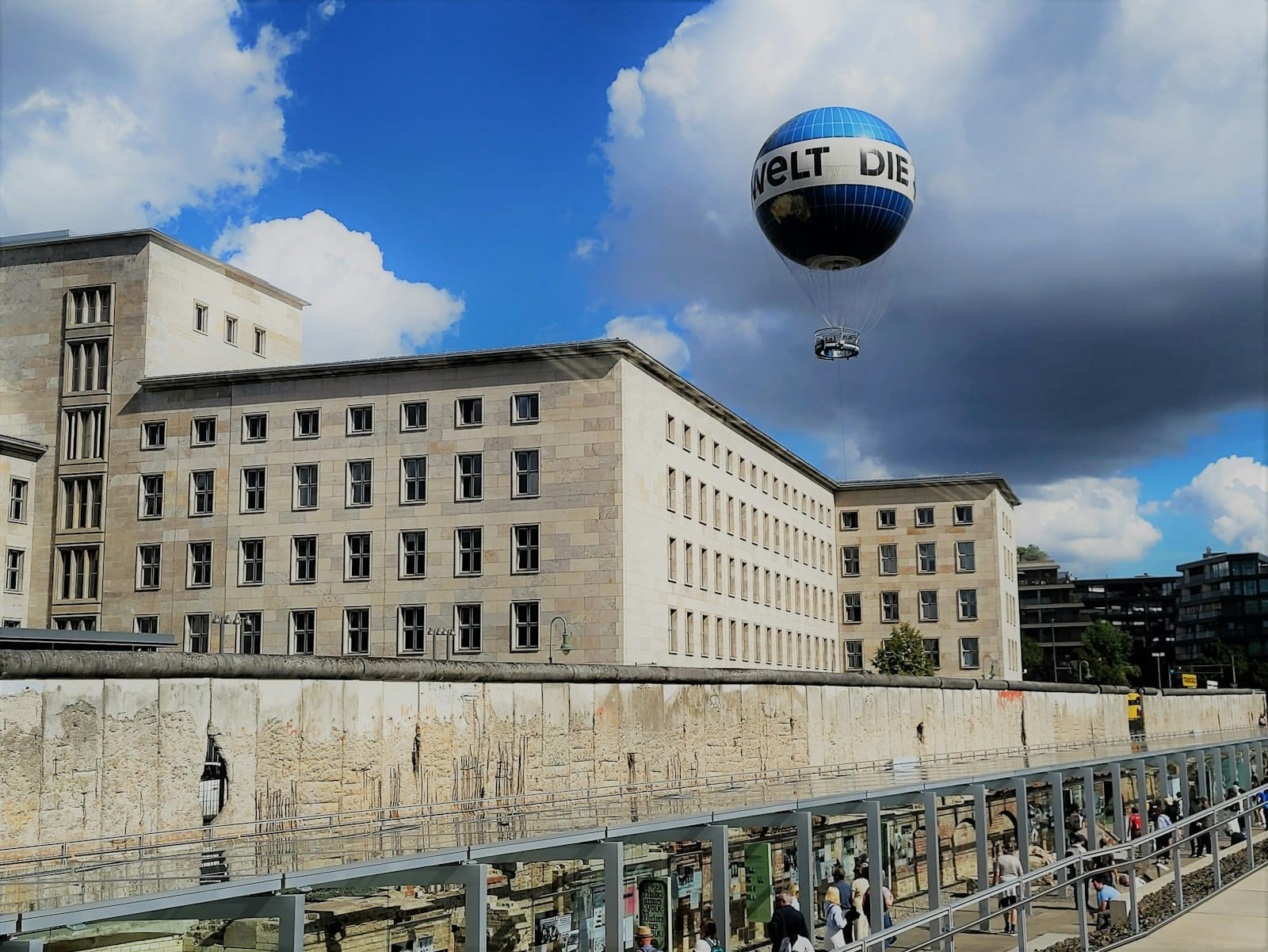
Running along the northern edge of the outdoor site is one of the longest preserved sections of the Berlin Wall still standing in the city. This is not a painted gallery stretch like the East Side Gallery in Friedrichshain. It is an unadorned, weathered concrete barrier, grey and crumbling at the edges, still standing at its original height. The proximity of the Wall to the Gestapo ruins is not coincidental from a curatorial standpoint: the site asks visitors to hold two distinct chapters of German authoritarianism in view at the same time.
The outdoor site is open until nightfall (maximum 20:00) and can be accessed independently of the indoor exhibition. In summer, late afternoon light falls across the Wall section and the excavated foundations in a way that makes the textures of the concrete and brick unusually vivid. In winter, the site takes on a starker quality: grey sky, grey stone, bare trees. Both are appropriate.
How This Site Compares to Other Berlin Memorials
Berlin has no shortage of sites addressing Nazi history and the Holocaust. The Holocaust Memorial a short walk north on Niederkirchnerstraße is a powerful work of abstract architecture, but it communicates through form and scale rather than documentation. The Jewish Museum Berlin focuses on the broader sweep of Jewish history in Germany. The German Historical Museum on Unter den Linden addresses German history across centuries.
What the Topography of Terror does that none of these do: it names the perpetrators. It documents the institutions, the organizational charts, the orders issued, and the people who issued them. If you want to understand the mechanics of how the Third Reich's terror infrastructure was built and operated, this is the place that answers that question most directly. It is less emotionally overwhelming than some memorial sites, and more intellectually demanding.
For a broader framing of Berlin's memorial landscape, the Berlin memorials guide covers major sites across the city and suggests practical routes between them.
Practical Walkthrough: How to Plan Your Visit
The documentation center is at Niederkirchnerstraße 8, a few minutes' walk south from Potsdamer Platz. The most direct approach on public transit is the S-Bahn or U-Bahn to Potsdamer Platz (served by S1, S2, S25, S26, and U2), then a short walk east and south. Anhalter Bahnhof (S1, S2, S25, S26) is another option, placing you a block from the entrance. The area around the site has wide, open sidewalks, and the entrance itself is at ground level.
The documentation center is fully wheelchair accessible, including all rooms, exhibition areas, and facilities. The outdoor terrain walkway is at ground level and navigable, though the gravel surface requires some attention. An audio guide is available for the outdoor site's 15 stations.
There is no coat check or bag storage prominently on offer, so travel light if possible. The building is well-heated in winter. In summer, the indoor hall stays cool. Photography is permitted throughout, though visitors naturally tend toward restraint given the subject matter. There is no café on site, but the area around Potsdamer Platz has multiple options for a meal before or after.
⚠️ What to skip
The site is closed on 1 January, 24 December, and 31 December. If visiting during holiday periods, plan accordingly.
Who Will Get the Most From This Visit — and Who Might Not
The Topography of Terror rewards visitors who come prepared to read carefully and think. The exhibition is not designed for passive consumption. If you arrive without any prior knowledge of National Socialism and expect the site to provide a complete narrative from scratch, you may find the depth of the documentary material disorienting rather than illuminating. A basic familiarity with the timeline of the Third Reich helps considerably.
Visitors with young children should be aware that the exhibition contains graphic historical photographs depicting violence, deportations, and execution sites. The site does not restrict access by age, but parents should use judgment. For families traveling with older teenagers who are studying this period, the site is exceptionally well-suited. A broader look at how to approach Berlin with younger visitors is covered in the Berlin with kids guide.
Visitors expecting an emotionally cathartic experience, like the one the Holocaust Memorial offers through its sensory architecture, may find the documentary register here more austere. That is by design. The Topography of Terror is a place of historical accountability, not mourning. Both are necessary. They are different things.
The Neighborhood Context: Mitte and the Government District
The Topography of Terror sits on the edge of Mitte, Berlin's central district, in an area that in the early twentieth century was part of the administrative and governmental core of the city. Wilhelmstraße, running parallel just to the west, was lined with government ministries during the Weimar Republic and then the Third Reich. Today the area is mixed: federal government buildings, the approach roads to Potsdamer Platz, the Martin-Gropius-Bau exhibition hall directly across the street, and the beginning of the Tiergarten park district to the north.
The Martin-Gropius-Bau, a late-nineteenth-century exhibition hall that survived the war with significant damage and was later restored, hosts major temporary exhibitions and is worth checking for current programming when planning a visit. The two buildings sit across Niederkirchnerstraße from each other: the ornate historicist facade of the Gropius-Bau and the low glass line of the documentation center, with the Wall running between them.
Insider Tips
- The outdoor terrain walkway closes at nightfall, not at a fixed hour, which means in midsummer you can walk it up to about 20:00 in extended daylight. In winter, plan to finish by around 16:30.
- The exhibition panels are dense. If you have limited time, prioritize the sections on the organizational structure of the Gestapo and SS in the early panels, and the section on occupied Europe toward the latter third. These two are the most distinct from what other Berlin memorials cover.
- The preserved Berlin Wall section along the northern edge of the outdoor site is often photographed from outside the site's perimeter fence. For a clear, unobstructed view of the full height and texture of the concrete, enter the outdoor site itself rather than photographing from the pavement.
- There is no formal queuing system and no booking required. Even on busy summer days, the building's long corridor layout means crowds disperse quickly across the exhibition's length.
- The Martin-Gropius-Bau directly across the street frequently runs exhibitions related to history, photography, and politics. Pairing the two in a single morning or afternoon is a natural combination.
Who Is Topography of Terror For?
- History students and educators seeking primary documentary material on the Nazi perpetrator apparatus
- Travelers building a structured itinerary of Berlin's twentieth-century memorial and historical sites
- Visitors who have already seen the Holocaust Memorial and want context on how the regime's institutions operated
- Anyone with a particular interest in the architecture of political violence and state bureaucracy
- Travelers on a budget, given completely free admission and proximity to other major free sites
Nearby Attractions
Other things to see while in Mitte:
- Alexanderplatz
Alexanderplatz sits at the geographical and historical heart of former East Berlin, a vast open square with roots going back to the 13th century. Today it's a free, always-open crossroads of transit, Cold War monuments, and everyday Berlin life — chaotic, fascinating, and impossible to avoid.
- Berlin Cathedral (Berliner Dom)
The Berlin Cathedral, or Berliner Dom, is Germany's largest Protestant church and one of the most architecturally striking buildings in the city. Built between 1894 and 1905, it anchors Museum Island with a dome you can climb, a royal crypt below ground, and a nave that rewards slow, unhurried attention.
- Berlin TV Tower (Fernsehturm)
Standing 368 metres above central Berlin, the Berliner Fernsehturm is the tallest structure in Germany and the tallest publicly accessible building in Europe. Its observation deck at 203 metres delivers an unobstructed 360-degree panorama of the city. This guide covers what you actually see up there, when crowds are worst, and whether the ticket price is justified.
- Berlin Victory Column (Siegessäule)
Rising from the centre of the Großer Stern roundabout in Tiergarten, the Siegessäule is one of Berlin's most recognisable monuments. At around 67 metres tall, it offers a sweeping panorama over the city's forest-park heart — but you earn the view with 285 steps and no lift.