East Side Gallery: Berlin's Open-Air Wall Gallery on the Spree
The East Side Gallery is a 1,316-metre stretch of the former Berlin Wall painted by 118 artists from 21 countries in 1990. Free to visit at any hour, this protected memorial in Friedrichshain is the longest surviving section of the Wall and one of the most significant open-air art sites in the world.
Quick Facts
- Location
- Mühlenstraße 3–100, 10243 Berlin, Friedrichshain
- Getting There
- S-Bahn: Ostbahnhof or Warschauer Straße; U1/U3: Schlesisches Tor; Bus 300
- Time Needed
- 1–2 hours for a relaxed walk with time to read the artwork
- Cost
- Free. Guided tours available separately — check visitBerlin or the Berlin Wall Foundation for current details.
- Best for
- History, street art, photography, solo travellers, couples
- Official website
- www.eastsidegalleryexhibition.com
What the East Side Gallery Actually Is
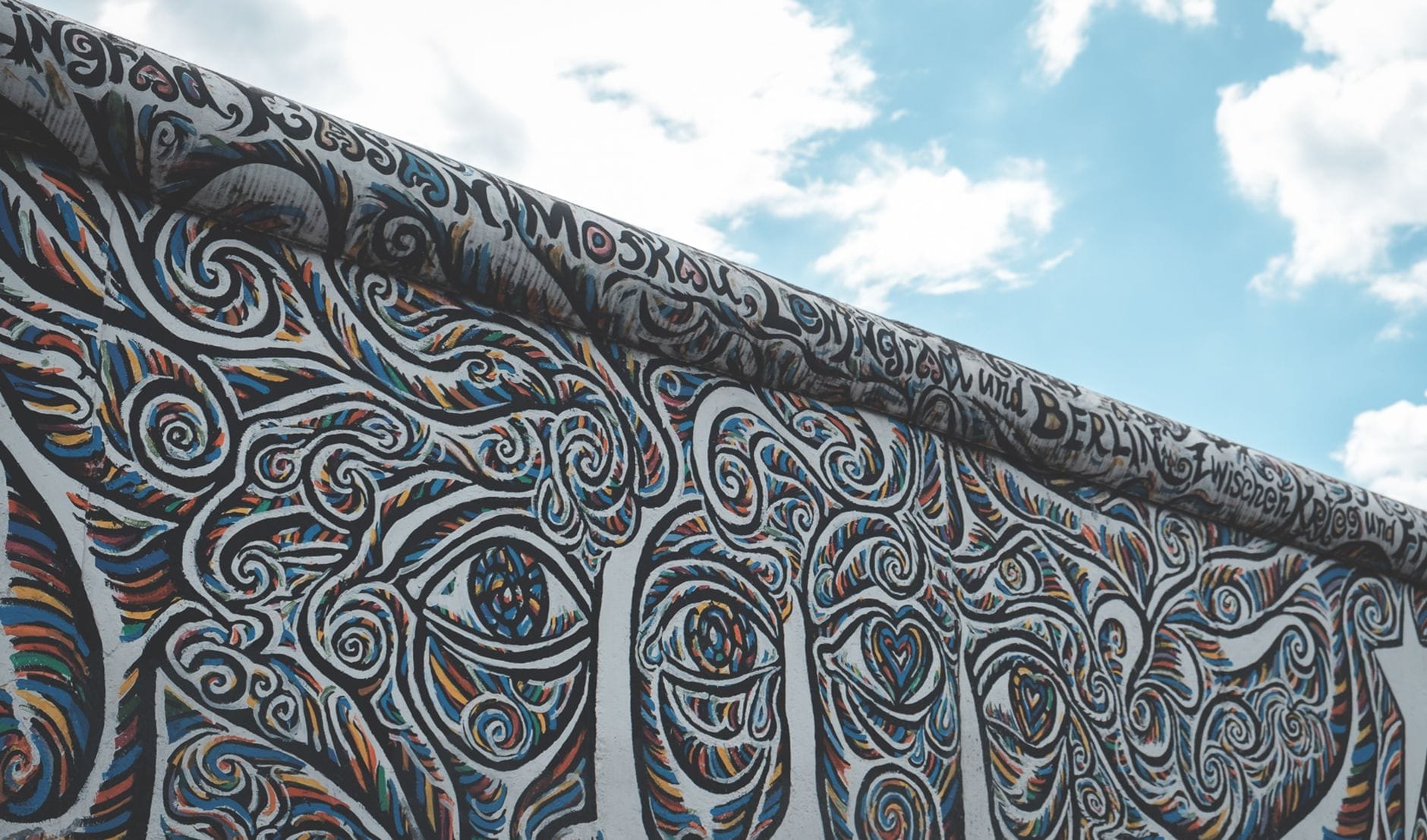
The East Side Gallery is not a gallery in any conventional sense. There are no admission queues, no darkened rooms, no audio guides handed to you at a reception desk. It is a 1,316-metre section of the original Berlin Wall, still standing along Mühlenstraße in Friedrichshain, where it runs parallel to the Spree river between Ostbahnhof and the Oberbaumbrücke. In 1990, shortly after the Wall fell, 118 artists from 21 countries painted more than 100 murals directly onto the concrete. The resulting outdoor gallery opened formally on 28 September 1990 and received protected memorial status in 1991.
The concrete itself is original: these are the actual border fortification panels, each roughly 3.6 metres tall, that once formed part of the structure dividing East and West Berlin from 1961 until the night of 9 November 1989. Walking alongside them, you are aware of their weight and blankness before any paint appears. The scale is unexpectedly imposing up close.
For broader historical context on what the Wall meant for the city, the Berlin Wall Memorial on Bernauer Straße is the more academic and architecturally considered site. The East Side Gallery is something different: more immediate, more populist, and considerably more chaotic in a way that suits its subject.
The Artworks: What You Will See
The murals range from the politically pointed to the abstractly decorative. Two images have become internationally reproduced to the point of cliché: Dmitri Vrubel's 'My God, Help Me to Survive This Deadly Love', showing a fraternal kiss between Erich Honecker and Leonid Brezhnev, and Birgit Kinder's 'Test the Rest', featuring a Trabant car breaking through the Wall. Both are photographed constantly and both are worth seeing in person, where scale and texture add something that reproductions lose.
Many of the original works deteriorated significantly over the decades due to weathering and vandalism. Between 2008 and 2009, most were restored by the original artists under a coordinated effort, though the quality and authenticity of the results prompted debate. What you see today is largely this restored version, not the raw 1990 paintings. Graffiti continues to accumulate on top of and alongside the murals, which is either a living continuation of the site's spirit or a problem, depending on your point of view. Both readings are defensible.
Moving the full length of the gallery west to east, from Ostbahnhof toward Oberbaumbrücke, gives a natural narrative arc. The density of visitors tends to drop in the middle stretch, where some of the less-reproduced works are actually more interesting. Allow time to stop at murals that are not already surrounded by tourists holding phones.
💡 Local tip
Start from the Ostbahnhof end rather than Warschauer Straße. The crowds are lighter at that end in the morning, and you walk toward the photogenic Oberbaumbrücke, which makes a natural finish point.
Tickets & tours
Hand-picked options from our booking partner. Prices are indicative; availability and final rates are confirmed when you complete your booking.
Berlin Wall East Side Gallery self-guided audio tour
From 10 €Instant confirmationEast Side Boat Cruise with Commentary on the Spree
From 30 €Instant confirmationFree cancellationThe Wall Museum at the East Side Gallery tickets
From 10 €Instant confirmationFree cancellationSolar-powered catamaran cruise on Berlin's Spree River at sunset
From 35 €Instant confirmationFree cancellation
How the Experience Changes by Time of Day
Early morning, before 9am, the gallery is genuinely quiet. The light in summer comes low and warm off the Spree, catching the surface texture of the concrete and the layered paint in a way that midday flat light does not. This is the best window for photography and for reading the works without bodies in your frame or noise in your ears. At this hour the site feels like what it is: a memorial, not a tourist corridor.
By mid-morning, especially on weekends between May and September, the gallery fills rapidly. Tour groups arrive from Ostbahnhof, cyclists thread through pedestrians, and the two famous murals become focal points for slow-moving crowds. This is still worth experiencing, but adjust your expectations: the atmosphere is lively rather than contemplative.
In the evening, particularly in summer, the light returns and the crowd composition shifts. Fewer tour groups, more Berliners walking along the river path, and a more relaxed pace. Photographers who missed the morning window often find good conditions from around 6pm onward. At night the wall is lit at points, and while visibility is lower, the gallery takes on a different character entirely, with individual murals emerging from shadow.
Winter visits are genuinely underrated. The site is free of its summer crowds, the concrete feels appropriately austere in grey light, and the historical weight of the subject is easier to absorb when you are not competing for space. Dress warmly; there is no shelter along the route and Berlin winters average around 0°C.
If you are planning a winter trip more broadly, the guide to Berlin in winter covers timing, what stays open, and how to structure days around shorter daylight hours.
Getting There and Moving Through the Site
The gallery runs along Mühlenstraße, a busy road, so the experience involves some traffic noise throughout. The footpath between the wall and the road is wide enough in most sections but narrows in places. Accessibility is generally good: the surface is level urban pavement with no steps, though the urban outdoor conditions mean it is not equivalent to indoor museum infrastructure. Visitors with mobility considerations should note the road proximity and the variable surface quality near the wall's edge.
From Ostbahnhof, the walk to the gallery entrance takes about five minutes. Warschauer Straße station, served by S-Bahn and the U1/U3 U-Bahn lines, puts you at the opposite end near Oberbaumbrücke. Bus 300 stops at East Side Gallery and Tamara-Danz-Straße directly along the route. If you are coming from Kreuzberg or Mitte by U-Bahn, Schlesisches Tor (U1/U3) deposits you at the Oberbaumbrücke end after a short walk across the bridge.
The Oberbaumbrücke itself is worth a pause: the double-deck red-brick bridge over the Spree was a former border crossing and now connects Friedrichshain to Kreuzberg. Walking across it before or after the gallery adds historical depth and a good river view.
ℹ️ Good to know
The East Side Gallery is open 24 hours a day, 365 days a year. Admission is free. No booking is required.
Historical and Cultural Context
The Berlin Wall was constructed beginning on 13 August 1961, initially as a barbed-wire barrier that was rapidly reinforced with concrete. It eventually stretched approximately 155 kilometres around West Berlin. The Mühlenstraße section that survives as the East Side Gallery ran along the inner edge of the restricted border zone on the Eastern side, facing the Spree. Because it was on the Eastern side, it was not the surface that West Berliners painted and decorated during the years of division. That painted western face was largely demolished. What survives at the East Side Gallery is the east-facing concrete, painted for the first time only after the Wall had already fallen.
This distinction matters. The East Side Gallery is not a document of resistance during the Cold War. It is a document of response to liberation, created by an international community of artists in the months immediately after reunification became possible. That context shifts how the murals read: they are not protest art made under surveillance, but celebratory and sometimes satirical works made in a moment of collective euphoria and uncertainty about what would come next.
For a deeper engagement with the divided city and the Cold War period, the Cold War Berlin guide covers sites across the city including Checkpoint Charlie, the Palace of Tears, and the Stasi Museum. The Berlin memorials guide provides a comparative overview of how the city has chosen to remember its divided past.
Photography and Practical Considerations
The East Side Gallery is one of the most photographed sites in Berlin, and the best images require some patience. The two famous murals are almost always surrounded by people, especially between 10am and 4pm. Morning is the clear answer for photographers, but even then, arriving at the Ostbahnhof end first and working toward Warschauer Straße means you reach the most-photographed works before the tour groups do.
The concrete surface catches light differently depending on angle and time of day. Overcast conditions actually work well for even colour rendering. A wide-angle lens is useful for capturing full panels, while detail shots of cracked and layered paint can be rewarding with a standard focal length. The river side of Mühlenstraße offers views back toward the wall from a slight distance if you want to include the Spree in frame.
Wear comfortable shoes and plan for approximately 1.3 kilometres on foot. The walk is flat throughout. There are cafes and food options at both ends of the gallery, particularly near Warschauer Straße, which has a concentration of bars, restaurants, and the RAW Gelände complex nearby.
⚠️ What to skip
The area directly adjacent to the wall is often used by cyclists as a shortcut. Watch for fast-moving bikes, especially if you are stopping frequently to photograph.
Is the East Side Gallery Worth Your Time?
The honest answer is: yes, with managed expectations. The East Side Gallery is genuinely significant, both historically and artistically, and walking its full length takes no more than 90 minutes at a thoughtful pace. It costs nothing. The combination of scale, subject matter, and setting on the Spree is unlike anything else in the city.
However, visitors who arrive expecting pristine 1990 paintings in a contemplative setting will be disappointed. The murals are weathered, repeatedly restored and re-graffitied, and the surroundings are urban and sometimes noisy. The commercial density near Warschauer Straße, with souvenir stalls and merchandise near the wall, undercuts the memorial atmosphere at that end.
Visitors who want more curatorial structure around Berlin Wall history may find the Berlin Wall Memorial on Bernauer Straße more rewarding as a primary site, with the East Side Gallery as a complementary experience afterward. Those already exploring Friedrichshain will find it a natural and worthwhile stop that requires no detour.
Who should skip it: visitors with very limited time who have already engaged deeply with Berlin Wall history elsewhere may find the experience repetitive rather than additive. The site also rewards walkers; if mobility is significantly limited, the full experience is harder to access.
Insider Tips
- Arrive before 9am on any day of the week for genuinely calm conditions. The gallery never closes, and early morning access on a weekday in shoulder season (April or October) gives you the site almost entirely to yourself.
- The less-photographed murals in the middle section of the gallery, between the two main entry points, include some of the more formally interesting works. Most visitors walk quickly through this stretch; slow down here.
- If you are doing a longer Berlin Wall route, the East Side Gallery pairs logically with a visit to the Oberbaumbrücke at the western end and then a walk or tram ride to the Berlin Wall Memorial on Bernauer Straße for the full arc of how the Wall is remembered.
- The restored murals from 2008-2009 sparked controversy when original artists repainted over earlier graffiti layers. Reading about this debate before your visit makes the layered, imperfect surface more legible as a document of the site's contested afterlife.
- Street food and coffee options near Warschauer Straße have improved significantly in recent years. If you finish your walk at that end, the area around the station is a reasonable place to stop before heading onward.
Who Is East Side Gallery For?
- Travellers with an interest in Cold War history and Berlin's division
- Street art and mural photography enthusiasts
- Solo walkers who want a meaningful, self-paced outdoor route
- First-time visitors to Berlin looking for a free and substantive experience
- Anyone exploring Friedrichshain who wants historical grounding alongside the neighbourhood's contemporary character
Nearby Attractions
Other things to see while in Friedrichshain:
- Berghain / Panorama Bar
Housed in a former DDR-era power plant near Ostbahnhof, Berghain / Panorama Bar is the nucleus of Berlin's techno scene and one of the most discussed nightclubs on earth. This guide covers what the experience is actually like, how the door works, and who should probably skip it.
- Karl-Marx-Allee
Karl-Marx-Allee is Karl-Marx-Allee is a 2.3-kilometre stretch of monumental East German architecture running through Friedrichshain and Mitte, built between 1949 and 1961 as a showcase of socialist urbanism. as a showcase of socialist urbanism. Free to walk at any hour, it offers one of the most intact and visually striking examples of Stalinist classicism outside Russia, with wide sidewalks, ornate residential towers, and landmarks like Kino International still operating today.
- Oberbaumbrücke
Oberbaumbrücke is a double-deck brick bridge over the River Spree, connecting Friedrichshain and Kreuzberg since 1896. Its neo-Gothic towers, resident U-Bahn line, and position on the former Berlin Wall border make it one of the city's most historically loaded and visually striking crossings. Entry is free, and it's open around the clock.
- RAW-Gelände
RAW-Gelände is a sprawling former railway repair works in Friedrichshain that has been reinvented as one of Berlin's most charismatic open cultural complexes. Across more than 70,000 square metres of semi-derelict industrial buildings, the site hosts nightclubs, street art, beach bars, skate facilities, and weekend markets. Entry to the outdoor grounds is free, and the gates stay open around the clock.