RAW-Gelände: Berlin's Industrial Playground in Friedrichshain
RAW-Gelände is a sprawling former railway repair works in Friedrichshain that has been reinvented as one of Berlin's most charismatic open cultural complexes. Across more than 70,000 square metres of semi-derelict industrial buildings, the site hosts nightclubs, street art, beach bars, skate facilities, and weekend markets. Entry to the outdoor grounds is free, and the gates stay open around the clock.
Quick Facts
- Location
- Revaler Straße 99, 10245 Berlin (Friedrichshain)
- Getting There
- S+U Warschauer Straße (S3, S5, S7, S75, S9, U1, U3); Tram M10/M13 to Revaler Straße
- Time Needed
- 1–2 hours for exploration; all evening for nightlife
- Cost
- Free to enter the grounds; venue/club entry fees vary
- Best for
- Nightlife, street art, weekend flea markets, urban culture
- Official website
- raw-gelaende.de
What Is RAW-Gelände?
RAW-Gelände, formally known as RAW-Friedrichshain, is a former Prussian railway maintenance facility that has evolved over two decades into one of the most distinctive cultural spaces in eastern Berlin. The site stretches across more than 70,000 square metres and sits just a short walk from the Warschauer Straße transport hub, making it one of the most accessible examples of Berlin's post-reunification urban repurposing.
The original facility, built in 1867 as the Königlich Preußische Eisenbahnwerkstatt Berlin II, later operated as a Reichsbahnausbesserungswerk, the repair works of the Deutsche Reichsbahn. The acronym RAW stuck. After reunification, the workshops fell idle, and from 1999 the site was gradually colonised by clubs, social projects, artists, and sports facilities. In April 2015, a substantial 52,000 m² section was acquired by developer Kurth, shifting the site toward a more managed model, though its rough-edged character largely remains.
Unlike a conventional attraction, RAW-Gelände has no single entrance fee, no curated visitor route, and no closing time for its outdoor grounds. It operates more like a small city district compressed onto an industrial plot. Think of it as the physical counterpart to the East Side Gallery, another Friedrichshain landmark built on the bones of Berlin's divided past.
The Grounds: What You Actually See
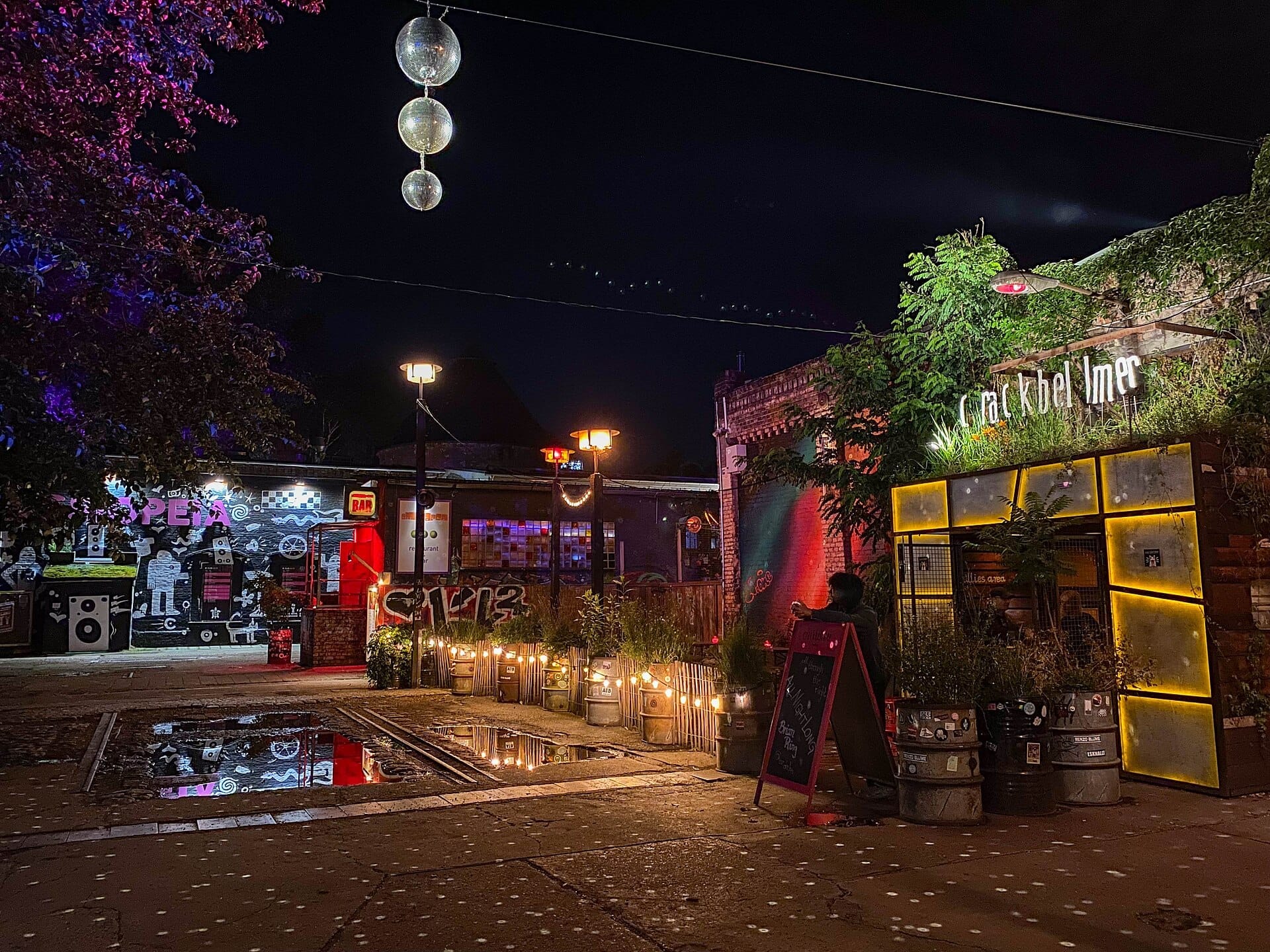
The complex is a patchwork of reused red-brick workshop buildings, open courtyards, makeshift bars, and painted concrete walls. Much of the architecture is deliberately unfinished-looking, with exposed steel, crumbling render, and layers of graffiti that change from month to month. This is not a manicured heritage site. It has the texture of a place that still feels unresolved, which is precisely its appeal.
On a daytime weekday visit, the site feels sparse and almost contemplative. You can walk through the yards, inspect the street art up close, and get a clear sense of the architectural bones without crowds in the way. The brick workshops carry the weight of industrial history, and several buildings retain original ironwork and heavy timber doors. The contrast between the 19th-century railway engineering and the layers of contemporary art and pop-up culture is immediately legible.
The site includes a climbing wall, a skatepark, and a beach volleyball facility, making it more physically active than most urban cultural spaces in Berlin. On summer afternoons, the sports areas see steady use from locals, giving the place a neighbourhood feel that's absent from more tourist-heavy zones like Alexanderplatz.
💡 Local tip
Visit on a Saturday afternoon to catch the flea market atmosphere and street food stalls before the evening club crowd arrives. The transition between the two moods, families and browsers giving way to the nightlife queue, happens quickly after sunset.
Tickets & tours
Hand-picked options from our booking partner. Prices are indicative; availability and final rates are confirmed when you complete your booking.
Berlin nightlife experience with bar crawl, club entry and shots
From 25 €Instant confirmationFree cancellationSkip-the-line ticket for Gemaldegalerie Berlin
From 14 €Instant confirmationPanoramapunkt Berlin ticket with skip-the-line option
From 9 €Instant confirmation1-Hour Berlin Spree River Cruise with On-Board Guide
From 21 €Instant confirmationFree cancellation
How the Site Changes By Time of Day
Morning is the quietest window. The outdoor area is accessible around the clock, but before midday the only activity tends to be cleaners, delivery workers for the cafés, and the occasional skater. The industrial silence at this hour, broken only by distant S-Bahn trains on the elevated tracks nearby, gives you the clearest sense of the site's pre-cultural history.
By mid-afternoon on weekends, the energy shifts considerably. Vendors set up food stalls near the central courtyards, the sports facilities fill up, and weekend markets bring browsers of all ages. The smell of grilled food, the clatter of skateboards on concrete, and the bass bleed from soundcheck rehearsals inside the clubs all layer together. It is deliberately un-curated, and navigating it rewards curiosity over planning.
After dark, RAW-Gelände becomes primarily a nightlife destination. Several clubs operate from within the old workshop buildings, their bass audible from the street outside. The contrast between the dark industrial exterior and the lights and sound inside is part of the experience. Queues form at club entrances on Friday and Saturday nights, and the crowd skews younger and local rather than tourist-heavy. If you are here primarily to explore the cultural and architectural character of the site, evening is not the ideal time.
The Nightlife Scene Inside RAW
RAW-Gelände is home to several clubs and bars housed inside the former workshop buildings. Entry fees and door policies are set independently by each venue and change frequently, so check individual venue websites before visiting. The clubs here sit in a different tier from the internationally famous Berghain, which is also in Friedrichshain, but they attract a genuine Berlin crowd and maintain the neighbourhood's reputation for nightlife with less ceremony around the door.
Most venues open late and run through the early morning. If you are planning a nightlife visit, note that the industrial site has limited lighting in the outdoor areas between venues. Wearing practical footwear matters: the ground surfaces include uneven cobblestone, gravel, and cracked concrete, and navigating between venues after midnight requires some care.
⚠️ What to skip
RAW-Gelände is privately owned but freely accessible. Security at individual venues may decline entry at their discretion. Bring valid ID. The outdoor area is poorly lit at night and the surface is uneven in places, so flat, sturdy shoes are strongly recommended.
Street Art, Markets, and Daytime Culture
For visitors with no interest in clubbing, RAW-Gelände still has genuine daytime value. The walls across the complex are covered in rotating murals and graffiti that constitute a live, unguided street art gallery. Artists have worked on the site for years, and sections of it have become significant within Berlin's street art scene. Unlike static murals in more polished districts, the work here gets painted over, added to, and responded to, which gives the walls an evolving quality.
Weekend markets bring a different crowd. The flea market element draws vintage shoppers, second-hand book buyers, and the kind of browsing that works best without a tight schedule. If you enjoy this type of urban market culture, the nearby Mauerpark flea market in Prenzlauer Berg offers a useful comparison, though RAW has a more local and less tourism-oriented feel.
Photography is rewarding here at almost any hour, though the quality of light in the late afternoon, when sun catches the brick facades from a low angle, is particularly good. The combination of industrial architecture and layered visual culture makes it one of the more photogenic urban spaces in Friedrichshain. For a broader look at Berlin's street art culture, the Berlin street art guide covers the wider city context.
Getting There and Practical Notes
The main address is Revaler Straße 99, 10245 Berlin. S+U Warschauer Straße is the primary transit connection, served by S-Bahn lines S3, S5, S7, S75, and S9, and by U-Bahn lines U1 and U3. Tram M10 and M13 run to Revaler Straße, stopping very close to the site entrance. Bus lines 300, 347, and N1 stop at Helsingforser Platz nearby. The walk from Warschauer Straße station takes approximately five minutes.
The outdoor area is open 24 hours. Individual clubs, bars, and market vendors operate on their own schedules, and you should check specific venues before making the trip for a particular event. There is no central ticketing office for the site as a whole.
Accessibility across the site is inconsistent. The grounds are an active industrial repurposing project with uneven terrain, and there is no unified accessibility standard applied across all venues. Visitors with mobility requirements should contact individual venues directly before visiting. For a broader overview of how to navigate the city, the getting around Berlin guide covers transport options across all districts.
ℹ️ Good to know
RAW-Gelände is in the heart of Friedrichshain, a neighbourhood with a dense concentration of bars, late-night food options, and the Oberbaumbrücke bridge nearby. It pairs naturally with a broader evening walk through the district.
Who Should Skip RAW-Gelände
RAW-Gelände is not a family attraction in any conventional sense. While the sports facilities are used by locals of all ages during the day, the overall character of the site, its uneven ground, graffiti-covered walls, and nightlife orientation, does not make it a natural choice for families with young children or visitors looking for an organised, comfortable sightseeing experience.
Travellers who prioritise heritage in a formal sense, with guided interpretation, preserved interiors, and institutional presentation, will find more satisfaction at Berlin's museum district. RAW retains its industrial history as backdrop rather than exhibit. There are no guided tours, no audio guides, and no visitor centre. If that kind of structure matters to you, manage expectations accordingly.
It is also worth noting that RAW-Gelände is not, by Berlin standards, undiscovered. It appears in enough travel coverage that weekends attract a mixed crowd of locals and tourists. If you want to understand the authentic neighbourhood character of Friedrichshain at its most everyday, a walk along Karl-Marx-Allee or around the side streets east of Warschauer Straße offers a quieter kind of immersion.
Insider Tips
- Come on a Saturday afternoon rather than a Friday or Saturday night if you want to see the full range of what RAW offers: market stalls, sports use, street art, and café culture all coexist before the nightlife crowds take over after dark.
- The flea market and street food stalls are concentrated in the central courtyard area nearest the Revaler Straße entrance. Go straight through the main gate and you will find them without needing to navigate the entire site.
- The brick walls on the northern side of the complex tend to receive the best light for photography in the afternoon. The combination of peeling industrial paint and layered graffiti is at its most visually readable when the sun is low.
- Venue entry policies at RAW clubs are generally more relaxed than at Friedrichshain's most famous clubs, but bringing your passport or national ID card is still essential. Some venues will not accept a photo of an ID on a phone.
- The terrain between buildings is rough and includes loose gravel and uneven cobblestones. This matters more than it sounds after a few hours and several drinks. Flat, closed-toe shoes make the evening noticeably more comfortable.
Who Is RAW-Gelände For?
- Nightlife explorers who want a more local, lower-key alternative to Friedrichshain's most famous clubs
- Street art photographers looking for a concentrated, freely accessible outdoor gallery
- Weekend visitors who want to browse flea market stalls and street food in a genuinely urban setting
- Architecture and urban history enthusiasts interested in post-industrial repurposing
- Travellers spending a full evening in Friedrichshain who want a flexible starting point before exploring the wider neighbourhood
Nearby Attractions
Other things to see while in Friedrichshain:
- Berghain / Panorama Bar
Housed in a former DDR-era power plant near Ostbahnhof, Berghain / Panorama Bar is the nucleus of Berlin's techno scene and one of the most discussed nightclubs on earth. This guide covers what the experience is actually like, how the door works, and who should probably skip it.
- East Side Gallery
The East Side Gallery is a 1,316-metre stretch of the former Berlin Wall painted by 118 artists from 21 countries in 1990. Free to visit at any hour, this protected memorial in Friedrichshain is the longest surviving section of the Wall and one of the most significant open-air art sites in the world.
- Karl-Marx-Allee
Karl-Marx-Allee is Karl-Marx-Allee is a 2.3-kilometre stretch of monumental East German architecture running through Friedrichshain and Mitte, built between 1949 and 1961 as a showcase of socialist urbanism. as a showcase of socialist urbanism. Free to walk at any hour, it offers one of the most intact and visually striking examples of Stalinist classicism outside Russia, with wide sidewalks, ornate residential towers, and landmarks like Kino International still operating today.
- Oberbaumbrücke
Oberbaumbrücke is a double-deck brick bridge over the River Spree, connecting Friedrichshain and Kreuzberg since 1896. Its neo-Gothic towers, resident U-Bahn line, and position on the former Berlin Wall border make it one of the city's most historically loaded and visually striking crossings. Entry is free, and it's open around the clock.