Oberbaumbrücke: Berlin's Most Photogenic Bridge
Oberbaumbrücke is a double-deck brick bridge over the River Spree, connecting Friedrichshain and Kreuzberg since 1896. Its neo-Gothic towers, resident U-Bahn line, and position on the former Berlin Wall border make it one of the city's most historically loaded and visually striking crossings. Entry is free, and it's open around the clock.
Quick Facts
- Location
- Am Oberbaum, 10243 Berlin (Friedrichshain/Kreuzberg border)
- Getting There
- U Schlesisches Tor or S+U Warschauer Str. (both ~0.4 km); bus stop Oberbaumbrücke
- Time Needed
- 20–45 minutes to walk and photograph; longer if you linger on the riverbank
- Cost
- Free. No ticket, no booking required. Open 24 hours.
- Best for
- Architecture lovers, photographers, history buffs, and anyone walking between Kreuzberg and Friedrichshain
What Is Oberbaumbrücke?
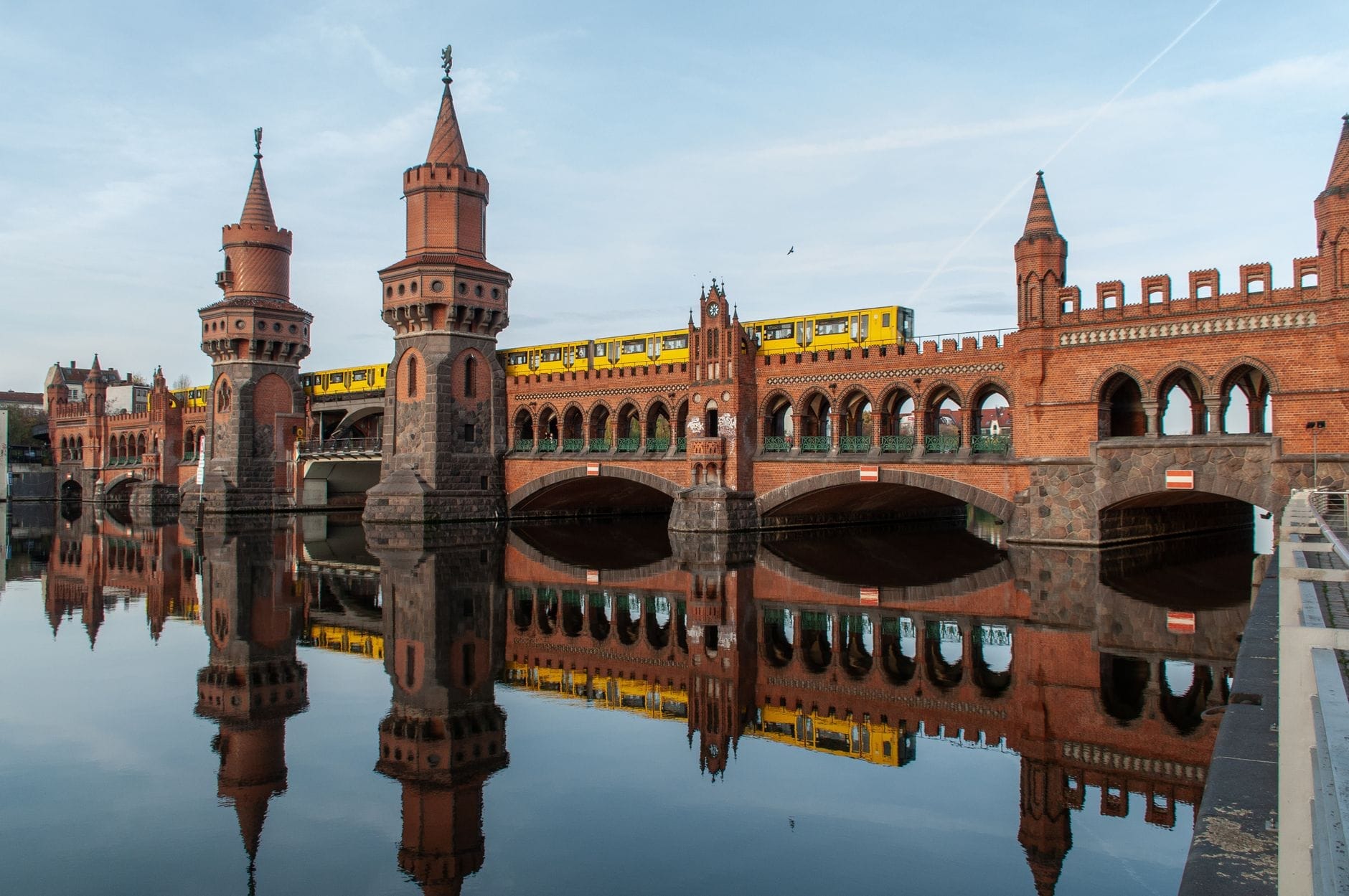
The Oberbaumbrücke (Oberbaum Bridge) is one of Berlin's most recognizable structures: a 154-meter double-deck crossing over the River Spree, built in red brick with neo-Gothic towers, pointed arches, and a working U-Bahn line rumbling across its upper deck. It has connected the districts of Friedrichshain and Kreuzberg since 1896, and that civic role, linking two distinct communities across water and, for decades, across a geopolitical divide, gives it a significance that goes well beyond its photogenic exterior.
Unlike many of Berlin's landmark structures, the Oberbaumbrücke is not a museum or a monument behind a ticket barrier. It is a working piece of infrastructure. Cyclists, pedestrians, and U-Bahn trains share its structure simultaneously, which means you experience it in motion rather than from a respectful distance. That quality, ordinary city life layered over extraordinary architecture, is precisely what makes it worth seeking out.
💡 Local tip
For the best photograph of the bridge's full length, walk down to the Spree riverbank on the Friedrichshain side. The angle shows both towers, the brick arches, and often a U-Bahn train crossing overhead if you time it right.
Architecture and Historical Context
The bridge was designed by the city architect Otto Stahn and completed in 1896, part of a wave of civic construction during Berlin's rapid industrial expansion under Kaiser Wilhelm II. Stahn drew on late medieval brick Gothic, a style rooted in Northern European ecclesiastical and civic buildings, and applied it to what was essentially a traffic bridge. The result is unusual: a utilitarian crossing dressed in the visual language of a cathedral gatehouse, complete with octagonal towers, blind arcading, and decorative crenellation.
The upper deck was designed from the start to carry the elevated railway, which is now the U1 and U3 lines running between Warschauer Str. and the western city. Watching a yellow Berlin U-Bahn train slide across the Gothic arcade is one of those small, slightly surreal moments the city delivers without fanfare.
The bridge was partially destroyed in the final weeks of World War II, as retreating Wehrmacht units demolished river crossings to slow the Soviet advance. A temporary wooden structure was erected after the war, and the current stone bridge was fully reconstructed and reopened in 1994, with Spanish architect Santiago Calatrava contributing a cable-stayed central span to replace the destroyed section, though this addition was later replaced with a more historically sympathetic design. Today the restored version closely follows Stahn's original.
Tickets & tours
Hand-picked options from our booking partner. Prices are indicative; availability and final rates are confirmed when you complete your booking.
Skip-the-line ticket for Gemaldegalerie Berlin
From 14 €Instant confirmationPanoramapunkt Berlin ticket with skip-the-line option
From 9 €Instant confirmation1-Hour Berlin Spree River Cruise with On-Board Guide
From 21 €Instant confirmationFree cancellationSamurai Experience Berlin skip-the-line ticket
From 15 €Instant confirmation
How the Experience Changes by Time of Day
Early morning, roughly 7 to 9 a.m., the bridge belongs almost entirely to commuters. Cyclists stream across from Kreuzberg toward Warschauer Str. The light at this hour, especially in spring and autumn, hits the red brick at a low angle and turns it a deep rust-orange. The Spree below is usually calm, reflecting the towers in the water. There is almost no tourist pressure at this hour, which makes it the best time for photography without people in every frame.
By midday the bridge is properly busy. Tour groups come through, particularly in summer, and the footpath narrows between cyclists who treat it as a through route and visitors who stop to lean on the railings and look downriver toward the East Side Gallery. The energy is not unpleasant, just compressed. The views from the middle of the bridge, upstream toward the Museum of Technology district and downstream toward the old port cranes at Osthafen, are worth the pause.
At dusk the bridge is lit with warm amber lights that play against the brick. On clear evenings, particularly in summer, people gather on the steps leading down to the riverbank on both sides to sit, drink, and watch the light change. The U-Bahn trains crossing overhead glow from inside as the sky darkens, and the combined effect of illuminated Gothic towers and moving train cars is genuinely striking. This is the hour the bridge rewards most generously.
ℹ️ Good to know
In winter, fog over the Spree can make the towers appear to emerge from nothing. Cold mornings between November and February, when the riverbanks are nearly empty, offer some of the bridge's most atmospheric conditions. Dress warmly and bring a lens cloth for condensation.
Walking the Bridge: A Practical Guide
The most natural approach is from the Friedrichshain side, arriving via S+U Warschauer Str. From the station, walk south along Warschauer Str. for about 400 meters until you reach the northern tower. The approach gives you the full elevation of the structure before you step onto it.
The pedestrian and cycling path runs along the lower deck, at road level. The upper deck is for U-Bahn only and is not accessible to pedestrians. The lower walkway is about 5 meters wide and shared by foot traffic moving in both directions plus a steady flow of cyclists. Stay aware of bikes, particularly on weekday mornings and evenings when commuter volume peaks. There is no formal separation between cyclists and pedestrians on the crossing itself.
The Kreuzberg end of the bridge drops you onto Skalitzer Str., close to Schlesisches Tor U-Bahn station and within a short walk of the Turkish Market at Maybachufer, which runs on Tuesdays and Fridays along the Landwehrkanal. Combining both in one morning is a practical and rewarding half-day itinerary.
⚠️ What to skip
The shared pedestrian and cycling lane can feel narrow during peak hours. If you plan to stop frequently for photographs, move to the side of the walkway rather than pausing mid-stream. Cyclists on this route tend to move fast.
The Surrounding Area
The Oberbaumbrücke sits at the western end of the East Side Gallery, the longest preserved section of the Berlin Wall, which runs east along the Spree from the Friedrichshain bank. Walking from the bridge along the wall takes about 15 minutes to cover the full 1.3 km stretch. This combination, bridge plus wall section, is one of the most concentrated historical routes in the city.
On the Kreuzberg side, the riverbank has developed significantly since reunification. The area around Schlesische Str. and Paul-Lincke-Ufer has bars, restaurants, and a creative-industry cluster that bleeds into the broader Kreuzberg scene. The Media Spree development, which includes large tech company offices and event venues, has transformed what was once wasteland along this stretch of river into a functional mixed-use district, not universally welcomed by longtime residents, but worth knowing about as context.
Visitors with more time should note that RAW Gelände, the former railway repair yard turned cultural venue, is a short walk from Warschauer Str. on the Friedrichshain side. It operates as a weekend flea market, climbing wall, and event space, and represents a different but complementary face of the neighborhood.
Photography Tips and Practical Notes
The single best angle is from the riverbank below the Friedrichshain tower, looking southwest. A wide-angle lens captures both towers and the full sweep of the arches. A telephoto lens from further downriver, near the East Side Gallery, isolates the towers against sky. For sunset shots, position yourself on the Kreuzberg riverbank facing northeast so the light falls directly on the brick face.
Drone photography is subject to German aviation regulations and is not permitted in urban Berlin without prior authorization from the relevant aviation authority. Do not assume it is acceptable here.
The bridge is accessible around the clock, and accessibility for wheelchair users depends on the approach route. The bridge deck itself is flat, but the riverbank steps below are not ramped. Warschauer Str. station has elevator access, making the approach from that side manageable. The Schlesisches Tor approach involves stairs at the U-Bahn station, so check current BVG accessibility information before planning that route.
💡 Local tip
If you want a photograph without cyclists in the frame, 6:30 to 7:00 a.m. on a weekend morning is close to ideal. Traffic is minimal, the light is favorable for much of the year, and the U-Bahn runs frequently enough that you can catch a train crossing with patience.
Insider Tips
- The steps leading down to the Spree on the Friedrichshain side are a popular informal gathering spot on summer evenings. Bring something to drink and sit for a while: the view of the lit bridge from river level at night is better than the view from the bridge itself.
- The bridge appears in the opening sequence of the film 'Run Lola Run' (Lola rennt, 1998), one of the defining Berlin films of the 1990s. Watching the film before or after your visit adds a layer of cultural context that guidebooks rarely mention.
- If you time your walk to cross as a U1 or U3 train passes overhead, the low rumble through the brick structure is noticeable underfoot. It is an oddly satisfying sensory detail that reminds you this is a functional building, not a stage set.
- The bridge was the site of an annual flour-sack battle between Friedrichshain and Kreuzberg residents on Unity Day (October 3rd) for many years, a mock 'war' between the two districts with thousands of participants. The tradition has been interrupted in recent years but is worth checking if you are visiting in early October.
- From the center of the bridge looking upstream, you can see the Molecule Man sculpture rising from the middle of the Spree: three interlocking human figures, 30 meters tall, by American artist Jonathan Borofsky. It marks the point where Friedrichshain, Kreuzberg, and Treptow-Köpenick meet in the river.
Who Is Oberbaumbrücke For?
- Architecture and urban history enthusiasts who want to read a building rather than just photograph it
- Photographers working the golden hour on either end of the day
- Walkers combining the bridge with the East Side Gallery as part of a Berlin Wall itinerary
- Travelers crossing between Kreuzberg and Friedrichshain on foot or by bike who want to understand why this particular crossing matters
- Anyone curious about how Berlin's reunification physically reshaped the city's geography
Nearby Attractions
Other things to see while in Friedrichshain:
- Berghain / Panorama Bar
Housed in a former DDR-era power plant near Ostbahnhof, Berghain / Panorama Bar is the nucleus of Berlin's techno scene and one of the most discussed nightclubs on earth. This guide covers what the experience is actually like, how the door works, and who should probably skip it.
- East Side Gallery
The East Side Gallery is a 1,316-metre stretch of the former Berlin Wall painted by 118 artists from 21 countries in 1990. Free to visit at any hour, this protected memorial in Friedrichshain is the longest surviving section of the Wall and one of the most significant open-air art sites in the world.
- Karl-Marx-Allee
Karl-Marx-Allee is Karl-Marx-Allee is a 2.3-kilometre stretch of monumental East German architecture running through Friedrichshain and Mitte, built between 1949 and 1961 as a showcase of socialist urbanism. as a showcase of socialist urbanism. Free to walk at any hour, it offers one of the most intact and visually striking examples of Stalinist classicism outside Russia, with wide sidewalks, ornate residential towers, and landmarks like Kino International still operating today.
- RAW-Gelände
RAW-Gelände is a sprawling former railway repair works in Friedrichshain that has been reinvented as one of Berlin's most charismatic open cultural complexes. Across more than 70,000 square metres of semi-derelict industrial buildings, the site hosts nightclubs, street art, beach bars, skate facilities, and weekend markets. Entry to the outdoor grounds is free, and the gates stay open around the clock.