Turkish Market Maybachufer: Berlin's Best Open-Air Market
The Turkish Market at Maybachufer draws up to 180 traders to the canal banks of Neukölln every Tuesday and Friday. Part food market, part social ritual, it's one of the most authentic outdoor markets in the city — free to enter and open to all.
Quick Facts
- Location
- Maybachufer, 12047 Berlin (Neukölln / Reuterkiez)
- Getting There
- U8 Schönleinstrasse or U1/U3/U8 Kottbusser Tor, then 5–10 min walk
- Time Needed
- 1–2 hours for the food market; longer if browsing the canal
- Cost
- Free entry; pay only for what you buy (EUR)
- Best for
- Food lovers, local culture, photography, slow mornings
- Official website
- www.visitberlin.de/en/neukollner-wochenmarkte-am-maybachufer
What the Turkish Market at Maybachufer Actually Is
The Türkischer Markt am Maybachufer, officially the Neuköllner Wochenmarkt am Maybachufer, runs along the northern bank of the Landwehrkanal between Kottbusser Brücke and Friedelstraße every Tuesday and Friday from 11:00 to 18:30. With up to 180 traders spreading across both sides of the canal-side street, it holds its place as one of the largest Turkish-oriented markets in Berlin — not as a tourist reconstruction, but as a functioning weekly provisioning market that has served the neighborhood's large Turkish and Arab community for decades.
The distinction matters. This is not a curated food hall or a weekend pop-up. It is a working street market where vendors shout prices in Turkish and German, whole fish are laid out on ice, and the smell of freshly baked simit (sesame bread rings) mixes with roasting köfte and the sharp edge of spice stalls. Alongside established Turkish vendors, you'll find traders selling Italian cheeses, organic produce from Brandenburg farms, fresh herbs, olives by the kilo, and handmade pasta. The mix is the point.
💡 Local tip
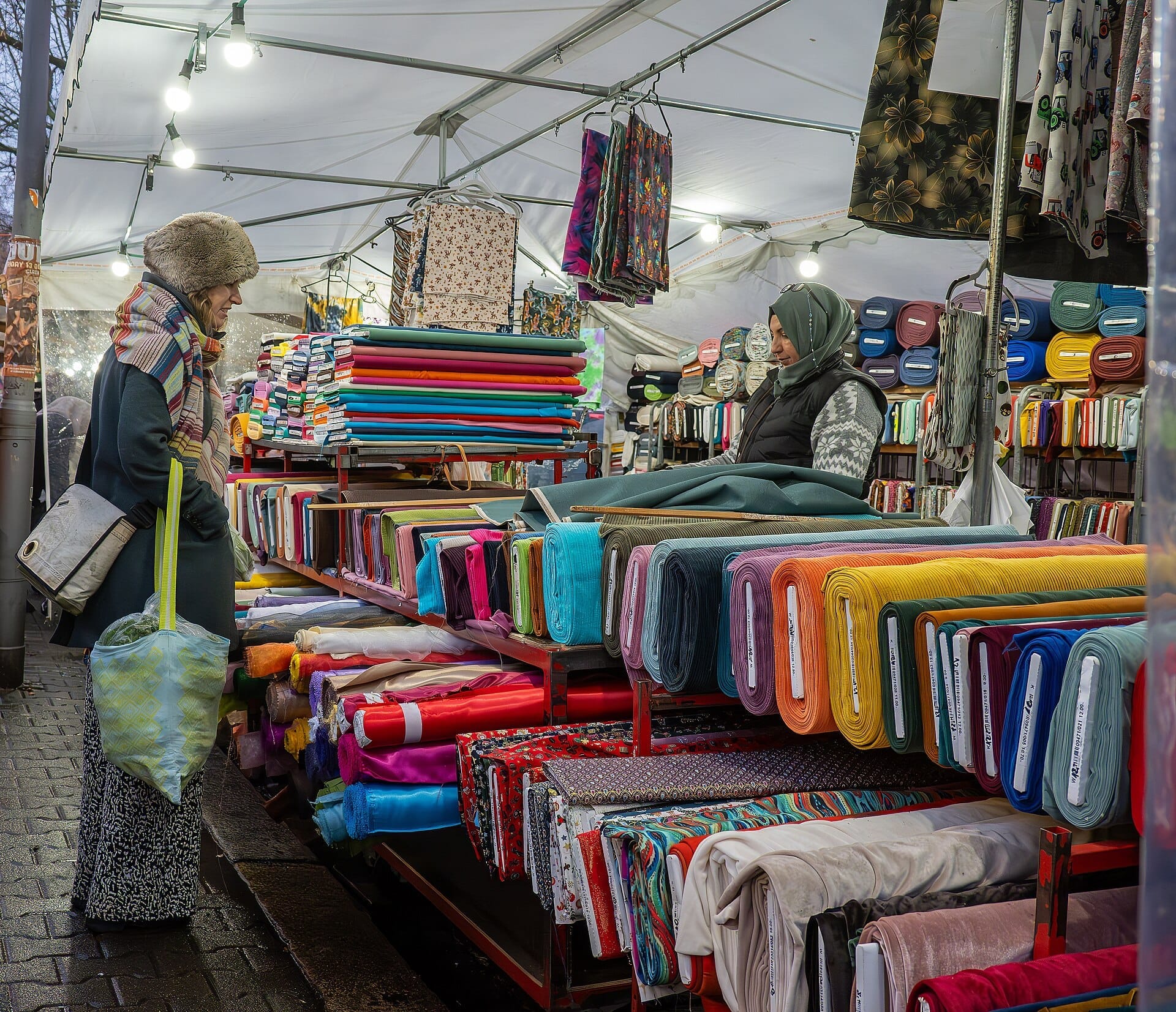
The fabric market runs on Saturdays (11:00–17:00), and the Nowkoelln Flowmarkt flea market takes over roughly every second Sunday. If you want the full Turkish food experience, come Tuesday or Friday.
How the Market Changes Through the Day
Arriving at 11:00 when the market opens means quieter stalls, vendors still arranging their displays, and a genuine chance to talk to traders without the crowd pressing in. The light at this hour falls low across the canal, catching the colors of stacked peppers and pomegranates in a way that photographers specifically seek out. It's also when the bread is freshest and the queues at the street food stalls are shortest.
By early afternoon, around 13:00–14:00, the market hits its peak density. The canal path becomes a slow shuffle. Families, students from nearby Kreuzberg, office workers on lunch breaks from the surrounding streets — everyone converges. The noise level rises noticeably: vendor calls, the crackle of frying pans, bicycle bells from riders trying to thread through the crowd. This is the most atmospheric hour but also the most physically demanding, particularly for anyone with mobility considerations.
After 17:00, vendors begin reducing prices on perishables. It's common to see significant discounts on fruit, vegetables, and pastries in the final ninety minutes. The crowd thins, the pace slows, and the canal view reasserts itself. If your goal is eating cheaply rather than photographing the peak scene, the last hour rewards patience.
Tickets & tours
Hand-picked options from our booking partner. Prices are indicative; availability and final rates are confirmed when you complete your booking.
Skip-the-line ticket for Gemaldegalerie Berlin
From 14 €Instant confirmationPanoramapunkt Berlin ticket with skip-the-line option
From 9 €Instant confirmation1-Hour Berlin Spree River Cruise with On-Board Guide
From 21 €Instant confirmationFree cancellationSamurai Experience Berlin skip-the-line ticket
From 15 €Instant confirmation
What to Buy and Eat
The produce side of the market is genuinely strong. Vendors carry varieties of eggplant, tomato, and pepper that don't appear in German supermarkets. Olives are sold loose from barrels in dozens of preparations. Turkish cheeses — beyaz peynir, kaşar — are cut to order. Dried fruits, nuts, and spice mixes are weighed by hand. If you're self-catering during your stay in Berlin, a Tuesday or Friday morning here stocks a kitchen far better than any convenience store.
For eating on the spot, the street food options are serious. Gözleme (thin flatbread stuffed with cheese, spinach, or meat and cooked on a griddle) is the market's signature dish and draws reliable queues. Köfte rolls, falafel wraps, and stuffed mussels (midye) are common at other stalls. Simit, the sesame-crusted bread ring found across Turkey, is sold fresh and warm. Budget roughly 3–8 EUR for a full street food meal, depending on what you pick.
ℹ️ Good to know
Most stalls accept cash only. ATMs are available nearby on Kottbusser Damm and Sonnenallee, but bringing small EUR notes avoids friction at the busy stalls.
The Neighborhood Context: Neukölln and the Canal
The market sits on the boundary between Kreuzberg and Neukölln, two districts that together form Berlin's densest concentration of Turkish and Arab residents. The Landwehrkanal here is calm and tree-lined, and the canal bank on the Kreuzberg side (Fraenkelufer) is a popular place for people to sit with drinks after the market winds down. The surrounding Reuterkiez neighborhood — within a ten-minute walk in any direction — is full of independent bakeries, Arabic grocery stores, and the kind of low-lit bars that open at noon and don't close until very late.
Understanding this geography helps frame the market visit properly. The Maybachufer market is not an isolated attraction; it's an entry point into a neighborhood that rewards wandering. The Markthalle Neun in Kreuzberg offers a covered market alternative when weather turns, and it's accessible without a long detour. For a broader picture of Berlin's outdoor market culture, the Berlin flea markets guide covers the range of options across the city, including the canal-side Flowmarkt that occupies this same stretch every other Sunday.
Getting There and Getting Around the Market
The two most practical transit options are U8 to Schönleinstrasse, which puts you about a five-minute walk north to the market, or U1/U3/U8 to Kottbusser Tor, from which you walk south across the canal in roughly the same time. Both work well. The Kottbusser Tor approach lets you arrive from the Kreuzberg side, which some visitors prefer because it gives a view of the full market length from the bridge before you descend into it. The Schönleinstrasse approach drops you directly into the Neukölln end.
The market runs along Maybachufer street with stalls on both the canal-facing pavement and the building-facing side. Surfaces are standard city pavement and generally level, but the sheer density of stalls and shoppers means navigation is slow when the market is busy. Wheelchair users and those with pushchairs can move through, but it requires patience and timing: the opening hour and the final hour are significantly easier to navigate than the midday peak. The paid public toilets near the market involve steps and are not step-free.
⚠️ What to skip
Cycling through the market is officially discouraged and practically impossible at peak times. Lock your bike at the ends of Maybachufer and walk through on foot.
Photography and Practical Preparation
The Turkish Market photographs exceptionally well in the hour after opening, when the stalls are full, the light hits the canal at a low angle, and there's enough space to frame a shot without a stranger's shoulder in it. The colors — stacked citrus, bundles of flat-leaf parsley, displays of dried chili — reward a wide lens. By midday the backdrop becomes an unbroken wall of people, which is its own kind of photograph but a different one.
Always ask before photographing vendors or their customers directly. Most traders are relaxed about it, but a brief gesture of acknowledgment goes a long way. Street photography of the general scene is fine and common.
If you're visiting Berlin in summer, the canal banks after the market make for a natural extension of the afternoon. For context on what else is worth doing in the warmer months, the Berlin in summer guide covers the city's outdoor scene in detail. For winter visitors, the market still operates in cold weather — vendors are well-equipped — though the atmosphere is more functional than festive compared to the summer peak. The Berlin in winter guide has useful context for planning a cold-weather trip.
Who This Market Is and Isn't For
The Turkish Market at Maybachufer is not a polished experience. There's no map, no signage system, no customer service desk. It's a street market operating in a narrow urban corridor that gets genuinely crowded. Visitors expecting a tidy artisan market with English-language labels and contactless payment will find it frustrating.
For food-focused travelers, anyone interested in Berlin's Turkish and Arab communities, or visitors who simply want to see the city at street level rather than through a ticketed attraction, it delivers something that few places in the city can match. It fits naturally into a broader exploration of Berlin's food scene and pairs well with the free culture described in the free things to do in Berlin guide. Those with limited time in the city who are primarily focused on landmark sightseeing may find the time-to-payoff ratio less compelling — but anyone with a spare Tuesday or Friday morning and an appetite for something genuinely local will not regret showing up.
Insider Tips
- Arrive at 11:00 on a Tuesday rather than a Friday — Friday draws larger crowds from both Kreuzberg and Neukölln, while Tuesday mornings feel more like a neighborhood market and less like an event.
- The gözleme stalls run out of their most popular fillings by mid-afternoon. If cheese-and-spinach gözleme is your goal, get there before 14:00.
- Walk the full length of the market before buying anything. Prices and quality vary noticeably between stalls selling the same produce, and a single pass gives you a clear picture of what's available before you commit.
- The canal bank on the opposite (Kreuzberg/Fraenkelufer) side is quieter and offers good views back across the market. It's the best place to eat your street food away from the crowd.
- Bring a reusable bag or a wheeled shopping trolley if you're serious about buying produce. The paper bags vendors provide are functional but small, and carrying four kilos of olives and vegetables for twenty minutes becomes awkward quickly.
Who Is Turkish Market Maybachufer For?
- Food travelers who want fresh produce and authentic street food without tourist pricing
- Photographers looking for color, texture, and genuine street-level scenes
- Budget-conscious visitors — free entry and affordable eating make this one of the most cost-effective experiences in Berlin
- Anyone curious about Berlin's Turkish and Arab communities and the daily rhythms of multicultural Neukölln
- Self-catering visitors stocking up for a week in the city