Markthalle Neun: Kreuzberg's Historic Market Hall
Built in 1891 and relaunched as a food-focused community market in 2011, Markthalle Neun is the most serious food destination in Kreuzberg. From Saturday's Big Market to the legendary Street Food Thursday, it draws producers, chefs, and curious eaters in equal measure.
Quick Facts
- Location
- Eisenbahnstraße 42/43, 10997 Berlin-Kreuzberg
- Getting There
- U1 Görlitzer Bahnhof; Bus 140 to Wrangelstraße
- Time Needed
- 1.5 to 3 hours depending on the event
- Cost
- Free entry; food and drink purchased separately
- Best for
- Food lovers, local culture, architecture, Saturday markets
- Official website
- markthalleneun.de/en
What Markthalle Neun Actually Is
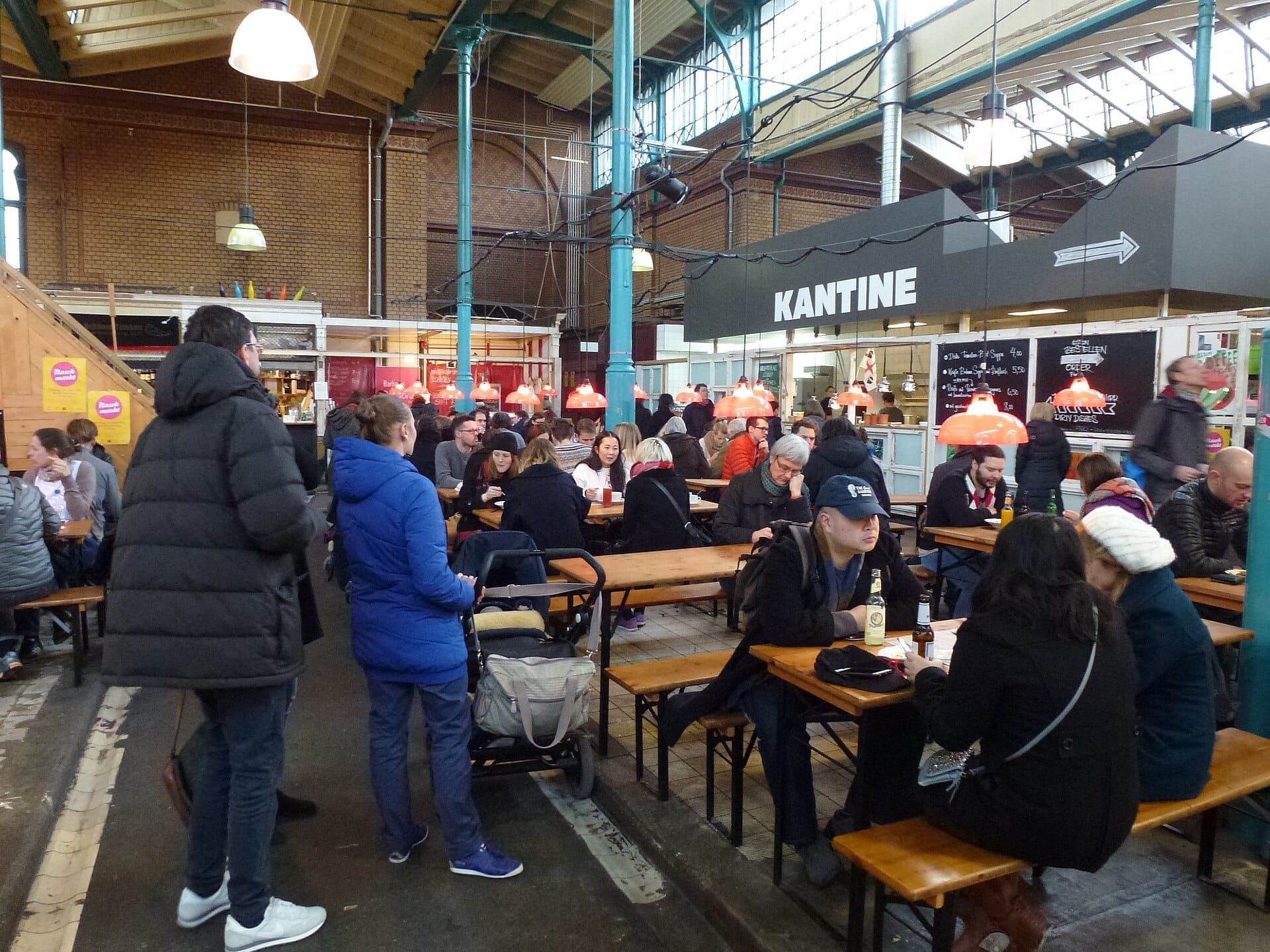
Markthalle Neun is a restored 19th-century iron-and-glass market hall in the heart of Kreuzberg, operating as a working food market and event space. It opened in 1891 as one of fourteen covered market halls commissioned by the city of Berlin to provide hygienic, weather-protected shopping for working-class neighborhoods. For most of the 20th century it survived in various states of decline, eventually falling into disuse. In 2011, a community-led initiative relaunched it as a platform for independent food producers, artisan vendors, and quality-focused street food.
The hall sits on Eisenbahnstraße, a few minutes' walk from Görlitzer Bahnhof. The building itself is classified as a historical monument, and its renovation preserved the original steel framework, high vaulted ceiling, and central nave that give the space its distinctive character. This is not a tourist attraction that happens to have food. It is a functional marketplace that happens to occupy a beautiful building.
💡 Local tip
Street Food Thursday (Thursdays 17:00–22:00) is the most atmospheric and popular event at Markthalle Neun. Arrive before 18:00 to avoid the longest queues at popular stalls. The hall is generally open Mon–Wed 08:00–20:00, Thu 08:00–22:00, Fri–Sat 08:00–20:00; check the calendar for occasional Sunday events.
The Building: Iron, Glass, and 130 Years of Use
The structure has the proportions of a minor cathedral: a central barrel-vaulted nave flanked by lower side aisles, all supported by decorative cast-iron columns. Morning light enters through the upper clerestory windows and tracks across the worn floor tiles in a way that makes the space feel genuinely different at 09:00 versus 14:00. The iron framework is original, painted in muted tones that let the geometry speak rather than the color.
On a quiet weekday morning, with a handful of permanent vendors open and few visitors, the acoustics become noticeable: voices echo gently, coffee machines punctuate the calm, and the scale of the hall becomes easier to read. On Saturday or Thursday evening, that same scale absorbs hundreds of people without feeling cramped, which says something about how thoughtfully the original engineers understood crowd flow. Photographers will find the light best in the late morning on weekdays, when the hall is calm and the sun angles through the east-facing windows.
For context on how Markthalle Neun fits into Berlin's broader food culture, the Berlin food guide covers the city's most notable eating areas across all neighborhoods.
Tickets & tours
Hand-picked options from our booking partner. Prices are indicative; availability and final rates are confirmed when you complete your booking.
Skip-the-line ticket for Gemaldegalerie Berlin
From 14 €Instant confirmationPanoramapunkt Berlin ticket with skip-the-line option
From 9 €Instant confirmation1-Hour Berlin Spree River Cruise with On-Board Guide
From 21 €Instant confirmationFree cancellationSamurai Experience Berlin skip-the-line ticket
From 15 €Instant confirmation
Street Food Thursday: The Event That Defines the Hall
Street Food Thursday runs every Thursday from 17:00 to 22:00 and is the single most-visited recurring event at Markthalle Neun. Around thirty to forty vendors set up inside the hall, covering a range of cuisines and formats that skews heavily toward quality-ingredient, made-to-order food rather than the lowest-common-denominator festival fare you find elsewhere. Expect to see Taiwanese bao, handmade pasta, craft beer from local breweries, natural wines, Korean fried chicken, and whatever seasonal collaborations the organizers have arranged that week.
The atmosphere from 17:00 to 18:30 is relaxed enough to move around and compare options before committing. By 19:00 on a typical Thursday, the hall is at capacity and the central aisle is dense with standing eaters. If you are coming with children or have mobility considerations, the earlier window is significantly more comfortable. The crowd skews local and young, with a mix of Kreuzberg residents, office workers from the surrounding area, and visitors who have done their research.
⚠️ What to skip
Street Food Thursday does not accept reservations and seating is first-come, first-served. On rainy evenings, the hall fills faster than on dry nights, since it offers shelter. Go early if you want a seat rather than eating standing at the edge of the nave.
The Saturday Market: Slower, More Local
The Big Market runs on Saturdays from 10:00 to 18:00 and has a completely different register from Thursday. The energy is calmer, the crowd includes more families and older residents, and the vendor mix leans toward take-home produce: raw-milk cheeses, cured meats, fermented vegetables, sourdough bread, regional honey, dry goods, and specialty coffee. This is where you go if you want to cook rather than eat on the spot.
Saturday morning, between 10:00 and noon, is the most pleasant window. The vendors are freshest, the hall is not yet crowded, and there is time to talk to producers about what they make and where it comes from. Several of the permanent vendors who operate on weekdays also expand their presence on Saturdays. If you are staying in a self-catering apartment anywhere near Kreuzberg, this market is worth planning a Saturday morning around.
Kreuzberg has more to explore beyond the market hall. The Turkish Market at Maybachufer runs on Tuesdays and Fridays along the canal and offers a completely different style of outdoor market shopping.
Getting There and Moving Around the Neighborhood
The most direct public transport connection is the U1 to Görlitzer Bahnhof. From the station exit, Markthalle Neun is roughly a five-minute walk south along Skalitzer Straße and then east on Eisenbahnstraße. Bus 140 stops at Wrangelstraße and puts you an even shorter distance from the entrance. The area is flat and easily walkable, with secure bike parking available near the hall entrance.
If you are combining the visit with other Kreuzberg sights, the neighborhood rewards slow walking. The East Side Gallery is about 2 km northeast, and Görlitzer Park is a short walk west of the station. For a broader orientation to the district, the Kreuzberg neighborhood guide covers what to see, eat, and do across the area.
Permanent Vendors and Weekday Visits
On weekdays, Markthalle Neun operates as a more conventional market hall. A smaller number of permanent vendors are open, selling bread, coffee, cheese, meat, and specialty groceries. The Small Market runs Monday through Thursday from 12:00 to 18:00, with a Big Market on Friday from 12:00 to 18:00. The hall is genuinely quiet on weekday mornings, which makes it a good time to appreciate the architecture without distraction, pick up provisions, or have a coffee at one of the in-hall cafes without competing for space.
The building is free to enter at any time during opening hours, regardless of whether a market event is running. If your schedule does not include a Thursday or Saturday, a short weekday visit is still worthwhile for the architecture alone. However, if you have any flexibility, prioritize a Thursday evening or Saturday morning for the full experience.
ℹ️ Good to know
Markthalle Neun’s regular markets do not run on Sundays, though there are occasional special Sunday events. Plan accordingly if your Berlin itinerary is concentrated over a weekend.
Who Should Temper Their Expectations
Markthalle Neun is not a destination for every traveler. If you are looking for traditional German market food, bread, and wurst, the vendor mix here leans more international and artisan than regional. The prices reflect the quality: a plate at Street Food Thursday will typically cost more than a comparable meal at a Kreuzberg Imbiss. And if you arrive expecting a quiet, contemplative space on a Thursday evening, the reality is a crowded, loud, sociable hall where conversation requires some volume.
Travelers focused on historical sights and memorials rather than food culture might allocate their Kreuzberg time differently. The Berlin memorials guide covers significant sites that are within reach of the neighborhood.
Insider Tips
- The hall's permanent cheese and charcuterie vendors on weekdays often have smaller portions available for tasting without commitment to a full purchase. Ask directly if you want to sample before buying.
- Thursday crowds peak between 19:00 and 20:30. If you arrive at 17:15, you can do a full circuit of the stalls, decide what you want, and be seated eating before the hall becomes genuinely packed.
- The upper-level mezzanine walkway, when accessible during events, gives an excellent view of the hall's iron structure and the crowd below. It is the best angle for interior photography.
- Many vendors at the Saturday market are small-scale producers who come from Brandenburg and surrounding regions. Asking where something is from almost always starts a worthwhile conversation.
- For budget-conscious visitors, the Saturday morning market is more economical than Street Food Thursday. Bread, produce, and takeaway portions can be assembled into a solid lunch for considerably less than a full Thursday meal.
Who Is Markthalle Neun For?
- Food-focused travelers who want to engage with Berlin's independent producer scene rather than restaurant chains
- Architecture enthusiasts interested in 19th-century iron-and-glass civic infrastructure
- Self-catering visitors looking for quality ingredients in a single well-curated location
- Travelers visiting on a Thursday evening who want a social, atmospheric dinner experience without a reservation
- People who want to understand what Kreuzberg actually looks like from the inside rather than just passing through
Nearby Attractions
Other things to see while in Kreuzberg:
- Berlinische Galerie
The Berlinische Galerie is Berlin's dedicated museum for modern art, photography, and architecture, housed in a converted 1964 glass warehouse in Kreuzberg. With a focused permanent collection rooted in Berlin's art history and rotating special exhibitions, it rewards visitors who want depth over spectacle.
- German Museum of Technology (Deutsches Technikmuseum)
The Deutsches Technikmuseum in Kreuzberg is one of Berlin's largest and most hands-on museums, covering aviation, railways, shipping, computers, and more across around 26,500 square metres of exhibition space. Free for under-18s, and free for everyone on the first Friday afternoon of each month, it offers serious depth for curious visitors of almost any age.
- Tempelhofer Feld
Tempelhofer Feld is Berlin's largest inner-city open space, a 355-hectare former airport converted into a free public park where Berliners cycle, skate, fly kites, and garden on the same runways that once carried airliners. It is equal parts city lung, social experiment, and urban history lesson.