Tempelhofer Feld: Berlin's Former Airport Turned Extraordinary Urban Park
Tempelhofer Feld is Berlin's largest inner-city open space, a 355-hectare former airport converted into a free public park where Berliners cycle, skate, fly kites, and garden on the same runways that once carried airliners. It is equal parts city lung, social experiment, and urban history lesson.
Quick Facts
- Location
- Tempelhofer Damm, 12101 Berlin (Tempelhof, between Kreuzberg and Neukölln)
- Getting There
- S-Bahn/U-Bahn Tempelhof (west entrance); U-Bahn Paradestraße (side entrance)
- Time Needed
- 1.5 – 3 hours; cyclists can cover more in less time
- Cost
- Free — no ticket required
- Best for
- Outdoor space, cycling, local Berlin culture, clear skies and open horizons
- Official website
- www.tempelhoferfeld.de/en
What Tempelhofer Feld Actually Is
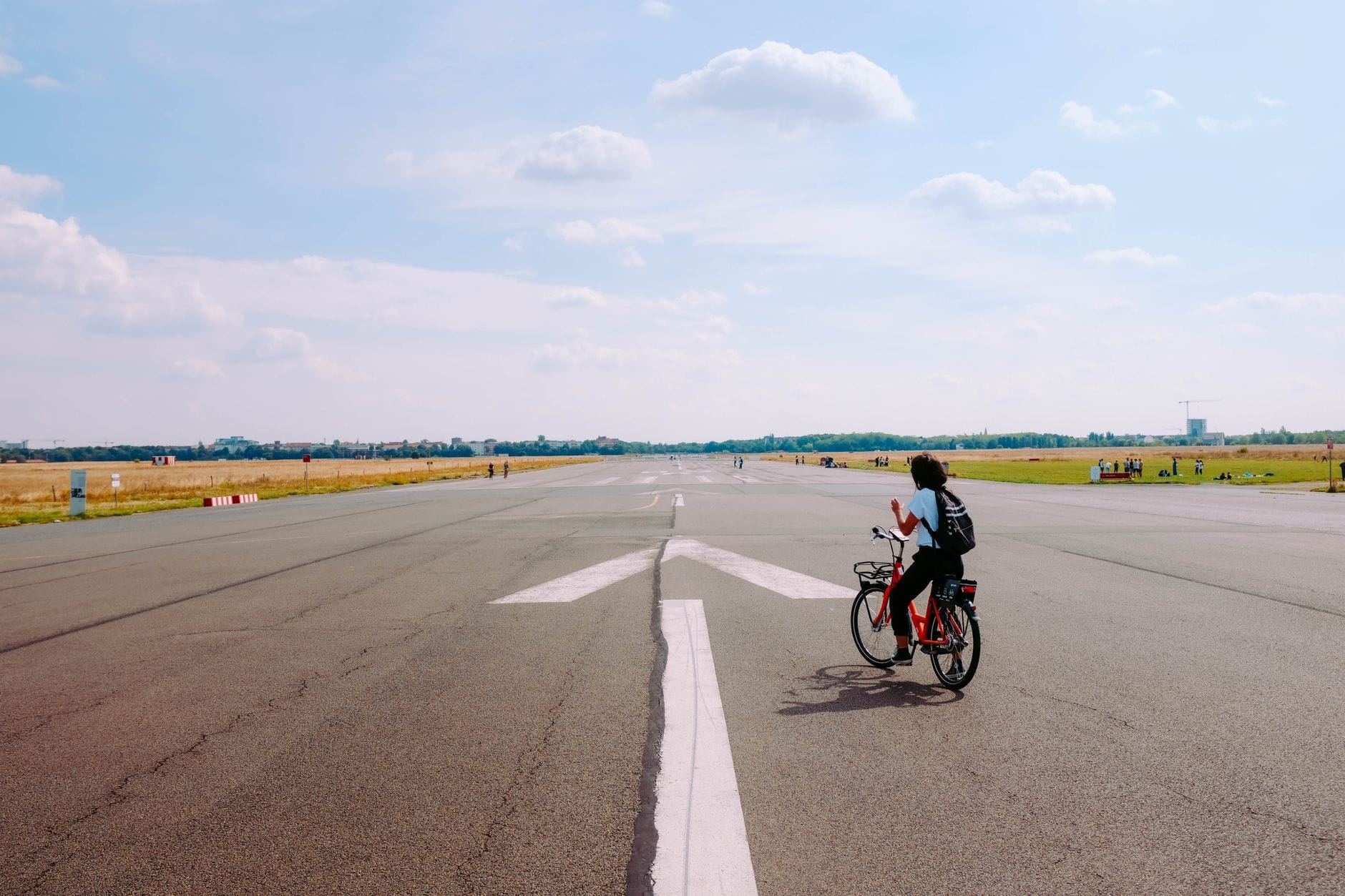
Tempelhofer Feld is not a conventional park. There are no manicured flower beds or ornamental fountains. What you find instead is an almost surreal expanse of flat, open land in the middle of a dense European capital — former taxiways and runways still marked with faded aviation paint, stretching toward a horizon that feels impossibly wide for a city of nearly four million people.
At roughly 355 hectares, it is Berlin's largest inner-city open space, slightly larger than New York's Central Park. The name connects to a history going back more than 700 years: the area was associated with the Knights Templar, whose seat gave Tempelhof its name. In more recent history, this site operated as Tempelhof Airport, one of the world's earliest commercial airports and a place of immense significance during the 1948–49 Berlin Airlift, when Allied aircraft used it to supply West Berlin during the Soviet blockade.
The airport closed in 2008 after decades of political debate. On 8 May 2010, the field reopened as a public park. In 2014, Berliners voted in a referendum to keep it exactly as it is — undeveloped and free — enshrining that decision in law (the Tempelhofer Feld preservation law, ThFG). For more on how this fits into Berlin's broader landscape of public space and history, the things to do in Berlin guide covers the city's most important open-air experiences.
The Experience: What You See, Hear, and Feel
Walking through one of the main entrances, the first thing that strikes you is the sheer scale. The airport terminal building — a colossal 1930s structure stretching over a kilometre along the southern edge — forms a constant presence on the horizon. It is one of the largest buildings in the world by floor area, and its curved facade looms with a gravity that ordinary parkland does not usually carry.
Out on the runways, the texture underfoot shifts depending on where you walk: original tarmac in the central lanes, cracked and patched but serviceable; gravel paths cutting through rough grassland that smells of dry hay in summer; and the occasional stretch of compacted earth where community garden plots take over the margins. On a warm afternoon, the field generates its own ambient soundtrack: the zip of bicycle tyres on old asphalt, the snap of kite strings, the low murmur of a few hundred people spread across space large enough that none of it feels crowded.
💡 Local tip
Bring a bicycle if you can. The runways are smooth enough for road bikes, and cycling the full perimeter gives a completely different sense of scale compared to walking. Bike rentals are available near the Tempelhof S-Bahn/U-Bahn station.
The peripheral areas are wilder. Sections of rough meadow have been deliberately left to grow for biodiversity, supporting skylarks and other ground-nesting birds. Designated zones with community garden beds, beehives, and small urban farming plots occupy the eastern and northern edges. These beds are tended by registered groups and are not open to pick from, but watching the activity gives a clear sense of how actively Berliners have claimed this space as their own.
Tickets & tours
Hand-picked options from our booking partner. Prices are indicative; availability and final rates are confirmed when you complete your booking.
Skip-the-line ticket for Gemaldegalerie Berlin
From 14 €Instant confirmationPanoramapunkt Berlin ticket with skip-the-line option
From 9 €Instant confirmation1-Hour Berlin Spree River Cruise with On-Board Guide
From 21 €Instant confirmationFree cancellationSamurai Experience Berlin skip-the-line ticket
From 15 €Instant confirmation
How the Experience Changes Through the Day
Early morning, roughly 07:00 to 09:00, is when the field belongs to joggers and dog walkers. The light is low and flat across the open ground, and the terminal building catches the first sun on its west-facing sections. There is almost no wind noise yet — just the grass and footsteps. This is when the space feels closest to its original emptiness.
By late morning and early afternoon on weekends, the character shifts dramatically. Kite surfers on wheeled boards use the long runway stretches as their track. Rollerbladers, skateboarders, and cyclists all share the tarmac with varying degrees of mutual awareness. BBQ grills appear in the designated barbecue areas on the grass margins — this is legal and very much part of weekend culture here from May onward. Food trucks and temporary stalls cluster near the main western entrance on Tempelhofer Damm.
Sunset visits, especially between June and August when the sun drops over the Kreuzberg roofline, draw a different crowd: people with bottles of Sekt or beer, picnic blankets laid out facing west. The flat horizon makes sunsets here cleaner and longer than anywhere else in central Berlin. The terminal's outline turns silhouette. It is, genuinely, one of Berlin's more impressive free spectacles.
ℹ️ Good to know
The park is open daily with fixed seasonal hours (for example, from 6:00 to 23:00 in June and July, and shorter hours in winter); check the official site for current times before visiting.
Historical and Cultural Context
The Tempelhof Airport terminal was largely built between 1936 and 1941, designed under the direction of architect Ernst Sagebiel. Its scale was intended to impress: the covered aircraft apron alone measured over a kilometre, and the building was designed to be visible from approaching aircraft as an emblem of the city. It sits today as one of the few large-scale structures from that era still standing largely intact in Berlin, which gives visits a particular weight if you know what you are looking at.
During the Berlin Airlift of 1948–49, Tempelhof was the primary landing point for Western Allied supply flights bringing food and fuel to a blockaded city. Planes landed in rapid succession at the peak of the operation. A small memorial near the terminal entrance commemorates the aircrew who died during the airlift. For deeper context on this period, the Cold War Berlin guide traces the full arc of the city's divided history.
The 2014 referendum that locked Tempelhofer Feld's open status into law reflects something specific about Berlin's civic culture. Proposals to build housing on parts of the field — an idea supported by the city government given Berlin's severe housing shortage — were rejected by 64.3 percent of voters. The debate has not fully settled, but for now the field remains as it is: deliberately incomplete, deliberately open.
Getting There and Getting Around
The main western entrance on Tempelhofer Damm is a two-minute walk from Tempelhof station, served by both the S-Bahn (S41, S42, S47) and the U-Bahn (U6). This is the most straightforward entry point and the one closest to the terminal building. For those coming from Neukölln or the eastern part of Kreuzberg, the multiple entrances along Oderstraße (east side) are more convenient, with Leinestraße U-Bahn on the U8 a short walk away.
The Paradestraße side entrance, accessible from Paradestraße U-Bahn station on the U6, drops you into a less-trafficked southern section — useful if you want to arrive during peak weekend hours without fighting the main gate crowd.
The park's terrain is almost entirely flat, making it one of Berlin's most accessible outdoor spaces. Paved runways and compacted gravel paths cover most of the main circulation routes. Wheelchairs and pushchairs manage the main lanes without difficulty. The softer meadow sections are harder going in wet weather, but routes can be planned entirely on hard surfaces.
⚠️ What to skip
On summer weekends after about 14:00, the western entrance area becomes genuinely congested — bicycles, pedestrians, and food stalls competing for the same narrow approach. If you are cycling, arrive before noon or use one of the eastern Oderstraße gates instead.
Photography, Seasons, and Who Might Want to Skip This
Photographically, Tempelhofer Feld rewards patience and timing. The terminal building as a backdrop to kite surfers or rollerbladers is one of Berlin's more distinctive images, and the flat light of overcast mornings makes the lines of the runway and the scale of the structure read clearly without the harsh shadows of direct sun. Golden hour in summer turns the whole field amber; the lack of trees means uninterrupted horizontal light across the grassland.
Seasonally, the field changes significantly. Winter strips it back to something austere: the grass goes pale, fog sometimes settles at runway level, and the sense of exposure is total. It becomes a different, quieter place. Summer is the obvious peak for activity, but spring — particularly late April and May when the meadow sections start to green up and larks begin nesting — offers a version of the field that feels almost rural. For a full picture of what Berlin offers across the seasons, the Berlin in summer guide and Berlin in winter guide both have useful orientation.
Who should skip it: travelers looking for curated cultural content, shade, or any kind of traditional park infrastructure will be disappointed. There are no playgrounds at the centre of the field, no cafes inside the perimeter (only near the western entrance), and no shelter from rain or sun in the middle sections. If the weather is poor, the field loses most of its appeal in a way that a museum or covered attraction does not. On hot days, bring water and sunscreen — the exposure is relentless.
Insider Tips
- The community garden plots in the northeastern section of the field include beehives, and on warm afternoons you can watch beekeepers working. The gardeners are generally welcoming to curious visitors as long as you stay on the paths.
- Kite surfing on wheels (a sport called kite buggy or speed kite) is practiced on the long southern runway on windy afternoons. It is free to watch and more visually dramatic than it sounds — the boards reach speeds that feel startling in an urban context.
- The Columbiadamm entrance on the northern side puts you closest to the old aircraft apron and some of the most photogenic sections of the terminal facade. Most visitors enter from the west and never reach this angle.
- Tempelhofer Feld hosts open-air cinema screenings (such as Freiluftkino Tempelhof) and other seasonal events. Check the official website before visiting if you want to combine a visit with an evening event.
- The park is officially dog-friendly across most of its area, but dogs must be leashed in designated nature conservation zones, particularly around nesting bird areas in the meadow sections from spring through early summer. Signs mark the boundaries clearly.
Who Is Tempelhofer Feld For?
- Cyclists wanting long flat stretches without traffic lights
- Families with space-hungry kids who need room to run, fly kites, or skate
- Travelers interested in Cold War and WWII aviation history who want context beyond a museum
- Anyone seeking a genuine slice of everyday Berlin life away from tourist circuits
- Sunset seekers who want an unobstructed western horizon in the middle of the city
Nearby Attractions
Other things to see while in Kreuzberg:
- Berlinische Galerie
The Berlinische Galerie is Berlin's dedicated museum for modern art, photography, and architecture, housed in a converted 1964 glass warehouse in Kreuzberg. With a focused permanent collection rooted in Berlin's art history and rotating special exhibitions, it rewards visitors who want depth over spectacle.
- German Museum of Technology (Deutsches Technikmuseum)
The Deutsches Technikmuseum in Kreuzberg is one of Berlin's largest and most hands-on museums, covering aviation, railways, shipping, computers, and more across around 26,500 square metres of exhibition space. Free for under-18s, and free for everyone on the first Friday afternoon of each month, it offers serious depth for curious visitors of almost any age.
- Markthalle Neun
Built in 1891 and relaunched as a food-focused community market in 2011, Markthalle Neun is the most serious food destination in Kreuzberg. From Saturday's Big Market to the legendary Street Food Thursday, it draws producers, chefs, and curious eaters in equal measure.