Karl-Marx-Allee: Berlin's Grand Socialist Boulevard
Karl-Marx-Allee is Karl-Marx-Allee is a 2.3-kilometre stretch of monumental East German architecture running through Friedrichshain and Mitte, built between 1949 and 1961 as a showcase of socialist urbanism. as a showcase of socialist urbanism. Free to walk at any hour, it offers one of the most intact and visually striking examples of Stalinist classicism outside Russia, with wide sidewalks, ornate residential towers, and landmarks like Kino International still operating today.
Quick Facts
- Location
- Friedrichshain / Mitte, Berlin — runs from Strausberger Platz to Frankfurter Tor
- Getting There
- U5 to Weberwiese, Schillingstraße or Strausberger Platz; also walkable east from Alexanderplatz
- Time Needed
- 1–2 hours for a full walk; longer if visiting Kino International or nearby cafés
- Cost
- Free (public street, open 24/7); standard BVG fare applies for U-Bahn
- Best for
- Architecture enthusiasts, Cold War history buffs, photography, urban walkers
- Official website
- www.visitberlin.de/en/karl-marx-allee
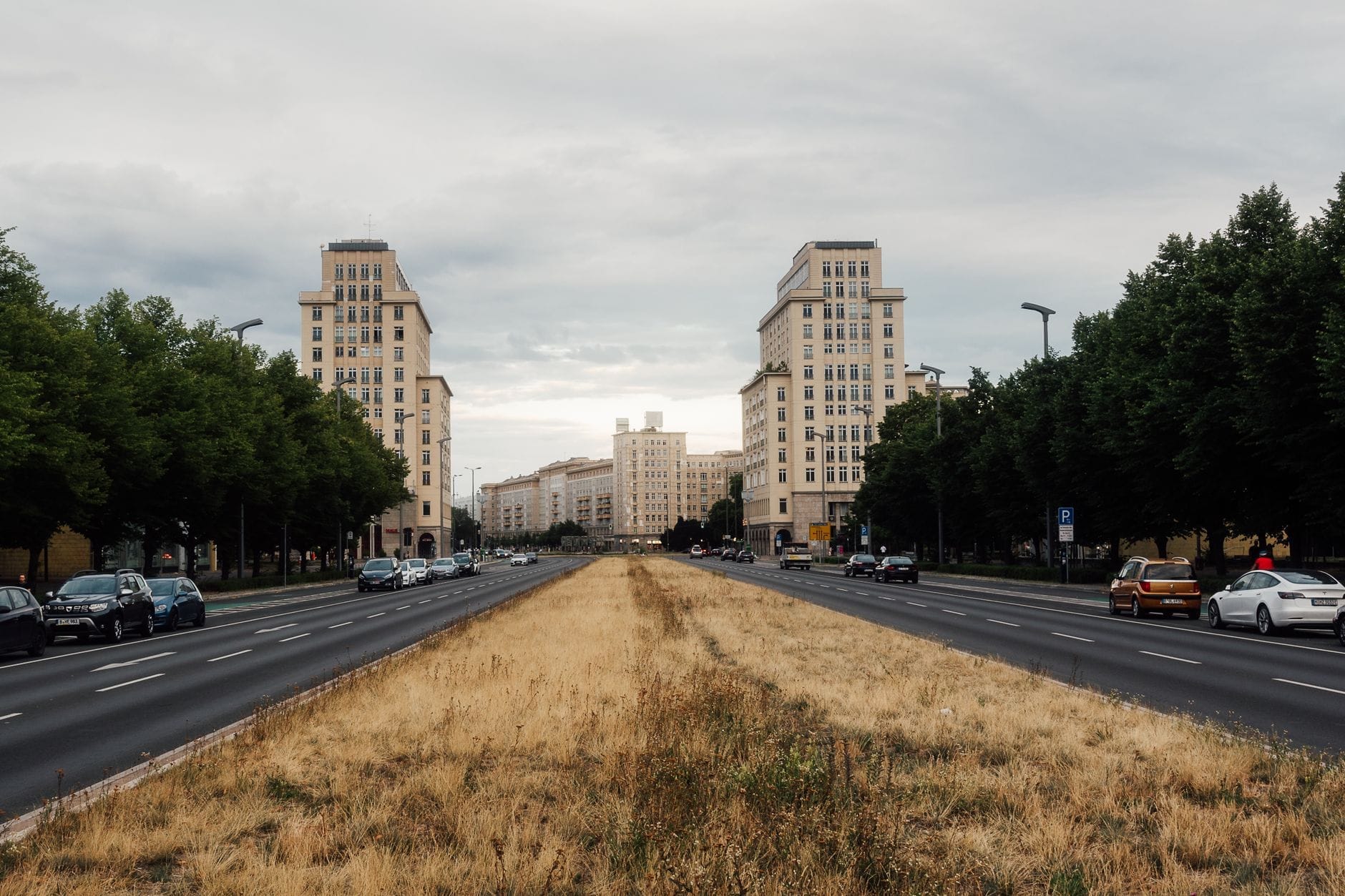
What Karl-Marx-Allee Actually Is
Karl-Marx-Allee is not a tourist attraction in the conventional sense. There are no gates, no tickets, and no queues. It is a public boulevard, open around the clock every day of the year, and it is one of the most architecturally coherent streets in Germany. What makes it worth a deliberate visit is the sheer scale and intention of the thing: roughly 2 kilometres of monumental apartment blocks, ceremonial sidewalks wide enough to feel like plazas, and decorative tile facades that still gleam in the right light after more than sixty years.
The street runs east from Strausberger Platz through the district of Friedrichshain, terminating at the twin towers of Frankfurter Tor. That endpoint is the visual anchor of the whole composition, two domed towers modelled loosely on the Gendarmenmarkt churches in Mitte, framing the boulevard in a deliberately theatrical way. Architects Hermann Henselmann and others designed the whole corridor to be experienced as a procession, not just a street.
ℹ️ Good to know
The boulevard is technically in two districts: the western portion near Alexanderplatz sits in Mitte, while the majority of the grand residential stretch runs through Friedrichshain. Visitors usually access it from either end.
The History Behind the Architecture
The East German government began constructing Stalinallee, as it was then known, in 1949 on the rubble left by wartime destruction in Friedrichshain. The project was the GDR's most visible architectural statement: a demonstration that socialist reconstruction could produce grandeur, not just utility. Workers who contributed to the building were celebrated publicly. The housing provided inside, by the standards of the time, was considered high quality for East Berlin residents.
After de-Stalinisation reached East Germany, the street was renamed Karl-Marx-Allee in 1961. The name change was largely cosmetic; the physical fabric remained exactly as built. What the street also carries, quietly, is the memory of June 17, 1953: East German construction workers on Stalinallee were among the first to go on strike against raised work quotas, helping trigger the broader GDR uprising that Soviet tanks ultimately suppressed.
For a deeper look at how Karl-Marx-Allee fits into Berlin's Cold War story, the Cold War Berlin guide covers the key sites across the city, including several within walking distance of the boulevard.
The architectural style is sometimes called Zuckerbäckerstil in German, loosely translated as 'wedding cake style', referencing the tiered, ornamented appearance shared with Stalinist buildings in Moscow and Warsaw. Ceramic tiles in muted ochre, beige, and terracotta cover the lower floors of many buildings. Look closely and you will find relief sculptures, stylised working-class motifs, and decorative cornices that would have seemed deliberately opulent in a country officially committed to collective austerity.
Tickets & tours
Hand-picked options from our booking partner. Prices are indicative; availability and final rates are confirmed when you complete your booking.
Solar-powered catamaran cruise on Berlin's Spree River at sunset
From 35 €Instant confirmationFree cancellationDigital Dimensions exhibition at Berlin P61 gallery
From 14 €Instant confirmationEscape Tour self-guided, interactive city challenge in Berlin
From 30 €Instant confirmationWe call it Ballet, Sleeping Beauty Dance and Light Show in Berlin
From 29 €Instant confirmation
Walking the Boulevard: What You Actually See
The most rewarding approach is to start at Strausberger Platz, the circular intersection on the boulevard, and walk west toward Alexanderplatz or east toward Frankfurter Tor. Strausberger Platz has a fountain at its centre and gives you a clear sightline in both directions, which is useful for understanding the scale before committing to a direction.
Walking east from Strausberger Platz, the residential blocks grow progressively taller and more ornamented as you approach Frankfurter Tor. The ground floors were designed to house shops, cafés, and public services, and some of that commercial fabric has survived. Café Sybille at Karl-Marx-Allee 72, a small bar and former GDR-era snack bar, operates as a café and occasional exhibition space with a permanent display about the boulevard's history. It is one of the few places on the street where you can sit down and absorb what you are looking at.
Kino International at Karl-Marx-Allee 33 is the other anchor of the street worth pausing at. Built in 1963, this cinema still operates as a cinema today, and the interior, which is occasionally accessible during events or club nights, retains much of its original 1960s modernist feel. Even from the outside, the cantilevered canopy and glass facade are a sharp contrast to the heavier Stalinist blocks nearby.
💡 Local tip
The walk from Strausberger Platz to Frankfurter Tor takes about 20 minutes at a casual pace. If you want to read the building details and stop for photographs, allow 45 minutes for this section alone.
How the Boulevard Changes by Time of Day
Early morning, before 8am, Karl-Marx-Allee is almost deserted. The wide sidewalks, which can easily be 15 metres across in places, feel enormous when empty. This is the best time for photography: long shadows from the east catch the tile relief work on the facades, and there are almost no people or delivery vehicles to navigate around. The light in summer from around 6am is particularly useful for architectural shots looking west toward Alexanderplatz.
By midday the street fills with the rhythms of a normal residential boulevard: cyclists, trams on the parallel routes, people heading in and out of the supermarkets and pharmacies that now occupy many of the original shop units. It does not feel like a tourist corridor. The residents who live in those monumental blocks treat the street as ordinary, which is part of what makes it interesting. Lunchtime in summer brings people to the benches near Strausberger Platz.
After dark, the boulevard is mostly quiet, though on nights when Kino International or Kosmos hosts events, small clusters of people gather near those venues. The street lighting is not spectacular and the architectural detail is largely lost at night, so there is little reason to visit after dusk unless you have a specific event to attend.
💡 Local tip
For the best combination of good light and few crowds, visit on a weekday morning between May and September. Weekend mornings are also quiet but attract more photographers and cyclists.
Getting There and Getting Around
The U5 U-Bahn line is the simplest way in. Schillingstraße and Strausberger Platz stations both sit directly on the boulevard. From Alexanderplatz, it is also a short walk east along the street itself, which gives you a sense of the approach as it was intended. Alexanderplatz is a major interchange for U-Bahn, S-Bahn, trams, and regional trains, so it works well as a starting point if you are combining the boulevard with other sights in Mitte.
The boulevard is entirely flat and the sidewalks are wide. Wheelchair users and visitors with pushchairs will find the surface easy to manage. Step-free access at U5 stations varies: check current BVG accessibility information before your visit if this matters to your group. The street itself presents no barriers.
If you are spending a full day in the area, Karl-Marx-Allee pairs naturally with the East Side Gallery to the south and the Berlin Wall Memorial for a broader arc of Cold War-era Berlin. All three can be covered on foot or with short U-Bahn hops in a single day.
Photography on Karl-Marx-Allee
The boulevard rewards photographers who pay attention to geometry. The repeating window patterns, the horizontal tile bands, and the symmetry of the building facades produce strong compositional lines. A wide-angle lens is useful here: the buildings are tall and close together, so a standard focal length often captures only fragments. Standing in the middle of the road during a quiet moment, with the facade lines converging toward Frankfurter Tor, gives you the full effect of the avenue's monumental perspective.
The twin towers at Frankfurter Tor are best photographed from a position about 300 metres to the west, where the street is wide enough to frame both towers in a single shot. In winter, bare trees on the central median do not obstruct this view. In summer, the foliage adds depth but reduces the sightline. Both work; they produce different results.
⚠️ What to skip
Karl-Marx-Allee is a lived-in residential street. The buildings are people's homes. Photograph the architecture; be discreet about photographing residents on balconies or in windows.
Who This Is For (and Who Should Skip It)
Karl-Marx-Allee is not for everyone, and there is no point pretending otherwise. If you have limited time in Berlin and your priorities are the major historical landmarks, the museums on Museum Island, or the nightlife in Kreuzberg and Friedrichshain, this boulevard may not justify a dedicated trip. From the outside it can read as a very long street with old buildings.
But if you have even a passing interest in 20th-century European history, urban planning, or architecture, it is one of the most thought-provoking places in the city. You cannot look at these buildings without thinking about the society that built them, the people who lived in them, and the political system that collapsed while many of those residents were still there. That is a kind of encounter that does not happen at a museum exhibit.
Visitors who are already exploring the Cold War layer of Berlin will find it pairs well with a visit to the Stasi Museum in nearby Lichtenberg, and the DDR Museum near Alexanderplatz provides context on everyday GDR life that enriches a walk along the boulevard.
For a broader itinerary that includes Karl-Marx-Allee alongside other key Berlin sites, the 3 days in Berlin guide offers a practical day-by-day structure that works well for first-time visitors.
Insider Tips
- Café Sybille at Karl-Marx-Allee 72 has a small but genuine display about the history of the boulevard. It is easy to miss and rarely crowded. Worth stopping in before or after your walk for a coffee and some context.
- The decorative ceramic tiles on the lower facades are part of the original 1950s construction. Run your hand along them and you get a tactile sense of the scale of the project. They were manufactured specifically for this street.
- Check whether Kino International has any event nights scheduled during your visit. The venue occasionally hosts club nights and film screenings that give access to the original interior, which is not normally open to casual visitors.
- The best symmetrical photograph of the boulevard looking east is taken from just west of Strausberger Platz, using the fountain circle as a foreground anchor. Arrive before 8am on a clear day for no cars and good light.
- June 17 carries particular historical weight at this location: the 1953 workers' uprising began on this street. If you visit around that date, it can add an additional layer of significance to what you are looking at.
Who Is Karl-Marx-Allee For?
- Architecture and design enthusiasts interested in Soviet-influenced modernism
- Cold War and GDR history buffs who want to understand East Berlin beyond the Wall
- Photographers looking for strong geometric lines and monumental urban scale
- Walkers who want a quieter, less touristy alternative to the main Mitte landmarks
- Travellers combining a full day across Friedrichshain including the East Side Gallery and Mauerpark
Nearby Attractions
Other things to see while in Friedrichshain:
- Berghain / Panorama Bar
Housed in a former DDR-era power plant near Ostbahnhof, Berghain / Panorama Bar is the nucleus of Berlin's techno scene and one of the most discussed nightclubs on earth. This guide covers what the experience is actually like, how the door works, and who should probably skip it.
- East Side Gallery
The East Side Gallery is a 1,316-metre stretch of the former Berlin Wall painted by 118 artists from 21 countries in 1990. Free to visit at any hour, this protected memorial in Friedrichshain is the longest surviving section of the Wall and one of the most significant open-air art sites in the world.
- Oberbaumbrücke
Oberbaumbrücke is a double-deck brick bridge over the River Spree, connecting Friedrichshain and Kreuzberg since 1896. Its neo-Gothic towers, resident U-Bahn line, and position on the former Berlin Wall border make it one of the city's most historically loaded and visually striking crossings. Entry is free, and it's open around the clock.
- RAW-Gelände
RAW-Gelände is a sprawling former railway repair works in Friedrichshain that has been reinvented as one of Berlin's most charismatic open cultural complexes. Across more than 70,000 square metres of semi-derelict industrial buildings, the site hosts nightclubs, street art, beach bars, skate facilities, and weekend markets. Entry to the outdoor grounds is free, and the gates stay open around the clock.