DDR Museum Berlin: Life Behind the Wall Explored
The DDR Museum on the Spree riverbank puts you inside the world of the German Democratic Republic, from a furnished East German apartment to a drivable Trabant simulator. It is one of Berlin's most hands-on history experiences, and one of its most polarizing.
Quick Facts
- Location
- Karl-Liebknecht-Straße 1, 10178 Berlin (Mitte), opposite Berlin Cathedral
- Getting There
- Bus 200/300 to Spandauer Str./Marienkirche (100 m); U5 Museumsinsel; S-Bahn Hackescher Markt (300 m)
- Time Needed
- 1.5–2.5 hours
- Cost
- Adults €13.90 / Reduced €8.50 / Under 6 free / School groups €5.50 p.p.
- Best for
- Cold War history, families with older children, first-time Berlin visitors
- Official website
- www.ddr-museum.de/en
What the DDR Museum Actually Is
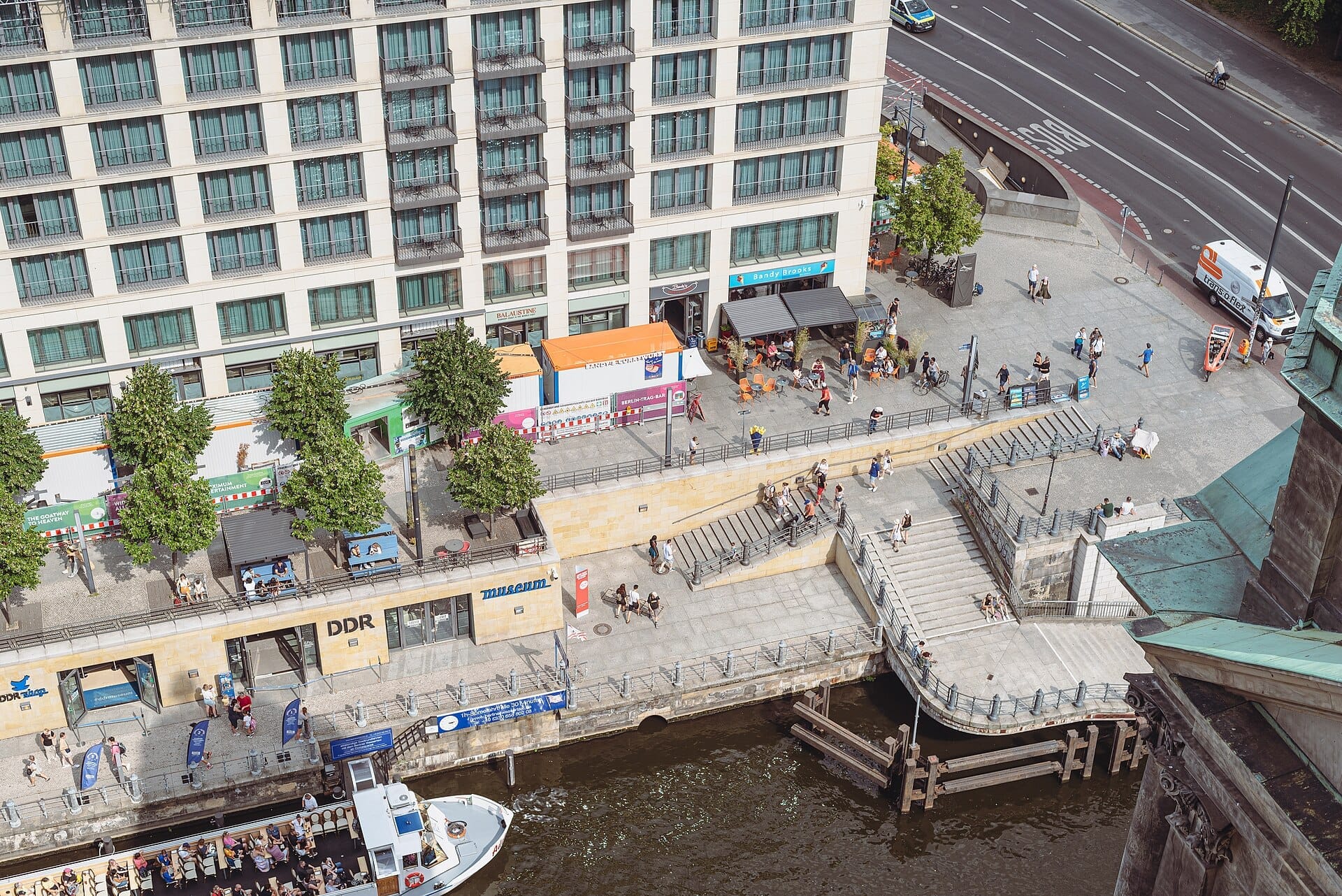
The DDR Museum opened in 2006 and has since become one of the most visited museums in Berlin, which tells you something about both its appeal and its controversy. It occupies a compact space on the Spree riverbank in Mitte, directly opposite the Berlin Cathedral, and its subject is the German Democratic Republic, the socialist state that ruled roughly 16 million East Germans from 1949 until reunification in 1990.
The museum's defining characteristic is interactivity. This is not a place of glass cases and reverent silence. Drawers pull open. Cabinets swing out. You sit in a reconstructed East German apartment, feel the texture of drab state-issued furniture, and read handwritten documents pulled from replicated filing cabinets. The approach is deliberate: the museum argues that the GDR is best understood through the objects and routines of daily life, not through ideology alone.
💡 Local tip
Buy tickets online in advance, especially on weekends and school holidays. The museum is small and popular — queues at the door can stretch along the riverside.
The Exhibits: What You Will Actually See
The permanent exhibition is organized around themes of everyday GDR life: housing, work, leisure, travel restrictions, Stasi surveillance, and youth culture. The reconstructed apartment is the emotional core of the museum. Walking through its rooms, you encounter the specific textures of East German domesticity: the wall-mounted folding table, the particular shade of orange used in 1970s GDR kitchens, the smell of cleaning products that visitors of a certain age apparently recognize immediately.
The Trabant is the most photographed exhibit. Visitors sit in a car body and use a driving simulator to navigate streets that appear on a screen ahead of them. Children love it. Adults who remember the real Trabant's two-stroke engine, which took up to a decade on a waiting list to obtain, may feel the satire more sharply. Beyond the car, there are exhibits on the FKK nudism culture that was unusually prevalent in the GDR, the shortages that defined consumer life, and the mechanisms of state surveillance.
The Stasi section is among the more sobering parts of the museum. It gives context to the scale of surveillance in the GDR without being exhaustive — for deeper treatment of that subject, the Stasi Museum in Lichtenberg covers the secret police apparatus in far greater detail and inside their actual former headquarters.
Tickets & tours
Hand-picked options from our booking partner. Prices are indicative; availability and final rates are confirmed when you complete your booking.
DDR Museum entrance ticket
From 14 €Instant confirmationSkip-the-line ticket for Gemaldegalerie Berlin
From 14 €Instant confirmationPanoramapunkt Berlin ticket with skip-the-line option
From 9 €Instant confirmation1-Hour Berlin Spree River Cruise with On-Board Guide
From 21 €Instant confirmationFree cancellation
How the Experience Changes by Time of Day
Morning visits, from opening at 09:00 until around 11:00, offer the quietest conditions. The museum's compact layout means that even moderate crowds create bottlenecks at interactive stations. By midday, school groups and tour parties arrive in volume, and the noise level rises considerably. If you are visiting with the intention of reading exhibit text carefully, mornings are the only reliable window.
Late afternoon, from about 16:00 onward, sees a secondary wave of visitors but generally remains calmer than the midday peak. The museum stays open until 21:00 on most days of the year, which is unusual among Berlin museums and gives evening visitors a real option. The riverside location is pleasant at dusk, with views across to the lit facade of the Berlin Cathedral.
⚠️ What to skip
On 24 and 31 December, the museum closes early at 16:00. All other public holidays follow normal 09:00–21:00 opening hours.
Historical and Cultural Context
The museum sits in what was part of the governmental heart of East Germany. The Palace of the Republic, the GDR parliament building, once stood just a few hundred meters away on the site now occupied by the reconstructed Berlin Palace (Humboldt Forum). That context matters: the museum is not located in the abstract but in a place where the architecture around it has been actively debated, demolished, and rebuilt since 1990.
Visitors interested in the broader geography of the divided city should consider pairing this with the Berlin Wall Memorial in Bernauer Straße, which covers the physical and human reality of the border itself, or with the Palace of Tears at Friedrichstraße station, which focuses specifically on the experience of separation at a major crossing point.
It is worth knowing that the DDR Museum is a private, commercially run institution rather than a state museum. This shapes its tone. Critics, including some historians and GDR survivors, argue that the museum's emphasis on everyday objects and its interactive, almost playful approach can soften the political reality of life under a surveillance state. The museum's defenders argue that reaching a broad, non-specialist audience requires exactly this kind of accessibility. Both positions have merit, and being aware of this debate makes for a richer visit.
Getting There and Getting Around
The museum is well connected by multiple transit options. Bus lines 100 and 200 stop at Spandauer Str./Marienkirche, roughly 100 meters from the entrance, while line 300 stops at Lustgarten nearby. The U5 line, extended through central Mitte in 2020, stops at Museumsinsel station about 400 meters away. From Hackescher Markt S-Bahn station, it is a straightforward 300-meter walk along the riverside.
The museum is within easy walking distance of several major landmarks in Mitte, including the Berlin Cathedral directly across the water and Museum Island immediately to the south. A single morning can combine the DDR Museum with an exterior walk around Museum Island without significant extra travel.
Barrier-free access is available via a side entrance. The permanent exhibition is fully accessible up to and including the Trabant exhibit level. Visitors who require this access are asked to call the cash desk shortly before arrival so staff can assist.
Is the DDR Museum Worth Your Time?
The honest answer depends on what you are looking for. If you want rigorous historical scholarship presented with academic depth, this is not that museum. The format prioritizes sensation and accessibility over complexity. But for a first-time visitor to Berlin who wants to understand, in a tangible way, what the eastern half of the city actually felt like for the people who lived there, the DDR Museum delivers that better than almost anywhere else.
Travelers who have already spent time at the Topography of Terror or read broadly about the Cold War period may find the DDR Museum's approach too surface-level. For that audience, the Cold War Berlin guide covers the full range of deeper sites across the city.
Families with children aged roughly 8 and up tend to get strong value here. The interactive format keeps younger visitors engaged in a way that most history museums do not, and the subject matter is serious enough to generate real conversation afterward. The Trabant simulator alone can occupy a child for 15 minutes while adults read nearby panels.
ℹ️ Good to know
Photography is permitted throughout the museum without flash. The reconstructed apartment makes for genuinely interesting photographs, though the low lighting requires a steady hand or a phone with a good night mode.
Insider Tips
- Pull every drawer and open every cabinet in the apartment reconstruction. A significant portion of the exhibit content is inside furniture rather than on wall panels — visitors who walk through without touching miss roughly a third of what is there.
- The museum's ground-floor shop sells original GDR-era items alongside reproductions. It is worth distinguishing between the two if authenticity matters to you; staff can clarify.
- If you are visiting with a German speaker, the German-language audio guide covers material that does not appear in the translated exhibit text, particularly around regional dialect humor and specific product names.
- The riverside terrace just outside the entrance is an underused spot. On a dry day, five minutes standing here with a view of the Cathedral dome and the Spree costs nothing and places the museum's location in its full historical geography.
- Weekday mornings in autumn and winter offer the museum at its most manageable. Summer weekends, particularly during school holidays across German federal states, are the most congested periods.
Who Is DDR Museum For?
- First-time Berlin visitors wanting a tangible introduction to the city's divided past
- Families with children aged 8 and older who need hands-on engagement
- Travelers with limited time who want Cold War context in under two hours
- Anyone curious about the texture of everyday life under a socialist state, rather than its political mechanics alone
- Visitors combining a half-day walk through Mitte with Museum Island and the Cathedral
Nearby Attractions
Other things to see while in Mitte:
- Alexanderplatz
Alexanderplatz sits at the geographical and historical heart of former East Berlin, a vast open square with roots going back to the 13th century. Today it's a free, always-open crossroads of transit, Cold War monuments, and everyday Berlin life — chaotic, fascinating, and impossible to avoid.
- Berlin Cathedral (Berliner Dom)
The Berlin Cathedral, or Berliner Dom, is Germany's largest Protestant church and one of the most architecturally striking buildings in the city. Built between 1894 and 1905, it anchors Museum Island with a dome you can climb, a royal crypt below ground, and a nave that rewards slow, unhurried attention.
- Berlin TV Tower (Fernsehturm)
Standing 368 metres above central Berlin, the Berliner Fernsehturm is the tallest structure in Germany and the tallest publicly accessible building in Europe. Its observation deck at 203 metres delivers an unobstructed 360-degree panorama of the city. This guide covers what you actually see up there, when crowds are worst, and whether the ticket price is justified.
- Berlin Victory Column (Siegessäule)
Rising from the centre of the Großer Stern roundabout in Tiergarten, the Siegessäule is one of Berlin's most recognisable monuments. At around 67 metres tall, it offers a sweeping panorama over the city's forest-park heart — but you earn the view with 285 steps and no lift.