Mauerpark: Berlin's Wall Park, Flea Market, and Open-Air Karaoke
Mauerpark occupies the former Berlin Wall death strip between Prenzlauer Berg and Wedding, covering about 15 hectares of grass, gravel paths, and a remaining 300-metre stretch of the Wall itself. Every Sunday, the park transforms into one of Berlin's most atmospheric flea markets, followed by the legendary Bearpit Karaoke. Entry is always free.
Quick Facts
- Location
- Bernauer Straße 63, 10435 Berlin (Prenzlauer Berg / Wedding border)
- Getting There
- Tram M10/12 to Friedrich-Ludwig-Jahn-Sportpark; Bus 247 to Wolliner Str.; U2 Eberswalder Straße (about a 5–8 minute walk)
- Time Needed
- 1.5–3 hours on a Sunday; 30–45 minutes on a weekday
- Cost
- Free entry. Flea market browsing free; purchases extra. Bearpit Karaoke free.
- Best for
- Sunday flea market culture, Berlin Wall history, people-watching, street art
- Official website
- gruen-berlin.de/en/projects/parks/mauerpark/about-the-park
What Mauerpark Actually Is
Mauerpark, which translates simply as "Wall Park," sits on one of the most loaded strips of ground in modern European history. From 1961 to 1989, this corridor was part of the Berlin Wall's "death strip" — a heavily patrolled no-man's land that separated the former East from the West. Today it is a 15-hectare public park, open at all hours, free of charge, managed by Grün Berlin. The transformation is intentional and symbolic: the space that was once designed to prevent movement has become one of Berlin's most socially active outdoor spaces.The park was designed by landscape architect Gustav Lange and first opened on 13 November 1994, shortly after the fifth anniversary of the Wall’s fall. A major extension completed in 2020 added quieter green areas to the north, softening what was previously a harder-edged urban space. A 300-metre section of the original Wall still stands along the park's eastern edge, now covered floor-to-ceiling in graffiti and murals. For context on the broader Wall trail and its other memorial sites, the Berlin Wall guide covers the full picture.
ℹ️ Good to know
The park has no gates and no closing time. You can visit at any hour, though the Sunday flea market and Bearpit Karaoke operate seasonally, generally from spring through autumn.
The Sunday Flea Market: What to Expect
The Sunday flea market at Mauerpark is the park's defining weekly event and the main reason most visitors come here. It fills the flat lower section of the park with several hundred stalls selling a mixture of vintage clothing, Soviet-era memorabilia, second-hand vinyl, handmade jewelry, art prints, and the kind of random household objects that somehow feel interesting outdoors. Browsing is free; you pay only for what you buy, in euros.
Arrive before 10:00 if you're serious about the market. By noon, the crowd density makes it difficult to examine stalls carefully, and the better vintage clothing pieces tend to disappear quickly. In the hours before midday, the atmosphere is still loose enough to have an actual conversation with sellers, many of whom are Berlin residents rather than professional vendors. After 13:00, the crowd swells considerably with visitors who come primarily for the karaoke and the general Sunday scene rather than shopping.
If you want to compare this with Berlin's other major flea market scene, the Berlin flea markets guide covers Mauerpark alongside Boxhagener Platz, Tiergarten, and the Antikmarkt am Ostbahnhof — each with a distinct character.
Tickets & tours
Hand-picked options from our booking partner. Prices are indicative; availability and final rates are confirmed when you complete your booking.
Mauerpark Berlin: open graffiti workshop
From 89 €Instant confirmationFree cancellationGraffiti workshop in Mauerpark Berlin
From 75 €Instant confirmationFree cancellationSkip-the-line ticket for Gemaldegalerie Berlin
From 14 €Instant confirmationPanoramapunkt Berlin ticket with skip-the-line option
From 9 €Instant confirmation
Bearpit Karaoke: A Crowd You Have to See
The Bearpit Karaoke takes place in the park's natural stone amphitheater, a bowl-shaped outdoor stage that sits at the northern edge of the main lawn. On Sunday afternoons in warmer months, the amphitheater fills with hundreds of spectators watching members of the public grab a wireless microphone and perform in front of a genuinely massive and enthusiastic crowd. There is no stage fee, no sign-up process beyond showing up, and no professional polish required.
The performances vary wildly — someone belting Bonnie Tyler followed by a teenager attempting a Beyoncé song followed by a group of tourists doing ABBA — and the crowd's reaction is warm regardless of ability. The acoustics of the stone bowl carry sound better than you'd expect from an open-air space. The whole thing is organized by a volunteer who runs the sound system from a cart. Sunday afternoons, roughly 15:00 to 18:00, is when the energy peaks. Admission is free, though the organizer does pass around a hat.
💡 Local tip
Bearpit Karaoke runs on fair weather. If it rains on a Sunday, the event typically does not happen. Check the official Bearpit Karaoke Facebook page the morning of your planned visit.
The Berlin Wall Remnant and Street Art
Along the park's eastern edge, a 300-metre original section of the Berlin Wall still stands at its full height. Unlike the East Side Gallery in Friedrichshain, which is a curated memorial with named international artists and restoration work, the Mauerpark Wall section functions more as a living, ever-changing street art canvas. New layers appear regularly, old murals disappear beneath fresh ones, and the overall effect is raw rather than museological.
This is worth spending 15 to 20 minutes with — walk the full length, look at the layering of styles and languages, and read the fragments of political commentary mixed in between abstract designs. If street art is a primary interest, the broader Berlin street art guide maps out where the most significant works are concentrated across the city.
For those interested in the Wall's historical weight beyond the visual surface, the Berlin Wall Memorial on Bernauer Straße is a short distance away and provides documentary depth that Mauerpark, as a park rather than a memorial, does not attempt to offer.
How the Park Changes Through the Day
On weekday mornings, Mauerpark belongs to a different city entirely. Dog walkers move through the grass in small clusters, and the only sound is the occasional tram passing on the nearby tracks. The air carries a faint smell of damp earth and cut grass, especially after overnight rain. The Wall section is easier to photograph without crowds at this hour, and the amphitheater sits empty and unexpectedly peaceful.
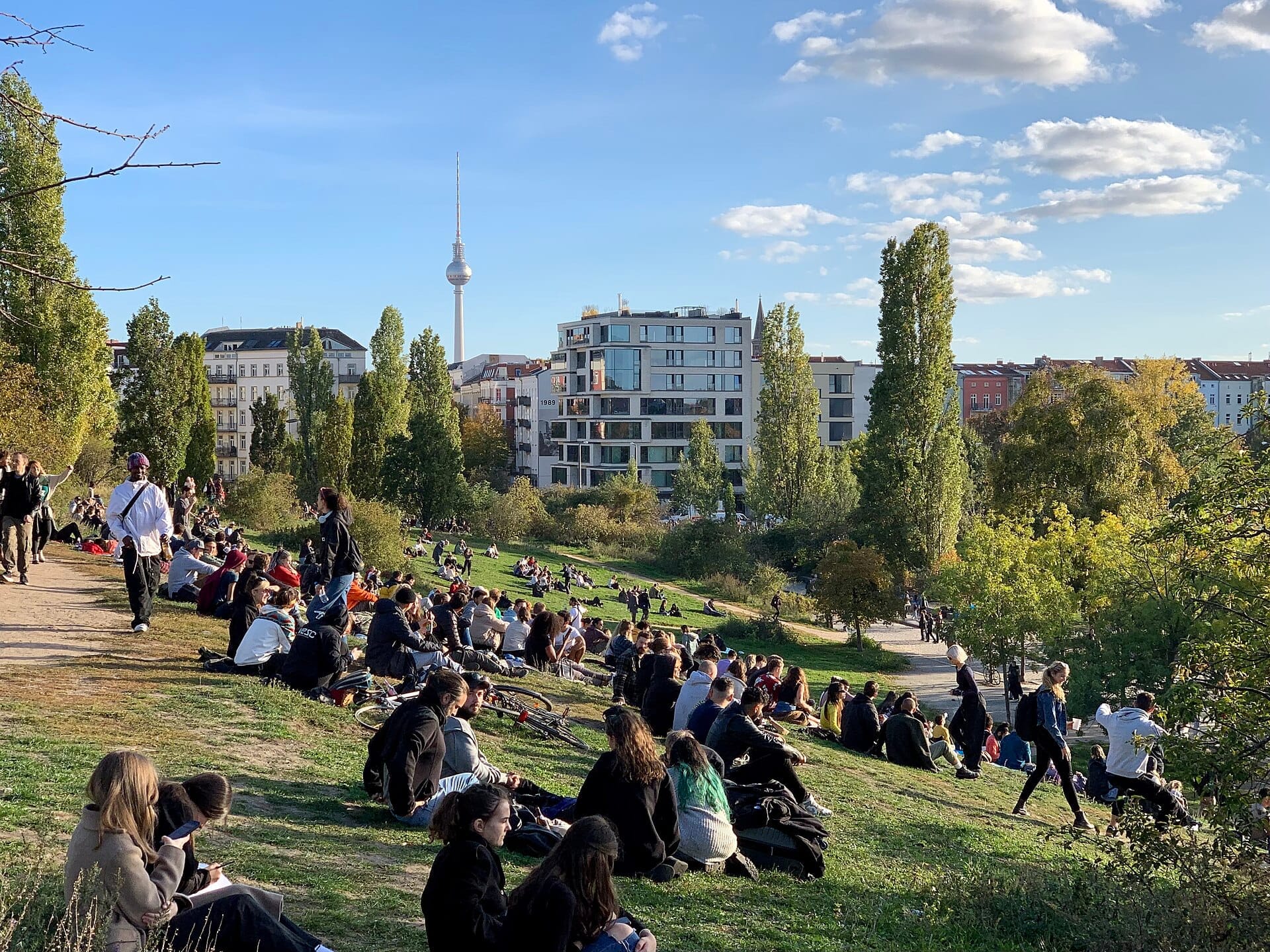
By a Sunday afternoon in summer, the sensory register is completely different. The smell shifts to grilled food from the stalls ringing the market, sunscreen, and beer. The noise level from the amphitheater carries across most of the lower park. Grass patches fill with people sitting in circles. Children run between stalls. The slope above the amphitheater becomes standing-room viewing for karaoke. It is a genuinely sociable place — less of a quiet park and more of an outdoor social event.
Evening visits on Sundays, after the market packs up and the karaoke finishes around dusk, are underrated. The crowd thins sharply, and the light falling across the Wall section and the open grass takes on a quality that photographs well without the crowds.
Getting There and Practical Details
The most convenient public transport options are Tram M10 or 12 to Friedrich-Ludwig-Jahn-Sportpark, which drops you almost at the northern park entrance, or the U2 subway to Eberswalder Straße, which requires about a 10-minute walk north through Prenzlauer Berg's residential streets. Bus 247 stops at Wolliner Straße, close to the southern park entrance. On Sundays, trams on the M10 run frequently and are a reliable option.
The park sits at the edge of Prenzlauer Berg, which means the streets around the southern entrance have good café options for before or after your visit. Kastanienallee, a five-minute walk south, has several places to sit down. For a broader orientation of how Mauerpark fits into a Berlin itinerary, the 3 days in Berlin guide places it well in the context of a Sunday.
Accessibility across most of the flat lower section of the park is straightforward; paths are wide and mostly level. The amphitheater seating involves stone steps, and the northern slope of the park includes gradients that may be challenging for wheelchairs or pushchairs. The 2020 extension added flatter green areas that are easier to navigate.
When Mauerpark Works (and When It Doesn't)
Mauerpark is heavily promoted as a Berlin experience, and it earns that description on a Sunday in warm weather. The flea market, the karaoke, and the Wall section together create something genuinely unlike most parks in any European city. It is not polished or curated — it is scruffy, loud, and social, which is exactly the point.
On a weekday, or in winter, the park loses most of what makes it distinctive. The market does not run. The amphitheater is quiet. The Wall section and the open grass are pleasant enough, but you could be in almost any Berlin park. Visitors who plan their trip around Mauerpark should make sure they are arriving on a Sunday, ideally between late April and October.
If crowds, noise, and a festival-like atmosphere on a Sunday afternoon are not appealing to you, this is worth knowing in advance. The park at peak hours is not a quiet retreat. It is also worth noting that pickpocketing in dense flea market crowds is not unknown in Berlin, so keep bags zipped and close.
⚠️ What to skip
Mauerpark on a rainy Sunday is significantly less interesting — the flea market may reduce or not operate, and the karaoke does not run. Check the weather and the Bearpit Karaoke social channels before building your Sunday around it.
Insider Tips
- Arrive at the flea market before 10:00 if you're shopping seriously. Vintage clothing in good condition and interesting vinyl go fast, and sellers are more willing to negotiate before the crowds arrive.
- The slope above the Bearpit amphitheater gives a better overhead view of the karaoke than sitting in the bowl itself — useful if you arrive after it fills up. Bring something to sit on since the grass gets worn down on busy Sundays.
- The northern section of the park, added in the 2020 extension, is significantly quieter than the market area and offers a place to eat something from the market stalls without the crowd pressure. Most visitors don't walk that far.
- Photography of the Wall section is best in the early morning when the light comes from the east and hits the murals directly. By midday the wall is largely in shadow depending on the season.
- Food stalls at the market lean toward street food — grilled sausage, crepes, international snacks — but quality varies. Eating before you arrive, or stopping at a café on Kastanienallee afterward, is usually a better option.
Who Is Mauerpark For?
- Travelers who want a realistic slice of Berlin Sunday culture rather than a tourist attraction
- Flea market and vintage shopping enthusiasts with time to arrive early
- People interested in Berlin Wall history who want a living, informal complement to the formal memorial sites
- Street art and graffiti observers looking for an ever-changing outdoor gallery
- Budget travelers: the entire experience costs nothing beyond what you choose to buy or eat
Nearby Attractions
Other things to see while in Prenzlauer Berg:
- Berlin Wall Memorial (Gedenkstätte Berliner Mauer)
The Berlin Wall Memorial on Bernauer Straße is the most complete and historically serious place to understand the Wall. Stretching 1.4 km along the former border strip, it preserves original fortifications, a watchtower, the death strip, and the stories of those who tried to cross. Entry is free for all areas of the memorial.
- Kulturbrauerei
Once the engine of Berlin's most celebrated brewery, the Kulturbrauerei in Prenzlauer Berg is now a sprawling cultural complex spread across 25,000 square metres of red and yellow brick. Entry to the courtyards is free, and what you find inside ranges from a permanent Cold War museum to some of the city's most respected club nights.