Kulturbrauerei: Berlin's Brewery Complex That Never Stopped Fermenting
Once the engine of Berlin's most celebrated brewery, the Kulturbrauerei in Prenzlauer Berg is now a sprawling cultural complex spread across 25,000 square metres of red and yellow brick. Entry to the courtyards is free, and what you find inside ranges from a permanent Cold War museum to some of the city's most respected club nights.
Quick Facts
- Location
- Schönhauser Allee 36, 10435 Berlin (Prenzlauer Berg)
- Getting There
- U2 Eberswalder Straße; Tram M1, M10, 12 to Eberswalder Straße; Night bus N2
- Time Needed
- 1–3 hours for the grounds and museum; longer if attending an evening event
- Cost
- Free entry to grounds and Museum in der Kulturbrauerei; clubs and events charge separately
- Best for
- Architecture lovers, Cold War history, Berlin nightlife, daytime wandering
- Official website
- www.kulturbrauerei.de
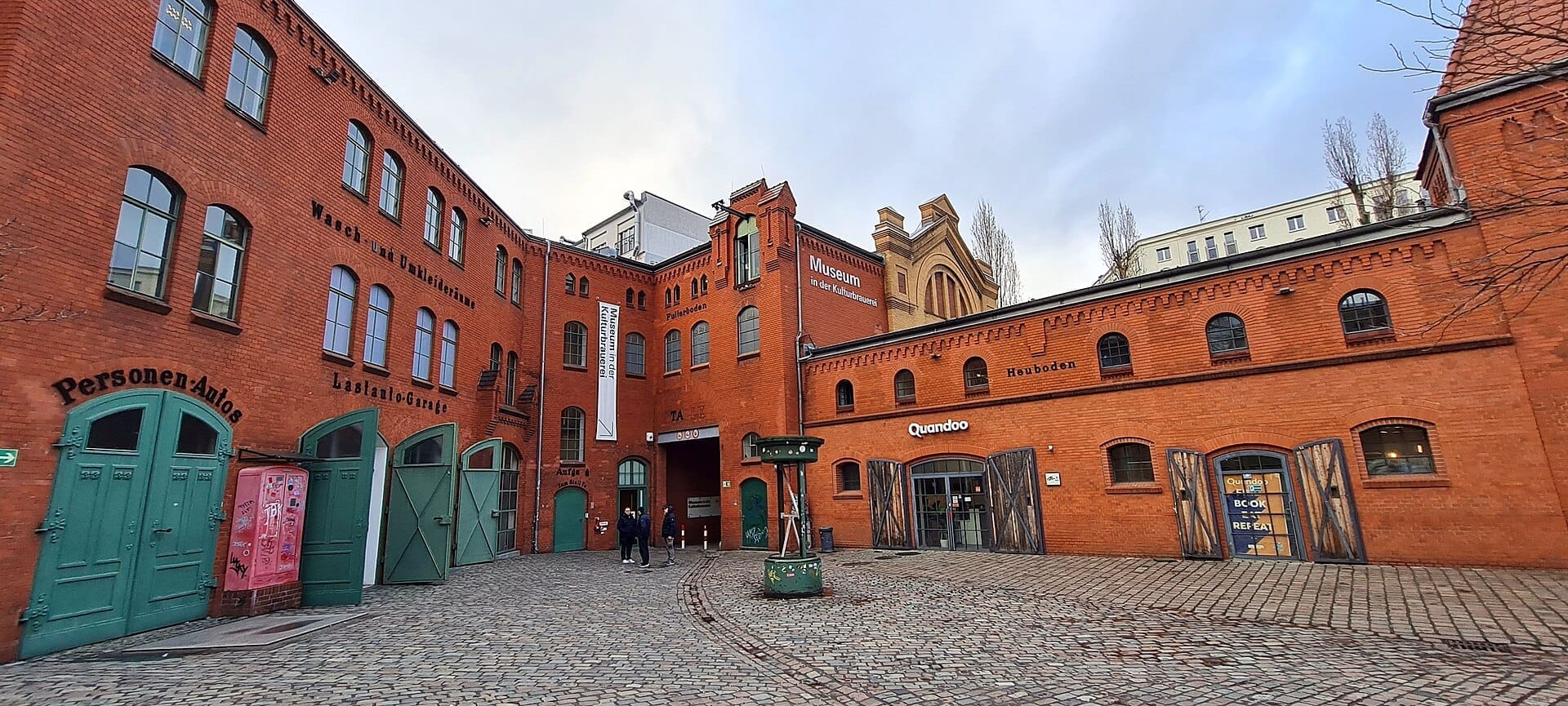
What the Kulturbrauerei Actually Is
The Kulturbrauerei is not one venue. It is a compound: six interconnected courtyards, 20 buildings, and a combined floor area of roughly 25,000 square metres, all wrapped in the distinctively warm tones of late 19th-century red and yellow brick. On any given afternoon you can walk freely from Schönhauser Allee through arched gateways into successive yards, each with a slightly different character, some quieter and residential in feel, others anchored by a café terrace or a concert poster board plastered three layers deep.
The complex takes its name from its former life as the Schultheiss-Brauerei, one of Germany's most prominent industrial breweries. Beer was produced on this site from the early 1840s, and the current architectural ensemble was built out from 1878 onwards to designs by Franz Heinrich Schwechten, the same architect who would later design the Kaiser Wilhelm Memorial Church to the west. Brewing operations at this location ceased in 1967, and the buildings were listed as protected historic monuments in 1974. After reunification, the site was gradually converted into the cultural centre it is today.
ℹ️ Good to know
The outdoor courtyards and passageways are freely accessible with no ticket required. The Museum in der Kulturbrauerei is also free of charge. You only pay for specific events: concerts, club nights, cinema screenings, or theatre performances.
The Architecture: What to Look at and Why
Schwechten's design for Schultheiss drew heavily on the Rundbogenstil tradition, a German interpretation of Romanesque revival that favoured rounded arches, decorative brickwork, and the kind of robust proportions that signalled industrial seriousness. Walking the courtyards, you notice details that feel almost ecclesiastical: corbelled cornices, ornamental friezes, iron gates with stylised hop motifs. The brewery was designed to impress as well as to function, and that combination still reads clearly in the facades.
The contrast between the historic brick exterior and the mix of uses inside creates an interesting friction. A club entrance sits beneath a 19th-century stone arch. A supermarket occupies what was once an industrial storage hall. A cinema runs beneath a vaulted former machine room. None of this has been forced into seamless harmony, which is part of what makes the Kulturbrauerei feel genuinely lived-in rather than curated for tourists.
If you are comparing Berlin's large-scale adaptive reuse projects, the Kulturbrauerei sits in a different register from the slickness of Hamburger Bahnhof. The brewery complex was not transformed into a prestige gallery but into something more unglamorous and functional, which gives it a texture closer to the surrounding neighbourhood.
Tickets & tours
Hand-picked options from our booking partner. Prices are indicative; availability and final rates are confirmed when you complete your booking.
Skip-the-line ticket for Gemaldegalerie Berlin
From 14 €Instant confirmationPanoramapunkt Berlin ticket with skip-the-line option
From 9 €Instant confirmation1-Hour Berlin Spree River Cruise with On-Board Guide
From 21 €Instant confirmationFree cancellationSamurai Experience Berlin skip-the-line ticket
From 15 €Instant confirmation
How the Complex Changes Through the Day
On weekday mornings, the courtyards are calm. Residents cut through on their way somewhere else. Café chairs are going out. The museum opens at 9:00 and is essentially empty for the first hour, which is when the permanent exhibition is at its best: no queues, no noise, just the documentary photographs and objects of East German daily life arranged in a way that rewards slow attention.
By early afternoon, the space fills with people who are not necessarily there as visitors: students using the courtyard as a shortcut, parents with pushchairs taking a break, people eating lunch outside from the surrounding food options. The Kulturbrauerei does not perform for tourists. It functions as part of Prenzlauer Berg's daily life, which can be either refreshing or underwhelming depending on what you came expecting.
Evenings shift the atmosphere entirely. The clubs and event venues come into their own after 22:00, with queues forming at Frannz Club and Kesselhaus on busier nights. If you are arriving for a late-night event, the brick facades lit from below take on a different quality altogether, heavier and more theatrical. The courtyard itself stays open as a through-route, so even people not attending events move through the space.
💡 Local tip
If you want the museum without distractions, arrive on a Tuesday or Wednesday morning before 11:00. Weekends between 12:00 and 15:00 are the busiest period for general visitors to the grounds.
Museum in der Kulturbrauerei: The Hidden Free Attraction
The Haus der Geschichte operates a permanent exhibition inside the complex called Museum in der Kulturbrauerei (Everyday Life in the GDR). It is free, well-documented, and consistently undervisited by international tourists who do not know it exists. The exhibition covers daily life in East Germany from the 1950s through to the Wende in 1989: housing, work, leisure, consumption, faith, and dissidence. The objects are specific and telling: a Trabant dashboard, a Pionierpalast badge collection, the kind of kitchen goods that were available and the kind that were not.
Opening hours are Tuesday to Friday 9:00 to 18:00, and Saturday to Sunday 10:00 to 18:00. The museum is closed Mondays. Holiday hours may differ; check the Haus der Geschichte website before visiting. The exhibition takes around 45 to 75 minutes to do properly. There is no audio guide fee and no booking required.
For visitors already interested in GDR history, this exhibition pairs well with a visit to the Stasi Museum in Lichtenberg or the DDR Museum near Museum Island, though those take different angles. The Kulturbrauerei museum is the most object-centred of the three and focuses on the texture of ordinary experience rather than political structures.
Getting There and Moving Around the Complex
The most straightforward approach is the U2 to Eberswalder Straße, which puts you at the western edge of the complex within a two-minute walk. Tram lines M1, M10, and 12 also stop at Eberswalder Straße. If you are coming from the city centre late at night, the N2 night bus serves the area when the U-Bahn is not running.
The complex has four street-level entry points: Schönhauser Allee 36, Schönhauser Allee 37, Knaackstraße 97, and Sredzkistraße 1. The Sredzkistraße entrance is ground-level and is the designated barrier-free access point. The courtyards are paved and mostly flat, suitable for wheelchairs and pushchairs. Individual venues within the complex handle their own accessibility arrangements, so it is worth checking cinema or club venues separately if that matters to you.
There is a paid underground car park with approximately 250 spaces beneath the cinema building for those arriving by car, though public transport from central Berlin is straightforward enough that driving is rarely the better option.
💡 Local tip
Photography inside the courtyards is unrestricted. The brick textures photograph well in late afternoon light when the sun hits the southern-facing facades directly. For architectural detail shots, the archways connecting the inner and outer courtyards are the most rewarding.
Kulturbrauerei and the Prenzlauer Berg Context
The Kulturbrauerei sits in a neighbourhood that underwent one of Berlin's most dramatic post-reunification transformations. Prenzlauer Berg was a densely populated working-class district under the GDR, notable for its unsanctioned cultural scene and a relatively high degree of organised dissidence in the 1980s. After 1990, the neighbourhood gentrified at speed, and today it has a reputation for family households, independent cafés, and the kind of weekend farmers' markets that attract residents with disposable income. The Kulturbrauerei's survival as an affordable, publicly accessible site within this changed landscape is worth noting.
The surrounding streets are worth exploring on foot before or after your visit. Schönhauser Allee connects the area to Mauerpark to the north, where a Sunday flea market and outdoor karaoke draw large crowds in warmer months. The Berlin flea markets guide covers both in detail if you are planning a combined outing.
For travellers spending more than a day in Berlin, the Kulturbrauerei is most naturally combined with a walk through the neighbourhood rather than treated as a standalone destination. Budget two to three hours for the museum, courtyard exploration, and a coffee break, then continue north or east on foot.
Who This Is Not For
If you are expecting a polished cultural institution with a gift shop, organised tours, and a clear visitor flow, the Kulturbrauerei will feel disorganised. There is no single front entrance, no welcome desk, and no map handed to you at the door. The courtyards serve residents and regulars more than visitors, and on a quiet Tuesday afternoon some parts of the complex feel more like a commercial estate than a cultural attraction.
Visitors who are primarily interested in Berlin's Cold War and division history will find the museum worth the trip but may feel the rest of the complex needs context that is not provided on-site. The free exhibition does have English-language signage, but it is not exhaustive. Coming with some prior knowledge of GDR history makes the objects significantly more legible.
Insider Tips
- The Museum in der Kulturbrauerei is operated by the Haus der Geschichte foundation, the same federal institution behind the major history museum in Bonn. The standard of research and curation is high, but it is not widely marketed to international visitors. Tell people about it.
- Kesselhaus and Frannz Club are two of the most atmospheric mid-size venues in Berlin for live music and club nights. Check their calendars before your trip rather than on arrival: popular events sell out in advance and there is no guaranteed door admission.
- The Christmas market held in the Kulturbrauerei courtyards each December is one of the city's better seasonal markets, with a focus on craft goods and mulled wine rather than mass-produced souvenir stalls. It draws local families rather than tourist crowds.
- If you are visiting with a very young child, the ground-level Sredzkistraße entrance makes pushchair access easy. The courtyard surfaces are smooth enough for strollers, which is not always the case at Berlin's older historical sites.
- Arrive via the Knaackstraße 97 entrance if coming from the east. It brings you into one of the quieter inner courtyards first and gives a better sense of the scale before you reach the more commercial areas near Schönhauser Allee.
Who Is Kulturbrauerei For?
- Architecture enthusiasts interested in 19th-century industrial design and adaptive reuse
- Travellers with an interest in East German history who want a free, substantive museum experience
- Berlin nightlife visitors looking for mid-size live music venues with genuine atmosphere
- Families based in Prenzlauer Berg wanting a free, accessible outdoor space with café options
- Photographers working on Berlin's industrial heritage or urban texture
Nearby Attractions
Other things to see while in Prenzlauer Berg:
- Berlin Wall Memorial (Gedenkstätte Berliner Mauer)
The Berlin Wall Memorial on Bernauer Straße is the most complete and historically serious place to understand the Wall. Stretching 1.4 km along the former border strip, it preserves original fortifications, a watchtower, the death strip, and the stories of those who tried to cross. Entry is free for all areas of the memorial.
- Mauerpark
Mauerpark occupies the former Berlin Wall death strip between Prenzlauer Berg and Wedding, covering about 15 hectares of grass, gravel paths, and a remaining 300-metre stretch of the Wall itself. Every Sunday, the park transforms into one of Berlin's most atmospheric flea markets, followed by the legendary Bearpit Karaoke. Entry is always free.