Neues Museum Berlin: Ancient Egypt, Nefertiti, and a Building That Survived History
The Neues Museum on Museum Island holds one of Europe's greatest collections of ancient Egyptian and prehistoric artifacts, anchored by the famous bust of Nefertiti. The building itself, a 19th-century masterpiece restored by David Chipperfield after decades of wartime ruin, is as compelling as anything inside it.
Quick Facts
- Location
- Bodestraße 1–3, 10178 Berlin (Museum Island, Mitte)
- Getting There
- S-Bahn to Hackescher Markt or U5 to Museumsinsel; Bus 100 or 200
- Time Needed
- 2–3 hours minimum; allow a full half-day if exploring all four levels
- Cost
- €14 standard, €7 concessions; free for under‑18s
- Best for
- Ancient history enthusiasts, architecture lovers, first-time Berlin visitors
- Official website
- www.smb.museum/en/museums-institutions/neues-museum/home
What Is the Neues Museum?
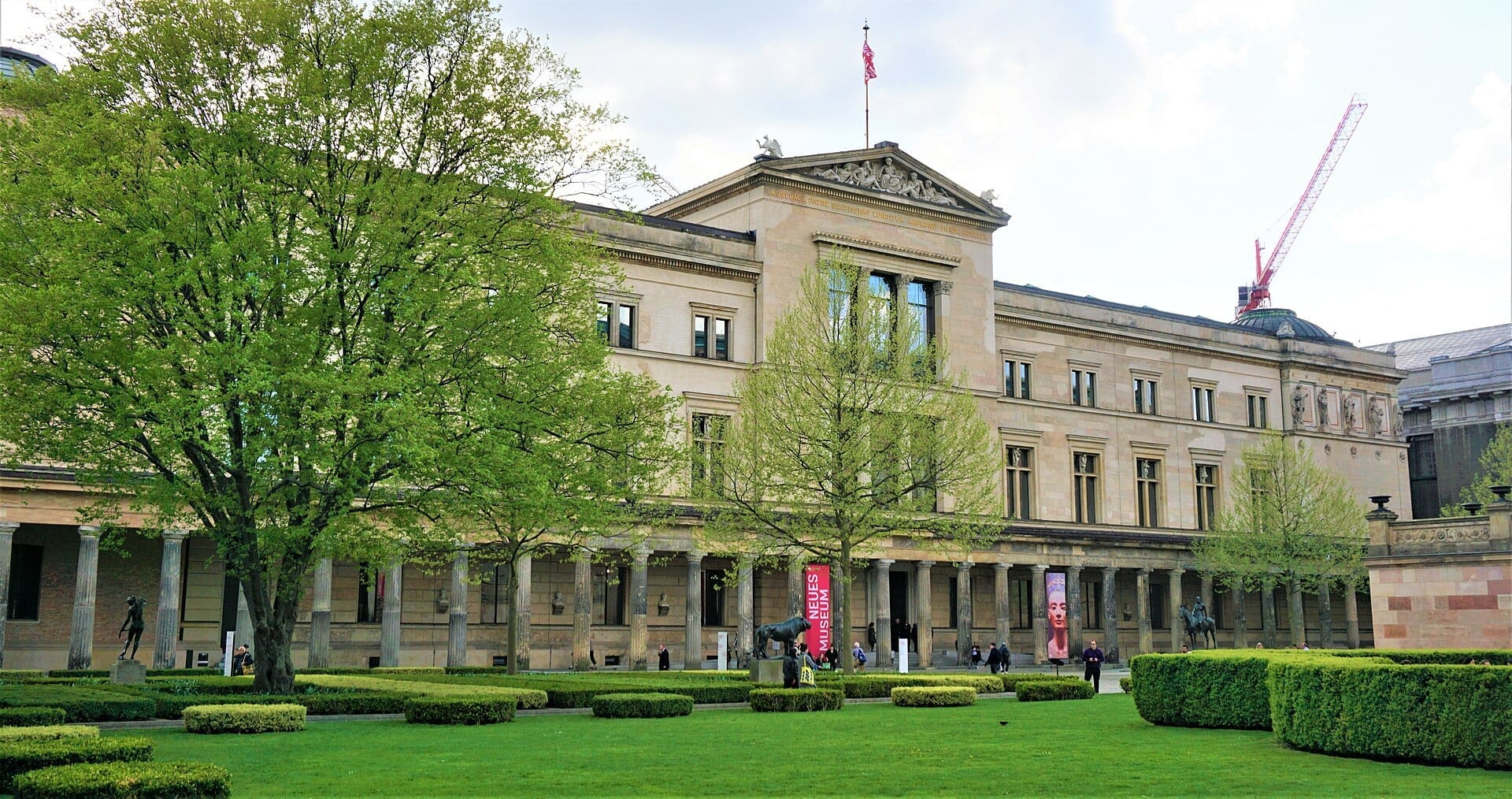
The Neues Museum (New Museum) sits at the northern end of Museum Island, a UNESCO World Heritage Site in the heart of Mitte. It is one of five major museums on the island and holds the Egyptian Museum and Papyrus Collection alongside the Museum of Prehistory and Early History. Together, that means thousands of objects spread across several thousand square metres and four levels — from prehistoric flint tools to gilded pharaonic grave goods to the most photographed artwork in Berlin.
The museum opened in 1855, was severely bombed during World War II, and then sat as a roofless shell in East Berlin for over four decades. That ruin is now part of the attraction. British architect David Chipperfield led a careful restoration from 1999 that preserved the damage rather than erasing it, and the museum reopened in 2009. The result is a building where Roman-style frescoed ceilings sit next to exposed wartime brickwork, and where Chipperfield's clean modern insertions make no pretence of being something they are not. For architecture and history together, very few museums in Europe come close.
💡 Local tip
Book tickets online at smb.museum before your visit. Timed-entry slots for the Nefertiti chamber fill quickly on weekends, and queuing at the door on a Saturday morning without a reservation can mean a long wait or a turned-away visit.
The Nefertiti Bust: Managing Expectations and Reality
The bust of Nefertiti is the reason many people come, and it genuinely rewards the visit. The painted limestone portrait of the Egyptian queen, created around 1340 BCE during the reign of Pharaoh Akhenaten, is kept in a small dedicated room on the upper floor. She stands behind glass in low, directed light, turning slightly on her pedestal in a way that makes the missing left eye feel deliberate rather than damaged. The colours remain vivid after more than three thousand years: blue crown, terracotta skin, dark brows drawn with precision.
What the photographs don't prepare you for is the scale. She is smaller than most visitors expect, about 50 centimetres tall, and the room is intimate. Crowds form a loose orbit around the case. Early on a Tuesday or Wednesday morning, the room can hold just a handful of people at a time, and the silence is appropriate. On a weekend afternoon, the space can feel like a single-room gallery during a vernissage. Photography is permitted, but flashes are not. The quality of light in the room is carefully calibrated, and a phone shot taken without flash at close range will capture her better than anything taken from the back of a crowd.
ℹ️ Good to know
A tactile model of the Nefertiti bust is available for visually impaired visitors, allowing direct handling of the form. Ask staff at the information desk on arrival.
Tickets & tours
Hand-picked options from our booking partner. Prices are indicative; availability and final rates are confirmed when you complete your booking.
Neues Museum entrance ticket with self-guided audio tour
From 26 €Instant confirmationSelf-guided audio tour of Berlin with Neues Museum access
From 30 €Instant confirmationNeues Museum skip-the-line tickets
From 14 €Instant confirmationNeues Museum audio tour
From 10 €Instant confirmation
The Building: Friedrich August Stüler, David Chipperfield, and a Conversation Across Time
Friedrich August Stüler designed the Neues Museum between 1843 and 1855, creating a neo-Renaissance structure that was considered one of the finest museum buildings in Europe. Its interior rooms were designed thematically, with the decoration — frescoes, painted ceilings, ornamental columns — intended to complement the collections housed within. Many of those decorations were destroyed in Allied bombing raids in 1943 and 1945, and the building was left unmaintained through the Cold War division of Berlin.
Chipperfield's approach to the restoration was to leave the visible evidence of destruction intact wherever structurally possible. Bullet holes remain in columns. Some frescoes survive in fragments, bordered by bare plaster. Entirely destroyed sections were rebuilt in a deliberately minimal language: plain brick, understated concrete, proportional but not decorative. The effect is of two eras in honest dialogue rather than one concealing the other. This approach won the Mies van der Rohe Award for European Architecture in 2011.
The grand staircase hall is the most striking single space in the building. Natural light falls through a restored skylight onto walls that are part surviving 19th-century mural, part bare reconstruction. Standing at the base of the stairs and looking up, the building tells its own history more clearly than any exhibition panel could. This space alone justifies the entrance fee for anyone with even a passing interest in architecture or urban memory.
The Collections: Beyond Nefertiti
The Egyptian Museum occupies the ground and first floors. The collection ranges from small faience amulets and papyrus scrolls to full-scale sarcophagi, monumental sculptures, and the reconstructed burial chamber known as the Green Head Chamber. The quality and density of the objects is consistently high. Many pieces arrived in Berlin through 19th-century excavations led by Karl Richard Lepsius and later the German Oriental Society.
The Museum of Prehistory and Early History occupies the upper levels and covers an arc from the Stone Age through the Bronze Age, the Iron Age, and into early medieval Europe. The Trojan gold, a collection of artefacts associated with Heinrich Schliemann's excavations at Troy in the 1870s, is displayed here. Some of the most significant pieces in Schliemann's original hoard were taken to Moscow in 1945 and have never been returned, so what is shown in Berlin represents the portion that remained. The display is honest about this gap.
If you're building a full day around the island, the Pergamon Museum and the Berlin Cathedral are within a five-minute walk. The Museum Island guide covers how to sequence all five museums without the fatigue of doing too much at once.
When to Visit and How the Experience Shifts
The museum is open Tuesday through Sunday, 10:00 to 18:00, and is closed on Mondays. Tuesday and Wednesday mornings between 10:00 and 12:00 are consistently the quietest windows. Friday afternoons and all day Saturday and Sunday draw the largest crowds, particularly in summer.
The interior is climate-controlled and largely independent of weather, which makes it a practical choice on rainy or very cold days. That also means it becomes a refuge for other visitors on the same logic, so poor weather outside does not guarantee an empty building inside. In summer, arriving at opening and moving directly to the Nefertiti room before tour groups settle in makes a meaningful difference to the experience.
If you are visiting Berlin primarily for its history and monuments, the best museums in Berlin guide provides a useful comparison across the city's major institutions. For those building a broader itinerary around the area, the 3-day Berlin itinerary includes Museum Island as part of a coherent route.
Practical Information: Getting There, Getting Around
The most direct public transport options are the S-Bahn to Hackescher Markt (lines S3, S5, S7, S9), a five-minute walk across the Monbijou Bridge to the island, or the U5 to Museumsinsel. Bus routes 100 and 200 both stop near the island and connect centrally from Alexanderplatz and Unter den Linden. The location is well connected and easy to reach from any central neighbourhood.
The museum is fully wheelchair accessible. All four levels are reachable by lift, and wide corridors throughout the building accommodate mobility aids without difficulty. Audio guides are available at the entrance in multiple languages and are worth the additional cost for the Egyptian collection, where context significantly enhances the experience of many objects.
There is a museum shop and a café on site. The café seating area is modest and tends to fill during midday. Eating in the surrounding area is straightforward: the Hackescher Markt district immediately to the north has a wide range of cafés and lunch options within a ten-minute walk.
Who Should Consider Skipping It
Visitors with little interest in ancient history or archaeology may find the collections less engaging than the building itself. If the architecture draws you, the upper staircase hall and Chipperfield's interventions are worth seeing even if the objects don't hold your attention for two hours. That said, if neither ancient Egypt nor prehistoric Europe forms any part of your interest, there are more immediately engaging museums in Berlin for contemporary art, Cold War history, or urban culture.
For Cold War history specifically, the DDR Museum and the Topography of Terror both serve that interest more directly and are within reasonable distance of Museum Island.
Insider Tips
- The Nefertiti room allows photography without flash. Turn off your flash, get as close to the case as politely possible, and use a slightly longer exposure setting. The dedicated lighting in the room produces a better result than any artificial flash would.
- The museum's ticket covers only the Neues Museum. If you plan to visit multiple Museum Island institutions, the Museum Island Day Pass (available at the ticket desk or online) offers better value across several admissions.
- The upper levels of the museum are significantly less crowded than the Egyptian collection floors. The Museum of Prehistory and Early History, including the Trojan gold display, can often be explored at a genuinely unhurried pace even when the ground floor is busy.
- Free admission applies to visitors under 18 regardless of nationality. If you are travelling with children or teenagers, this is one of Berlin's most rewarding free experiences for younger visitors with any curiosity about ancient civilisations.
- The building's north courtyard is partially visible through upper-floor windows. On a clear morning, the exterior geometry of Chipperfield's additions seen from inside frames the restored stonework in a way that is more legible than any exterior photograph.
Who Is Neues Museum For?
- First-time visitors to Berlin who want world-class collections in a single building
- Architecture and design enthusiasts interested in adaptive reuse and historic restoration
- Families with older children and teenagers who have an interest in ancient Egypt
- Travellers combining several Museum Island venues in a single day
- History-focused visitors building an itinerary around Berlin's major cultural institutions
Nearby Attractions
Other things to see while in Mitte:
- Alexanderplatz
Alexanderplatz sits at the geographical and historical heart of former East Berlin, a vast open square with roots going back to the 13th century. Today it's a free, always-open crossroads of transit, Cold War monuments, and everyday Berlin life — chaotic, fascinating, and impossible to avoid.
- Berlin Cathedral (Berliner Dom)
The Berlin Cathedral, or Berliner Dom, is Germany's largest Protestant church and one of the most architecturally striking buildings in the city. Built between 1894 and 1905, it anchors Museum Island with a dome you can climb, a royal crypt below ground, and a nave that rewards slow, unhurried attention.
- Berlin TV Tower (Fernsehturm)
Standing 368 metres above central Berlin, the Berliner Fernsehturm is the tallest structure in Germany and the tallest publicly accessible building in Europe. Its observation deck at 203 metres delivers an unobstructed 360-degree panorama of the city. This guide covers what you actually see up there, when crowds are worst, and whether the ticket price is justified.
- Berlin Victory Column (Siegessäule)
Rising from the centre of the Großer Stern roundabout in Tiergarten, the Siegessäule is one of Berlin's most recognisable monuments. At around 67 metres tall, it offers a sweeping panorama over the city's forest-park heart — but you earn the view with 285 steps and no lift.