Pergamon Museum Berlin: The Iconic Museum Island Giant (Currently Closed)
The Pergamonmuseum is one of the most celebrated archaeology museums in the world, home to monumental reconstructions of ancient gates and altars. The main building is currently closed for a major renovation, but an alternative panorama exhibition remains open nearby. Here is everything you need to plan around it.
Quick Facts
- Location
- Bodestraße 1-3, 10178 Berlin-Mitte (Museum Island)
- Getting There
- S-Bahn Hackescher Markt (approx. 5-min walk); Oranienburger Straße (approx. 7-min walk)
- Time Needed
- Main museum: currently closed. Panorama exhibition: allow 1–1.5 hours
- Cost
- Main museum: not currently ticketed (closed). Panorama exhibition: check smb.museum for current prices in EUR
- Best for
- Ancient history enthusiasts, architecture lovers, serious museum-goers
- Official website
- www.smb.museum/en/museums-institutions/pergamonmuseum/home
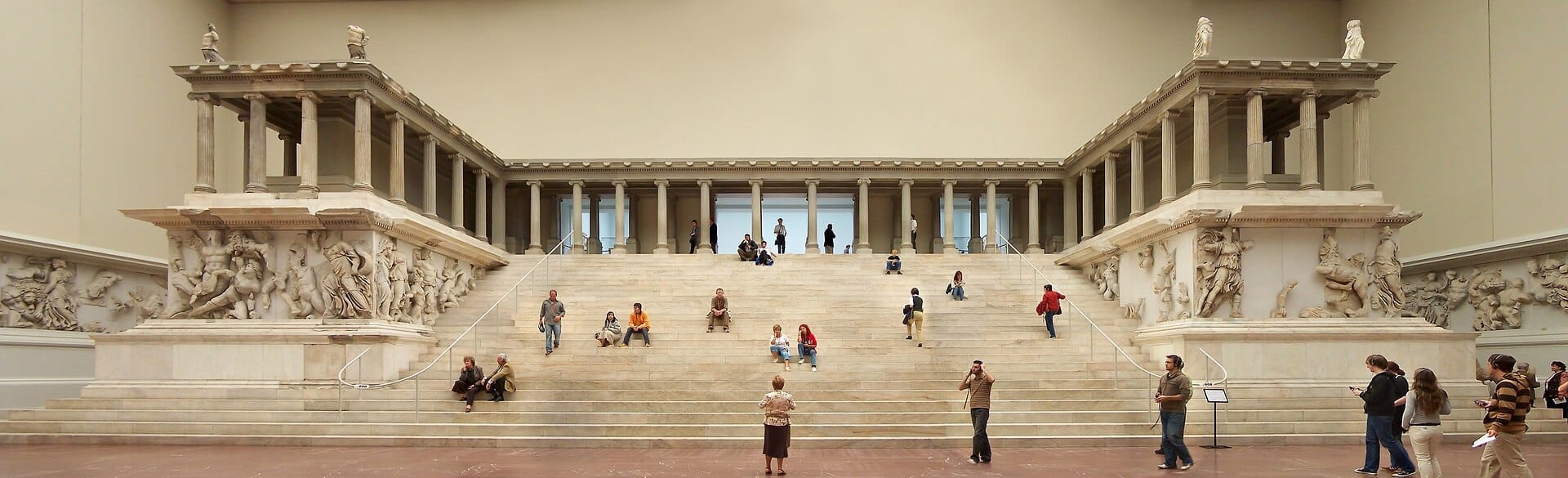
The Big Picture: What the Pergamon Museum Is (and Why It's Complicated Right Now)
The Pergamonmuseum, standing on Museum Island in the heart of Berlin's Mitte district, was for decades the most visited museum in Germany. It earned that reputation not through sheer volume of artifacts, but through scale. The building was designed specifically to house objects that could not fit inside conventional gallery rooms: reassembled monumental architecture from ancient Babylon, Pergamon, and Miletus, transported to Berlin during the late 19th and early 20th centuries and reconstructed inside purpose-built halls.
The current building was constructed between 1910 and 1930 to designs by Alfred Messel, completed under Ludwig Hoffmann, and opened in 1930 as a three-wing complex. It houses three collections: the Antikensammlung (Collection of Classical Antiquities), the Vorderasiatisches Museum (Museum of the Ancient Near East), and the Museum für Islamische Kunst (Museum of Islamic Art). The entire Museum Island complex, of which the Pergamonmuseum is a part, was inscribed as a UNESCO World Heritage Site in 1999.
⚠️ What to skip
The Pergamonmuseum main building is completely closed to visitors due to large-scale construction and renovation works. Standard museum tickets are not being sold for the main building. Before visiting, check the official Staatliche Museen website for the latest updates on the reopening, with a first partial reopening currently announced for 2027.
This is not a temporary partial closure or wing-by-wing rotation. The entire building is off-limits for public visiting during the construction phase. If you are traveling to Berlin specifically to see the Pergamon Altar or the Ishtar Gate, you need to adjust your plans accordingly.
What You Can Still See: Pergamonmuseum. Das Panorama
In place of the main museum, an alternative exhibition titled "Pergamonmuseum. Das Panorama" has been made available to visitors. This is a separate physical venue, located opposite Museum Island, and it operates with its own opening hours and ticketing. The centerpiece is a large-format 360-degree panorama artwork by artist Yadegar Asisi, giving a monumental, immersive impression of ancient Pergamon. The exhibition also includes contextual displays and selected artifacts from the museum's collections.
It is worth managing expectations clearly. The Panorama exhibition is a thoughtful and visually striking experience, but it is not a substitute for the main museum. It functions as a bridge: something substantial enough to justify a visit on its own terms, particularly if you are interested in the history of Pergamon or enjoy large-scale immersive art installations. Ticket prices for the Panorama exhibition are separate from regular museum admissions; check the official Staatliche Museen zu Berlin website for current EUR pricing before you go.
💡 Local tip
The Panorama exhibition tends to attract fewer visitors than Museum Island's other open institutions, which means shorter queues and more room to take in the visuals. Weekday morning visits are the most relaxed.
Tickets & tours
Hand-picked options from our booking partner. Prices are indicative; availability and final rates are confirmed when you complete your booking.
1-Hour Berlin Spree River Cruise with On-Board Guide
From 21 €Instant confirmationFree cancellationCity Sightseeing Berlin hop-on hop-off ticket
From 32 €Instant confirmationCity Sightseeing Berlin hop-on hop-off ticket
From 25 €Instant confirmationFree cancellationCity Sightseeing Berlin hop-on hop-off ticket
From 47 €Instant confirmationFree cancellation
What Was Inside: The Collections in Context
Understanding what the Pergamonmuseum contains helps explain both its cultural significance and the controversy that has always surrounded it. The collection's anchor piece is the Pergamon Altar, a massive Greek temple altar dating to the 2nd century BCE, originally built in the ancient city of Pergamon (in present-day Turkey). Its frieze depicts the Gigantomachy, the mythological battle between gods and giants, and is considered one of the finest surviving examples of Hellenistic sculpture.
The Ishtar Gate, dating to the reign of Nebuchadnezzar II in the 6th century BCE, is a reconstructed processional entrance from ancient Babylon. Decorated with glazed brick reliefs of dragons and bulls in deep blue and gold, it stands about 14 meters tall inside the museum's hall and is one of the most recognizable ancient artifacts in any European collection. The Market Gate of Miletus, a Roman-era structure from the 2nd century CE, completes the trio of monumental reconstructions in the Antikensammlung wing.
The Museum of Islamic Art within the Pergamonmuseum houses the Aleppo Room, a lavishly decorated reception chamber from a merchant's house in 17th-century Aleppo, Syria. Given the ongoing conflict in Syria and the destruction of much of Aleppo's historic built fabric, the room carries a weight it did not have when first installed. It is one of those objects that has changed meaning in the decades since it arrived in Berlin. For broader context on Berlin's world-class museum offerings, the best museums in Berlin guide covers the full landscape across the city.
Getting to Museum Island: Transit, Walk, and Arrival
Museum Island sits in the Spree River in central Mitte, accessible on foot from multiple S-Bahn stations. The most convenient option is S-Bahn Hackescher Markt, which puts you about five minutes from the museum's front entrance on Bodestraße. From Alexanderplatz, the walk along the river takes roughly ten to twelve minutes and passes the Berlin Cathedral before arriving at the museum's neoclassical facade.
The island itself is worth approaching slowly. The cluster of five museums, the cathedral, and the bridges over the Spree create one of the most architecturally coherent public spaces in Germany. If you arrive by tram at Georgenstraße/Am Kupfergraben, you step directly onto the island's edge with the museum complex ahead of you. The Museum Island page covers the full site including the other institutions currently open, such as the Neues Museum and the Alte Nationalgalerie.
Cycling to Museum Island is practical for most of Berlin's flat terrain. Bike parking is available near the museum entrances, though it fills quickly on weekend afternoons. Walking across the Monbijoubrücke or Schlossbrücke bridges on approach gives good views of the buildings and orients you to the island before you enter any building.
The Museum Island Setting: What Surrounds It
The Pergamonmuseum's location on Museum Island places it within easy reach of several significant sites. The Berlin Cathedral is directly adjacent, its copper dome visible from most angles on the island. A short walk along Unter den Linden leads to the Humboldt Forum and the Brandenburg Gate beyond. The broader Mitte district contains more historical density per square kilometer than almost anywhere else in Germany.
If you are spending a full day in this part of the city, consider the Museum Island visitor guide which covers all five institutions on the island, entry strategies, and how to allocate time across multiple museums without fatigue. The island's museums collectively represent some of the most significant archaeological and art collections assembled anywhere in Europe, and understanding the layout before arriving saves considerable walking and backtracking.
Historical and Ethical Context: The Artifacts and Their Origins
The Pergamonmuseum has never been far from debate about the ethics of large-scale artifact acquisition. Most of the major objects were excavated or purchased during the late 19th and early 20th centuries under arrangements that would not be sanctioned under contemporary international heritage law. The German government and Staatliche Museen have engaged in ongoing discussions with Turkey regarding the Pergamon Altar, and the broader conversation about decolonizing European museum collections is particularly relevant here.
This context does not diminish the scholarly and visual experience of the collections, but it does shape how thoughtful visitors engage with them. The museum itself has, in recent years, invested in more transparent presentation of acquisition histories. For visitors interested in the ethical dimensions of archaeological collecting, the museum's own publications and the research accessible via the Staatliche Museen website provide substantive reading beyond what gallery labels convey.
Photography, Accessibility, and Practical Notes for the Panorama Visit
For the Panorama exhibition currently operating, photography is generally permitted without flash. The immersive panorama format, with its circular floor-to-ceiling image, rewards slow movement around the viewing platform rather than a single fixed angle. Early morning slots give cleaner light in the surrounding contextual gallery spaces, though the panorama image itself is artificially lit and looks consistent throughout opening hours.
Accessibility arrangements for the Panorama venue are separate from those of the main museum building. Visitors with mobility requirements should check the current access provisions directly with the Staatliche Museen, as the alternative venue has its own entry configuration. The official Staatliche Museen website includes a dedicated visitor services section with current barrier-free access information.
For visitors planning a broader Berlin itinerary that incorporates the Pergamon closure alongside other key sites, the 3-day Berlin itinerary offers a practical framework for balancing Museum Island with other parts of the city.
Insider Tips
- Do not assume the Pergamonmuseum is open based on older guidebook information or travel blogs written before 2023. The full closure is ongoing and the reopening date has shifted. Check smb.museum directly in the week before your visit.
- The Neues Museum on the same island is fully open and houses the bust of Nefertiti, one of the most recognized objects in any Berlin museum. If you're already on Museum Island, factor in at least 90 minutes there.
- The Panorama exhibition is far less crowded than pre-closure visitor numbers for the main building, which means you can stand in front of the panorama without queuing or jostling. This is genuinely one of the calmer cultural experiences currently available on Museum Island.
- Museum Island gets significantly busier from 11am onward, especially on Saturdays. Arriving when the Panorama exhibition opens gives you the first 45 minutes with very few other visitors in the space.
- The Humboldt Forum, a short walk from the island's southern tip, now houses significant Ethnologisches Museum collections and is worth pairing with a Museum Island visit, particularly given the current limited access on the island itself.
Who Is Pergamon Museum For?
- Travelers with a specific interest in ancient Mesopotamian, Greek, or Islamic art history
- Architecture enthusiasts interested in early 20th-century museum design and neoclassical Berlin
- Visitors building a full Museum Island day who want to understand the complete picture of the complex
- Anyone interested in the ethics of archaeological collection and colonial-era acquisition
- Travelers who have already visited the main museum previously and want to see the Panorama as a new experience
Nearby Attractions
Other things to see while in Mitte:
- Alexanderplatz
Alexanderplatz sits at the geographical and historical heart of former East Berlin, a vast open square with roots going back to the 13th century. Today it's a free, always-open crossroads of transit, Cold War monuments, and everyday Berlin life — chaotic, fascinating, and impossible to avoid.
- Berlin Cathedral (Berliner Dom)
The Berlin Cathedral, or Berliner Dom, is Germany's largest Protestant church and one of the most architecturally striking buildings in the city. Built between 1894 and 1905, it anchors Museum Island with a dome you can climb, a royal crypt below ground, and a nave that rewards slow, unhurried attention.
- Berlin TV Tower (Fernsehturm)
Standing 368 metres above central Berlin, the Berliner Fernsehturm is the tallest structure in Germany and the tallest publicly accessible building in Europe. Its observation deck at 203 metres delivers an unobstructed 360-degree panorama of the city. This guide covers what you actually see up there, when crowds are worst, and whether the ticket price is justified.
- Berlin Victory Column (Siegessäule)
Rising from the centre of the Großer Stern roundabout in Tiergarten, the Siegessäule is one of Berlin's most recognisable monuments. At around 67 metres tall, it offers a sweeping panorama over the city's forest-park heart — but you earn the view with 285 steps and no lift.