Berliner Philharmonie: Berlin's Greatest Concert Hall
The Berliner Philharmonie is one of the world's most celebrated concert venues, home to the Berliner Philharmoniker and a landmark of 20th-century architecture. Whether you come for a performance or a guided tour, the building alone rewards a detour.
Quick Facts
- Location
- Herbert-von-Karajan-Straße 1, 10785 Berlin (Kulturforum, near Potsdamer Platz)
- Getting There
- U2 / S1 / S2 / S25 / S26 to Potsdamer Platz; buses M48, M85, M29
- Time Needed
- 1.5–3 hours for a concert; 45–60 min for a guided tour
- Cost
- Ticket prices vary by concert and seat category; check the official site for current listings
- Best for
- Classical music lovers, architecture enthusiasts, cultural travellers
- Official website
- www.berliner-philharmoniker.de/en/about-us/philharmonie
Why the Berliner Philharmonie Matters
The Berliner Philharmonie is not simply a concert hall. It is one of the defining cultural institutions of postwar Europe, a building that changed how orchestral music is experienced and a venue whose reputation draws serious music listeners from across the world. Completed in 1963 to designs by architect Hans Scharoun, it has been the permanent home of the Berliner Philharmoniker ever since, and the acoustics of its Grand Hall are considered among the finest ever engineered for a symphony orchestra.
The Philharmonie sits within the Kulturforum complex near Potsdamer Platz, a cultural campus that also includes the Gemäldegalerie, the Neue Nationalgalerie, and the Musical Instruments Museum. This concentration of institutions makes the area worth a full day if you have the appetite for it. But even on a tight schedule, the Philharmonie stands apart from its neighbours in the depth of experience it offers.
💡 Local tip
Concert tickets sell out weeks or months in advance for popular programmes. Check the official online ticket shop early and set an alert if you have a specific date in mind. Last-minute availability sometimes appears, but it is not reliable for major concerts.
The Architecture: Scharoun's Radical Design
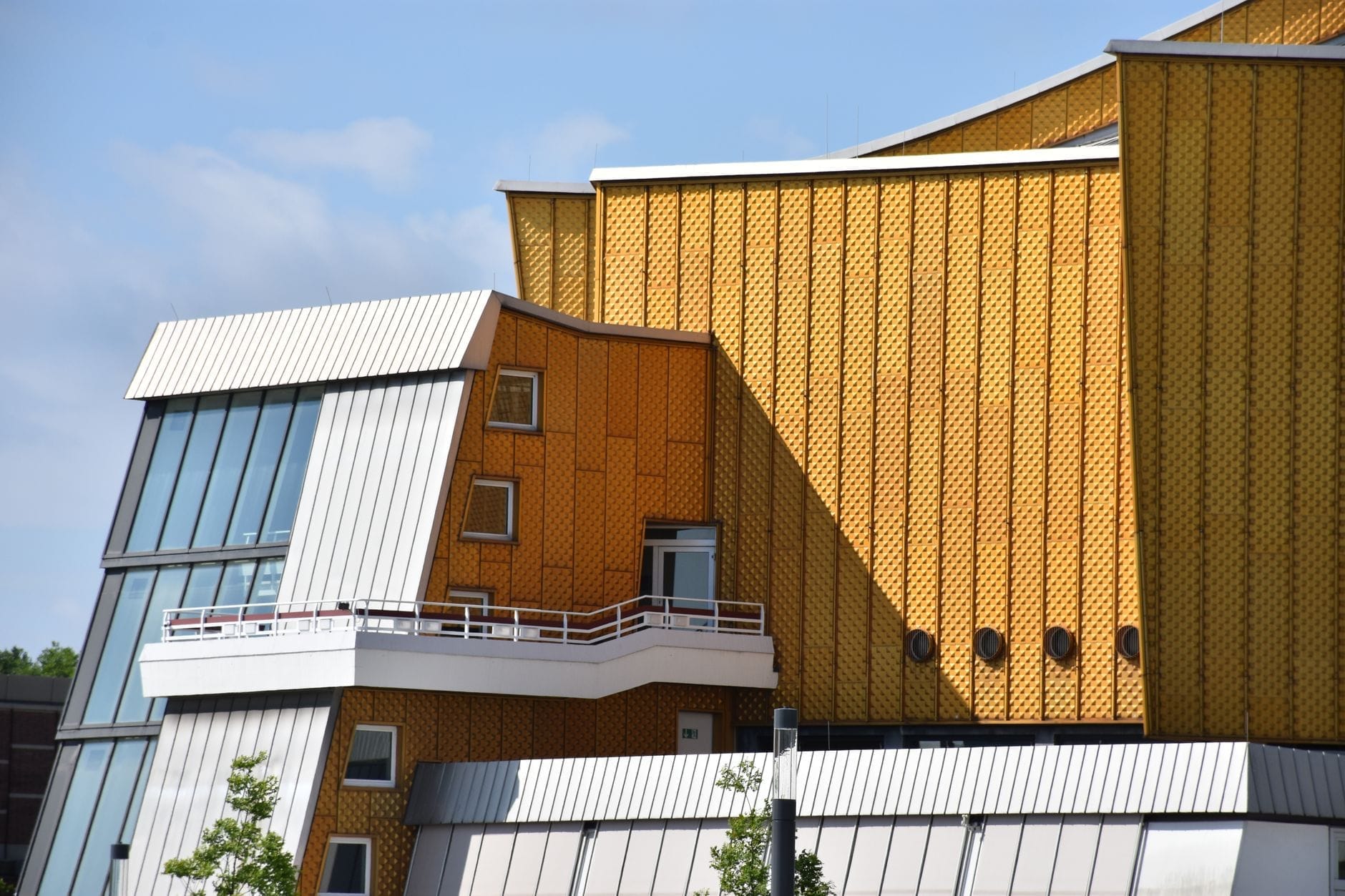
Before you enter, stop on the pavement and look at the building. Hans Scharoun designed the Philharmonie between 1960 and 1963 at a moment when most concert halls still put the orchestra at one end and the audience in rows facing it. Scharoun inverted this entirely. He placed the performers at the centre and arranged the audience in ascending terraced sections around them, a layout that became known as the vineyard configuration. The idea was simple and radical: the audience surrounds the music rather than observing it from a distance.
The exterior reads as a series of angular, tent-like rooflines clad in a golden-yellow anodised aluminium. It is an unusual building by any standard. From street level it can look deliberately ungainly, almost provisional, as if Scharoun was more concerned with what happened inside than with creating a photogenic facade. That is, in fact, exactly what he intended. The exterior form follows the interior logic. Walk around the perimeter and the building shifts character with each angle.
A second, smaller hall, the Kammermusiksaal (Chamber Music Hall), was added to the complex in 1987 to designs completed posthumously from Scharoun's plans. It seats 1,180 and applies the same spatial logic at a more intimate scale. The two halls share a foyer and are connected internally, though each has its own distinct atmosphere.
Tickets & tours
Hand-picked options from our booking partner. Prices are indicative; availability and final rates are confirmed when you complete your booking.
Berliner Zimmer dinner party by GAiETY
From 117 €Instant confirmationFree cancellationSkip-the-line ticket for Gemaldegalerie Berlin
From 14 €Instant confirmationPanoramapunkt Berlin ticket with skip-the-line option
From 9 €Instant confirmation1-Hour Berlin Spree River Cruise with On-Board Guide
From 21 €Instant confirmationFree cancellation
Inside the Grand Hall: Acoustics and Atmosphere
The Großer Saal (Grand Hall) seats 2,440 people across its terraced sections. No seat is more than 32 metres from the podium. What this means in practice is that wherever you sit, you feel close to the orchestra, not in a front-row-only way but in the sense that the spatial relationship between performer and listener feels genuinely shared. The hall does not have a cheap seat in the acoustic sense, though some terrace sections have partially obstructed sightlines to certain parts of the stage.
The ceiling is an irregular canopy of convex reflectors designed to distribute sound evenly across the room. The effect is hard to describe in advance, but during a performance the sound appears to arrive from all around you rather than from a single point. At full orchestral volume, the physical sensation in the chest is noticeable. At quieter passages, the hall's silence between notes is almost total.
The interior materials are mostly pale wood and textured concrete, warm in artificial light. On a concert night the foyers fill with a mix of dressed-up regulars, serious students with scores tucked under their arms, and first-time visitors clearly uncertain where to go. Staff are generally helpful and signage inside the building is clear. The atmosphere before a performance is anticipatory rather than stiff. This is not a place where you need to feel intimidated, even if you have never attended a classical concert before.
ℹ️ Good to know
The vineyard seating means that some sections face the back of the conductor rather than the front. These seats offer a different but equally valid perspective, and the acoustic experience is not compromised. Many regulars prefer them.
Visiting Without a Concert Ticket: Guided Tours
If attending a concert is not possible, guided tours of the Philharmonie are offered on selected days. Dates and times are published in advance on the official website. Tours typically move through the main foyer, the Grand Hall itself, and provide architectural context that is difficult to grasp from a seat during a performance. Standing in the empty Grand Hall, you can examine the ceiling geometry and terrace layout without distraction.
Tours are conducted in German and, on specific dates, in English. Group sizes are limited. If your visit to Berlin coincides with a tour date, it is worth booking ahead. The building without an audience still conveys the ambition of Scharoun's design, and for anyone interested in 20th-century architecture, it is a genuinely educational hour.
💡 Local tip
Tour availability is not continuous. Check the Berliner Philharmoniker website for the current schedule before planning your day around it.
Time of Day, Crowds, and What to Expect
The area around the Philharmonie is quiet during the day. The Kulturforum does not generate street-level foot traffic the way Museumsinsel or the Brandenburg Gate does. On weekday mornings, the plaza outside the Philharmonie is largely empty, the golden facade catching whatever light comes through Berlin's typically overcast sky. It is a good time to photograph the exterior without tour groups in frame.
On concert evenings, the character shifts. Coaches and taxis arrive from around 6:30pm for a typical 7:30pm start. The foyers open well before performances begin and are worth arriving early to explore. There is a bar and cloakroom service inside. After a performance, the crowd disperses quickly toward Potsdamer Platz S-Bahn, so the platform can be crowded for about 15 minutes post-concert.
If you are spending the afternoon in the area, the Gemäldegalerie and the Neue Nationalgalerie are both within a five-minute walk and make natural companions to an evening at the Philharmonie.
Practical Details for Your Visit
The Philharmonie is located at Herbert-von-Karajan-Straße 1, 10785 Berlin. The street is named after Herbert von Karajan, the conductor who led the Berliner Philharmoniker for 35 years and who was instrumental in the hall's construction and early reputation. The address places it directly between the Kulturforum complex and the western edge of the Tiergarten.
By public transport, U-Bahn line U2 and S-Bahn lines S1, S2, S25, and S26 all stop at Potsdamer Platz, a six-minute walk from the hall. Buses M48, M85, and M29 also serve the area. For more on navigating Berlin's transit network, the guide to getting around Berlin covers BVG tickets, day passes, and the Welcome Card in detail.
Dress code for concerts is smart casual to formal, though Berlin audiences are more relaxed about this than some European cities. You will see everything from black tie to clean jeans on any given concert night. What you should not do is arrive late: doors close and latecomers are held in the foyer until a suitable break, which can mean missing the first movement entirely.
The venue has accessible entrances, lifts, and designated wheelchair spaces. Detailed accessibility information is available on the official Berliner Philharmoniker website and it is worth contacting them directly if you have specific requirements, as seat selection for accessible positions may work differently from the standard booking flow.
Who Should Think Twice
The Philharmonie is not the right visit for everyone. If classical music holds no interest for you, a guided tour of an empty concert hall is likely to feel thin, regardless of how impressive the architecture is. The exterior, while genuinely distinctive, does not reward a quick photograph and move on in the way that, say, the Brandenburg Gate does. The value of the Philharmonie is almost entirely experiential, rooted in sitting inside the hall during a performance.
Travellers with children should be aware that the Berliner Philharmoniker does programme family and children's concerts on specific dates. These can be an excellent introduction for younger audiences. Check the concert calendar for Family Concerts (Familienkonzerte) before ruling it out. For other family-friendly options across the city, the guide to Berlin with kids has practical recommendations.
Insider Tips
- The Digital Concert Hall (available via the Berliner Philharmoniker website) lets you stream live and archived performances. If you cannot get tickets, this is the next best thing and far better than most alternatives.
- Seats in the choral terrace directly behind the orchestra offer an unusual perspective: you see the conductor's face rather than their back, and you watch the strings and woodwinds from above. Some listeners find this the most involving vantage point in the hall.
- The free foyer exhibitions and instrument displays in the adjacent Musical Instruments Museum (Musikinstrumenten-Museum) are worth visiting on the afternoon of a concert to extend the musical context of your evening.
- If you are attending a concert, arrive at least 30 minutes early. The irregular foyer layout is easy to get turned around in, and finding your terrace section takes longer than it would in a conventional hall.
- Student and last-minute tickets are occasionally released close to the performance date at reduced prices. Check the official ticket shop within 48 hours of a concert you want to attend.
Who Is Berliner Philharmonie For?
- Classical music listeners who want to experience one of the world's top orchestras in their home hall
- Architecture and design travellers with an interest in postwar European modernism
- Cultural travellers building a serious itinerary around Berlin's museum and arts institutions
- Couples looking for a formal evening out that goes beyond dinner and a bar
- Visitors with a full day in the Kulturforum area combining galleries in the afternoon with a concert in the evening
Nearby Attractions
Other things to see while in Potsdamer Platz:
- Gemäldegalerie
The Gemäldegalerie at Berlin's Kulturforum houses more than 1,200 European paintings spanning the 13th to 18th centuries, from Vermeer and Rembrandt to Raphael and Caravaggio. It is one of the most important Old Master galleries in the world, and among the least crowded for its caliber.
- Neue Nationalgalerie
The Neue Nationalgalerie is one of the 20th century's most celebrated museum buildings, a steel-and-glass pavilion by Ludwig Mies van der Rohe that opened in West Berlin in 1968. After a six-year renovation completed in 2021, it houses the Nationalgalerie's collection of 20th-century European art at the Kulturforum. Whether you come for the architecture or the art, you leave having seen both.