Coney Island sits at the southwestern tip of Brooklyn, where the Atlantic Ocean meets nearly two centuries of American amusement park history. From the historic Cyclone roller coaster to three miles of open beach, it offers a side of New York City that feels nothing like Manhattan.
Coney Island is Brooklyn's famous seaside resort district, a place where a historic wooden roller coaster runs within earshot of actual ocean waves and the boardwalk smells like sunscreen, hot dogs, and salt air in equal measure. It is one of the few places in New York City where the pace slows down, the skyline disappears, and the city feels very far away, even though you can be here from Midtown in under an hour by subway.
Orientation
Coney Island occupies the southernmost tip of Brooklyn, on a peninsula that juts into the Atlantic Ocean. To get a mental picture: Brooklyn itself sits southeast of Manhattan across the East River, and Coney Island is at the far bottom of that borough, about 12 miles from Midtown Manhattan by road. The neighborhood is essentially a long strip running east to west, with the ocean and beach forming the entire southern edge and residential streets stepping northward toward Gravesend and Brighton Beach.
The main commercial spine is Surf Avenue, which runs parallel to the boardwalk one block inland. Most of the amusement attractions, subway stations, and food vendors cluster along Surf Avenue between West 8th Street and West 16th Street. The boardwalk itself stretches nearly three miles, from Corbin Place at the eastern end to West 37th Street at the western edge. Brighton Beach begins where Coney Island ends at Ocean Parkway, and the two neighborhoods share a continuous boardwalk, though their characters are quite different: Brighton Beach is dense and residential with a large Russian-speaking community, while Coney Island is oriented almost entirely toward visitors and seasonal recreation.
Understanding that geography helps set expectations. Coney Island is not a dense urban neighborhood in the way that the Lower East Side or Williamsburg are. It is a beach and amusement district with residential blocks behind it, and it functions on a strongly seasonal calendar. The stretch from Memorial Day to Labor Day is when it operates at full intensity. Outside those months, parts of it go quiet, attractions close or reduce hours, and the boardwalk becomes a windswept stretch where locals walk their dogs and joggers outnumber tourists.
Character & Atmosphere
On a Saturday morning in July, the D or F train pulls into Coney Island–Stillwell Avenue and deposits what feels like half of Brooklyn onto Surf Avenue. Families with folding chairs, teenagers in groups, older couples who have been making this trip for decades. By 10am the beach is already staked out with umbrellas, the smell of the ocean mixing with grease from the Nathan's Famous on the corner of Stillwell and Surf. The light at this hour is good: flat and bright off the water, the Wonder Wheel still in the background.
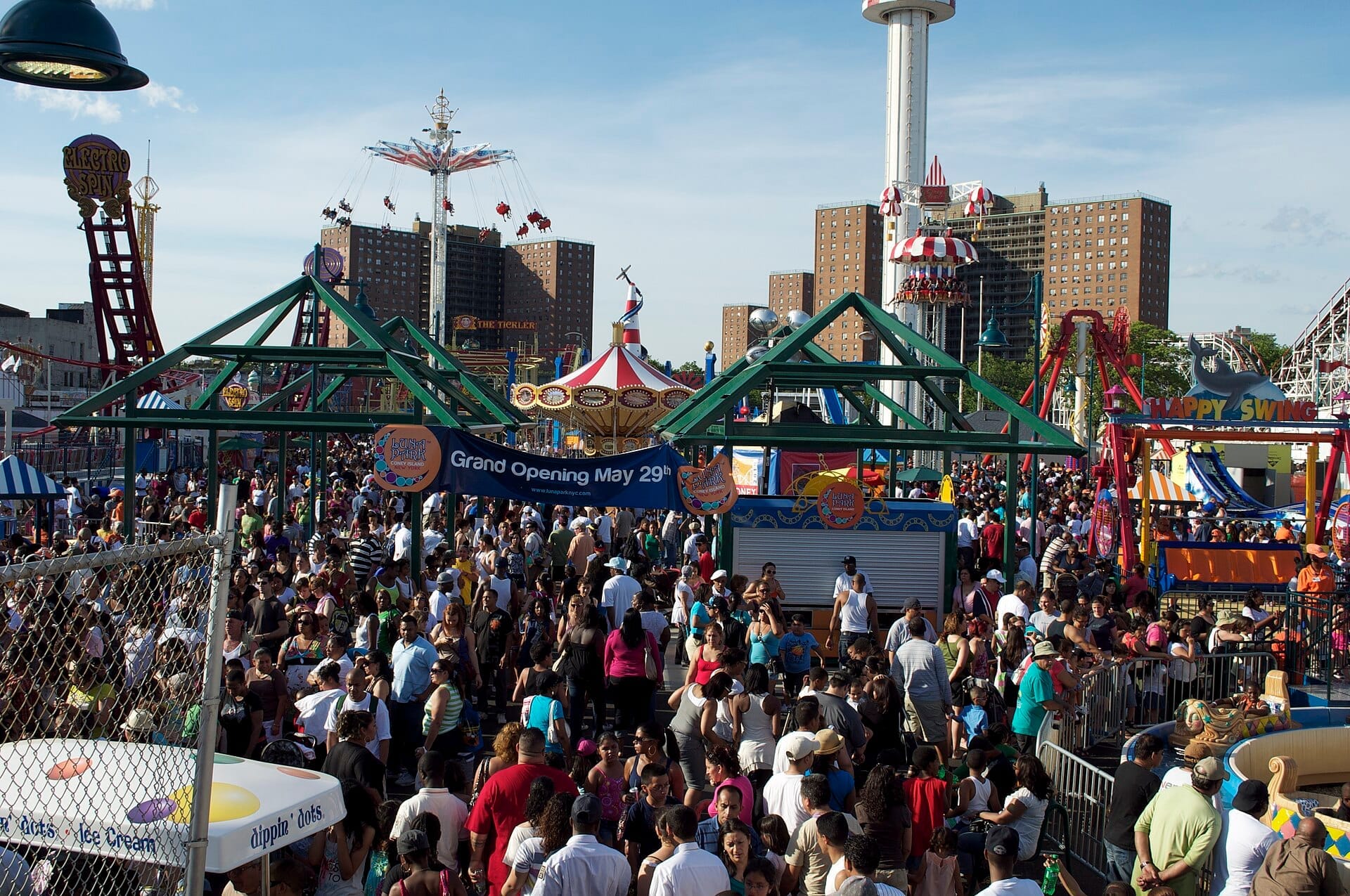
By early afternoon, the amusement area reaches peak energy. The Cyclone sends riders screaming over its wooden hills, the carnival midway fills with the sounds of games and music, and the boardwalk becomes difficult to walk in a straight line. This is not a manicured experience. The paint peels on some structures, vendors compete noisily for attention, and the whole thing has a slightly worn, deliberately unpolished quality that is part of its appeal. Coney Island has never tried to be Disney World, and that distinction matters.
By late afternoon, as the beach crowd thins and the shade grows longer, the boardwalk shifts tone. Locals come out to walk. The light on the water turns golden and flat. A minor league baseball game might be winding down at Maimonides Park a few blocks north on Surf Avenue. This is the most photogenic and least crowded window of the day. After dark, the amusement parks stay open into the evening during peak season, and the area remains busy but takes on a different quality: the rides lit up against the night sky, the ocean no longer visible but still audible.
⚠️ What to skip
Coney Island is heavily seasonal. Many attractions and food vendors operate reduced hours or close entirely between September and April. If you are visiting outside summer, check Luna Park's calendar and confirm individual venue hours before making a special trip.
The crowd here is diverse in a way that reflects the city at large: working-class Brooklyn families, day-trippers from Manhattan, international tourists, elderly residents who treat the boardwalk as their daily exercise route. It is not a polished tourist district, and visitors expecting sanitized theme-park cleanliness will be disappointed. Visitors who want to feel the texture of an older, scrappier New York City will find something here that has almost disappeared elsewhere in the borough.
What to See & Do
The anchor of any Coney Island visit is Luna Park, the main amusement park at 1000 Surf Avenue. The current version of Luna Park opened in 2010, reviving a name that had been famous here since 1903. It operates dozens of rides for all ages, from family-friendly spinning rides to the Thunderbolt steel coaster. Tickets are sold per-ride or as unlimited packages, so families planning a full day should do the math before arriving at the gate.
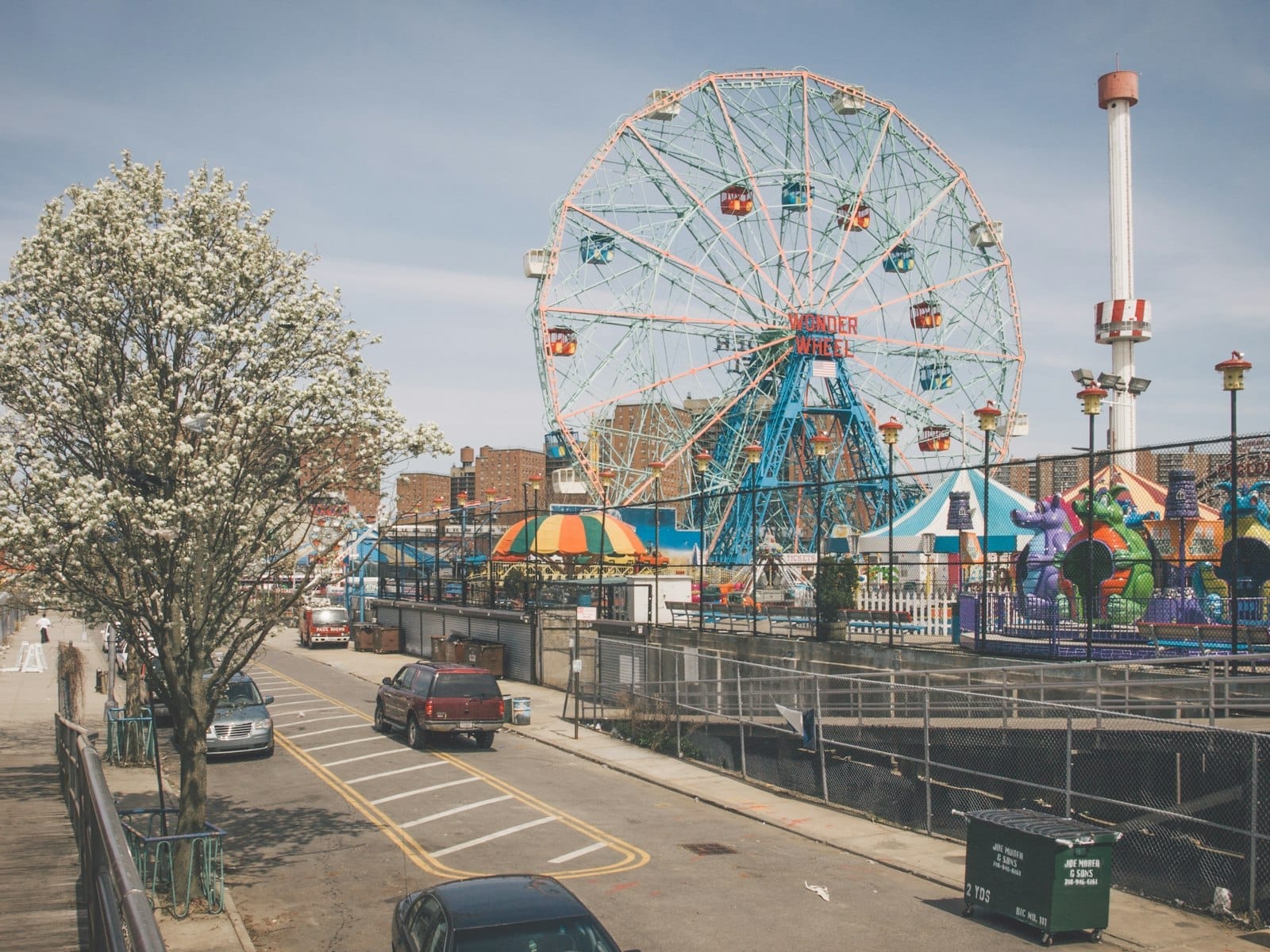
The single most historically significant attraction on the peninsula is the Cyclone, a wooden roller coaster that has been running since 1927 and is now a New York City landmark. It is loud, it is rough, and it is thrilling in a way that newer, smoother steel coasters are not. The Cyclone sits just east of Luna Park and operates under its management. The Wonder Wheel at Deno's Wonder Wheel Amusement Park, just a short walk along the boardwalk, is another landmark from the same era: a 150-foot Ferris wheel built in 1920, with both fixed and swinging gondola options.
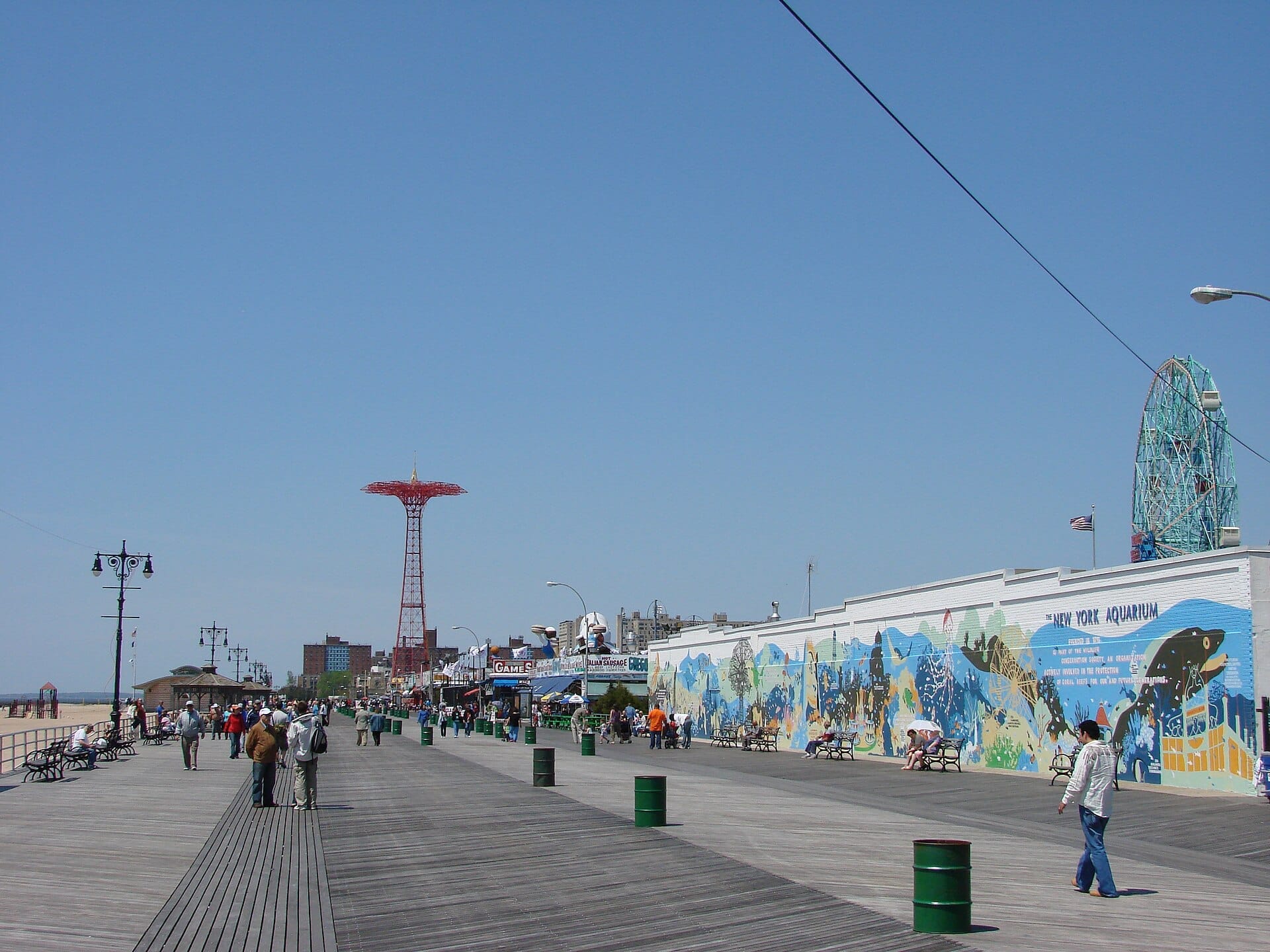
Beyond the rides, the beach itself is the main draw. The Coney Island Beach and Boardwalk is a New York City Parks facility offering nearly three miles of Atlantic Ocean shoreline. The water quality is regularly monitored, and lifeguards are posted during the summer season. The boardwalk runs the full length, offering a flat promenade above the sand where you can walk in either direction while the beach unfolds below.
Coney Island Boardwalk: free, open year-round, though the beach itself is most useful from late May through Labor Day
Luna Park: seasonal amusement park with individual-ride and all-day pass options
The Cyclone: historic wooden roller coaster, NYC landmark since 1927
Wonder Wheel at Deno's: 1920 Ferris wheel, open seasonally
Maimonides Park: minor league baseball home of the Brooklyn Cyclones, with summer home games
Ford Amphitheater at Coney Island Boardwalk: outdoor concert venue with summer programming
Coney Island Museum: small institution on Surf Avenue dedicated to the area's history
Coney Art Walls: rotating outdoor murals along Stillwell Avenue, visible year-round
💡 Local tip
A Brooklyn Cyclones minor league baseball game at Maimonides Park is one of the best-value ways to spend an evening at Coney Island. Tickets are affordable, the stadium is intimate, and the experience feels local rather than touristy. Check the schedule for summer home games.
For broader context on making the most of a Brooklyn visit, the NYC Brooklyn guide covers how Coney Island fits into a longer itinerary across the borough.
Eating & Drinking
The food at Coney Island is honest, caloric, and priced for beach crowds. Nathan's Famous, the hot dog institution at the corner of Surf Avenue and Stillwell Avenue, has been at this location since 1916 and hosts the nationally televised hot dog eating contest every July 4th. Getting a Nathan's hot dog here is the most obligatory food experience on the peninsula, not because it will change your understanding of hot dogs, but because the context makes it correct: eating one on the boardwalk steps from the ocean, with the Wonder Wheel visible in the distance.
Beyond Nathan's, the boardwalk and Surf Avenue are lined with vendors and counter-service spots selling pizza by the slice, corn on the cob, cotton candy, fried dough, ice cream, and seafood. Most of these are walk-up operations with plastic seating or standing room. The price point is low by New York standards, which is unusual for any beach or tourist area in the city. A full meal for two people, drinks included, can be achieved for under $25 if you're eating from the walk-up vendors.
For sit-down dining, options are more limited but do exist along Surf Avenue and Neptune Avenue a few blocks inland. The dining scene here is not a destination in the way that nearby Brighton Beach is, where you can find substantial Russian restaurants with multi-course meals and Black Sea cuisine. If you want a proper dinner after a day at Coney Island, the short walk east along the boardwalk to Brighton Beach opens up more substantial options, including Georgian and Central Asian restaurants.
Nathan's Famous: the original Surf Avenue location, hot dogs and fries, open year-round
Boardwalk vendors: corn on the cob, fried dough, ice cream, very affordable
Pizza by the slice: multiple counter-service spots along Surf Avenue, quick and cheap
Brighton Beach restaurants: a 10-minute walk east for sit-down Russian and Georgian cuisine
Seasonal seafood: several spots near the boardwalk serve fried shrimp and clam platters in summer
For a more comprehensive picture of eating across the five boroughs, the NYC food guide covers the full range from street food to fine dining.
Getting There & Around
The subway is the correct way to get to Coney Island, and it is more direct than the distance might suggest. The primary station is Coney Island–Stillwell Avenue, which sits on Surf Avenue and serves as the southern terminal for multiple lines. The D, F, N, and Q trains all terminate here, making this one of the few points in the subway system that is the end of the line for four separate services. From Midtown Manhattan, the D or F train from 34th Street–Herald Square reaches Stillwell Avenue in roughly 50 to 60 minutes depending on service. The N and Q offer options from other Manhattan locations. Trains run frequently in summer.
Once you arrive at Stillwell Avenue, the beach and boardwalk are a three-minute walk south along Stillwell Street. Luna Park is directly visible from the station exit. The boardwalk itself is entirely flat and easy to navigate on foot; most of what Coney Island offers is within a 10-minute walk of the station. There is essentially no reason to take a car, and parking in summer is both expensive and difficult.
For visitors who want to combine Coney Island with other Brooklyn stops, the West 8th Street–New York Aquarium station, one stop before Stillwell on the F and Q lines, serves as an alternative entry point near the eastern end of the boardwalk. The guide to getting around New York City covers subway basics, OMNY payment, and how to read the system map.
ℹ️ Good to know
The subway to Coney Island operates 24 hours, but late-night service is slower and less frequent. If you are attending an evening event at the Ford Amphitheater or a night game at Maimonides Park, check departure times before the event ends so you are not waiting on a nearly empty platform for a long stretch.
Where to Stay
Coney Island is not a conventional hotel district, and most visitors treat it as a day trip rather than a base. The residential fabric around Surf and Neptune Avenues is made up of apartment buildings and houses rather than hotels, and the area goes quiet after the amusement parks close. For visitors who want to stay close to the beach, a small number of budget hotels exist in the surrounding streets, but the options are limited and the location is inconvenient for exploring the rest of Brooklyn or Manhattan.
A more practical approach is to base yourself elsewhere in Brooklyn and make the subway trip to Coney Island for the day. Neighborhoods like Park Slope or Brooklyn Heights offer better accommodation choices, good transit connections, and access to a wider range of restaurants and things to do. Both are on subway lines that connect directly to the Coney Island–Stillwell Avenue terminal.
If you want a full overview of where to stay across the city before narrowing down to a Brooklyn base, the NYC neighborhood accommodation guide compares options borough by borough.
Practical Tips & Safety
Swimming is only advisable when lifeguards are on duty, which is typically between 10am and 6pm during the summer season. NYC Parks posts water quality advisories when conditions are poor; these are visible at the beach entrances and on the NYC Parks website. Rip currents are a genuine hazard on Atlantic-facing beaches, and the swim-when-lifeguards-are-present rule exists for a reason.
During peak summer weekends, the boardwalk and beach become very crowded, particularly between noon and 4pm. Arriving before 11am or after 4pm significantly improves the experience. Weekday visits in July and August are noticeably less crowded than Saturdays and Sundays. Bringing cash is useful: many boardwalk vendors and some ride operators at the smaller parks are cash-only or prefer it.
As with any large public gathering space in New York City, standard urban awareness applies: keep an eye on your belongings on the beach, especially when swimming. The area around Stillwell Avenue station is busy and commercially active during the day. After the amusement parks close and the crowds thin, the surrounding residential streets are quiet rather than threatening, but there is less reason to be in the area late at night unless you have a specific event to attend.
💡 Local tip
Bring cash, sunscreen, and a bag you do not mind getting sandy. Leave anything you cannot afford to lose at your accommodation. Lockers are not widely available, and leaving valuables unattended on the beach is never advisable.
For general safety guidance across New York City, including advice on navigating the subway and tourist-heavy areas, the NYC safety tips guide covers the practical essentials.
TL;DR
Coney Island is a historic seaside amusement district at the southern tip of Brooklyn, reached in about an hour from Midtown Manhattan via D, F, N, or Q subway trains to Coney Island–Stillwell Avenue.
Best visited in summer (late May through Labor Day) when Luna Park, the Cyclone, the Wonder Wheel, and full beach services are operating; the experience is significantly diminished in the off-season.
The food scene is inexpensive and casual: Nathan's Famous hot dogs, boardwalk vendors, and pizza slices rather than restaurant dining.
Not a practical base for visiting the rest of New York City; better used as a day trip from accommodation in central Brooklyn or Manhattan.
Ideal for families with children, anyone curious about old-school American amusement park culture, beach days, or a Brooklyn Cyclones minor league baseball game; less suited to travelers who prioritize fine dining, nightlife, or walkable neighborhood exploration.
Three days is enough to cover New York City's greatest hits — if you plan smart. This itinerary organizes Manhattan by neighborhood cluster, adds a Brooklyn half-day, and cuts through the noise with practical guidance on what's worth your time and money.
New York City has more than 100 museums, which makes choosing worthwhile. This guide cuts through the noise and covers the best museums across Manhattan, Brooklyn, and Queens, from encyclopedic giants to intimate institutions you'll wish you'd discovered sooner.
New York City rewards visitors year-round, but the timing of your trip shapes everything from hotel rates to how much you'll enjoy walking the streets. This guide breaks down every season honestly, including the months most guides skip over.
New York City's skyline is one of the most iconic in the world, and the city offers an extraordinary range of ways to see it. This guide covers every major paid observation deck, the best free viewpoints, and the hidden-angle panoramas that most visitors never find.
Broadway is one of the defining experiences of any visit to New York City. This guide covers everything from ticket prices and discount programs to the best seats, what to expect on the night, and how to avoid getting ripped off.
New York City rewards explorers who venture beyond Manhattan. Whether you want Atlantic Ocean beaches, Victorian river towns, wild urban nature, or a different borough entirely, these day trips are all reachable within two hours of Midtown.
New York City is one of the world's most expensive destinations, but a surprising amount of its best experiences cost nothing at all. From harbor ferry rides and elevated parks to world-class museums with free admission, this guide covers the top free things to do across all five boroughs.
New York City has one of the most comprehensive transit networks in the world, but navigating it takes some know-how. This guide covers the subway, buses, ferries, Citi Bike, taxis, ride-hailing, and airport transfers, with current fares, practical tips, and straightforward guidance on what to skip.
New York City's most famous attractions draw millions, but the city rewards those who look beyond the obvious. From a medieval monastery perched above the Hudson to a car-free harbor island and a cemetery with better skyline views than most rooftop bars, these hidden gems span all five boroughs and cost nothing to seek out.
New York City is one of the world's premier luxury destinations, with six three-Michelin-star restaurants, world-class private experiences, and neighborhoods that reward serious travelers. This guide cuts through the noise to focus on what actually delivers at the high end.
New York City is served by three major airports, and picking the wrong one can cost you an hour or more in transit. This guide breaks down JFK, LaGuardia, and Newark by location, ground transport options, travel times, and real costs so you can make the right call before you book.
New York City contains more than 7,000 completed high-rise buildings spanning four centuries of architectural history. This guide breaks down the city's defining styles, the best buildings to visit by neighborhood, observation deck logistics, and how to explore beyond Manhattan's famous skyline.
New York City is one of the world's great art capitals, with roughly 1,500 galleries spread across Chelsea, the Lower East Side, SoHo, and Brooklyn, plus a cluster of world-class museums that define modern and contemporary art globally. This guide cuts through the noise to identify the essential institutions, experimental spaces, and outdoor art experiences worth your time.
Brooklyn is New York City's most populous borough, home to 2.7 million residents, iconic landmarks, and more distinct neighborhoods than most cities have total. This guide covers the best things to do in Brooklyn, from the Brooklyn Bridge and Prospect Park to Coney Island and Smorgasburg, with practical transport advice, seasonal timing, and honest takes on what's worth your time.
New York City is the stand-up comedy capital of the world, with intimate basement rooms and historic theaters hosting everyone from open-mic newcomers to surprise celebrity drop-ins. This guide covers the best clubs and complementary venues across Manhattan and beyond, with practical tips on booking, neighborhoods, and what to expect.
New York City rewards visitors who come prepared. This guide covers the five boroughs, how to get around on the subway, airport transfers, seasonal timing, tipping customs, and the attractions actually worth your time — plus honest warnings about what to skip.
New York City restaurants span every cuisine on earth, every budget, and every borough. This guide cuts through the noise to tell you exactly what to order, where to go, and what to skip — from legendary delis on the Lower East Side to Queens' unmatched immigrant food corridors.
New York City does romance at every budget and in every season. This guide covers the best couples activities in NYC, from iconic skyline viewpoints and free waterfront walks to Broadway date nights and quiet neighborhood escapes, with practical advice on timing, booking, and what to skip.
Harlem is one of New York City's most culturally significant neighborhoods, home to the Apollo Theater, landmark soul food restaurants, live jazz venues, and a history that shaped American music and literature. This guide covers everything you need to plan a meaningful visit, from the best spots on 125th Street to the quieter brownstone blocks locals actually frequent.
December transforms New York City into its most theatrical self: Christmas trees, ice rinks, department store windows, and the world's most-watched New Year's Eve countdown. This guide covers every major holiday event, practical logistics, weather realities, and the shortcuts that make the difference between a stressful visit and a genuinely great one.
Fall is one of the best times to visit New York City, but it is also one of the most expensive. This guide covers the weather month by month, where to catch the best foliage, every major fall event worth planning around, and the honest tradeoffs of visiting during peak season.
Spring is one of the best times to visit New York City, but timing matters more than most guides admit. This guide covers the real weather picture, cherry blossom logistics, top seasonal events, crowd patterns, and practical tips for getting the most out of April and May in NYC.
Summer in New York City runs hot, loud, and packed with free programming that most visitors never find. This guide covers the best events, beaches, outdoor concerts, and borough-by-borough highlights for June, July, and August, plus practical tips on heat, crowds, and advance booking.
New York City is the jazz capital of the world, with legendary clubs spread across Greenwich Village, Midtown, Harlem, and the Upper West Side. This guide covers the best rooms for hearing live jazz, from intimate basement stages to world-class concert halls.
New York City's neighborhoods span five boroughs and dozens of distinct communities, each with its own character, price point, and visitor experience. This guide breaks down what each area is actually like, who it suits, and what you need to know before you go.
New Year's Eve in New York City is one of the world's most iconic celebrations, but pulling it off well requires planning. This guide covers the Times Square Ball Drop, fireworks locations, transport logistics, ticketed events, and smarter alternatives for every type of traveler.
New York City night options span more than 25,000 establishments across five boroughs. This guide breaks down the best neighborhoods, what drinks cost, how late things run, and the practical details most guides skip.
New York City has a reputation for being expensive, but the reality is more nuanced. With the right approach to transit, food, accommodation, and attractions, you can experience the best of the city for far less than you might expect. This guide covers every angle of the New York City budget equation.
New York City attraction passes promise big savings, but the math only works under specific conditions. This guide breaks down CityPASS, the New York Pass, and the Go City Explorer Pass side by side, with real pricing, key caveats, and a clear verdict on who should buy which.
New York City is far safer than its reputation suggests, but smart travelers still follow a few ground rules. This guide covers subway safety, common scams, neighborhood awareness, seasonal hazards, and practical emergency information so you can focus on enjoying the city.
New York City is one of the world's great shopping destinations, offering everything from Midtown luxury flagships and SoHo boutiques to Brooklyn flea markets and Queens food halls. This guide breaks down the best shopping districts, practical budgeting advice, seasonal crowd patterns, and what to skip — so you spend your time and money wisely.
Thanksgiving in New York City means one thing above all else: the Macy's Thanksgiving Day Parade. But there's far more to the long weekend than giant balloons and floats. This guide covers the parade route, smartest viewing strategies, what to do if crowds aren't your thing, and how to make the most of one of NYC's biggest holidays.
The US Open is one of the four Grand Slam tennis tournaments and the only one held in the United States. Staged each year at the USTA Billie Jean King National Tennis Center in Flushing Meadows–Corona Park, Queens, it draws hundreds of thousands of fans over two weeks in late August and early September. This guide covers everything from buying tickets to getting there, what to expect on site, and how to plan your trip around it.
New York City rewards walkers more than almost any city on earth. These self-guided routes take you through historic districts, iconic parks, waterfront promenades, and neighborhoods where the architecture tells the story better than any museum. Lace up and go.
New York City's weather shifts dramatically across four distinct seasons, from humid July heat to January snowstorms. This guide breaks down what to expect each month, what to pack, and when the climate actually works in your favor as a visitor.
Two days in New York City is enough to see iconic landmarks, eat well, and understand why this city operates at a different scale than anywhere else. This guide gives you a practical, honest framework for a weekend in NYC, with real prices, transit logistics, and clear priorities.
From the American Museum of Natural History to Coney Island, New York City with kids is genuinely doable — if you know where to go, what things actually cost, and how to avoid the planning mistakes that derail family trips. This guide covers the best family-friendly attractions, practical transit tips, seasonal timing, and honest takes on what's worth your time.
Seven days is enough to hit NYC's iconic landmarks, explore its best neighborhoods, and actually understand why this city operates the way it does. This itinerary is built around the subway, structured by geography, and honest about what's worth your time.
New York City is one of the most rewarding solo travel destinations in the world, but it rewards preparation. This guide covers transit, safety, neighborhoods, budgeting, and seasonal strategy so you can move through all five boroughs with confidence.
New York City offers more experiences per square mile than almost anywhere on earth. This guide cuts through the noise to highlight the top things to do in New York City, with honest takes on prices, crowd patterns, and which attractions are actually worth your time.
New York City has over 25,000 restaurants, 57 Michelin-starred venues, and some of the world's best street food — all within five boroughs. This guide cuts through the noise with specific recommendations, honest price ranges, and practical booking advice to help you eat well no matter your budget or neighborhood.
Choosing where to stay in New York City shapes your entire trip. This guide breaks down every major neighborhood by price, access, vibe, and who it suits best — with practical advice on what to avoid and when to book.