Coney Island Boardwalk: Brooklyn's Iconic Stretch of Sand, Salt Air, and Americana
The Riegelmann Boardwalk at Coney Island is a 2.7-mile wooden promenade along the southern Brooklyn shoreline, free to walk and open year-round. From summer crowds eating Nathan's Famous hot dogs to quiet winter mornings with only the Atlantic for company, it offers one of New York City's most iconic experiences.
Quick Facts
- Location
- Corbin Place to Brighton 15th Street, Boardwalk, Brooklyn, NY 11224
- Getting There
- Coney Island–Stillwell Ave (D, F, N, Q trains); 5–10 min walk to boardwalk
- Time Needed
- 1–3 hours for a casual walk; full day if combining beach and rides
- Cost
- Free (boardwalk access); amusement parks and food charge separately
- Best for
- Families, history buffs, beach days, summer evenings, off-season walks
- Official website
- www.nycgovparks.org/parks/coney-island-beach-and-boardwalk
What the Riegelmann Boardwalk Actually Is
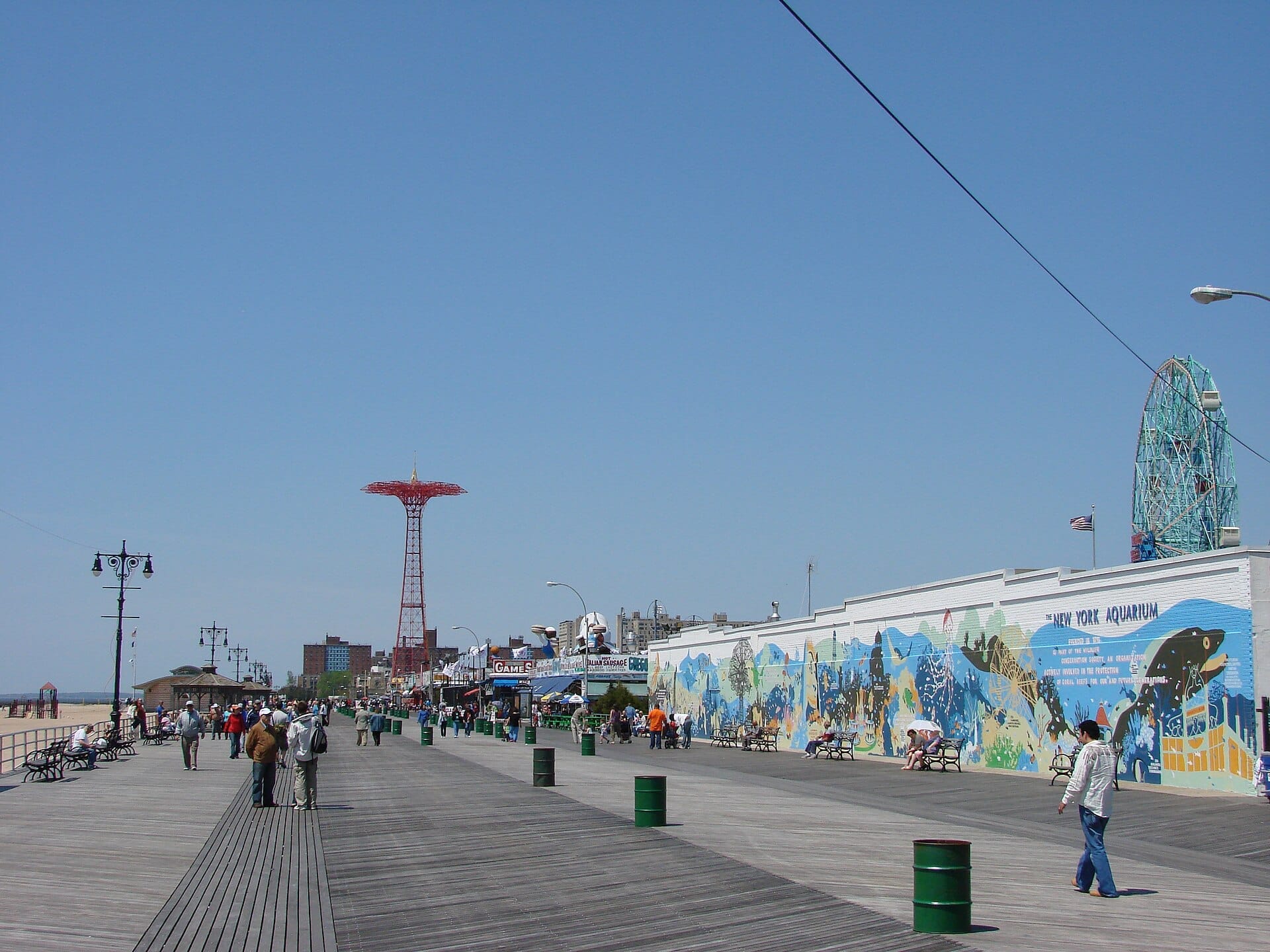
The Coney Island Boardwalk, officially the Riegelmann Boardwalk, is a New York City public park stretching roughly 2.7 miles along the southern Brooklyn shoreline. It was designated a New York City landmark in 2018, recognizing a structure that first opened in stages in 1922. Construction used wooden planks laid in a chevron pattern atop concrete and steel supports, and much of that original engineering logic still defines the structure you walk on today.
The boardwalk runs from Corbin Place in the east to Brighton 15th Street in the west, with the Atlantic Ocean on one side and a corridor of amusement parks, food stalls, game arcades, and low-rise buildings on the other. It is not a theme park. It is not a shopping mall with a sea view. It is a public promenade that happens to sit beside Luna Park, the New York Aquarium, and one of the city's most historically layered beachfronts.
ℹ️ Good to know
Access to the boardwalk is free at all times. There are no gates, no tickets, and no reservations required. Individual attractions along the boardwalk, including Luna Park rides and the New York Aquarium, charge their own separate fees.
A Century of History Along the Planks
The boardwalk was named after Edward J. Riegelmann, the Brooklyn Borough President who championed its construction. The first section, running from Ocean Parkway to West 5th Street, opened in October 1922. The second section followed on December 24, 1922, and the entire structure was formally opened in 1923. PBS's American Experience series has described it as a defining symbol of what Coney Island became in the early 20th century: a democratized resort where immigrant working-class New Yorkers could access a beach day that had previously been reserved for those with money and leisure time.
Coney Island's peak era ran roughly from the 1920s through the 1950s, when it drew millions of visitors annually and operated multiple competing amusement parks simultaneously, including Luna Park (the original) and Steeplechase Park. Those institutions are long gone, but the boardwalk itself survived, and its landmark designation ensures it cannot simply be redeveloped out of existence.
Today, the boardwalk connects the modern Luna Park (opened in 2010 on the footprint of the original) with the New York Aquarium, Nathan's Famous at Stillwell Avenue, and a beach that fills with tens of thousands of people on summer weekends. The historical weight and the plastic cotton-candy bags blowing across the planks coexist without much contradiction.
Tickets & tours
Hand-picked options from our booking partner. Prices are indicative; availability and final rates are confirmed when you complete your booking.
Neighborhoods of New York tour: Brooklyn, Bronx, Harlem, Queens and Coney Island
From 72 €Instant confirmationFree cancellationStatue of Liberty, Ellis Island, and Brooklyn Bridge Happy Hour Cruise
From 49 €Instant confirmationFree cancellationSpirit of New York Dinner Cruise
From 161 €Instant confirmationFree cancellationNew York City Highlights bike tour
From 70 €Instant confirmationFree cancellation
What the Walk Feels Like at Different Hours
Early morning, before 9 a.m. in summer, the boardwalk is a different place entirely. The air smells of salt and faint traces of grease from the night before. Joggers run the full length in both directions. Older men fish off the piers. The Parachute Jump, Coney Island's defunct 262-foot steel tower that stands as a permanent landmark at the western end of the boardwalk, catches the early light in a way it never does when surrounded by crowds. If you want photographs of the boardwalk's structure and atmosphere without people filling every frame, arrive before 9 a.m.
By noon on a summer weekend, the transformation is complete. The boardwalk surface radiates heat. The smell of Nathan's hot dogs and fried dough travels a full block. Families stake out territory at the beach access ramps, dragging folding chairs and coolers. The sound layer builds: ride music from Luna Park, the periodic shriek of the Cyclone roller coaster, conversations in Russian, Spanish, Mandarin, Bengali, and a dozen other languages. Coney Island's neighborhood demographics are reflected directly in who shows up here.
Evenings in summer are arguably the most atmospheric time to visit. The heat drops, the boardwalk lights come on, and the crowd shifts from families to young adults and couples. The Cyclone's ride cycle becomes a rhythmic background sound rather than an overwhelming one. If there is a minor league Brooklyn Cyclones baseball game at Maimonides Park just north of the boardwalk, the evening crowd swells further after the final out.
💡 Local tip
For the most comfortable summer visit, arrive before 10 a.m. or after 5 p.m. Midday from late June through August is intensely crowded and hot, with limited shade along the boardwalk itself. Sunscreen and water are non-negotiable.
The Off-Season: A Completely Different Boardwalk
Between October and April, the Coney Island Boardwalk becomes one of New York City's genuinely underrated urban walks. Most of the food stalls and arcades are shuttered, the beach is empty, and the quiet is startling given how chaotic the summer version feels. The wind off the Atlantic is consistent and cold from November onward, so dress accordingly: a hat and windproof layer are more useful than a heavy coat.
The structural details of the boardwalk, the chevron plank pattern, the weathered railings, the Art Deco-influenced support structures at some pavilion sections, are far easier to appreciate when you are not navigating around strollers and beach carts. Photographers and architecture enthusiasts specifically seek out the off-season for this reason.
One note: the famous Polar Bear Club holds its traditional New Year's Day swim here each January 1st, drawing hundreds of participants and spectators. If you are visiting New York in winter, this is one of the more genuinely local events the city offers, free to watch from the boardwalk.
Practical Walkthrough: Getting Here and Moving Around
The most direct route from Manhattan is the D, F, N, or Q train to Coney Island–Stillwell Avenue, which is the subway's southernmost terminal station. The trip from Midtown takes roughly 45 to 60 minutes depending on the line and time of day. From the station, the boardwalk is a 5 to 10-minute walk south along Surf Avenue. The station itself, rebuilt in 2004, is one of the few above-ground terminal stations in the MTA system and worth a brief look on its own.
If you are building a broader Brooklyn day trip, the boardwalk pairs naturally with a visit to Brooklyn Botanic Garden or the Brooklyn Museum earlier in the day, then taking the subway south to Coney Island in the afternoon. The Brooklyn neighborhood guide covers how the borough's various areas connect for day planning.
Driving to Coney Island is possible but parking is limited and expensive on summer weekends. Surf Avenue and the surrounding streets fill completely by late morning from June through August. The subway is genuinely faster and less stressful on peak days.
⚠️ What to skip
Subway service to Coney Island–Stillwell Avenue operates on multiple lines, but service frequency varies by line and time of day. On weekends, MTA often runs planned service changes on Brooklyn subway lines. Check the MTA website before traveling, particularly for weekend visits.
What to Do Along the Boardwalk
The boardwalk itself is the activity, not just a path to something else. Walking the full length, roughly 2.7 miles one way, takes about 45 minutes at a relaxed pace without stops. Most visitors gravitate toward the central section between Brighton Beach in the east and West 12th Street in the west, where the amusement concentration is highest.
Luna Park, the current amusement park anchoring the western portion of the boardwalk, operates rides including the original wooden Cyclone roller coaster (built in 1927 and also a New York City landmark), the Wonder Wheel Ferris wheel (built in 1920), and numerous other rides. The Luna Park has its own ticketing and seasonal hours separate from boardwalk access.
Beyond the rides, the boardwalk supports a consistent strip of food vendors in summer: corn on the cob, fried clams, zeppole, sausage and pepper sandwiches, and the inevitable Nathan's Famous hot dogs at the corner of Surf Avenue and Stillwell Avenue. The original Nathan's location has been at that corner since 1916. The boardwalk-facing side fills quickly on summer afternoons, so order early if you want a table.
The beach itself is free to access via multiple ramps along the boardwalk. Lifeguards are on duty during summer season, typically Memorial Day through Labor Day. The water quality is monitored by the city; current beach water quality reports are available through NYC Parks before a swimming visit.
Photography Notes and Accessibility
The Parachute Jump at the western end of the boardwalk, nicknamed the Eiffel Tower of Brooklyn, is the single most photogenic structure. It is best captured from the beach rather than from directly beneath it, ideally in the hour before sunset when the lattice ironwork catches warm light. The Wonder Wheel and Cyclone also photograph well from the boardwalk itself, particularly in the late afternoon when the sun is behind you as you face inland.
For wide shots of the boardwalk's length, position yourself at either the eastern or western end in early morning. By 11 a.m. in summer, the crowd density makes clean compositional shots nearly impossible unless you specifically want that energy.
The boardwalk is largely flat and paved, making it accessible for wheelchairs and strollers along most of its length. NYC Parks provides ramps and accessible beach access points at several locations. For specific accessibility features and current conditions, the NYC Parks park manager for Coney Island Beach and Boardwalk can be reached at (718) 946-1353.
Insider Tips
- The D train runs express and reaches Coney Island from Manhattan faster than the F or N on most weekdays. On weekends, check MTA alerts as express patterns change.
- Brighton Beach, the neighborhood immediately east of the boardwalk's far end, is home to a large Russian-speaking community and has some of the best Eastern European food in New York City within a 5-minute walk of the boards. The shift from boardwalk Americana to the market stalls on Brighton Beach Avenue is genuinely abrupt and worth exploring.
- The Wonder Wheel has both stationary and swinging gondola cars. The swinging cars provide a noticeably wilder ride and better boardwalk views, but the movement is significant. If you are prone to motion sickness, request a stationary car.
- In September and October after Labor Day, crowds thin dramatically but most food vendors and Luna Park remain open on weekends through mid-October. This is the best value window: summer atmosphere without summer density.
- The Coney Island History Project operates a small exhibit and archive near the boardwalk at 3059 West 12th Street (seasonal hours; verify before visiting). It is free and staffed by enthusiasts who know the neighborhood's history in unusual detail.
Who Is Coney Island Boardwalk For?
- Families with children looking for a full beach-and-rides day outside Manhattan
- First-time visitors who want a slice of working-class New York City history far from tourist-heavy Midtown
- Off-season walkers and photographers who want an atmospheric, crowd-free urban waterfront
- Anyone building a Brooklyn day itinerary who wants to end the day at the beach
- History and architecture enthusiasts interested in New York City's early 20th-century leisure culture
Nearby Attractions
Other things to see while in Coney Island:
- Luna Park Coney Island
Luna Park in Coney Island is Brooklyn's seaside amusement park, sitting on the same storied stretch of boardwalk that once drew millions at the turn of the twentieth century. It offers classic coasters, carnival games, and sweeping Atlantic Ocean views within a short subway ride of Manhattan. Here's how to make the most of it.
- New York Aquarium
The New York Aquarium has been drawing visitors since 1896, making it the oldest continually operating aquarium in the United States. Set on 14 acres on the Coney Island boardwalk in Brooklyn, it combines serious marine conservation with genuinely engaging exhibits — including a 500,000-gallon shark tank that earns its reputation.