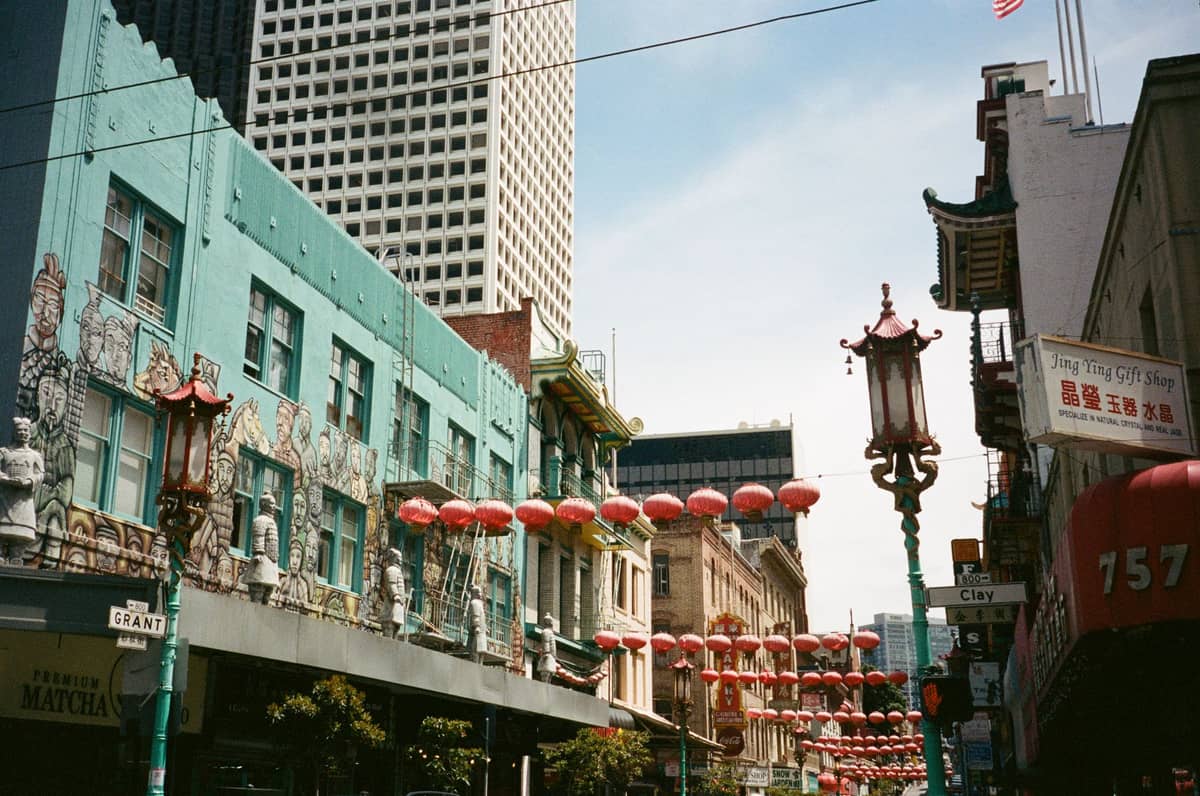
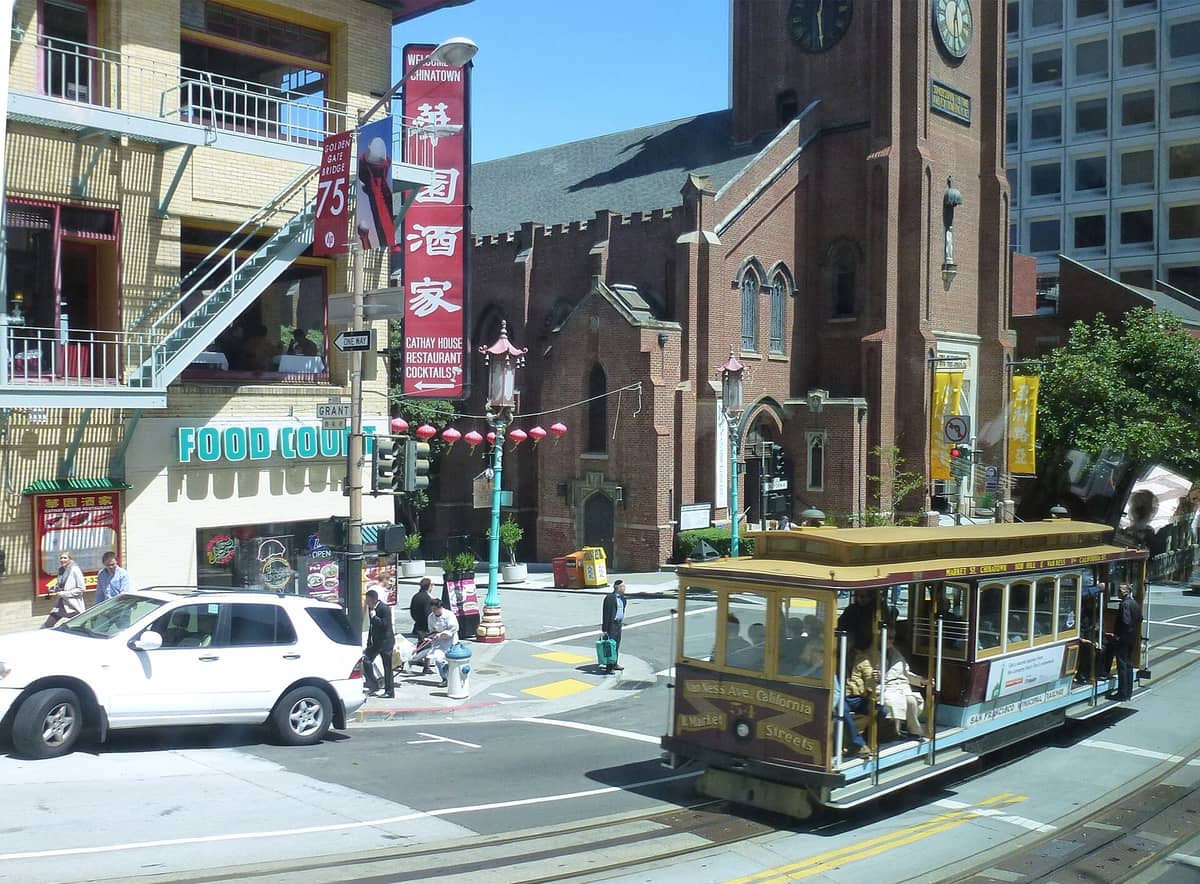
San Francisco's Chinatown is the oldest Chinese enclave in North America, officially covering 24 square blocks in downtown between the Financial District and North Beach. Grant Avenue draws visitors with its painted balconies and souvenir shops, while Stockton Street runs on a different clock entirely, serving the neighborhood's working Cantonese community with live seafood tanks, roast duck windows, and produce stalls that spill onto the sidewalk.
San Francisco's Chinatown is the oldest in North America, and it operates on two registers at once: a tourist corridor along Grant Avenue and an intensely functional neighborhood on Stockton Street, where Cantonese grandmothers haggle over bok choy and the air smells of roast pork and dried fish. It is one of the most densely populated urban districts in the United States, covering 24 blocks between the Financial District and North Beach with more history per square foot than almost anywhere else in California.
Orientation
Chinatown sits in the northeastern quadrant of San Francisco, wedged between several of the city's most recognizable districts. Its formal boundaries run from Bush Street in the south to Broadway in the north, and from Powell Street in the west to Kearny Street in the east. That puts it immediately north of Union Square, uphill from the Financial District to the east, and just south of North Beach, with Nob Hill rising steeply to the west.
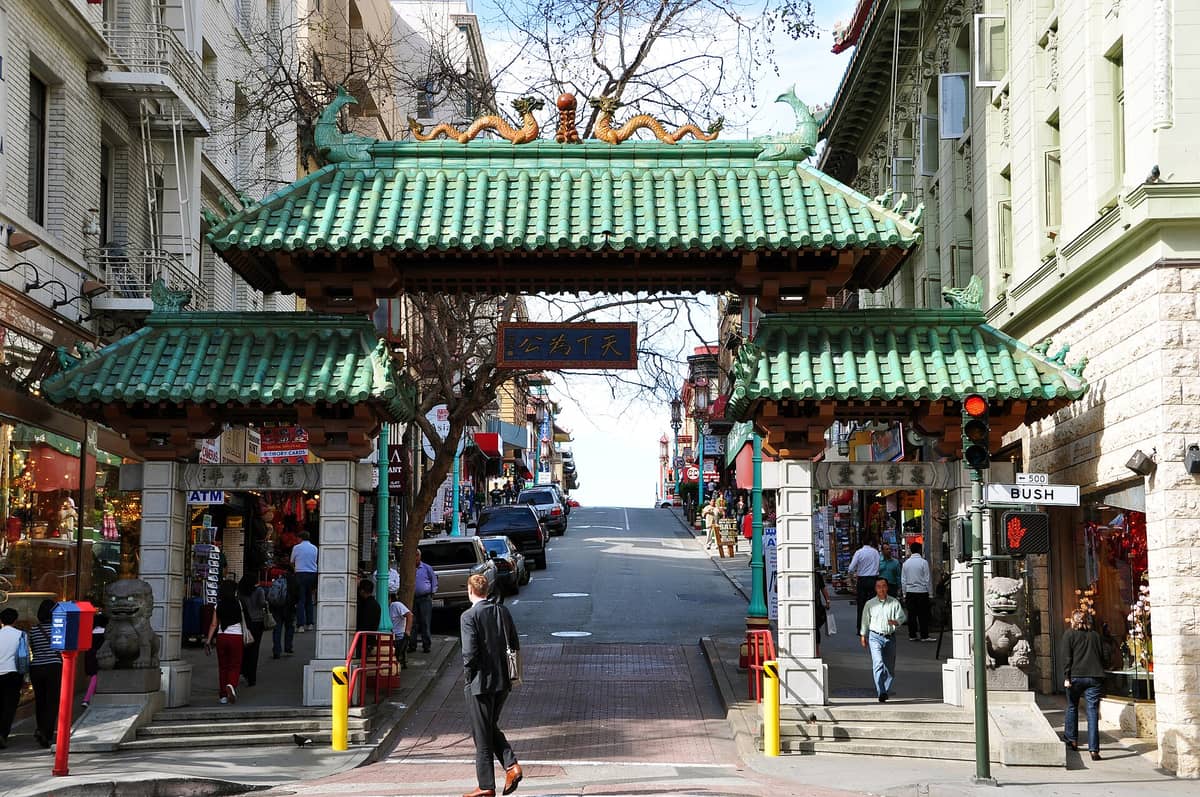
The two main north-south corridors tell completely different stories. Grant Avenue is the public face of the neighborhood, entered through the Dragon's Gate on Bush Street, a green-tiled ceremonial arch that marks the southern entrance. Walk north from the gate and you pass souvenir shops, dim sum parlors, and buildings with pagoda-style rooflines added during a late-19th century effort to make the neighborhood visually distinct. Stockton Street, one block west, is where the neighborhood actually lives. It runs narrower, louder, and more crowded, with markets, herbal medicine shops, and restaurants aimed squarely at local residents.
Portsmouth Square, the neighborhood's central public space, sits roughly in the middle of the district near Kearny and Clay streets. It was the original plaza of Yerba Buena before San Francisco existed as a city, and today it functions as an outdoor living room for elderly residents playing chess and mahjong. St. Mary's Square, one block south on California Street, is quieter and contains a statue of Sun Yat-sen, the founder of the Republic of China, who spent time in San Francisco organizing support for his political movement in the early decades of the 20th century.
ℹ️ Good to know
Chinatown borders are walkable from Union Square in under five minutes. From the Powell Street BART and Muni Metro station, walk north along Grant Avenue and you reach the Dragon's Gate at Bush Street almost immediately.
Character & Atmosphere
Early mornings in Chinatown belong to residents. By 7am on Stockton Street, the sidewalks are already crowded with shoppers pulling wheeled carts past stalls of ginger root, live crabs in buckets, and stacked trays of char siu pork. The produce vendors work fast, calling out prices in Cantonese. The light is low and angled, catching the steam rising from bakery vents. It is one of the most sensory-dense experiences in San Francisco at any hour, and in the morning it operates almost entirely in Chinese.
By midday, Grant Avenue fills with tour groups and visitors making their way between the Dragon's Gate and Columbus Avenue. The street gets noisy in a different way: camera clicks, the chime of shop doors, and the faint tinny music drifting from souvenir displays. The contrast between the two parallel streets becomes most visible at lunchtime, when restaurant queues form on both, but the clientele is noticeably different. Grant Avenue restaurants tend toward English menus and slightly higher prices; Stockton and the smaller alleys between them are where you find hand-written menus, lower prices, and tables full of families.
Evenings shift the mood again. Most of the souvenir shops close by 9pm, and the neighborhood quiets compared to nearby North Beach. The streets are well-lit along the main corridors, but the side alleys and blocks away from Grant Avenue are darker and less trafficked after dark. Chinatown is generally safe, though like any dense urban neighborhood it rewards basic awareness. The area around Portsmouth Square sees a range of activity at night, and the blocks toward the Financial District boundary on Kearny Street become quieter after business hours.
The neighborhood's character is shaped by its history as a survival community. Chinese immigrants arrived in California during the Gold Rush of 1849 and in large numbers to build the transcontinental railroad, yet faced severe legal discrimination including the Chinese Exclusion Act of 1882, which barred Chinese laborers from entering the country. After the 1906 earthquake and fires destroyed much of the original neighborhood, residents and local leaders rebuilt it in the distinctive pagoda-style architectural style visible today as a deliberate strategy to attract tourists and secure the neighborhood’s future at its long‑standing site. Understanding this history changes how you read the street. The ornamental details on Grant Avenue are not merely decorative; they were a deliberate strategy to attract tourists and ensure the neighborhood's economic survival. The Chinese Historical Society of America Museum on Clay Street provides the most thorough account of this story and is worth an hour of anyone's time.
What to See & Do
Start at the southern end with the Dragon's Gate on Grant Avenue at Bush Street. The arch was gifted by the Republic of China in 1970 and inscribed with the phrase 'All under heaven is for the good of the people.' It is one of the most photographed spots in San Francisco, which means it is best appreciated early morning before the tour buses arrive. Walk north along Grant Avenue, but turn onto the side streets and alleys to find the neighborhood's texture. Ross Alley and Waverly Place run parallel to the main corridors and reward slow exploration.
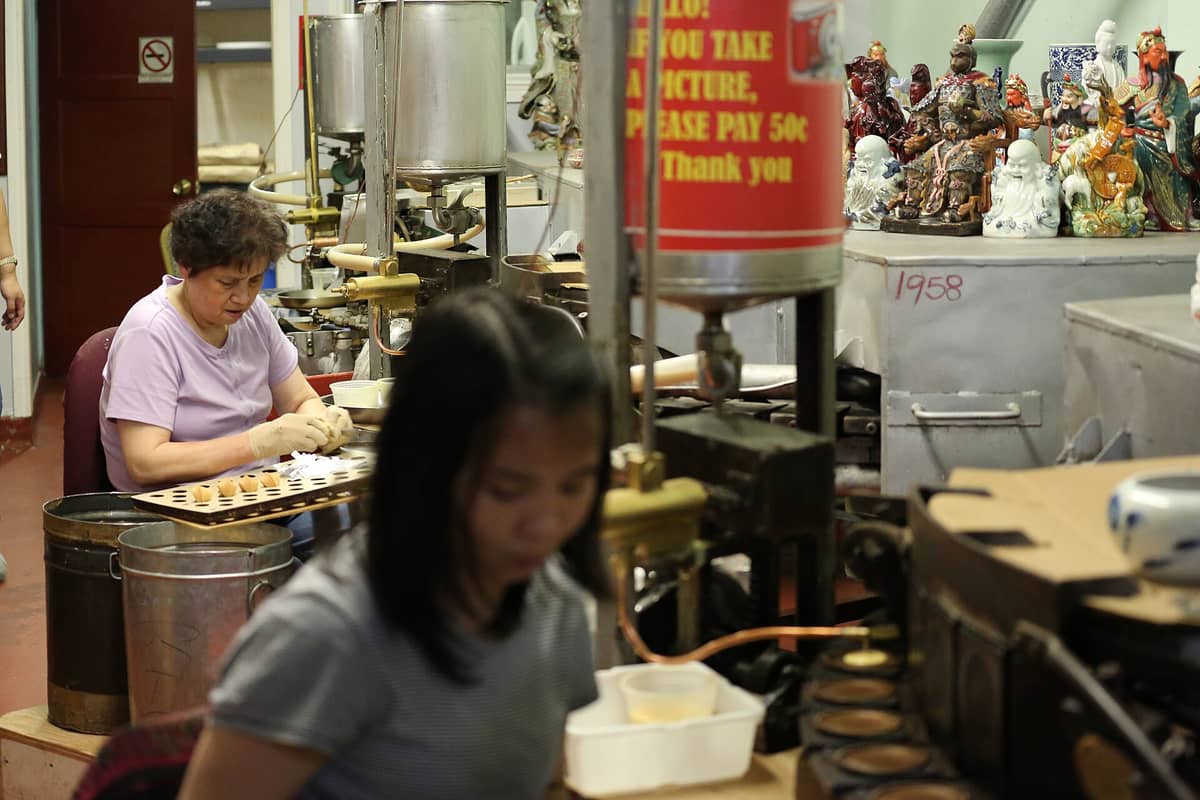
The Golden Gate Fortune Cookie Factory operates out of a narrow space in Ross Alley. It has been there since 1962 and still makes cookies by hand on small rotating griddles, with a posted small charge to take photographs.
Waverly Place, sometimes called the 'Street of Painted Balconies,' is one of the most visually distinctive alleys in San Francisco. The upper floors of buildings along this narrow lane house several of the neighborhood's traditional tong association halls and temples, some of which have been active since the 19th century. The Tin How Temple on the fourth floor of one building, founded in 1852, is among the oldest Chinese temples in the United States. Portsmouth Square, at Kearny and Clay, is a few minutes' walk east and connects Chinatown to the edge of the Financial District. The Chinese Historical Society of America Museum is on Clay Street just off the square and covers immigration history, the railroad era, and the community's survival through decades of legal exclusion.
Dragon's Gate: the ceremonial entrance at Grant Avenue and Bush Street
Waverly Place: narrow alley lined with painted balconies and association halls
Ross Alley: home to the Golden Gate Fortune Cookie Factory
Portsmouth Square: historic public plaza used daily by local residents
St. Mary's Square: quieter green space with statue of Sun Yat-sen
Chinese Historical Society of America Museum: the neighborhood's authoritative history institution
Old St. Mary's Cathedral on California Street: the first Catholic cathedral in California, completed in 1854
Chinatown sits at the edge of several other rich areas. Walking north on Grant Avenue past Broadway puts you immediately into North Beach, where you can visit City Lights Bookstore and Coit Tower without retracing your steps. It is one of the most natural neighborhood-to-neighborhood walks in the city.
Eating & Drinking
The food in Chinatown is predominantly Cantonese, reflecting the origins of the neighborhood's founding community. You will find dim sum served from carts or ordered by checksheet, roast duck and BBQ pork hanging in windows, clay pot rice, hand-pulled noodles, and congee in a range of versions. Prices are generally lower than the San Francisco average, and portions tend toward generous. The neighborhood does not have a sophisticated cocktail bar scene; it has tea houses, bubble tea shops, and a few straightforward bars.
For dim sum, look on Stockton Street and the cross streets between Grant and Stockton rather than on Grant Avenue itself. The best spots fill up by 10am on weekends and do not take reservations. Arrive before 9:30am or expect a wait. Grant Avenue has a higher concentration of full-service restaurants with English menus that are reliable but not the neighborhood's most interesting options. The alleys and side streets tend to have smaller, cheaper, and more specific operations: a bakery that only does egg tarts and pineapple buns, a noodle shop with four items on the menu.
The Chinese bakeries on both Grant Avenue and Stockton Street are worth a stop at any hour. Pineapple buns (the name refers to the patterned crust, not the filling), egg tarts, cocktail buns filled with coconut paste, and wife cakes made with winter melon are staples. Most cost between $1 and $3 USD. For a broader sense of San Francisco's Chinese food traditions beyond Chinatown, the Richmond District on Clement Street has a substantial Cantonese dining scene. For context on the neighborhood's culinary identity within the wider city, what to eat in San Francisco covers the range of regional options across the city.
💡 Local tip
For the most authentic and affordable meal in Chinatown, skip Grant Avenue and walk one block west to Stockton Street or explore the alleys like Ross Alley and Hang Ah Street. Look for hand-written menus in the windows and restaurants where the staff are speaking Cantonese to each other.
Getting There & Around
Chinatown is one of the most accessible neighborhoods in San Francisco by public transit. The Powell Street station, shared by BART and Muni Metro, sits at the corner of Powell and Market streets, about a five-minute walk south of the Dragon's Gate on Grant Avenue. From Powell Street station, walk north on Powell to Bush Street, then turn right one block to reach Grant Avenue and the gate. Multiple Muni bus lines serve the neighborhood directly, including routes along Stockton Street and Sacramento Street. For a full picture of how to navigate San Francisco's transit network, the getting around San Francisco guide covers Muni, BART, and cable car options in detail.
The California Street cable car line runs along the southern edge of Chinatown, with stops near Grant Avenue. This is one of the three operating cable car lines in San Francisco and provides a scenic connection west toward Nob Hill and east toward the Financial District. The San Francisco cable car guide explains routes, fares, and the best ways to use the system without spending most of your time in line.
Chinatown is a walking neighborhood by necessity. The streets are narrow, parking is difficult and expensive, and the density of things to see within a few blocks makes driving counterproductive. The terrain is mostly flat on Grant Avenue and Stockton Street, with some incline as you move west toward Nob Hill or east toward the steeper approach to Telegraph Hill. Walking from the Dragon's Gate to the Broadway boundary at the northern edge of the neighborhood takes about 10 minutes at a relaxed pace without stopping.
⚠️ What to skip
Driving into Chinatown is not recommended. Street parking is extremely limited, the blocks are congested at most hours, and several streets have restricted turns and loading zones. Use BART to Powell Street or take a Muni bus to Stockton Street and walk from there.
Where to Stay
There are very few hotels within Chinatown's boundaries, and most visitors who want to be near the neighborhood stay in Union Square, which is immediately to the south. Union Square offers a large concentration of hotels at various price points, from budget chains to full-service luxury properties, and puts Chinatown, the Financial District, and the Powell Street transit hub all within easy walking distance. For a detailed breakdown of accommodation options by neighborhood and price range, where to stay in San Francisco covers the practical tradeoffs across the city.
Staying close to Chinatown makes sense for travelers who want to be in the thick of early morning market activity, which starts before most hotel breakfast services open. It also places you at a natural crossroads: North Beach and the Embarcadero are walkable to the north and east, Nob Hill is uphill to the west, and the entire downtown transit network is within a few blocks. The neighborhood itself is not quiet at night on weekends, particularly near Portsmouth Square and the Grant Avenue corridor, so light sleepers should look for hotels on quieter streets toward Union Square.
Practical Tips & Honest Assessment
Chinatown is one of the most visited neighborhoods in San Francisco and one of the most misread. Grant Avenue is often the only part visitors see, and judged purely on that strip it can feel like a dense souvenir market. That reading misses almost everything interesting about the place. The neighborhood rewards visitors who are willing to step off the main street and spend time at a pace slower than a walking tour allows.
Chinese New Year, typically falling between late January and late February depending on the lunar calendar, brings the largest parade in Chinatown outside of Asia to San Francisco's streets. The parade runs along Geary Street and Grant Avenue and draws large crowds. If you are visiting during this period, book accommodation well in advance and expect significant street closures. For timing your visit around major events and the best weather, the best time to visit San Francisco provides a month-by-month breakdown. More broadly, the first-time visitor guide to San Francisco helps prioritize Chinatown within a broader itinerary.
The neighborhood is not a museum exhibit. It is one of the most densely populated urban areas in the United States, and the people who live and work there are not part of a visitor experience. The correct attitude is the same one you bring to any working neighborhood: observe, spend money at local businesses, and do not block the sidewalk while photographing someone else's grocery shopping.
ℹ️ Good to know
San Francisco's Chinatown is the oldest in North America, with roots in the late 1840s and early 1850s, and was the primary point of entry for Chinese immigrants to the United States for much of the 19th and early 20th centuries. At its highest recorded modern density, it has housed tens of thousands of residents within roughly 24 square blocks, making it one of the most crowded urban spaces in American history.
TL;DR
San Francisco's Chinatown covers 24 blocks between Union Square and North Beach, entered from the south through the Dragon's Gate on Grant Avenue at Bush Street.
Grant Avenue is the tourist-facing corridor; Stockton Street and the side alleys are where the neighborhood actually functions, with markets, bakeries, and restaurants serving the local Cantonese community.
Best visited in the early morning on Stockton Street for market atmosphere, or midweek to avoid the heaviest tourist traffic on Grant Avenue.
Easily reached on foot from Powell Street BART and Muni Metro station, or via the California Street cable car line along the neighborhood's southern edge.
Not ideal for travelers who want nightlife or quiet evenings; well-suited to food lovers, history enthusiasts, and anyone building a walkable itinerary that connects to North Beach, Nob Hill, or the Financial District.
San Francisco's beaches are unlike anywhere else in California. Cold water, dramatic fog, and powerful Pacific surf define the city's coastline, but the scenery is extraordinary. This guide covers the best beaches in San Francisco for sunset walks, surfing, coastal hikes, and day trips beyond the city.
San Francisco packs an unusually deep museum scene for a city of its size. This guide covers the city's finest institutions across art, science, history, and culture, with practical tips on pricing, free days, and how to plan your visit.
San Francisco's climate defies expectations. Summer is foggy and cool, fall is surprisingly warm, and winter can be a genuine bargain. This guide breaks down every season so you can pick the right time for your trip, your budget, and your tolerance for Karl the Fog.
San Francisco is one of the most visually dramatic cities in America, built on hills that frame the bay, the bridges, and the Pacific at every turn. This guide covers the best viewpoints in the city and beyond, from free hilltop parks to lesser-known coastal perches that most visitors never find.
San Francisco sits at the gateway to one of the most varied day-trip landscapes in America. Within two hours you can be walking among thousand-year-old redwoods, tasting Cabernet in Napa, hiking coastal bluffs in Point Reyes, or exploring a former federal prison on a rocky bay island.
San Francisco is one of America's most spectacular cities, and you don't need a big budget to experience it. From iconic bridges and coastal trails to free museum days and world-class public art, this guide covers the best free things to do in San Francisco.
From BART airport transfers to cable car fares, this guide covers every way to get around San Francisco — with practical advice on what's worth it, what to skip, and how to navigate the city like someone who actually lives there.
San Francisco offers a deep luxury travel scene for a city of its size. This guide covers where to stay, what to eat, which experiences justify the price, and how to time your visit to get the best value on high-end accommodations.
San Francisco International Airport sits 13-15 miles south of downtown, and getting into the city is straightforward once you know your options. This guide breaks down every transport method from SFO, including real costs, travel times, and the mistakes most first-timers make.
San Francisco's built environment spans Victorian row houses, Edwardian flats, Beaux-Arts civic monuments, and bold modernist towers. This guide breaks down the key styles, landmark buildings, and best neighborhoods to explore on foot, with practical advice for architecture walks in any season.
San Francisco's cable car system is one of the most recognizable transit networks in the world — and also one of the most misunderstood. This guide covers all three operating lines, how fares and passes work, the best times to ride, and clear guidance on avoiding the worst queues.
San Francisco's ferry network spans two separate operators, multiple terminals, and fares that vary by route and payment method. This guide breaks down every major route, current pricing, and how to avoid the most common mistakes first-time riders make.
San Francisco packs an enormous amount into 47 square miles of land. This guide covers everything a first-time visitor needs to know: how to arrive, where to stay, what to prioritize, and the common mistakes that waste time and money.
San Francisco Fleet Week is one of the largest free public events in the United States, drawing hundreds of thousands of visitors to the Bay waterfront each October. This guide covers the Blue Angels air show schedule, the best free viewing spots, ship tour logistics, VIP ticket options, and practical advice for navigating the crowds.
San Francisco is one of California's most naturally romantic cities. Bay views, foggy evenings, world-class food, and historic neighborhoods create an atmosphere that pairs well with almost any travel style. This guide covers where to go, what to spend, when to visit, and how to make the most of a couples trip to the City and County of San Francisco.
At 1,017 acres, Golden Gate Park is one of the great urban parks in the United States, and most visitors only scratch the surface. This guide covers the top attractions, practical logistics, seasonal timing, and the spots worth seeking out beyond the obvious.
San Francisco rewards the curious. Beyond the Golden Gate Bridge and Alcatraz, the city hides mosaic staircases, acoustic sculptures, Victorian cemeteries, and rooftop gardens that most visitors never find. This guide points you to the spots locals actually love.
San Francisco is one of America's most walkable cities, but its hiking scene goes far beyond neighborhood strolls. These trails deliver coastal cliffs, forested ridgelines, panoramic summits, and wild Pacific shorelines all within city limits or a short drive away.
San Francisco in summer is nothing like a Southern California beach vacation. Expect cool temperatures in the mid-60s°F, morning fog that can linger well past noon, and a packed event calendar from June through August. This guide breaks down exactly what you'll encounter and how to prepare.
Three days is enough to hit San Francisco's iconic landmarks, explore distinct neighborhoods, and get a real feel for the city. This itinerary routes each day logically so you spend less time in transit and more time actually experiencing the city.
The Mission burrito is not just a meal. It is a San Francisco institution with a disputed origin, a precise construction method, and a handful of taquerias that have been perfecting it for decades. This guide covers the history, the key ingredients, where to find the best version, and what separates the real thing from a pale imitation.
Muir Woods National Monument sits just 12-17 miles north of San Francisco, protecting one of the last old-growth coast redwood stands in the Bay Area. This guide covers everything you need to plan a successful day trip: mandatory reservations, transport options, trail choices, seasonal timing, and the common mistakes that catch first-time visitors off guard.
Napa Valley sits just 50-60 miles north of San Francisco, making it one of the Bay Area's most rewarding day trips. This guide covers every logistic: how to get there, what tastings cost, when to book, and how to pace a single day without burning out before the third pour.
San Francisco packs an extraordinary range of distinct neighborhoods into just 47 square miles of land. From the foggy avenues of the Outer Sunset to the sunny slopes of the Mission, this guide breaks down what each district is actually like, who it suits, and how to navigate between them.
San Francisco's nightlife runs deeper than most visitors expect. This guide breaks down the best neighborhoods for a night out, what to expect at live music venues, how late things actually run, and which parts of the city suit your style — from craft cocktail bars to late-night dance floors.
San Francisco has a reputation for draining wallets, but that reputation is only partly deserved. With the right approach to accommodation, transport, food, and attractions, a solo traveler can get by on $110–$160 per day without missing the city's best experiences. This guide breaks down exactly where your money goes and where you can cut back.
Twenty-four hours in San Francisco is enough to walk an iconic bridge, eat world-class food, explore historic neighborhoods, and watch the sun set over the Pacific. This itinerary is built around geography so you spend less time in transit and more time actually experiencing the city.
San Francisco is one of America's most rewarding cities to visit, but it rewards prepared travelers. This guide covers the real safety picture: car break-ins, petty theft hotspots, neighborhoods to navigate carefully, and practical strategies to keep your trip trouble-free.
San Francisco's shopping scene spans far more than one famous square. This guide breaks down every major retail district, from luxury flagships around Union Square to independent boutiques in Hayes Valley, vintage shops on Haight Street, and specialty food at the Ferry Building, with practical advice on getting there, what to expect, and where to skip.
The San Francisco to Los Angeles corridor is one of the most-traveled routes in the United States, with options ranging from a 90-minute flight to a two-day Pacific Coast Highway road trip. This guide breaks down every realistic method by cost, time, and comfort so you can choose the right one for your trip.
San Francisco is one of the world's great walking cities, built for exploration on foot. These 20 self-guided stops span the city's most rewarding routes, from waterfront promenades and Victorian hilltops to mural-filled alleys and coastal cliffs.
Forty-eight hours is enough time to hit San Francisco's greatest hits and still feel like you've gone beyond the surface. This guide covers the essential waterfront, neighborhoods, parks, and cultural stops to build a memorable weekend in one of America's most compelling cities.
San Francisco is one of the most family-friendly cities in the United States, with world-class science museums, free outdoor spaces, bay cruises, and a compact layout that keeps logistics manageable. This guide covers the best attractions for children, how to save on tickets, when to visit, and how to get around without a car.
San Francisco packs an extraordinary range of experiences into about 47 square miles of land. From the Golden Gate Bridge and Alcatraz to neighborhood walks through Chinatown and the Mission, this guide covers the top things to do in San Francisco with clear, practical detail to help you spend your time well.
San Francisco has one of the most serious food cultures in the United States, with about 30 Michelin-starred restaurants according to the 2026 Michelin Guide, roughly 4,400 restaurants packed into about 47 square miles, and an obsessive commitment to local, seasonal ingredients. This guide covers the iconic dishes, the neighborhoods where each food culture lives, what things actually cost, and where visitors consistently go wrong.
Choosing where to stay in San Francisco shapes your entire trip. This guide breaks down the city's most practical neighborhoods by price, transit access, safety, and atmosphere, so you can book with confidence rather than guesswork.