Golden Gate Fortune Cookie Factory: Chinatown's Hand-Folded Original
Tucked into Ross Alley in the heart of San Francisco's Chinatown, the Golden Gate Fortune Cookie Factory has been folding fortune cookies by hand since 1962. It's a rare chance to watch a working bakery up close, smell fresh-baked wafers, and buy cookies straight off the press — with free admission (note that photography may incur a small fee).
Quick Facts
- Location
- 56 Ross Alley, Chinatown, San Francisco, CA 94108
- Getting There
- Muni bus lines such as the 8, 30, and 45 on Stockton St; Chinatown-Rose Pak station on the T Third Muni Metro line or Powell St BART/Muni station are both a short walk
- Time Needed
- 15–30 minutes
- Cost
- Free to enter; cookies available for purchase at point of sale; small fee may apply for photography
- Best for
- First-time SF visitors, families, food history enthusiasts, photography
- Official website
- www.goldengatefortunecookies.com
What the Golden Gate Fortune Cookie Factory Actually Is
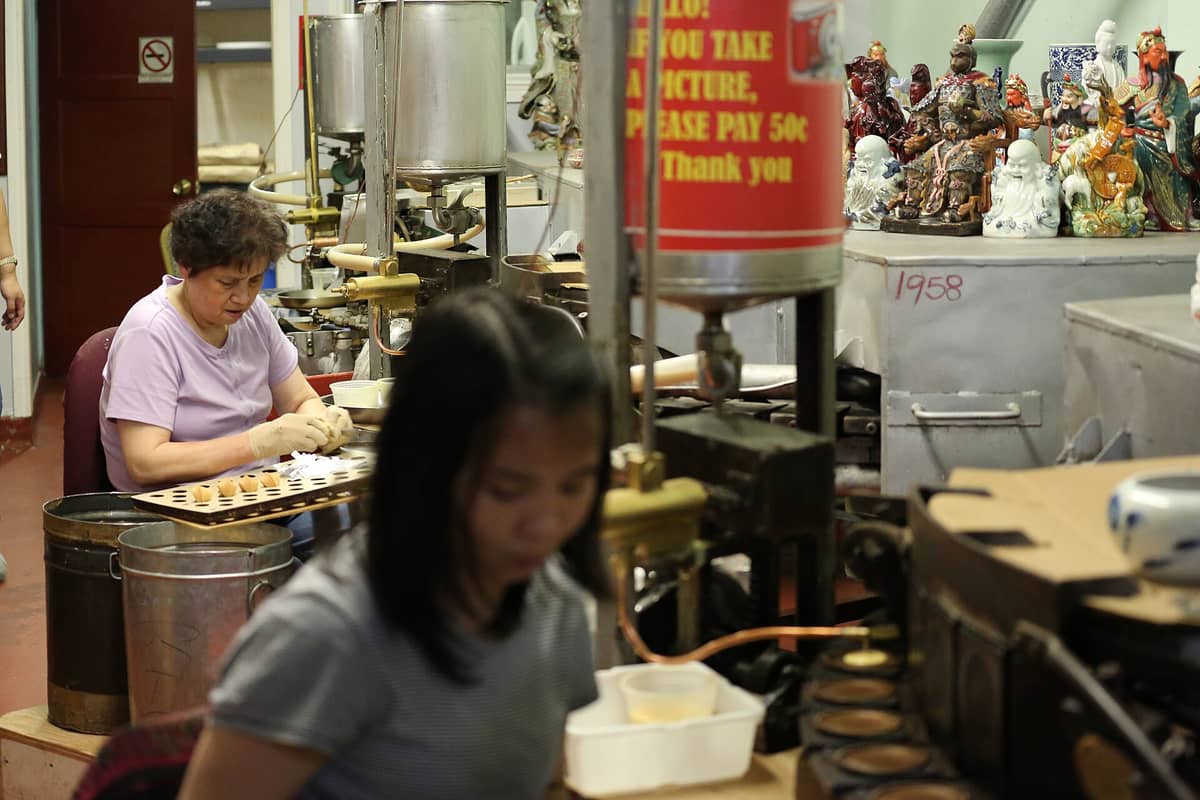
The Golden Gate Fortune Cookie Factory, also known as Golden Gate Fortune Cookies or the Golden Gate Fortune Cookie Company (金門餅食公 in Cantonese), is not a museum, not a theme attraction, and not a demonstration kitchen. It is a real working bakery that happens to let you watch. Since 1962, it has operated out of a narrow shopfront along Ross Alley, one of Chinatown's oldest pedestrian lanes, producing fortune cookies by hand using the same rotating iron molds that have defined the process for decades.
The space is genuinely small. Two or three workers can fill it. When a handful of visitors crowd in to watch, the room is full. That intimacy is exactly the point: this is not a sanitized factory tour with safety glass and guided scripts. You are standing a few feet from the press, in the warm air, watching someone fold a hot wafer around a paper slip with practiced speed. It takes a second per cookie. It is oddly hypnotic.
💡 Local tip
Arrive on a weekday morning if you want to watch cookies being made without a crowd. Weekend afternoons can get congested inside the narrow alley, making the interior difficult to navigate.
Finding It: Ross Alley and the Chinatown Context
Ross Alley runs between Jackson Street and Washington Street, parallel to Grant Avenue and just a block west of it. It is easy to miss if you are not looking for it, which is part of its appeal. San Francisco's Chinatown is one of the oldest and most densely populated Chinese communities in North America, and Grant Avenue's souvenir shops and restaurants are the face most visitors see. Ross Alley represents a different layer: narrower, quieter between rush periods, and lined with the kind of working businesses that have kept the neighborhood functional for generations.
Number 56 is on the eastern side of the alley. There is usually a small hand-painted sign, and if the factory is running, you will smell the baking before you see it. The scent is faint and warm, somewhere between a sugar wafer and a very light vanilla. On cool mornings, steam from the press drifts into the alley.
Getting there without a car is straightforward. Several Muni bus lines run along Kearny Street and Stockton Street, both within two or three blocks. Powell Street station, served by BART and multiple Muni Metro lines, is a walkable distance, making this an easy stop to build into a Chinatown walk or a broader downtown day.
Tickets & tours
Hand-picked options from our booking partner. Prices are indicative; availability and final rates are confirmed when you complete your booking.
Muir Woods and Sausalito guided tour with transportation
From 82 €Instant confirmationFree cancellationSan Francisco 2-day hop on hop off city and night tour
From 103 €Instant confirmationFree cancellationSan Francisco self-guided bike tour
From 27 €Instant confirmationFree cancellationGolden Gate Bridge to Sausalito guided bike tour
From 64 €Instant confirmationFree cancellation
The Experience at Different Times of Day
Weekday mornings, roughly between 9:00 am and noon, are the most rewarding time to visit. Production is usually active, the alley has not yet filled with tour groups, and workers have time to demonstrate the folding technique or let curious visitors try it themselves (typically for a small fee for custom cookies). The light in the alley at that hour is flat and even, which is actually useful for photography since the deep shade of the lane means harsh sunlight would be a problem anyway.
By early afternoon on weekends, Ross Alley sees real foot traffic. The factory interior, which holds perhaps eight to ten people comfortably, can reach capacity quickly. Groups press in from the door, making it hard to see the actual production. If you arrive during a peak moment and it feels too crowded to appreciate, it is worth stepping out and returning ten minutes later. The turnover is fast.
Late afternoon, especially on weekdays, tends to bring a secondary quiet period. The factory is open until 6:30 pm Monday through Friday and 7:00 pm on Saturdays and Sundays, so an early evening visit is viable. The alley takes on a different character as the overhead light fades and the shops along Grant Avenue begin closing. The factory often continues production until close.
What You Will See Inside
The production process is visible from just inside the door. Thin batter is pressed between heated iron molds, producing a round, flexible wafer. A worker lifts each wafer while it is still pliable, places a fortune slip in the center, and folds the cookie into its familiar shape by hand. The whole motion takes about two seconds. The finished cookies cool in paper-lined trays stacked near the front of the shop.
The smell inside is stronger than the alley: warm, starchy, with a faint sweetness that does not quite read as sweet until you are outside again. The iron molds make a rhythmic metallic sound as they press and release. The interior walls are close enough to touch both sides if you extend your arms, and the ceiling is low. It feels like a functional workspace that has never been remodeled for visitors, because it has not been.
Cookies are sold at the counter in bags of various sizes. Custom orders with personalized messages are available, typically at a higher price per cookie and sometimes requiring advance notice. Fortune cookies in unusual flavors or dipped in chocolate are also offered. The packaging is simple: clear bags, often sealed with a twist tie. No elaborate gift boxes, no branded tins.
ℹ️ Good to know
Custom fortune cookies with personalized messages make a distinctive souvenir or event favor. Ask at the counter for current pricing and lead times, as these vary.
Historical and Cultural Weight
The Golden Gate Fortune Cookie Factory has operated at this location since 1962, which puts its founding roughly in the period when Chinatown was undergoing significant demographic and commercial change following the Immigration Act reforms of the early 1960s. The fortune cookie itself has a contested origin story: the leading historical accounts trace it to Japanese Americans in California in the early twentieth century, not to China, where the cookie is not a traditional food. The fact that fortune cookies are now so strongly associated with American Chinese restaurants is itself a piece of food history worth knowing before you walk in.
The factory's longevity in a neighborhood where real estate pressure has displaced many long-standing small businesses makes it notable beyond its novelty. A 2024 San Francisco city document references the factory by name, reflecting its recognized status as a Chinatown institution. For visitors interested in the deeper history of the neighborhood, the Chinese Historical Society of America Museum is a few blocks away and provides substantial context for the community's history in California.
Photography and Practical Considerations
The factory is a popular photography stop, and staff are generally accustomed to visitors with cameras. The interior is dim, so phone cameras perform better here in a stable position than at arm's length in a moving crowd. The best shots tend to be close-ups of the folding motion or the rows of cooling cookies, rather than wide-angle attempts that will mostly capture the shoulders of other visitors.
There is no formal photography fee schedule posted, but if you are spending several minutes shooting and taking up space in a small working shop, buying a bag of cookies is a reasonable gesture, and staff may request a small fee (around 50 cents) for photos. Prices for cookies themselves are modest.
On accessibility: the factory is located in a narrow alley and the interior is a tight working space. No wheelchair accessibility information is published on the official site. Visitors with mobility needs should contact the factory directly before visiting to confirm current conditions.
⚠️ What to skip
The factory is not climate-controlled. On warm days, the combination of baking equipment and enclosed space makes the interior noticeably hot. Visitors sensitive to heat should plan accordingly, especially in September and October when San Francisco sees its warmest temperatures.
Situating This Stop in a Chinatown Visit
The factory works best as part of a broader Chinatown walk rather than a standalone destination. Ross Alley is close to several worthwhile stops: the Old Saint Mary's Cathedral at Grant and California is a short walk south, and the formal entrance arch at Dragon's Gate marks the southern edge of the neighborhood. A morning that begins at Dragon's Gate, moves through Grant Avenue, detours into Ross Alley for the factory, and then continues toward North Beach covers a useful stretch of the northeastern quarter of San Francisco without requiring transit.
If you are putting together a broader first day in the city, the San Francisco first-time visitor guide has a logical sequence for combining Chinatown with adjacent neighborhoods. The factory is the kind of stop that takes fifteen minutes but leaves a specific, tactile memory: the warmth of a just-folded cookie, the rhythm of the press, the paper fortune in your hand before the cookie is fully cooled.
Who should skip it: visitors who are strictly looking for architectural landmarks, outdoor experiences, or significant art collections will not find those here. This is a small industrial food operation in an alley. Its appeal is sensory and historical, not spectacular. If your Chinatown time is limited and you have to choose, the surrounding streets themselves carry more of the neighborhood's character than any single indoor stop.
Insider Tips
- Weekday mornings between 9:00 am and noon give you the best chance of watching active production without crowd interference. Weekend afternoons are the worst time to visit if you want to actually see anything.
- Ask to try folding a cookie yourself. Staff sometimes demonstrate or allow visitors to attempt it, especially when the shop is not crowded. The wafer cools and stiffens within seconds, so the timing is unforgiving.
- Custom fortune cookies with your own message are available but may require advance arrangement. If you have a specific event or message in mind, contact the factory before your visit rather than assuming same-day turnaround.
- Ross Alley itself has a history worth a few minutes of attention. It was historically associated with gambling houses, brothels, and other businesses in the late 19th and early 20th centuries. Walking the full length of the alley gives a sense of scale that tourist maps do not convey.
- The cookies are best eaten the day of purchase. The hand-folded wafers are crispier and lighter than mass-produced versions, and that texture degrades faster once the bag is opened.
Who Is Golden Gate Fortune Cookie Factory For?
- First-time San Francisco visitors wanting something specific and tactile to remember from Chinatown
- Families with children who can observe a working production process up close
- Food history enthusiasts interested in the American Chinese culinary tradition
- Photographers looking for low-light, detail-oriented subjects in an authentic working environment
- Visitors building a self-guided Chinatown walking itinerary who need a logical mid-route stop
Nearby Attractions
Other things to see while in Chinatown:
- Chinese Historical Society of America Museum
The Chinese Historical Society of America Museum tells the story of Chinese immigration, labor, and community in the United States from the Gold Rush to the present day. Housed in the landmark Julia Morgan-designed Chinatown YWCA building in the heart of San Francisco's Chinatown, it is the oldest and one of the most significant institutions dedicated to Chinese American heritage in the country.
- Dragon's Gate (Chinatown Gate)
Dragon's Gate (龍門, Lóngmén) stands at the corner of Bush Street and Grant Avenue, marking the formal threshold into the oldest Chinatown in North America. A paifang-style ceremonial arch dedicated in 1970, it costs nothing to visit and is open around the clock, making it a natural starting point for any exploration of the neighborhood.
- Old Saint Mary's Cathedral
Built in 1854 and still an active parish, Old Saint Mary's Cathedral stands at the corner of California Street and Grant Avenue as the oldest cathedral in San Francisco. Free to enter and rich in Gothic Revival detail, it offers a striking architectural and historical contrast to the surrounding energy of Chinatown.