Dragon's Gate: The Ceremonial Entrance to San Francisco's Chinatown
Dragon's Gate (龍門, Lóngmén) stands at the corner of Bush Street and Grant Avenue, marking the formal threshold into the oldest Chinatown in North America. A paifang-style ceremonial arch dedicated in 1970, it costs nothing to visit and is open around the clock, making it a natural starting point for any exploration of the neighborhood.
Quick Facts
- Location
- Bush Street & Grant Avenue, San Francisco, CA 94108
- Getting There
- 5-minute walk north from Union Square; served by multiple Muni bus lines on Stockton and Kearny
- Time Needed
- 10–20 minutes to view the gate; allow 2+ hours to explore Chinatown beyond it
- Cost
- Free, no tickets required, open 24 hours
- Best for
- First-time visitors, architecture enthusiasts, photographers, Chinatown walkers
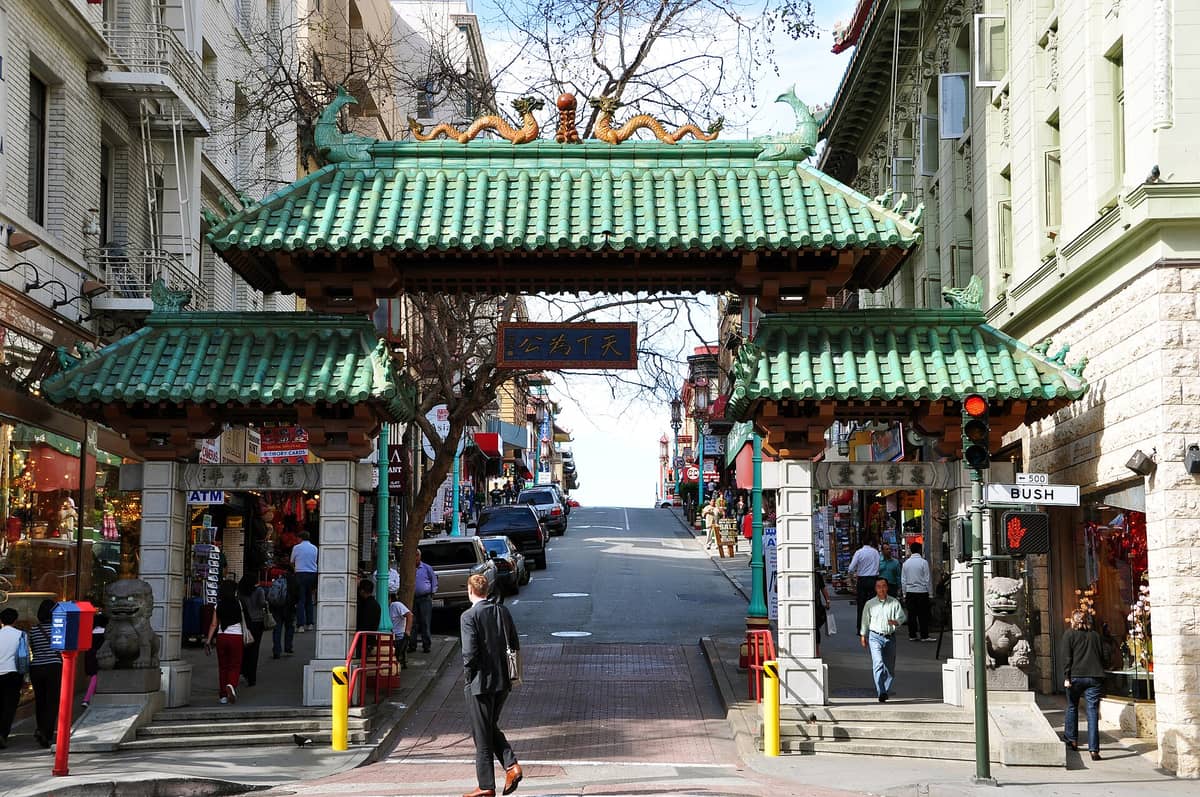
What Dragon's Gate Actually Is
Dragon's Gate is a paifang, the traditional Chinese ceremonial gateway style characterized by layered, sweeping rooflines and elaborately decorated crossbeams. This particular gate spans three portals across Grant Avenue, with jade-green ceramic tiled roofs rising above carved stone columns. At the apex of the central arch, a pair of carved dragons faces outward toward Bush Street, flanked by fish and other symbolic creatures worked into the green-glazed tilework.
The gate's official Chinese name, 龍門 (Lóngmén), translates directly as Dragon Gate, a reference drawn from classical Chinese mythology in which carp that leap the Dragon Gate waterfall transform into dragons, a metaphor for perseverance and upward achievement. That symbolism runs deeper than decoration: it speaks directly to the immigrant experience of the Cantonese community that built this neighborhood over more than a century.
The structure was designed by Clayton Lee and colleagues following a mayoral design competition, and was officially dedicated in 1970. It has since become the most photographed entry point in San Francisco's Chinatown, which itself is recognized as one of the oldest and most densely settled Chinese communities in North America.
How the Gate Looks and Feels at Different Times of Day
Early morning, between roughly 7 and 9 a.m., Dragon's Gate is at its quietest. The tourist flow hasn't started yet, and the gate frames a view straight up Grant Avenue where shopkeepers are pulling open latticed steel shutters, and the faint smell of roasting duck and dried seafood drifts from the side streets. The green roof tiles catch soft northern California light cleanly at this hour, and you have a genuine chance to stand in the center portal and look up at the carved detail without a crowd pressing behind you.
By mid-morning and through the afternoon, the scene shifts considerably. Tour groups arrive from nearby hotels and Union Square, and the crosswalk at Bush and Grant becomes a choreography of cameras pointing upward while Muni buses pass through the intersection. The gate doesn't change, but your experience of it does. Midday is the most congested stretch, particularly on weekends.
After dark, Dragon's Gate takes on a different character entirely. Red lanterns strung along Grant Avenue glow amber and red, and the gate's upper roofline catches the light from street lamps in a way that flattens the usual daytime palette into something more atmospheric. Evening visits are genuinely worthwhile for photographers, and foot traffic is lighter than midday. The surrounding blocks stay active with restaurants, so there's no safety concern about being in the area at night, though standard urban awareness applies as it would anywhere in the city.
💡 Local tip
For photography: arrive before 8:30 a.m. on a weekday for clear sightlines and soft light on the tile work. After 9 p.m., the lantern lighting creates a completely different mood, worth a second visit if you're staying nearby.
Tickets & tours
Hand-picked options from our booking partner. Prices are indicative; availability and final rates are confirmed when you complete your booking.
Sonoma and Napa Valley wine tour from San Francisco
From 127 €Instant confirmationFree cancellationGo City | San Francisco Explorer Pass
From 76 €Instant confirmationFree cancellationMuir Woods and Sausalito guided tour with transportation
From 82 €Instant confirmationFree cancellationSan Francisco CityPASS
From 77 €Instant confirmationFree cancellation
Historical and Cultural Context
San Francisco's Chinatown predates the gate by over a century. The neighborhood grew from the 1850s onward as Chinese laborers arrived during the Gold Rush and later to build the Central Pacific Railroad. By the late 19th century, the area around Sacramento, Clay, and Grant was already the social and commercial heart of Chinese immigrant life on the West Coast, despite systematic legal discrimination including the Chinese Exclusion Act of 1882.
The 1906 earthquake and fire destroyed the original Chinatown almost entirely, and the community rebuilt it in a deliberate effort to create what historians describe as a 'Oriental City' aesthetic appealing to tourists and demonstrating permanence. The pagoda-topped buildings and decorative archways that visitors see today largely reflect that post-1906 rebuilding philosophy, a community asserting cultural identity through architecture under difficult circumstances.
Dragon's Gate arrived relatively late in that story. The 1970 dedication came during a period of increased civic recognition of Chinese American identity in San Francisco, and the gate was partly intended as an official civic landmark formalizing what the neighborhood already represented. The Republic of China (Taiwan) gifted materials for the construction, a detail that reflects the political and cultural ties the Cantonese community in San Francisco maintained at the time.
For a deeper look at the neighborhood's documented history, the Chinese Historical Society of America Museum is located a short walk away on Clay Street and offers one of the most substantive accounts of Chinese American history in the country.
The Practical Walkthrough: Arriving and Moving On
Dragon's Gate sits at the intersection of Bush Street and Grant Avenue. Coming from Union Square, the walk takes roughly five minutes heading north on Grant Avenue, which is the commercial spine of Chinatown. The gate appears at the end of that stretch, framing the street ahead of you. If you're arriving by Muni, multiple bus lines run along Stockton Street one block west, and the Powell Street BART and Muni Metro station is about a 10-minute walk south.
There is no admission, no ticket booth, no barriers, and no scheduled opening or closing. The gate spans a public city street, so visiting is simply a matter of walking to the intersection. You can pass through the central portal or view it from across Bush Street for a full-frame perspective. The sidewalk area immediately in front of the gate is narrow during busy periods, so plan to photograph from a slight distance if you want to capture the full height of the structure without distortion.
ℹ️ Good to know
Accessibility: Dragon's Gate is an outdoor structure on a standard city sidewalk with crosswalks at the intersection. There are no steps to navigate to view or pass through the gate, though the surrounding Chinatown blocks involve typical San Francisco street terrain.
Once you pass through Dragon's Gate, Grant Avenue runs north through the heart of Chinatown. The street is lined with shops selling jade, silk, ceramics, and imported goods, as well as bakeries and tea shops. The Golden Gate Fortune Cookie Factory on Ross Alley, roughly four blocks north and one block east, is a small working factory worth finding. It's easy to miss if you stick only to Grant Avenue.
Weather and What to Wear
San Francisco's climate follows a warm-summer Mediterranean pattern heavily influenced by marine fog from the Pacific. Summer months, especially June through August, are often cooler and foggier than visitors expect, with average highs in the mid-60s Fahrenheit (around 18-19°C). September and October tend to be the warmest and clearest months in the city. For a visit to Dragon's Gate specifically, the weather matters mainly because Grant Avenue runs as a mild wind corridor and early mornings can be noticeably cool even in technically warm months.
Layers are the standard advice for San Francisco in all seasons, but especially spring through early summer. A light jacket packed in a bag covers most scenarios. Rain falls primarily from November through March, and a wet morning at the gate creates slippery stone surfaces on the surrounding sidewalks, though the visit itself is short enough that rain rarely makes it impractical.
For broader planning context around San Francisco's seasonal conditions, the best time to visit San Francisco guide breaks down month-by-month weather patterns in practical terms.
Is the Gate Worth Your Time?
Dragon's Gate is a genuine piece of urban architecture with real historical weight, but it is also a street-level structure that you can take in fully within a few minutes. If your goal is only to see the gate, the visit is brief by nature. The value compounds significantly when you treat the gate as the starting point for a Chinatown walk rather than the destination itself.
Visitors hoping for an immersive cultural site with interpretive signage, an interior space, or a ticketed experience will need to adjust expectations. Dragon's Gate is a threshold, architecturally and conceptually. What lies beyond it, in the blocks of Chinatown stretching north toward Columbus, is the actual experience.
People who find crowded tourist intersections frustrating might prefer visiting at 7 a.m. or after 8 p.m. Those with limited mobility will find the gate accessible but should know that Chinatown's side streets involve steeper grades than Grant Avenue itself.
Insider Tips
- Look up at the undersides of the roof tiers, not just the front face of the gate. The painted beamwork and carved medallions on the interior-facing surfaces are easy to miss when you're navigating foot traffic.
- The best unobstructed view of the gate as a complete structure is from the south side of Bush Street, standing back roughly 15-20 feet. This gives you the full vertical scale without a fisheye effect.
- Ross Alley, one block east of Grant Avenue and about four blocks north of the gate, is the quietest route through Chinatown and passes the Golden Gate Fortune Cookie Factory. Most visitors miss it entirely by staying on Grant.
- Chinatown's dim sum restaurants are most active for lunch service between 10 a.m. and 1 p.m. on weekends. If you arrive early for photos of Dragon's Gate, you can be seated at a restaurant before the wait lists form.
- The gate looks substantially different on Lunar New Year and during the surrounding festival period, typically January or February. The street is hung with additional lanterns and the neighborhood hosts one of the largest Lunar New Year parades in the United States, which passes through the gate itself.
Who Is Dragon's Gate (Chinatown Gate) For?
- First-time visitors to San Francisco who want a clear geographic entry point into Chinatown
- Photographers looking for architectural subjects with strong color contrast and layered detail
- History-focused travelers interested in Chinese American heritage and West Coast immigration history
- Walkers building a self-guided Chinatown itinerary who need a natural starting point
- Travelers combining a Chinatown visit with nearby North Beach, which begins just a few blocks north
Nearby Attractions
Other things to see while in Chinatown:
- Chinese Historical Society of America Museum
The Chinese Historical Society of America Museum tells the story of Chinese immigration, labor, and community in the United States from the Gold Rush to the present day. Housed in the landmark Julia Morgan-designed Chinatown YWCA building in the heart of San Francisco's Chinatown, it is the oldest and one of the most significant institutions dedicated to Chinese American heritage in the country.
- Golden Gate Fortune Cookie Factory
Tucked into Ross Alley in the heart of San Francisco's Chinatown, the Golden Gate Fortune Cookie Factory has been folding fortune cookies by hand since 1962. It's a rare chance to watch a working bakery up close, smell fresh-baked wafers, and buy cookies straight off the press — with free admission (note that photography may incur a small fee).
- Old Saint Mary's Cathedral
Built in 1854 and still an active parish, Old Saint Mary's Cathedral stands at the corner of California Street and Grant Avenue as the oldest cathedral in San Francisco. Free to enter and rich in Gothic Revival detail, it offers a striking architectural and historical contrast to the surrounding energy of Chinatown.