Coit Tower: Telegraph Hill's 210-Foot Window Over San Francisco
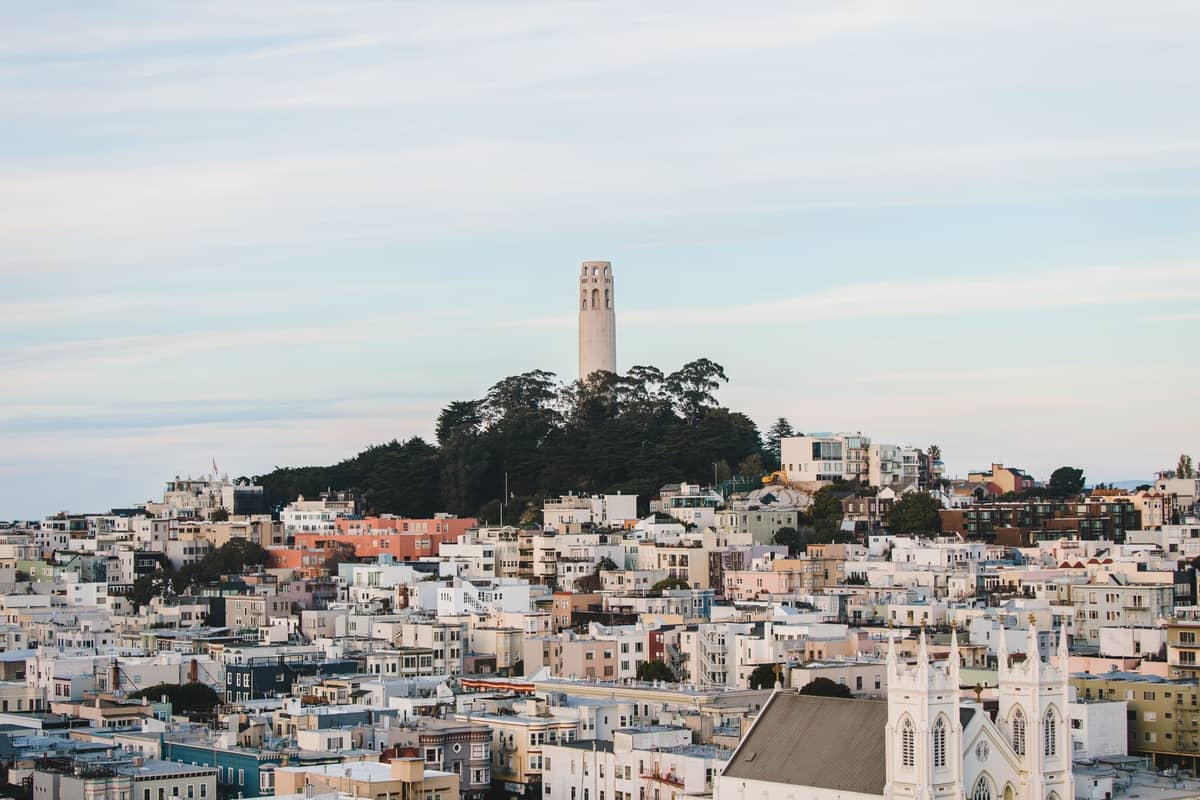
Rising 210 feet above North Beach on Telegraph Hill, Coit Tower is one of San Francisco's most recognizable landmarks. The real draw is twofold: sweeping 360-degree views of the Bay and a ground-floor lobby lined with remarkably preserved 1930s fresco murals. Neither is as simple as it looks on a postcard.
Quick Facts
- Location
- 1 Telegraph Hill Blvd, San Francisco, CA 94133 (Telegraph Hill, North Beach)
- Getting There
- Muni bus 39 (Coit) runs between Fisherman’s Wharf and Coit Tower via North Beach; walking via Filbert or Greenwich Steps is a popular alternative
- Time Needed
- 1 to 2 hours including the stairway approach and observation deck
- Cost
- Grounds and lobby murals: free. Elevator to observation deck: $11 adults / $8 seniors & youth (12–17) / $3 children (5–11) for non-SF residents; SF residents pay less. Children 4 and under: free
- Best for
- Views, WPA history, photography, walkers approaching via Filbert Steps
- Official website
- coittower.org
What Coit Tower Actually Is
Coit Tower is a 210-foot (64 m) fluted concrete column completed in 1933 and funded by a bequest from Lillie Hitchcock Coit, a colorful San Francisco socialite who left one-third of her estate to beautify the city she loved. The architect Arthur Brown Jr., who also designed San Francisco City Hall, gave it a clean, tapering form that architects still debate — some see the column as deliberately fluted to echo a fire hose nozzle, a nod to Coit's lifelong admiration for the Knickerbocker Engine Company No. 5 volunteer fire brigade. The city's official position is that no such intent was documented, and the resemblance may be coincidental.
The tower stands within Pioneer Park on the summit of Telegraph Hill, listed on the National Register of Historic Places (NPS Number 07001468). The grounds around the tower are free to access, though park hours may be limited. The interior lobby and observation deck operate on a ticketed schedule.
ℹ️ Good to know
The lobby murals are free to view during operating hours — no elevator ticket required. If the views matter more to you than the summit, the murals alone justify the trip.
The WPA Murals: The Part Most Visitors Rush Past
The interior base of Coit Tower contains 3,691 square feet of fresco murals painted in 1934 by a team of roughly 25 artists working under the Public Works of Art Project, a New Deal program that predated the better-known WPA. The murals depict California working life during the Depression: dockworkers, farm laborers, librarians, scientists, and newspaper readers. The style is Social Realism with unmistakable influence from Diego Rivera, whose San Francisco murals some of the same artists had studied.
What makes them unusual is their specificity. Look closely and you will see California newspapers with legible headlines from 1934, shelves stocked with actual books of the era, and faces that appear to be portraits of real people. One panel caused a minor scandal at the time: a copy of a radical newspaper visible in a newsstand scene prompted city officials to delay the tower's opening while they debated whether the content was too politically charged. The murals were eventually unveiled without alteration.
Spend at least 15 to 20 minutes with the murals before riding the elevator. Most visitors queue for the lift and ignore the paintings entirely. The second-floor murals, accessible only on guided tours offered on weekends, are in notably good condition and worth seeking out if your schedule allows. For more context on San Francisco's art institutions, the SFMOMA and the de Young Museum both hold related works from the same period.
Tickets & tours
Hand-picked options from our booking partner. Prices are indicative; availability and final rates are confirmed when you complete your booking.
Sonoma and Napa Valley wine tour from San Francisco
From 127 €Instant confirmationFree cancellationGo City | San Francisco Explorer Pass
From 76 €Instant confirmationFree cancellationMuir Woods and Sausalito guided tour with transportation
From 82 €Instant confirmationFree cancellationSan Francisco CityPASS
From 77 €Instant confirmationFree cancellation
The Observation Deck: Views and Realistic Expectations
The elevator ride to the top takes under a minute. The observation deck at the summit is an open-air terrace that wraps around the column, giving you a full 360-degree panorama. On a clear day you can trace the Bay Bridge arc to the east, identify Marin County's green hills to the north, pick out Alcatraz Island sitting low in the water, and look south over the rooftops of North Beach and the Financial District. On a morning when the fog hasn't fully lifted, you may see nothing but grey — and the wind will remind you why layers are not optional.
September and October are statistically San Francisco's warmest and clearest months, with less marine fog than the summer months. If you visit in June or July, plan for the possibility that thick fog will shroud the summit until late morning or early afternoon. The view at noon in September is categorically different from the view at 10 a.m. in July.
⚠️ What to skip
The deck railing is low relative to the drop. The viewing platform is narrow and can feel cramped when more than 15 to 20 people are up there simultaneously. Anyone with a strong fear of heights should factor this in before paying for the elevator ticket.
For comparison, the Twin Peaks viewpoint is free and offers a similarly expansive city panorama without the ticket queue. What Twin Peaks lacks is the architectural experience and the immediate foreground of the Bay. Both are worth doing, but they serve different purposes.
How to Get There: The Approach Matters
Muni bus 39 (Coit) runs between Fisherman’s Wharf and Coit Tower via Telegraph Hill Boulevard and deposits you near the tower entrance. This is the easiest option and runs frequently enough to be practical. Parking at the top is limited and the road is narrow — driving is not recommended unless you have a specific reason to.
The more rewarding approach, and the one that gives the visit its full context, is to walk up via the Filbert Steps. These wooden and concrete stairways climb the eastern face of Telegraph Hill through a canopy of fennel, blackberry, and garden plantings that residents have cultivated informally for decades. Wild parrots — a flock of cherry-headed conures that has lived on Telegraph Hill since at least the 1990s — are frequently seen and heard along this route, particularly in the morning. The climb takes about 15 to 20 minutes from the Embarcadero level and is steep enough to be a genuine workout.
The Greenwich Steps offer an alternative ascent from the north side, slightly less steep and less densely planted. Both routes deposit you near the top of the hill within a short walk of the tower entrance. Wear shoes with grip — the wooden steps on the Filbert route can be slick when damp.
When to Visit and What Changes by Time of Day
The tower opens at 10:00 a.m. daily, with closing times typically between 5:00 and 6:00 p.m. depending on the season. Arriving within the first 30 minutes means shorter queues for the elevator and better light for photography on the eastern-facing sections of the deck, where the Bay Bridge is lit from the front rather than in silhouette. By midday in peak season, the queue for the elevator can stretch outside the lobby, and the observation deck becomes noticeably crowded.
Late afternoon light, particularly from September through November, is exceptional for photographing the Bay. The sun drops toward the Pacific and casts warm tones across the water, the bridge, and Marin. Closing time typically ranges between 5:00 and 6:00 p.m. depending on the season, so arrive no later than an hour before the posted closing to allow time for both the murals and the deck.
The park grounds around the tower are accessible at all hours. On summer mornings before the tower opens, locals walk dogs and sit on the benches with coffee, and the city below is usually quieter and softer-edged before the fog burns off. It is a different experience from the midday tourist peak, and worth arriving early to catch even if you plan to buy tickets once the doors open.
💡 Local tip
Photography tip: The observation deck has a low concrete railing with no glass panels, so there is nothing between your lens and the view. A wide-angle lens captures the sweep of the Bay from the north-facing side. For Bay Bridge shots, the eastern side of the deck in morning light gives the clearest, shadow-free image.
Practical Details and Accessibility
Tickets for the elevator are sold on-site up to one hour before closing. There is no advance online booking for individuals at the time of writing; verify current procedures at sfrecpark.org before your visit, as this is the type of operational detail that can change. The lobby murals require no ticket and are viewable whenever the building is open.
The tower is managed by San Francisco Recreation and Parks. Vehicle access via Telegraph Hill Boulevard makes the site reachable without climbing stairs, and the interior elevator serves the observation level. The steep hill approach via the Filbert or Greenwich Steps is not suitable for wheelchairs or strollers. For families with young children, the Muni 39 bus is the practical choice. If you are planning a broader day in this part of the city, North Beach sits directly below with cafes, bookshops, and Washington Square Park within easy walking distance.
Dress in layers regardless of the season. The summit is consistently cooler and windier than street level, and the combination of wind and a narrow open deck can make it feel significantly colder than the temperature at the base of the hill suggests.
Who Should Consider Skipping It
If you have already visited on a previous San Francisco trip and the murals did not hold your attention, the view alone is unlikely to be worth the return. The observation deck is compact, and visitors who want a long, contemplative city panorama without crowds may find Twin Peaks or the Marin Headlands more satisfying. Travelers on tight schedules who are choosing between this and Alcatraz should know that Alcatraz requires significantly more planning but delivers a qualitatively different experience — this tower can be done in under two hours, start to finish.
Anyone primarily motivated by San Francisco's architectural history will get more depth from a structured walking tour that includes the tower as one stop among several. The San Francisco architecture guide covers how the tower fits into the broader context of 1930s civic building in the city.
Insider Tips
- The second-floor murals are in better condition than the ground-floor panels and include details not visible from the lobby. Weekend guided tours are the only way to access them — ask at the ticket desk about the current schedule.
- The wild cherry-headed conure flock is most reliably spotted along the Filbert Steps between 8:00 and 10:00 a.m. They tend to move higher up the hill as the day warms, so early walkers get the best sightings.
- If the elevator queue looks long when you arrive, view the lobby murals first. The queue often shortens by 20 to 30 minutes once the initial morning rush has gone up and come back down.
- The bench on the north side of Pioneer Park, just past the tower, gives an unobstructed view toward the Golden Gate Bridge and Alcatraz without any admission fee. It is one of the better free viewpoints in the city and most visitors walk straight past it.
- Bring exact change or a card. The ticket desk does accept cards, but smaller bills help when the line is moving quickly and staff are busy.
Who Is Coit Tower For?
- First-time San Francisco visitors wanting to understand the city's layout from above
- History and art enthusiasts interested in New Deal-era public art and Social Realist fresco technique
- Walkers who want to combine the Filbert Steps, the conure flock, and a hilltop view in one morning outing
- Photographers working in late afternoon September to November light over the Bay
- Families with children old enough to manage stairs or willing to use the Muni 39 bus
Nearby Attractions
Other things to see while in North Beach:
- Beat Museum
Housed at 540 Broadway in San Francisco's North Beach, The Beat Museum is a compact but richly layered tribute to the writers and artists who rewired American literature in the 1950s. With rare manuscripts, personal artifacts, first editions, and an evocative recreation of the era, it's the most concentrated encounter with Beat culture you can have anywhere in the world.
- City Lights Booksellers & Publishers
Founded in 1953 by poet Lawrence Ferlinghetti, City Lights Booksellers & Publishers is one of America's most historically significant independent bookstores. Spread across three floors in North Beach, it shaped American literary culture and remains a working bookstore and publisher open every day until 10 PM.
- Filbert Steps
The Filbert Steps are a free, publicly accessible stairway climbing the eastern face of Telegraph Hill from Sansome Street up to Coit Tower. With roughly 400 steps, hidden cottage gardens, wild parrots, and Bay views that open up mid-climb, this route is one of the most distinctive walks in San Francisco.
- Saints Peter and Paul Church
Standing tall above Washington Square Park in San Francisco's North Beach neighborhood, Saints Peter and Paul Church is a working Catholic parish with twin spires, a storied Italian-American heritage, and a facade that has anchored this corner of the city since 1924. Admission is free, the interior is open to visitors during posted hours, and the surrounding plaza makes it one of the most photogenic church settings in California.