Filbert Steps: San Francisco's Most Rewarding Urban Climb
The Filbert Steps are a free, publicly accessible stairway climbing the eastern face of Telegraph Hill from Sansome Street up to Coit Tower. With roughly 400 steps, hidden cottage gardens, wild parrots, and Bay views that open up mid-climb, this route is one of the most distinctive walks in San Francisco.
Quick Facts
- Location
- 202 Filbert St, San Francisco, CA 94133
- Getting There
- Muni F-line streetcar, disembark near Sansome St; walk inland to Filbert & Sansome
- Time Needed
- 45–90 minutes for the full climb and descent
- Cost
- Free (public stairway, no admission)
- Best for
- Walkers, photographers, nature lovers, and anyone seeking Bay views without a tour bus
What the Filbert Steps Actually Are
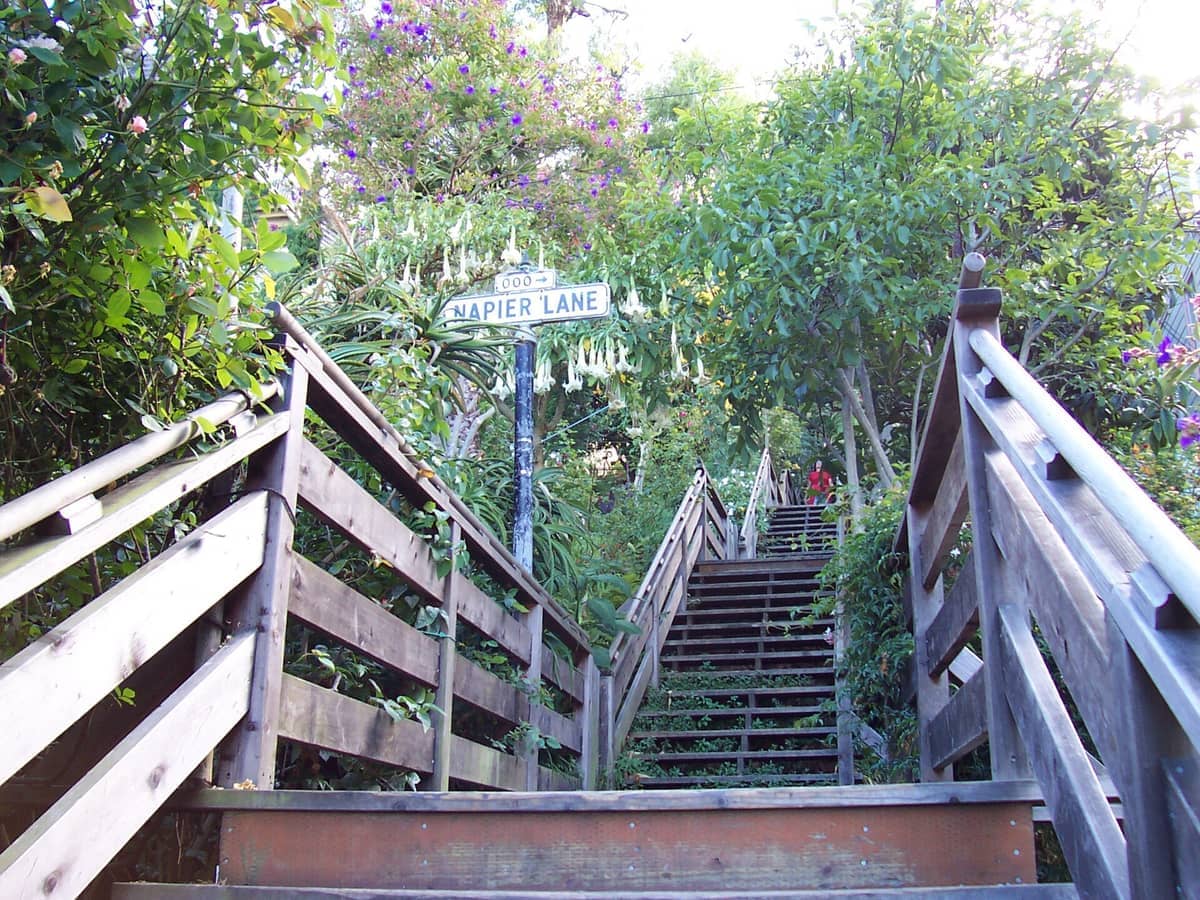
The Filbert Steps are the pedestrian continuation of Filbert Street where the road becomes too steep for cars, scaling the eastern face of Telegraph Hill from Sansome Street all the way up to Coit Tower. The stairway involves roughly 400 to 445 steps in total, split across multiple flights of wooden planking and concrete, connected by narrow garden paths and short boardwalk sections that cut through private lots maintained by residents.
Filbert Street itself carries one of the steepest gradients of any named street in San Francisco, with a maximum pitch of approximately 31.5 percent. Where the asphalt ends, the wooden steps begin, and from that point the character of the route changes completely. You leave the city grid behind and enter something that feels closer to a hillside trail through a botanical garden than an urban staircase.
ℹ️ Good to know
The lower entrance is at the corner of Filbert Street and Sansome Street, just east of Levi's Plaza. This is the base of the wooden steps section. If you are approaching from the Embarcadero, look for Levi's Plaza first, then continue one block inland.
The Climb: What You Pass on the Way Up
The first section of steps above Sansome Street is wooden, worn smooth by decades of foot traffic, and flanked by dense plantings that residents of the adjoining properties have cultivated over many years. The gardens here are informal and layered: jasmine and nasturtium spilling over fences, fig trees overhanging the path, and sections of boardwalk where the slope drops sharply below you toward the bay. On calm mornings the scent of the gardens, damp wood, and bay salt combines into something you will not encounter anywhere else in the city.
About halfway up, the wooden steps give way to concrete, and the path passes a handful of small cottages with addresses on Montgomery Street. These are genuine residences, some predating the 1906 earthquake and fire that destroyed most of the surrounding neighborhood. The cottages survived partly because of their position on the steep hillside and partly, according to local accounts, because residents used wine to wet their roofs against the spreading flames. Do not expect to verify this as official history, but the structures themselves are real and remarkably intact given what surrounded them.
As the steps continue above Montgomery Street, the vegetation thickens. This section of the hill is effectively a small urban nature reserve, and the combination of microclimatic shelter and long-term planting by residents has produced a canopy unusual for this part of the city. Views of the Bay begin to open here in earnest, framing the East Bay hills and the upper structure of the Bay Bridge through gaps in the trees.
The steps eventually deliver you to the circular overlook at the base of Coit Tower, where the panorama extends north to Marin County, east across the Bay to Oakland and Berkeley, and south along the waterfront. The transition from enclosed garden path to open hilltop is abrupt and genuinely impressive.
Tickets & tours
Hand-picked options from our booking partner. Prices are indicative; availability and final rates are confirmed when you complete your booking.
Sonoma and Napa Valley wine tour from San Francisco
From 127 €Instant confirmationFree cancellationGo City | San Francisco Explorer Pass
From 76 €Instant confirmationFree cancellationMuir Woods and Sausalito guided tour with transportation
From 82 €Instant confirmationFree cancellationSan Francisco CityPASS
From 77 €Instant confirmationFree cancellation
The Wild Parrots of Telegraph Hill
The flock of wild cherry-headed conures (Psittacara erythrogenys) that lives on and around Telegraph Hill is real and well established. These are not captive birds. The flock, which numbers in the dozens depending on the season, descends on the fruit trees and garden plantings along the Filbert Steps on a near-daily basis. You will hear them before you see them: a sharp, continuous shrieking that echoes off the hillside and carries down toward the Embarcadero.
The best time to encounter the parrots is in the morning, typically between 8 AM and 10 AM, when the flock moves through the upper section of the steps near the wooden boardwalk and the fig trees on the lower Montgomery Street stretch. They are not shy. On a quiet weekday morning it is possible to stand within a few feet of birds feeding on the branches above the path. Afternoon visits still offer parrot sightings, but the flock tends to disperse across the hill by mid-day.
💡 Local tip
For the best parrot encounters, arrive on a weekday morning before 10 AM. Weekends bring more foot traffic, which moves the birds higher up the hillside and makes close observation harder.
Time of Day and How the Experience Changes
Early morning is the most atmospheric time on the Filbert Steps. The light hits the eastern face of the hill directly, the gardens are still and dewy, and foot traffic is minimal. You may share the steps with a handful of locals heading down toward the Embarcadero, a dog walker, and whatever portion of the parrot flock happens to be feeding in the canopy. The wooden sections of the stairway creak underfoot in a way that feels less like urban infrastructure and more like a dock.
By late morning on weekends, particularly in summer, the steps see a significant increase in visitors coming from Fisherman's Wharf or the Embarcadero. The path is narrow in places, and passing oncoming foot traffic on the steeper wooden sections requires some patience. This is not a reason to avoid the steps, but it is a reason to time your visit if you want the experience of near-solitude.
Afternoon visits during summer months carry a fog risk. San Francisco's marine layer frequently rolls in from the west by mid-afternoon in June through August, and while the eastern face of Telegraph Hill is often clearer than the western neighborhoods, the Bay views from the upper steps can disappear into low cloud. September and October are statistically the clearest and warmest months, and afternoon visits in fall tend to reward with sharp, unobstructed sightlines across the water.
Visiting at dusk is possible since the steps are technically accessible at all hours, but the wooden sections become genuinely difficult to navigate in low light. Bring a flashlight or keep your phone torch on hand if you intend to descend after sunset.
Practical Walkthrough: Getting There and Back
The most straightforward approach is from the Embarcadero waterfront. Walk inland to Sansome Street near Levi's Plaza and turn onto Filbert Street. The wooden staircase begins within a block. From the F-line streetcar, the walk from any stop along the waterfront takes roughly five minutes on flat ground before the climb begins.
If you are combining this with a broader North Beach itinerary, the steps connect naturally to a walk through North Beach and the Washington Square Park area. From Coit Tower at the top, a separate set of stairs descends the western and northern faces of the hill back into the neighborhood grid.
Parking near the base is limited. The Levi's Plaza Garage at 101 Lombard Street and the ParcTel Garage at 1603 Montgomery Street are the closest options, though parking costs in this part of the city add up quickly if you plan a leisurely visit. The Embarcadero BART and Muni connections make this one of the more transit-accessible walks in the city.
⚠️ What to skip
The Filbert Steps are not wheelchair accessible and are challenging for anyone with significant mobility limitations. The wooden sections involve uneven treads and no handrail on one side in places. Wear shoes with grip; the wooden boards can be slippery after fog or light rain.
Photography Notes
The wooden section between Sansome and Montgomery Streets photographs best in morning light, which hits the east-facing slope directly and brings out the green density of the gardens. A standard 28–50mm equivalent lens handles the close-in garden details and the framed Bay views without distortion. The wider views from the upper concrete section near Coit Tower work well with anything from 24mm outward.
The Bay Bridge appears in the background of many shots taken from the upper steps, and on clear days it aligns cleanly with the path. For a wider architectural view of the bridge from ground level after your descent, Crissy Field offers a very different angle. If you are comparing views across the city, the best viewpoints in San Francisco guide breaks down the options by type and accessibility.
Photographing the parrots requires patience more than equipment. A short telephoto (85–135mm equivalent) helps compress the distance and isolate birds against the foliage, but the flock often comes close enough that a standard lens works. The light in the garden canopy is dappled and inconsistent; shooting in RAW and adjusting exposure in post gives more flexibility than trying to nail exposure at the moment.
Who This Walk Is Not For
The Filbert Steps require real physical effort. The climb is roughly equivalent to ascending a 30-to-40-story building, and while there are flat landings and pauses along the route, there is no easy detour once you are committed to the wooden section above Sansome. Visitors with knee problems, severe cardiovascular limitations, or anyone who finds stair climbing significantly painful should consider whether Coit Tower itself, accessible by car or taxi via Telegraph Hill Boulevard, offers what they are looking for without the physical demand.
If you are primarily interested in Coit Tower's murals and panoramic views, it is perfectly valid to drive or take a rideshare to the top and skip the Filbert Steps entirely. The steps add a specific kind of experience: the garden walk, the parrots, the cottage architecture, the gradual reveal of the Bay. If those elements are not priorities, the climb is optional.
Insider Tips
- The gardens along the lower wooden section are maintained voluntarily by local residents. Treat them as private property that you are fortunate to walk through: do not pick plants, move off the marked path, or disturb anything along the fence lines.
- If the parrot flock is not visible on the lower wooden steps, walk up to the fig trees just below the Montgomery Street crossing. The birds concentrate there more than anywhere else on the route.
- Descending the steps is significantly harder on the knees than ascending. If you have any knee sensitivity, consider taking Telegraph Hill Boulevard (the paved road) back down, then walking around the base of the hill to your starting point.
- The steps are at their most photogenic in the 30 to 45 minutes after sunrise when the low eastern light cuts directly into the garden canopy and the Bay is often mirror-flat. This window closes quickly as the sun rises above the hill.
- Combine the Filbert Steps with the Greenwich Steps, a parallel stairway on the north side of Telegraph Hill, for a loop that covers both faces of the hill and returns you to the Embarcadero via a completely different route.
Who Is Filbert Steps For?
- Walkers who want a genuine physical challenge with scenery proportional to the effort
- Wildlife enthusiasts interested in the wild parrot flock that inhabits Telegraph Hill
- Photographers looking for garden textures, Bay views, and birds in natural light
- First-time visitors who want to understand San Francisco's topography beyond the postcard view
- Anyone combining North Beach, Coit Tower, and the Embarcadero into a single half-day loop
Nearby Attractions
Other things to see while in North Beach:
- Beat Museum
Housed at 540 Broadway in San Francisco's North Beach, The Beat Museum is a compact but richly layered tribute to the writers and artists who rewired American literature in the 1950s. With rare manuscripts, personal artifacts, first editions, and an evocative recreation of the era, it's the most concentrated encounter with Beat culture you can have anywhere in the world.
- City Lights Booksellers & Publishers
Founded in 1953 by poet Lawrence Ferlinghetti, City Lights Booksellers & Publishers is one of America's most historically significant independent bookstores. Spread across three floors in North Beach, it shaped American literary culture and remains a working bookstore and publisher open every day until 10 PM.
- Coit Tower
Rising 210 feet above North Beach on Telegraph Hill, Coit Tower is one of San Francisco's most recognizable landmarks. The real draw is twofold: sweeping 360-degree views of the Bay and a ground-floor lobby lined with remarkably preserved 1930s fresco murals. Neither is as simple as it looks on a postcard.
- Saints Peter and Paul Church
Standing tall above Washington Square Park in San Francisco's North Beach neighborhood, Saints Peter and Paul Church is a working Catholic parish with twin spires, a storied Italian-American heritage, and a facade that has anchored this corner of the city since 1924. Admission is free, the interior is open to visitors during posted hours, and the surrounding plaza makes it one of the most photogenic church settings in California.