de Young Museum: Art, Architecture, and Afternoon Light in Golden Gate Park
The M. H. de Young Memorial Museum is San Francisco's flagship fine art museum, set inside a striking copper-clad building by Herzog & de Meuron in the heart of Golden Gate Park. From American art to Oceanic textiles to world-class traveling exhibitions, the de Young rewards both a casual afternoon and a full-day deep dive.
Quick Facts
- Location
- 50 Hagiwara Tea Garden Drive, Golden Gate Park, San Francisco, CA 94118
- Getting There
- Muni bus lines serve Golden Gate Park; check SFMTA for current routes to the park
- Time Needed
- 2 to 4 hours for permanent collection; allow a full day if a major exhibition is on
- Cost
- Adults about $25; seniors about $22; students about $10; youth 17 & under free (special exhibitions extra). Bay Area residents get free general admission on Saturdays. Confirm current USD pricing at famsf.org.
- Best for
- Art lovers, architecture enthusiasts, solo travelers, couples, and anyone exploring Golden Gate Park
- Official website
- www.famsf.org/visit/de-young
What the de Young Museum Actually Is
The M. H. de Young Memorial Museum, universally known as the de Young Museum, is one of the two flagship institutions of the Fine Arts Museums of San Francisco, the other being the Legion of Honor across town in Lincoln Park. Together they form the largest public arts institution in the American West. But in terms of sheer variety and architectural drama, the de Young stands apart.
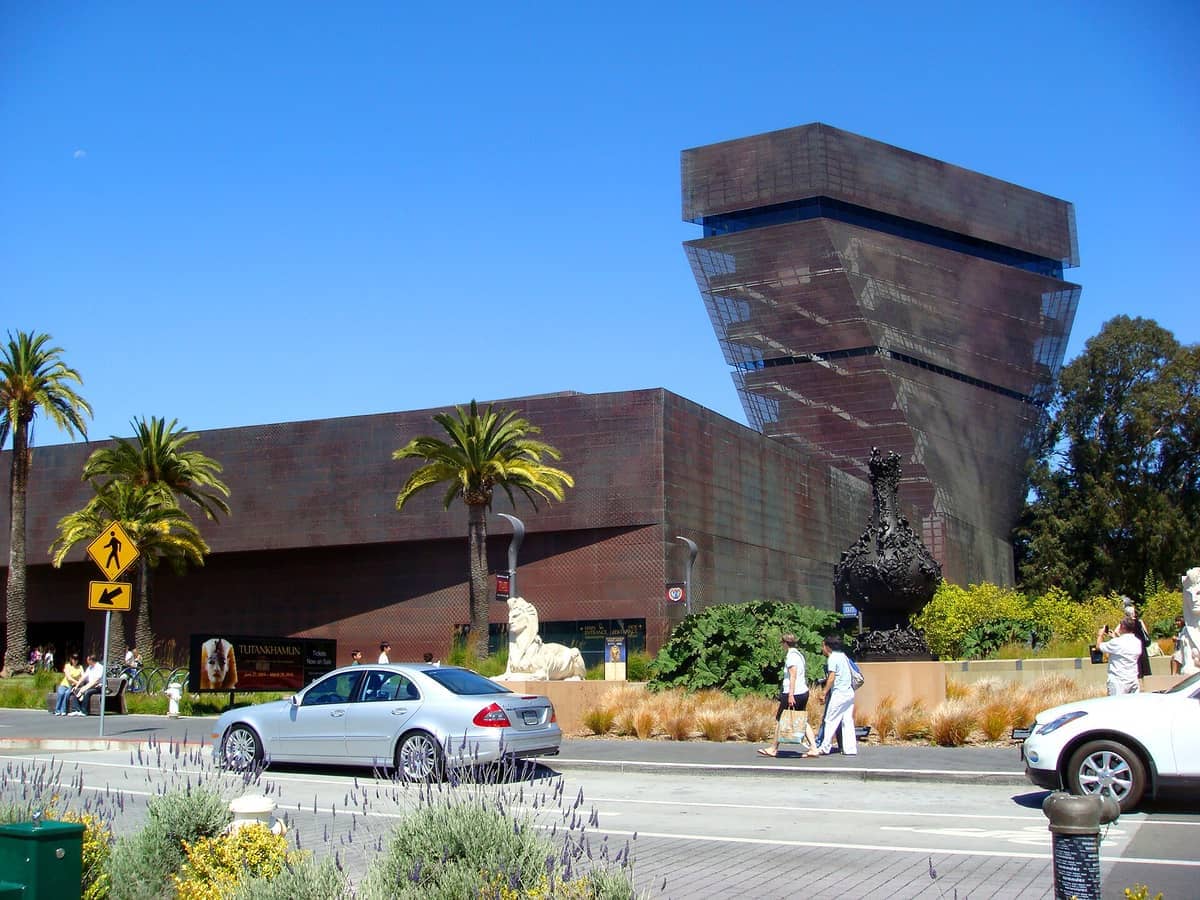
Founded in 1895 as a direct legacy of the California Midwinter International Exposition of 1894, the museum has been a fixture of Golden Gate Park for more than 125 years. The current building, a complete reconstruction opened in 2005, was designed by the Swiss firm Herzog & de Meuron, the same architects behind London's Tate Modern and many other major projects. The result is one of the most architecturally significant museum structures in the western United States.
The permanent collection spans American art from the 17th century to the present, alongside art from Africa, Oceania, and the Americas. Blockbuster traveling exhibitions rotate through regularly and have included major retrospectives drawing international attention. If you're planning a broader Golden Gate Park visit, the de Young fits naturally alongside the California Academy of Sciences, which sits directly across the Music Concourse.
The Building: Why the Architecture Matters
The de Young's exterior is clad in copper, approximately 950,000 pounds of it. When the building opened in 2005, that copper was a warm reddish-orange. Over time, the panels have oxidized to a mottled green-brown patina, designed from the beginning to blend with the surrounding trees. On foggy mornings, the building seems to dissolve into the park. On clear afternoons when the sun is low, the textured copper catches light in a way that makes the surface almost appear to move.
Herzog & de Meuron also incorporated a twisted, cantilevered tower into the design. At ten stories, it is not tall by city standards, but its position inside Golden Gate Park makes it visible from surprising distances. The Hamon Observation Tower offers a 360-degree view of the park, the ocean, and the San Francisco skyline, and it does not require a museum ticket. Most visitors do not realize they can ride up without paying general admission.
💡 Local tip
The Hamon Observation Tower is free — no museum ticket required — and is rarely crowded. Go early in your visit when the morning light hits the park from the east, or late afternoon when the setting sun silhouettes the ocean horizon to the west.
The building's interiors use the same material intelligence: concrete, wood, and natural light filtered through textured glass. Even visitors who come primarily for the art tend to pause in the central atrium. For more context on San Francisco's broader architectural landscape, the San Francisco architecture guide covers the city's most significant buildings and districts.
Tickets & tours
Hand-picked options from our booking partner. Prices are indicative; availability and final rates are confirmed when you complete your booking.
Sonoma and Napa Valley wine tour from San Francisco
From 127 €Instant confirmationFree cancellationGo City | San Francisco Explorer Pass
From 76 €Instant confirmationFree cancellationMuir Woods and Sausalito guided tour with transportation
From 82 €Instant confirmationFree cancellationSan Francisco CityPASS
From 77 €Instant confirmationFree cancellation
The Permanent Collection: What You Will Actually See
The de Young's permanent collection is organized across several wings and floors. The American art galleries are the largest and most comprehensive, covering colonial portraiture, Hudson River School landscapes, Gilded Age painting, early 20th-century modernism, and significant works from the Bay Area Figurative Movement. Artists represented include John Singer Sargent, Georgia O'Keeffe, and Wayne Thiebaud, the latter of whom painted iconic depictions of San Francisco's hills and his signature row of confections.
The African art collection occupies its own dedicated galleries and is considered one of the stronger holdings on the West Coast, covering ritual objects, textiles, and sculpture from across the continent. The Oceanic galleries bring together art from the Pacific Islands, including Papua New Guinea, Polynesia, and Micronesia, with objects that rarely appear in other American collections. The pre-Columbian and indigenous Americas collection rounds out what the museum calls its art of the ancient world holdings.
Textile and costume art has its own dedicated wing, which surprises many first-time visitors. The collection includes historic garments, tapestries, and fashion pieces that are rotated carefully due to light sensitivity. If fashion and textile history interest you, check what is currently on display before your visit, as this wing's contents change more frequently than the painting galleries.
Timing Your Visit: Morning Quiet vs. Weekend Crowds
The de Young is open Tuesday through Sunday, 9:30 am to 5:15 pm, and closed on Mondays, with occasional holiday closures; check the museum’s schedule for any special hours. The museum is busiest on weekend afternoons, particularly when a major traveling exhibition is running. Arriving at opening on a Tuesday or Wednesday gives you the best chance of moving through the American galleries at your own pace without competing for space in front of key works.
Saturday mornings occupy a particular sweet spot: Bay Area residents from all nine counties receive free general admission every Saturday, which draws a local crowd but generally well before noon. After 1 pm on Saturdays, the combination of free admission and weekend foot traffic from the broader park means the main halls can become genuinely crowded, especially around the entrance to any featured traveling exhibition.
ℹ️ Good to know
Bay Area county residents (nine counties) receive free general admission every Saturday. Bring valid proof of residence. Check famsf.org for current free days and any timed-entry requirements for special exhibitions, which may require advance reservation regardless of admission cost.
San Francisco's climate means that even in summer, mornings in Golden Gate Park often begin under a marine layer of fog. The park temperature can be 10 to 15 degrees Fahrenheit cooler than neighborhoods just a few miles east. Bring a layer even if you arrive on what seems like a warm day. The museum interior is climate-controlled and comfortable, but the walk from transit stops or parking can be cold. September and October, when fog is less persistent and afternoon temperatures in the park can reach the mid-60s Fahrenheit, are meteorologically the most comfortable months for combining an indoor museum visit with a walk through the surrounding grounds.
Getting There: Practical Transit and Arrival Notes
Golden Gate Park does not have a dedicated transit hub, but Muni bus lines serve multiple park entrances. The SFMTA publishes current routes and schedules, so check their website or app before travel, as service patterns change. Rideshares drop off easily at the museum's main entrance on Hagiwara Tea Garden Drive.
Driving into Golden Gate Park on weekends is increasingly complicated. Portions of the park, including sections of John F. Kennedy Drive, have car-free closures on certain days, which affects where you can park and how you enter. If you're combining the de Young with other Golden Gate Park attractions, consider arriving by transit and spending several hours in the park. The Golden Gate Park guide covers the park's layout, closures, and what is worth combining with a museum visit.
Bicycle parking is available near the museum entrance. The park has a network of dedicated cycling paths, and arriving by bike from the Richmond or Sunset neighborhoods is a straightforward option for visitors staying in those areas. The main entrance is fully accessible, with step-free routes, elevators to all gallery floors, and accessible restrooms on each level.
Photography, the Café, and Practical Details
Personal photography without flash is permitted in most permanent collection galleries. Special exhibitions sometimes restrict photography entirely, and signs at each gallery entrance make the policy clear. The copper exterior and the observation tower are especially photogenic. Early morning light on the copper facade is warmer and more detailed than the flat midday light, and the tower's narrow observation windows create natural framing for park panoramas.
The museum has an in-house café that serves food and beverages throughout the day. Seating is available both indoors and in the sculpture garden courtyard, which is a pleasant stop even if you are not eating. The museum shop is worth a look for art books, prints, and design objects that go well beyond typical souvenir fare. If you are continuing further into the park after your visit, the Japanese Tea Garden is a short walk away and makes for a natural extension of the afternoon.
Coat check and bag storage are available near the entrance, which matters if you have arrived with a larger pack or are continuing on to other destinations after the museum. Large bags are not permitted in the galleries.
Who Gets the Most from the de Young
The de Young is not a museum that overwhelms with a single iconic masterpiece. It does not have a Mona Lisa or a Night Watch. What it has is depth, coherence, and an unusually strong non-European collection in a context where most major American art museums are built around the Western canon. Visitors who come expecting a traditional European art experience may feel the collection is unfamiliar. That is, precisely, part of its value.
The traveling exhibition program is serious and ambitious. The museum has hosted retrospectives that ranked among the most-attended shows in the country in their respective years. If a major exhibition is scheduled during your visit, build extra time into your plan and book tickets in advance. Arriving without a reservation for a blockbuster show and expecting to walk in same-day is a gamble that does not always pay off.
Travelers with limited time in San Francisco who are trying to decide between this museum and others should know that the de Young and the SFMOMA cover fundamentally different ground. SFMOMA focuses on modern and contemporary art with a particularly strong photography collection. The de Young's range is broader historically and geographically. If you have one day, choose based on your interest; if you have two or three days, both are worth including.
⚠️ What to skip
Visitors who arrive expecting the de Young to function primarily as a Golden Gate Park sightseeing stop may find general admission (currently about $25 for adults; seniors and students less — confirm at famsf.org) harder to justify if they only plan to spend 45 minutes inside. Special exhibitions cost extra. The museum rewards a proper visit. If your time is limited, the observation tower alone is a poor reason to pay full admission — the tower is free without a ticket.
Insider Tips
- The Hamon Observation Tower does not require a museum ticket — enter via the elevator near the main lobby. Many visitors miss it entirely. The western windows offer a clear sightline to Ocean Beach and the Pacific on days when the fog has lifted.
- Timed-entry tickets for traveling exhibitions often sell out days in advance on weekends. Book online through the FAMSF ticketing system before you arrive, even if you are already planning to pay general admission at the door.
- The sculpture garden on the south side of the building is publicly accessible without a museum ticket. It is a quieter alternative to Dolores Park or Alamo Square if you want to sit outdoors without crowds.
- The museum's permanent collection galleries are significantly less crowded than the traveling exhibition spaces. If the blockbuster show has a long line, start in the American art or Oceanic galleries and loop back.
- Parking on Concourse Drive near the Music Concourse fills quickly on weekends. The Music Concourse Garage, accessed from Fulton Street at 10th Avenue on the north side of the park, is less obvious to out-of-towners and often has more availability.
Who Is de Young Museum For?
- Art enthusiasts seeking depth in American, African, and Oceanic collections beyond the European canon
- Architecture and design travelers interested in Herzog & de Meuron's copper-clad landmark
- Bay Area residents who qualify for free Saturday admission and want a low-cost full-day outing in the park
- Couples looking for a cultural afternoon that connects naturally to the rest of Golden Gate Park
- Travelers on multi-day itineraries who want a serious museum complement to SFMOMA's modern art focus
Nearby Attractions
Other things to see while in Golden Gate Park:
- California Academy of Sciences
The California Academy of Sciences packs a four-story rainforest, a deep-sea aquarium, and a planetarium under a single grass-covered roof in Golden Gate Park. Founded in 1853 and rebuilt in 2008, it is one of the largest natural history museums in the western United States, and one of the few places in San Francisco where you can spend half a day without running out of things to look at.
- Conservatory of Flowers
Built in 1879, the Conservatory of Flowers is the oldest building in Golden Gate Park and one of the finest surviving Victorian wood-and-glass greenhouses in the United States. Five climate-controlled galleries shelter rare tropical plants, towering palms, and flesh-eating specimens that most visitors won't find anywhere else in San Francisco.
- Dutch Windmill (Golden Gate Park)
Standing 75 feet tall at the northwest corner of Golden Gate Park, the Dutch Windmill is a piece of Victorian infrastructure that once pumped 30,000 gallons of water per hour to irrigate the park. Free to visit, open year-round with the exception of scheduled garden closures in May and October, and surrounded by seasonal tulip gardens, it rewards the curious traveler willing to venture to San Francisco's western edge.
- Japanese Tea Garden
The Japanese Tea Garden is the oldest public Japanese garden in the United States, a five-acre sanctuary of arched bridges, stone lanterns, and flowering cherry trees inside Golden Gate Park. Whether you arrive at opening on a quiet weekday or mid-afternoon on a sunny weekend, the experience shifts dramatically depending on when you go.