California Academy of Sciences: Aquarium, Planetarium, and Living Roof in One Building
The California Academy of Sciences packs a four-story rainforest, a deep-sea aquarium, and a planetarium under a single grass-covered roof in Golden Gate Park. Founded in 1853 and rebuilt in 2008, it is one of the largest natural history museums in the western United States, and one of the few places in San Francisco where you can spend half a day without running out of things to look at.
Quick Facts
- Location
- 55 Music Concourse Dr, Golden Gate Park, San Francisco, CA 94118
- Getting There
- Muni N Judah to 9th Ave & Irving, then walk north through the park; or Muni bus lines 5 and 44 to nearby stops
- Time Needed
- 3 to 5 hours for a thorough visit; allow a full day with the de Young Museum across the plaza
- Cost
- Paid admission; prices vary by age and date. Tickets sold online with dynamic pricing. Check calacademy.org/buy-tickets for current rates.
- Best for
- Families, science enthusiasts, rainy-day visits, anyone curious about natural history or sustainable architecture
- Official website
- www.calacademy.org
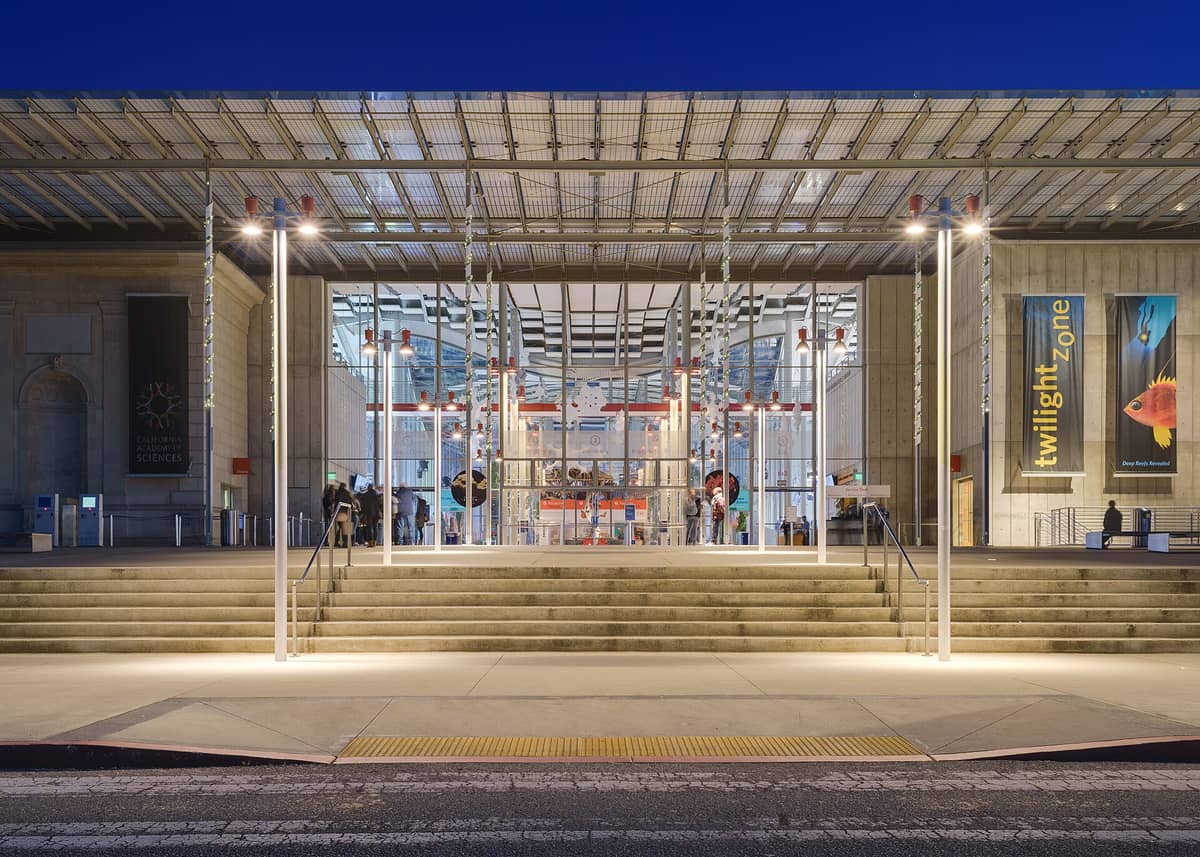
What the California Academy of Sciences Actually Is
The California Academy of Sciences is not a single attraction but four experiences stacked and spread across one building: a tropical rainforest dome, a coral reef aquarium, a digital planetarium, and a natural history museum with over 46 million specimens in its research collections. Most visitors only interact with the public galleries, but the scale of what sits beneath the surface, scientifically speaking, is genuinely unusual. This is a working research institution, not just a public exhibition space.
The Academy was founded on April 4, 1853, making it one of the oldest scientific institutions in the western United States. It was originally called the California Academy of Natural Sciences and renamed to its current form in 1868. The current building in Golden Gate Park reopened to the public on September 27, 2008 after a complete reconstruction, designed by Italian architect Renzo Piano. The older buildings on the site were demolished or deemed unsuitable after the 1989 Loma Prieta earthquake caused significant structural damage.
💡 Local tip
Book tickets in advance on the official website. The Academy uses dated ticketing with dynamic pricing, meaning the same visit will cost more on a rainy Saturday in summer than on a Tuesday in March. Early-morning slots on weekdays are consistently the cheapest and the quietest.
The Building Itself: Renzo Piano's Living Roof
Before you even pay admission, the exterior of the building tells you something. The Academy's roof is covered with 2.5 acres of native California plants, planted across a surface that rises and falls in gentle hills, two of which correspond to the domes of the rainforest and planetarium below. From the Music Concourse plaza, the roof looks almost like a continuation of the park itself, which was Piano's explicit intention. The building received LEED Platinum certification when it opened.
The glass canopy along the perimeter lets in natural light and allows the interior temperature to be regulated partially through passive ventilation, with operable skylights that open automatically. On a clear day, the interplay of natural light through the atrium canopy is genuinely striking. On overcast days, which are common in San Francisco from June through August, the interior feels more evenly lit but loses some of its depth.
If you're interested in how this building fits into the broader story of San Francisco's architectural history, the San Francisco architecture guide covers other notable structures around the city worth pairing with a visit here.
Tickets & tours
Hand-picked options from our booking partner. Prices are indicative; availability and final rates are confirmed when you complete your booking.
Explore California Academy of Sciences entrance tickets
From 42 €Instant confirmationFree cancellationMuir Woods to California's Coastal Redwoods tour
From 73 €Instant confirmationFree cancellationSonoma and Napa Valley wine tour from San Francisco
From 127 €Instant confirmationFree cancellationGo City | San Francisco Explorer Pass
From 76 €Instant confirmationFree cancellation
The Four Main Exhibits: What to Expect Inside
Osher Rainforest
The centerpiece of the building is the Osher Rainforest, a four-story glass dome that is 90 feet in diameter and houses live plants, insects, birds, reptiles, and butterflies from tropical ecosystems. Visitors walk a spiraling path from ground level through successive canopy layers. The humidity hits you immediately when you enter, a sharp contrast from the typically cool, dry air of a San Francisco morning. The dome is warm and close, with the sound of water, the smell of damp soil and leaves, and the occasional flash of a free-roaming butterfly at eye level.
An elevator descends from the base of the dome into an underground aquatic exhibit beneath the rainforest, showing the freshwater ecosystem that feeds from the forest floor. It is easy to miss this lower level if you are not paying attention to the signage, and many visitors do skip it.
Philippine Coral Reef Aquarium
The aquarium occupies the lower level of the building and is anchored by the Philippine Coral Reef tank, which holds approximately 212,000 gallons of water and is one of the largest living coral reef displays in the world. The tank curves around a central area, and visitors can view it from multiple angles and depths. Sharks, rays, and thousands of reef fish move through the water in a display that has real mass to it. It does not feel like a hotel lobby aquarium.
The touch tide pool nearby lets younger visitors handle sea stars and urchins under staff supervision. The lower level also houses the swamp exhibit, which has albino alligators that photograph well under the low, amber lighting used in that section.
Morrison Planetarium
The Morrison Planetarium uses a digital projection system to display full-dome shows on a 75-foot-diameter tilted screen. Shows run throughout the day on a published schedule and cover topics ranging from astronomy to Earth science. The seats recline and the shows last roughly 25 minutes. Separate evening programs operate on select nights. The planetarium is dark, enclosed, and loud during shows, which is worth knowing if you are visiting with young children who may find the experience disorienting.
ℹ️ Good to know
Planetarium shows are included with general admission but operate on a separate timed schedule. Check the daily show listing at the front desk or the Academy's app when you arrive, so you can plan the rest of your visit around the show time that suits you.
Natural History Exhibits and Research Collections
The natural history galleries rotate and cover topics including African safari ecosystems, penguin feeding exhibits, and the geology of California. The Kimball Natural History Museum section displays specimens and dioramas in the tradition of classic natural history museums, but with updated interpretive framing. The depth of the research collection, more than 46 million specimens, is not visible to the public but is referenced throughout the building as context for what you are seeing.
How the Experience Changes by Time of Day
Weekday mornings between opening at 9:30 am and around 11:00 am are the quietest window. School groups typically arrive mid-morning and fill the rainforest and aquarium by 10:30 to 11:00 am, especially on weekdays during the school year. If you arrive at opening, you can move through the rainforest dome and the coral reef tank before the noise and crowd levels build substantially.
Weekend afternoons, particularly between noon and 3:00 pm, are the busiest. The building's acoustics amplify crowd noise in the central atrium and around the touch pool. If a weekend is your only option, arriving right at the 11:00 am Sunday opening (or at the 9:30 am opening on Saturday) or purchasing the earliest available morning slot will improve the experience considerably.
Thursday evenings are a different category entirely. The Academy operates an adults-only evening program called NightLife, running from 6:00 pm to 10:00 pm, with a rotating weekly theme, cash bars, and live entertainment. The exhibits remain open during NightLife. Entry to NightLife is restricted to guests 21 and older with valid ID. It has a genuinely different atmosphere than a daytime visit, social rather than educational in tone, though the exhibits are the same.
⚠️ What to skip
The building is closed on select holidays, including Thanksgiving and Christmas. Hours are also subject to seasonal adjustment. Always verify current opening times on the official website before your visit, particularly around Thanksgiving, Christmas, and New Year's.
Getting There and Practical Logistics
The Academy sits at 55 Music Concourse Drive, inside Golden Gate Park, directly across the Music Concourse plaza from the de Young Museum. The two buildings face each other across a formal esplanade lined with plane trees, which makes it straightforward to combine both in one day if you have the stamina.
The Muni N Judah light rail line stops at 9th Avenue and Irving, from which the Music Concourse is a roughly 10-minute walk north through the park. Several Muni bus lines also stop nearby. Driving is possible but parking inside Golden Gate Park is metered and fills quickly on weekends. For a broader overview of navigating the park, the Golden Gate Park guide covers transit and parking in detail.
The Academy is fully accessible. The 2008 building was designed with step-free access to all principal exhibition areas, and elevators serve each level including the underground aquarium. For specific accessibility requirements, the visitor services line at +1 415-379-8000 is available daily.
Photography with a standard camera or phone is permitted throughout the general exhibition areas. The rainforest dome offers the most photogenic opportunities, particularly near the butterfly feeding plants on the upper walkway levels, though the lighting under the canopy requires patience or a camera that handles low-light conditions well. The albino alligator exhibit in the swamp section photographs better earlier in the day before the lighting shifts.
What the Academy Does Well, and Where It Falls Short
For families with children between roughly 5 and 14, the Academy is one of the strongest options in San Francisco. The combination of live animals, hands-on exhibits, and the planetarium means there is something engaging at almost every attention span. The building is also genuinely pleasant to be inside regardless of the weather outside, which matters in a city where June and July can be cold and foggy.
Adult visitors without children will also find real substance here, particularly in the aquarium and rainforest sections, but the experience is calibrated for family audiences. If your primary interest is fine art or cultural history rather than natural science, the de Young Museum directly across the plaza operates in an entirely different register and may be a better use of your afternoon.
The ticket price is one of the higher single-attraction admissions in San Francisco, and the value calculation depends heavily on how much time you actually spend inside. A 90-minute pass-through of the highlights will leave most visitors feeling it was expensive. A full three to four hour visit that includes a planetarium show and time in both the aquarium and rainforest justifies the cost more clearly. On the other hand, visitors looking to keep costs down should know that San Francisco residents and members of certain cultural institutions can access the Academy at reduced or no cost on specific days.
For travelers managing a tight budget, the free things to do in San Francisco guide includes options within and around Golden Gate Park that do not require paid admission.
Insider Tips
- The café on the main floor serves food that is genuinely above average for a museum cafeteria, but seating fills quickly between noon and 1:30 pm. Either eat before 11:30 am or plan lunch for after 2:00 pm if you want a seat without a wait.
- The rooftop is accessible to visitors and offers a ground-level view of the living plant installation, plus sightlines across Golden Gate Park toward the Panhandle. It is rarely crowded and most visitors do not think to go up. Access is via elevator in the main atrium.
- If you are visiting with a child who is particularly interested in the planetarium, check the daily show schedule online before you arrive. The most popular shows sell out their in-room capacity by mid-morning on busy days, and the front-desk listing is first-come, first-served.
- The Academy participates in the Museums for All program, which provides significantly discounted admission for visitors presenting an EBT card. Check the official site for current program terms, as availability and benefits are subject to change.
- The Music Concourse between the Academy and the de Young Museum is a pleasant outdoor space with café tables that are noticeably warmer and more sheltered from wind than most of Golden Gate Park. It is a good spot to decompress between the two museums if the afternoon is clear.
Who Is California Academy of Sciences For?
- Families with children who want live animals, hands-on exhibits, and a planetarium in a single admission
- Rainy or foggy days when outdoor attractions in San Francisco lose their appeal
- Science and natural history enthusiasts with an interest in marine ecosystems or tropical biodiversity
- Adults looking for an evening social event with a science backdrop, via the Thursday NightLife program
- First-time visitors who want to combine the Academy with the de Young Museum in a single full-day visit to Golden Gate Park
Nearby Attractions
Other things to see while in Golden Gate Park:
- Conservatory of Flowers
Built in 1879, the Conservatory of Flowers is the oldest building in Golden Gate Park and one of the finest surviving Victorian wood-and-glass greenhouses in the United States. Five climate-controlled galleries shelter rare tropical plants, towering palms, and flesh-eating specimens that most visitors won't find anywhere else in San Francisco.
- de Young Museum
The M. H. de Young Memorial Museum is San Francisco's flagship fine art museum, set inside a striking copper-clad building by Herzog & de Meuron in the heart of Golden Gate Park. From American art to Oceanic textiles to world-class traveling exhibitions, the de Young rewards both a casual afternoon and a full-day deep dive.
- Dutch Windmill (Golden Gate Park)
Standing 75 feet tall at the northwest corner of Golden Gate Park, the Dutch Windmill is a piece of Victorian infrastructure that once pumped 30,000 gallons of water per hour to irrigate the park. Free to visit, open year-round with the exception of scheduled garden closures in May and October, and surrounded by seasonal tulip gardens, it rewards the curious traveler willing to venture to San Francisco's western edge.
- Japanese Tea Garden
The Japanese Tea Garden is the oldest public Japanese garden in the United States, a five-acre sanctuary of arched bridges, stone lanterns, and flowering cherry trees inside Golden Gate Park. Whether you arrive at opening on a quiet weekday or mid-afternoon on a sunny weekend, the experience shifts dramatically depending on when you go.