Conservatory of Flowers: Inside SF's Victorian Greenhouse Landmark
Built in 1879, the Conservatory of Flowers is the oldest building in Golden Gate Park and one of the finest surviving Victorian wood-and-glass greenhouses in the United States. Five climate-controlled galleries shelter rare tropical plants, towering palms, and flesh-eating specimens that most visitors won't find anywhere else in San Francisco.
Quick Facts
- Location
- 100 John F. Kennedy Drive, Golden Gate Park, San Francisco, CA 94118
- Getting There
- Muni buses serving Golden Gate Park; walk along JFK Drive to the eastern end of the park
- Time Needed
- 1 to 1.5 hours inside; add 30 min for the surrounding gardens
- Cost
- Paid admission with demand-responsive pricing for non-residents; free for SF residents and veterans with ID. Free for everyone the first Tuesday of each month. Verify current rates at gggp.org.
- Best for
- Plant lovers, architecture admirers, families, rainy-day sightseeing
- Official website
- gggp.org/conservatory-of-flowers
What the Conservatory of Flowers Actually Is
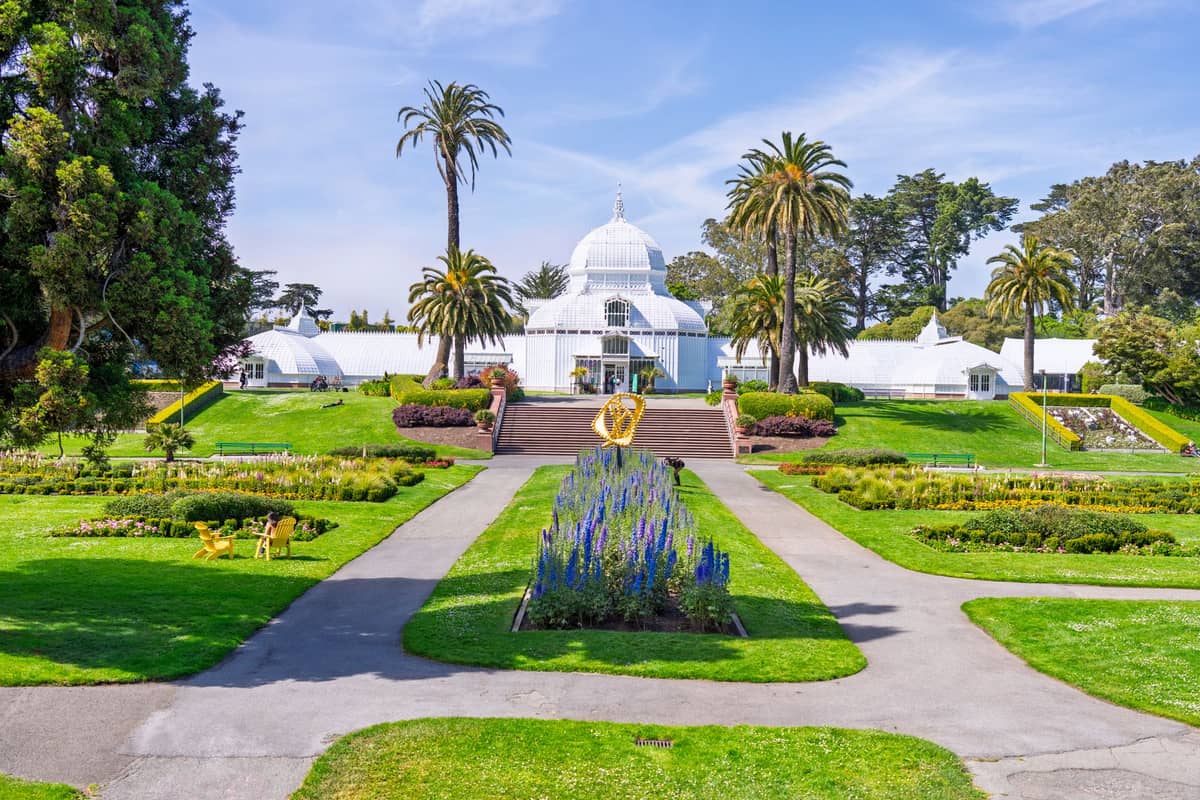
The Conservatory of Flowers is a working botanical greenhouse and public garden housed inside a wood-and-glass Victorian structure that opened in 1879, making it the oldest building in Golden Gate Park. The white-painted wood frame and domed central pavilion are modeled on the Palm House at Kew Gardens in London, and the building carries landmark designations at the city, state, and national levels. It is not a museum in the conventional sense. There are no audio guides, no artifact cases, no gift shop at every turn. What you get is five distinct gallery environments, each calibrated to a specific climate, holding plants that range from the spectacularly strange to the quietly beautiful.
The surrounding grounds are worth noting before you even buy a ticket. The parterre garden in front of the building is maintained with geometric flower beds that change seasonally, and the pale façade of the conservatory reflected in the morning light is one of the more photographed architectural images in San Francisco. The structure sits at the eastern end of the park, close enough to the de Young Museum and the California Academy of Sciences that a single day can cover all three.
ℹ️ Good to know
Hours: Thursday through Tuesday, 10:00 to 16:30; last entry at 16:00. Closed Wednesdays and select holidays. An annual maintenance closure may occur in winter, so check the official calendar before visiting.
Inside the Five Galleries: What You Will Actually See
The Lowlands gallery is the first major room most visitors enter and the one that delivers the biggest sensory shift. The humidity rises sharply the moment the door closes behind you. The air smells of wet soil, decomposing organic matter, and something faintly sweet from the flowering epiphytes overhead. Towering tropical specimens fill the central space, and the roof's wooden ribs curve above in a way that feels more like the hull of a ship than a greenhouse. Light filters through the glass panels and scatters green-tinted shadows across the path.
The Aquatic Plants gallery is where the building surprises most visitors. The room centers on a large lily pond containing Victoria amazonica, the giant Amazonian water lily whose circular pads can exceed six feet in diameter. Smaller aquatic species surround the main pond, and the reflections on the water surface make this one of the most photogenic spots inside the building. Bring a wide lens if you shoot with a camera; the room is not large, and getting a full pad in frame requires some maneuvering.
The Highland Tropics gallery shifts the atmosphere noticeably. The temperature drops a few degrees compared to the Lowlands, and the collection here focuses on orchids, bromeliads, and other epiphytes from montane environments. The Carnivorous Plants gallery is reliably the most popular stop with children and adults equally, housing pitcher plants, sundews, and Venus flytraps behind low barriers. The scale of some specimens, particularly the hanging Nepenthes pitcher plants, is genuinely startling if you have only encountered these plants in photographs.
The Potted Plants gallery at the back of the building is the most understated section. Rotating displays of tropicals and seasonal specimens line the benches, and this is where you are most likely to find staff tending plants, which makes it the best spot to ask specific questions if you want them answered by someone with actual horticultural knowledge.
Tickets & tours
Hand-picked options from our booking partner. Prices are indicative; availability and final rates are confirmed when you complete your booking.
Sonoma and Napa Valley wine tour from San Francisco
From 127 €Instant confirmationFree cancellationGo City | San Francisco Explorer Pass
From 76 €Instant confirmationFree cancellationMuir Woods and Sausalito guided tour with transportation
From 82 €Instant confirmationFree cancellationSan Francisco CityPASS
From 77 €Instant confirmationFree cancellation
Architecture and History: Why the Building Itself Matters
The Conservatory of Flowers was constructed starting in 1878 from a kit of prefabricated wood and glass components originally ordered by California entrepreneur James Lick. After Lick's death, the components were donated to the city of San Francisco and assembled in what was then the newly established Golden Gate Park. The structure opened in 1879, predating much of the park development that now surrounds it.
The building has survived two major crises. A 1918 storm caused significant structural damage, and a far more severe storm in December 1995 destroyed much of the west wing and sent glass panels across the lawn. The conservatory was closed for eight years while a restoration project raised roughly $25 million to rebuild the structure using traditional materials and period-accurate techniques. It reopened in 2003. For more context on how Victorian architecture shaped San Francisco's parks and civic buildings, the San Francisco architecture guide covers the broader landscape.
The exterior is best appreciated from a distance. Stand at the base of the parterre garden and look back toward JFK Drive, then look up at the central dome and the flanking wings. The white-painted wood ages and weathers constantly, and the maintenance team treats it as an ongoing preservation project rather than a static monument. Up close you can see where sections have been repaired, which adds to the texture of the building rather than detracting from it.
When to Go and How Conditions Change Through the Day
The conservatory opens at 10:00, and the first hour is reliably the quietest. Weekday mornings, particularly Tuesday through Thursday, see the lightest crowds. Weekend afternoons between noon and 14:00 are the busiest, when families with children and tour groups tend to move through simultaneously. The galleries are not large, and the Carnivorous Plants section in particular becomes congested when multiple groups arrive at once.
San Francisco's climate works in the conservatory's favor year-round. Because the galleries are climate-controlled, the experience inside is consistent regardless of the fog and wind outside. This makes the Conservatory of Flowers one of the more reliable rainy-day destinations in the city. On overcast mornings, the diffuse grey light filtering through the glass panels actually improves photography by eliminating harsh shadows. On bright sunny afternoons, the south-facing windows create strong contrast that can flatten subjects.
💡 Local tip
The first Tuesday of each month is free for all visitors. Expect higher attendance than a typical Tuesday, but still far more manageable than a weekend afternoon.
Autumn, specifically September and October, offers the most comfortable conditions for the surrounding gardens and the parterre. Those are also the warmest and clearest months in San Francisco meteorologically, which means the exterior of the building receives good light for much of the day. Summer visitors should bring a layer; the marine layer frequently keeps Golden Gate Park cool and damp even in July and August.
Getting There and Practical Logistics
The conservatory sits at 100 John F. Kennedy Drive, at the eastern entrance to Golden Gate Park. Several Muni bus lines stop near the park's Stanyan Street entrance, from which it is a short walk west along JFK Drive to the building. Verify current Muni routes and fares through SFMTA before your visit, as schedules change. If you are combining the conservatory with the de Young Museum or the California Academy of Sciences, both are within comfortable walking distance to the west along the Music Concourse.
Parking is available in the park but can be limited on weekends. If you are visiting as part of a longer park day, the Golden Gate Park guide has a full breakdown of how to navigate the park on foot, by bike, and by transit.
Non-resident admission uses demand-responsive pricing that changes by date, so check gggp.org for the current adult, senior, youth, and child rates before you go. San Francisco residents and veterans with ID receive free general admission, and everyone gets free entry on the first Tuesday of each month. The building is a historic landmark, which limits some structural modifications. Visitors with specific accessibility requirements are advised to contact the conservatory directly before arrival.
⚠️ What to skip
The conservatory is closed every Wednesday and may observe periodic maintenance closures, sometimes including a multi-week closure in winter. Always check the official calendar at gggp.org before planning a winter visit.
What the Conservatory Does Not Do Well
The conservatory is a small building with a focused collection. If you are expecting the scale of a major botanical garden with acres of outdoor displays, you will find it compact. The entire interior can be walked in under 45 minutes at a relaxed pace. On busy weekend afternoons, the combination of heat, humidity, and crowd density inside the Lowlands gallery can be genuinely uncomfortable, particularly for young children and older visitors.
The botanical labels inside the galleries are informative but not exhaustive. This is not an institution built around interpretive programming or deep educational signage. If you want guided context, check the conservatory's website for scheduled docent tours before your visit, as availability is not guaranteed. Travelers whose primary interest is contemporary art or street-level city culture will find more to engage with elsewhere in the park and beyond.
Combining Your Visit with Golden Gate Park
The conservatory works well as an anchor for a full day in Golden Gate Park. The de Young Museum is a ten-minute walk to the southwest, and the California Academy of Sciences sits directly across the Music Concourse from it. For a longer morning in the park, the Japanese Tea Garden is immediately adjacent to the de Young and offers a quieter, slower counterpoint to the indoor botanical experience.
If you are building a broader San Francisco itinerary around parks and outdoor spaces, the free things to do in San Francisco guide includes several Golden Gate Park options that pair naturally with a conservatory visit, including the park's outdoor gardens and viewpoints.
Insider Tips
- Arrive at 10:00 on a weekday and go directly to the Aquatic Plants gallery. The light is best in the morning and the room is usually empty for the first 20 minutes of the day.
- The carnivorous plants gallery is the most crowded section. If you want photographs without strangers in the frame, move through it quickly on arrival and come back near closing when most visitors have left.
- The parterre garden in front of the building is free to walk through at any time, no ticket required. It is one of the more consistently maintained flower gardens in the city and worth a few minutes on its own.
- Check the conservatory's events calendar before visiting. Occasional evening events and seasonal exhibitions change the lighting conditions inside dramatically and offer a different version of the building than the daytime visit.
- If you are traveling with children, the carnivorous plants gallery is the obvious highlight, but the Aquatic Plants room tends to hold their attention longer once they realize how large the lily pads actually are.
Who Is Conservatory of Flowers For?
- Travelers interested in botany, horticulture, or Victorian architecture who want more than a surface-level look
- Families with children aged 5 and up, especially those curious about unusual or exotic plants
- Photographers looking for controlled natural light and unusual subjects
- Visitors planning a full day in Golden Gate Park who want an indoor component regardless of weather
- Couples or solo travelers who want a quiet, unhurried experience on a weekday morning
Nearby Attractions
Other things to see while in Golden Gate Park:
- California Academy of Sciences
The California Academy of Sciences packs a four-story rainforest, a deep-sea aquarium, and a planetarium under a single grass-covered roof in Golden Gate Park. Founded in 1853 and rebuilt in 2008, it is one of the largest natural history museums in the western United States, and one of the few places in San Francisco where you can spend half a day without running out of things to look at.
- de Young Museum
The M. H. de Young Memorial Museum is San Francisco's flagship fine art museum, set inside a striking copper-clad building by Herzog & de Meuron in the heart of Golden Gate Park. From American art to Oceanic textiles to world-class traveling exhibitions, the de Young rewards both a casual afternoon and a full-day deep dive.
- Dutch Windmill (Golden Gate Park)
Standing 75 feet tall at the northwest corner of Golden Gate Park, the Dutch Windmill is a piece of Victorian infrastructure that once pumped 30,000 gallons of water per hour to irrigate the park. Free to visit, open year-round with the exception of scheduled garden closures in May and October, and surrounded by seasonal tulip gardens, it rewards the curious traveler willing to venture to San Francisco's western edge.
- Japanese Tea Garden
The Japanese Tea Garden is the oldest public Japanese garden in the United States, a five-acre sanctuary of arched bridges, stone lanterns, and flowering cherry trees inside Golden Gate Park. Whether you arrive at opening on a quiet weekday or mid-afternoon on a sunny weekend, the experience shifts dramatically depending on when you go.