Japanese Tea Garden: Golden Gate Park's Historic Living Landscape
The Japanese Tea Garden is the oldest public Japanese garden in the United States, a five-acre sanctuary of arched bridges, stone lanterns, and flowering cherry trees inside Golden Gate Park. Whether you arrive at opening on a quiet weekday or mid-afternoon on a sunny weekend, the experience shifts dramatically depending on when you go.
Quick Facts
- Location
- 75 Hagiwara Tea Garden Drive, Golden Gate Park, San Francisco, CA 94118
- Getting There
- Muni bus lines and the free Golden Gate Park Shuttle to the Music Concourse; near the de Young Museum and California Academy of Sciences
- Time Needed
- 1 to 2 hours
- Cost
- Non-resident adults typically $12–$16 (varies by season/day; confirm at gggp.org); Seniors/Youth (12–17) $7; Children (5–11) $3; Under 5 free; SF residents free with ID; Free Mon/Wed/Fri 9–10 a.m.
- Best for
- History, photography, quiet reflection, families, Japan enthusiasts
- Official website
- gggp.org/japanese-tea-garden
What the Japanese Tea Garden Actually Is
The Japanese Tea Garden is a five-acre traditional Japanese garden within Golden Gate Park, widely recognized as the oldest public Japanese garden in the United States. It is not a replica or a theme-park interpretation. The garden grew out of a real 19th-century cultural exchange, and some of its features date to the original 1894 exposition or were later added under the care of the Hagiwara family, who tended the garden for decades in the early 20th century.
The garden is operated by Gardens of Golden Gate Park with the San Francisco Recreation and Park Department. It sits on the Music Concourse, directly adjacent to the de Young Museum and the California Academy of Sciences, which means you can reasonably combine all three in a single day. The entrance on Hagiwara Tea Garden Drive is clearly signposted from the concourse.
💡 Local tip
Free entry is available Monday, Wednesday, and Friday from 9:00 to 10:00 a.m. Arrive right at 9 a.m. for the lowest crowds of the week regardless of whether you pay or use the free hour.
A Short History That Actually Matters Here
The garden originated as the Japanese Village exhibit at the California Midwinter International Exposition of 1894, a world's fair held inside Golden Gate Park. After the exposition closed, Japanese landscape designer Makoto Hagiwara persuaded park authorities to preserve the Japanese village as a permanent garden. The Hagiwara family maintained and expanded it for the next several decades, living on-site and are often credited with introducing the fortune cookie to American audiences through the garden's tea house, though that claim remains contested.
During World War II, the Hagiwara family, along with over 110,000 Japanese Americans on the West Coast, was forcibly removed and incarcerated under Executive Order 9066. The garden was renamed the 'Oriental Tea Garden' during the war years. The family never returned. On April 7, 1953, the name Japanese Tea Garden was legally restored, and on October 15, 2004, the garden was listed on the National Register of Historic Places. That designation recognizes the garden's historic significance and supports preservation of its cultural heritage.
The Hagiwara story is worth reading before you go, not after. It reframes what might otherwise look like a decorative park feature into something more complicated and more interesting. If you want to understand the neighborhood context, the Golden Gate Park guide covers the broader history of the park and its cultural institutions.
Tickets & tours
Hand-picked options from our booking partner. Prices are indicative; availability and final rates are confirmed when you complete your booking.
Boba tea train experience in Sacramento
From 50 €Instant confirmationFree cancellationSonoma and Napa Valley wine tour from San Francisco
From 127 €Instant confirmationFree cancellationGo City | San Francisco Explorer Pass
From 76 €Instant confirmationFree cancellationMuir Woods and Sausalito guided tour with transportation
From 82 €Instant confirmationFree cancellation
What You Actually See Inside
The layout follows traditional Japanese garden principles: asymmetry, borrowed scenery, and a deliberate sequence of views that unfold as you move. The path from the entrance leads you past stone lanterns and a bronze Buddha (Amazarashi-No-Hotoke), cast in Japan in 1790 and later donated to the garden.
The drum bridge, also called the moon bridge, is the garden's most photographed feature. Its steep wooden arch reflects almost perfectly in the pond below when the water is still, typically in the morning before foot traffic disturbs the surface. The koi pond stretches beneath it, well-stocked with orange and white fish that surface near the edges where visitors lean. Nearby, a wisteria-draped pergola frames one of the quieter sitting areas in the garden.
The tea house operates inside the garden and serves hot tea and light snacks. The seating is open-air and overlooks part of the pond. It functions as both a rest stop and a genuinely pleasant place to sit for twenty minutes, and given that Golden Gate Park offers few places to buy food without leaving it, stopping here is practical as well as atmospheric.
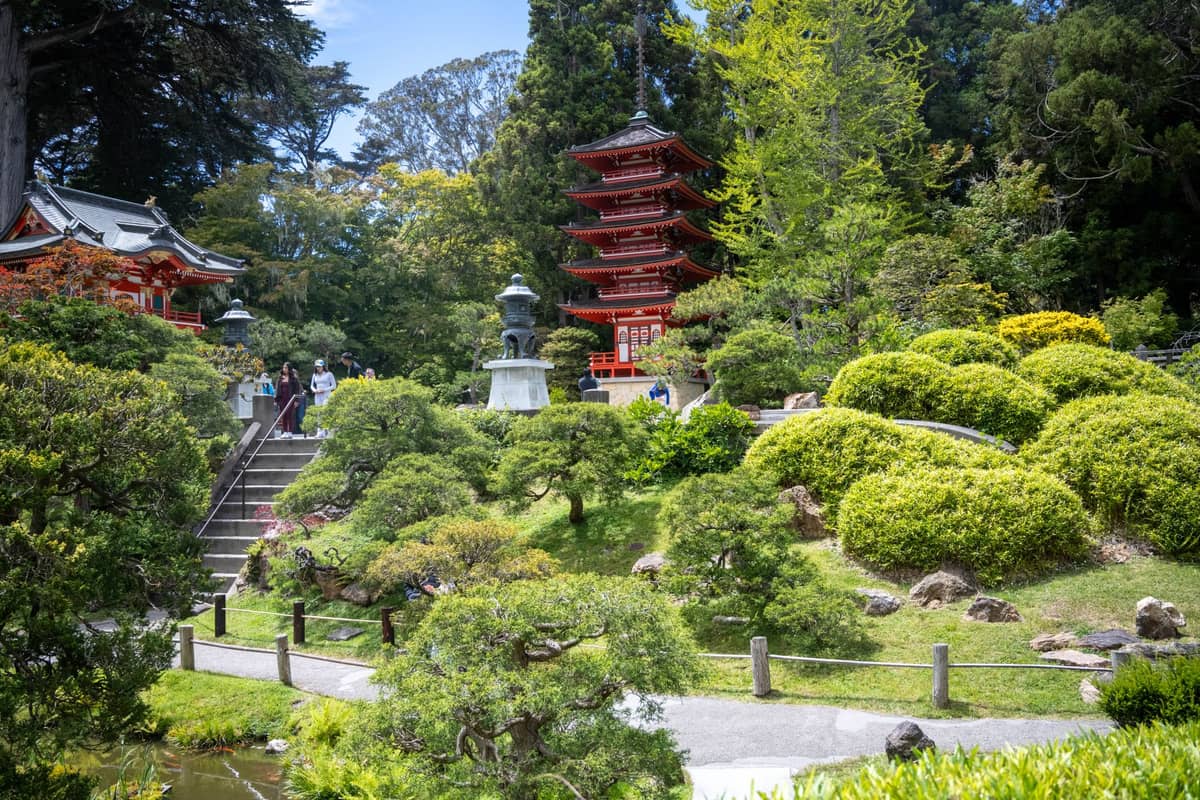
The pagoda near the center of the garden is a decorative structure. It is decorative rather than functional, but it anchors the garden visually and provides a vertical reference point from most paths. Spring cherry blossoms typically peak around the pagoda in late March to early April, when the garden reaches its most dramatic color, and also its highest visitor numbers.
How the Experience Changes by Time of Day
At 9:00 a.m. on a weekday, the garden is close to silent. The gravel paths have often been freshly raked, the pond reflects the trees without distortion, and the only sounds are birdsong and the faint hum of the city beyond the park's canopy. This is when the garden most resembles the experience it is designed to create.
By 11:00 a.m. on a weekend, school groups and tour parties begin arriving in numbers. The paths around the drum bridge become congested, and the tea house queue builds. This is not a reason to avoid the garden; the space is large enough to absorb moderate crowds without feeling overwhelmed. But if you want photographs without strangers in frame, you need to be there early.
Afternoon light in the garden is softer and falls at a low angle through the tree canopy in autumn, which produces some of the best natural photography conditions of the year. September and October are meteorologically the warmest and clearest months in San Francisco, with less of the summer marine fog that can flatten light and chill the air. If the garden is on your list but you have flexibility on dates, those months offer the most comfortable outdoor conditions.
⚠️ What to skip
Summer in San Francisco (June through August) is frequently foggy and cool, with temperatures often staying below 65°F (18°C). Bring a layer regardless of what the forecast says the night before.
Getting There and Practical Logistics
The garden is located at 75 Hagiwara Tea Garden Drive, positioned on the Music Concourse in the eastern section of Golden Gate Park. Muni bus lines serve Golden Gate Park from multiple directions; the area around 9th Avenue and Irving Street is a practical stop for visitors approaching from the Sunset District or downtown. Confirm current routes and schedules with SFMTA before your visit, as service patterns change.
Driving to the garden means competing for limited street parking in and around the park. Weekday mornings before 10:00 a.m. tend to be the most manageable for parking. On weekends, allow extra time or plan to use transit. The de Young Museum parking garage on Concourse Drive is a paid option nearby when street parking is unavailable.
Tickets are purchased through the San Francisco Recreation and Park Department. Opening hours run daily from 9:00 a.m., with last entry at 5:30 p.m. from March through October and 4:30 p.m. from November through February. If you are building a full day in the park around the garden, the de Young Museum and the California Academy of Sciences are directly adjacent and share the Music Concourse plaza.
Accessibility: The garden's traditional design includes steep bridges, uneven stone paths, and steps that are not universally accessible. Some areas of the garden can be navigated with mobility aids, but the drum bridge and certain terraced sections cannot. Visitors with specific accessibility needs should contact the Japanese Tea Garden directly before visiting to get current information on which areas are accessible.
Photography, What to Wear, and Small Practical Details
The garden is compact enough that a single lens covers most compositions, but a moderate telephoto helps isolate the drum bridge reflection and the pagoda against the tree line. The best light for the pond is in the morning, when the sun is low and the water surface is undisturbed. The wisteria pergola photographs well in late spring. The maple trees along the interior paths turn deep orange and red in November, which is often overlooked by visitors who associate the garden primarily with spring cherry blossoms.
Wear comfortable walking shoes with grip. The stone paths are uneven and can be slippery after rain. San Francisco's weather is unpredictable at any time of year, so a packable jacket takes up minimal bag space and eliminates the most common visitor complaint about the city.
If you are new to San Francisco and trying to build a logical route through the city, the first-time visitor guide covers how to structure your time across neighborhoods, including the Golden Gate Park cluster.
Who Might Not Enjoy This
Visitors who expect a large-scale botanical garden with extensive plant labeling will find the Japanese Tea Garden smaller and less encyclopedic than they might hope. At five acres, it is an intimate space, and the experience is more atmospheric than educational in a botanical sense. There is no audio guide included with admission, though interpretive signs appear at key points.
The garden is not ideal for visitors with significant mobility limitations, as noted above. And at peak weekend hours, it can feel crowded relative to its size, which undermines the contemplative quality that is its main appeal. If crowds genuinely bother you, the Monday/Wednesday/Friday free hour at 9:00 a.m. is the most effective solution.
Insider Tips
- The free entry window (Monday, Wednesday, Friday, 9:00–10:00 a.m.) is not widely advertised to casual visitors. Even if you do not need the cost saving, the first hour is when the garden is at its quietest and the paths are freshest.
- The drum bridge reflection is best photographed from the south side of the pond at low sun angles. Crouch slightly to align the bridge arch with its mirror image in the water before other visitors crowd the banks.
- Autumn foliage in the Japanese Tea Garden rivals the spring cherry blossoms in visual quality and is significantly less crowded. The Japanese maples peak in November, often after most visitors have mentally moved on from the garden for the year.
- The tea house inside the garden is run separately from the garden's ticketing operation. You reach it after entering the garden, so plan tea as part of a paid (or free-hour) visit rather than a separate stop.
- Combine your visit with the de Young Museum on the same day. The de Young's observation tower provides an unusual elevated perspective over the park's tree canopy, including the area around the garden.
Who Is Japanese Tea Garden For?
- Photographers seeking reflection shots, blossom backdrops, and autumn foliage
- Travelers interested in Japanese American history and the Hagiwara family story
- Families with children who can manage a one to two hour walk on varied terrain
- Visitors looking for a quiet midweek morning experience away from the waterfront crowds
- Anyone building a full Golden Gate Park day around the Music Concourse cluster
Nearby Attractions
Other things to see while in Golden Gate Park:
- California Academy of Sciences
The California Academy of Sciences packs a four-story rainforest, a deep-sea aquarium, and a planetarium under a single grass-covered roof in Golden Gate Park. Founded in 1853 and rebuilt in 2008, it is one of the largest natural history museums in the western United States, and one of the few places in San Francisco where you can spend half a day without running out of things to look at.
- Conservatory of Flowers
Built in 1879, the Conservatory of Flowers is the oldest building in Golden Gate Park and one of the finest surviving Victorian wood-and-glass greenhouses in the United States. Five climate-controlled galleries shelter rare tropical plants, towering palms, and flesh-eating specimens that most visitors won't find anywhere else in San Francisco.
- de Young Museum
The M. H. de Young Memorial Museum is San Francisco's flagship fine art museum, set inside a striking copper-clad building by Herzog & de Meuron in the heart of Golden Gate Park. From American art to Oceanic textiles to world-class traveling exhibitions, the de Young rewards both a casual afternoon and a full-day deep dive.
- Dutch Windmill (Golden Gate Park)
Standing 75 feet tall at the northwest corner of Golden Gate Park, the Dutch Windmill is a piece of Victorian infrastructure that once pumped 30,000 gallons of water per hour to irrigate the park. Free to visit, open year-round with the exception of scheduled garden closures in May and October, and surrounded by seasonal tulip gardens, it rewards the curious traveler willing to venture to San Francisco's western edge.