Dutch Windmill: Golden Gate Park's Forgotten Engineering Marvel
Standing 75 feet tall at the northwest corner of Golden Gate Park, the Dutch Windmill is a piece of Victorian infrastructure that once pumped 30,000 gallons of water per hour to irrigate the park. Free to visit, open year-round with the exception of scheduled garden closures in May and October, and surrounded by seasonal tulip gardens, it rewards the curious traveler willing to venture to San Francisco's western edge.
Quick Facts
- Location
- Northwest corner of Golden Gate Park, near 47th Avenue and Great Highway, San Francisco, CA
- Getting There
- Muni bus lines serve the western edge of Golden Gate Park; check SFMTA for current routes to the park's Great Highway entrance
- Time Needed
- 20–45 minutes to explore the windmill and Queen Wilhelmina Garden
- Cost
- Free. No ticket required. The interior is not open to visitors.
- Best for
- Photography, history enthusiasts, garden walks, and park wanderers
- Official website
- sfrecpark.org/908/Golden-Gate-Park---Queen-Wilhelmina-Gard
What You're Actually Looking At
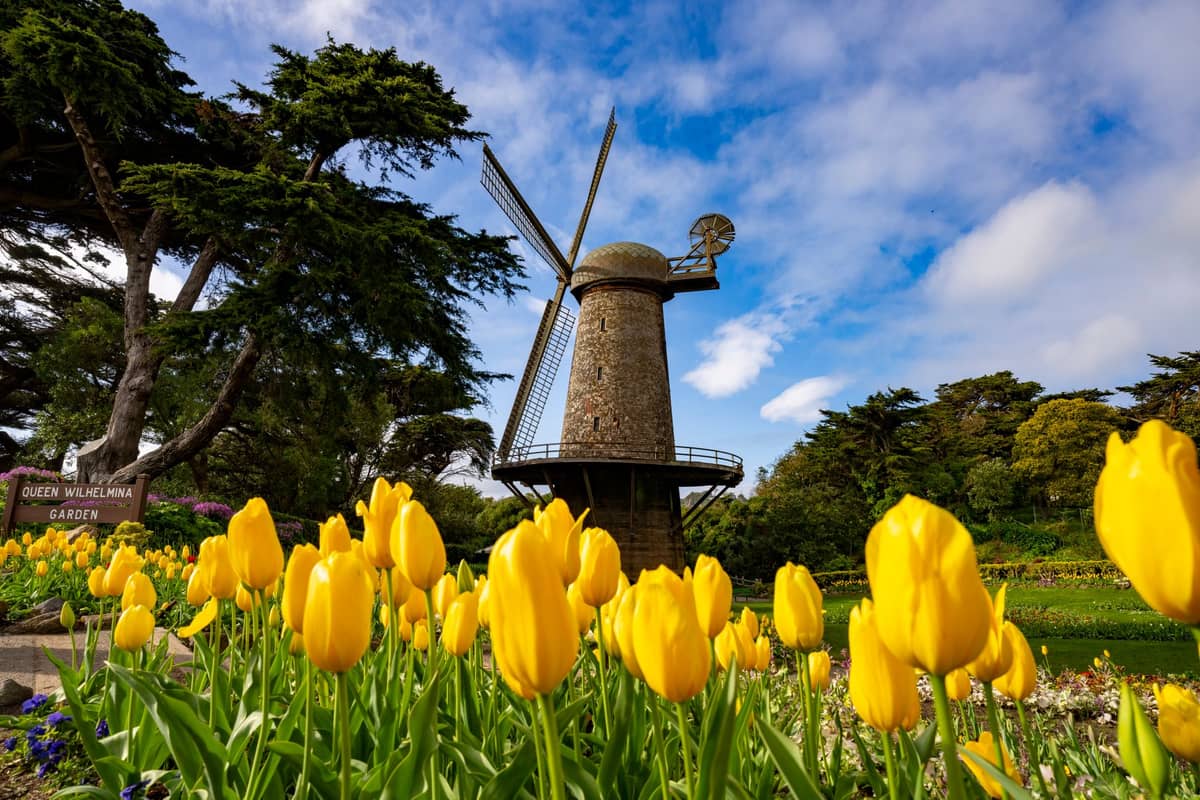
The Dutch Windmill, also known as the North Windmill, rises 75 feet above the sand dunes at the far western end of Golden Gate Park. Its four spar arms stretch 102 feet tip to tip, making it impossible to miss when you round the corner from JFK Drive onto the Great Highway. The structure is built in the style of a traditional Dutch smock mill, with a tapered brick base and a rotating cap, and it looks genuinely out of place in the California fog in the best possible way.
Most visitors who find it are surprised by the scale. Photographs consistently underplay how large it is. Standing at the base and looking up at the wooden spar arms, you start to understand why it was considered an engineering achievement when it was completed. This is not a decorative folly. It was constructed between 1902 and 1903 and was operational by 1903 with a specific, practical job: pumping groundwater up to 30,000 gallons per hour to irrigate the park's vast acreage at a time when the city's water supply could not support it.
ℹ️ Good to know
The Dutch Windmill is officially associated with the Queen Wilhelmina Garden, which surrounds its base. The garden is named after Queen Wilhelmina of the Netherlands and reflects the windmill's Dutch heritage.
The History Behind the Structure
Golden Gate Park was carved out of the Great Sand Waste, a stretch of largely barren coastal dunes that most engineers in the 1870s considered unsuitable for a public park. The park's first superintendent, William Hammond Hall, and later John McLaren, spent decades turning this unpromising terrain into 1,017 acres of engineered landscape. By the early 1900s, maintaining the park's irrigation needs had outpaced the available water supply infrastructure.
The Dutch Windmill was one solution. Funded in part by donations from the Netherlands consul in San Francisco and built to specifications that matched the working windmills of northern Europe, it tapped into the groundwater beneath the dunes to keep the park green. A second windmill, the Murphy Windmill, was added at the park's southwest corner around 1905–1907 to meet growing demand. Together, they ran for years before electric pumps gradually rendered them obsolete in the early 20th century.
The Dutch Windmill fell into disrepair across the mid-twentieth century, with restoration efforts bringing it back to its current condition. Today it is a San Francisco landmark. If you want to understand the engineering ambition that shaped Golden Gate Park as a whole, this windmill is one of the clearest surviving examples of that era's problem-solving.
Tickets & tours
Hand-picked options from our booking partner. Prices are indicative; availability and final rates are confirmed when you complete your booking.
Sonoma and Napa Valley wine tour from San Francisco
From 127 €Instant confirmationFree cancellationGo City | San Francisco Explorer Pass
From 76 €Instant confirmationFree cancellationMuir Woods and Sausalito guided tour with transportation
From 82 €Instant confirmationFree cancellationSan Francisco CityPASS
From 77 €Instant confirmationFree cancellation
The Experience at Different Times of Day
Early morning is the best time to visit, and by a significant margin. The western end of Golden Gate Park sits directly in the path of the marine layer that rolls in off the Pacific, and on most mornings from June through August, the windmill stands in a cool, damp fog that softens its outlines and mutes the sound of nearby traffic. At 7 or 8 a.m., you may have the garden entirely to yourself. The smell at this hour is a mix of wet soil, salt air from the ocean one block west, and the faint sweetness of whatever is blooming in the Queen Wilhelmina Garden.
By midday on weekends, the area draws a moderate number of visitors, cyclists cutting through on the park's paths, and joggers looping from the Panhandle all the way to the ocean. It never gets as crowded as the park's central areas near the de Young or the Conservatory. The windmill grounds feel removed from the main tourist circuit, which is part of their appeal.
Late afternoon in September and October can be spectacular. San Francisco's fog tends to pull back in autumn, and the low western sun catches the brick of the windmill's base and turns it a warm amber. The spar arms cast long shadows across the garden beds. This is the best window for photography if you want color and light rather than the atmospheric grey of a foggy morning.
⚠️ What to skip
Summer fog is not just a minor inconvenience here. From June through August, the windmill is frequently socked in by thick marine layer until late morning or early afternoon. If clear skies matter to your visit, September and October are the more reliable months. Check a local weather forecast before making a special trip.
The Queen Wilhelmina Tulip Garden
The garden surrounding the Dutch Windmill is planted with tulip bulbs each year, and the bloom period in late winter to early spring, typically peaking around March and April, draws visitors who might otherwise skip this corner of the park entirely. Hundreds of tulips in reds, yellows, and deep purples fill the beds around the windmill's base, creating a scene that looks improbable given the Pacific Ocean surf you can hear a block away.
Outside of tulip season, the garden is quieter and less showy, with ground cover plantings and shrubs that keep the space tidy but not dramatic. The windmill itself is worth seeing in any season, but if you're planning a visit around the flowers, aim for late March through April and check San Francisco Recreation and Parks for current bloom conditions, as timing shifts year to year.
Getting There and Getting Around
The Dutch Windmill sits at the far western edge of San Francisco, at roughly John F. Kennedy Drive and the Great Highway near the park's northwest corner. This is about as far from downtown as you can get while still being in the city. If you're coming by car, street parking is available along the Great Highway and surrounding blocks, though availability can be tight on sunny weekends. The park is free to enter.
By public transit, Muni bus routes serve the western neighborhoods and the park's outer reaches. Check the SFMTA website or app for current routes, as service patterns do change. If you're already in the park on a bike, the windmill is a natural endpoint for a west-to-east ride along JFK Drive. For context on navigating the city's transit network, the getting around San Francisco guide covers the full range of options including Muni, BART, and cycling.
From the windmill, Ocean Beach is less than a five-minute walk west through the park's western boundary. Many visitors combine the two stops, walking down to the shoreline after spending time at the garden. The beach here is cold, frequently windy, and not suitable for swimming, but the views and the sense of standing at the continent's edge are worthwhile.
Photography Notes and Practical Details
The windmill photographs best from the garden path that curves around its south and east sides, where you can include some of the garden beds in the foreground and get the full height of the structure. A wide-angle lens captures the scale. If you're shooting in fog, a polarizing filter helps cut through haze. The structure's brick and timber details reward close-up shots as well.
You cannot enter the windmill. The base is closed to the public. There are no facilities directly at the windmill itself, but restrooms are available at various points within Golden Gate Park. Wear layers: the western end of the park is exposed to ocean wind and typically several degrees cooler than the rest of the city.
If you're building a longer visit to the park, the windmill pairs well with a walk east along JFK Drive toward the San Francisco Botanical Garden or the Japanese Tea Garden. Both are well within cycling or walking distance. For a comprehensive overview of the park's many attractions, the Golden Gate Park guide is a useful planning resource.
Who Might Want to Skip This
If you have only one day in San Francisco and need to prioritize, the Dutch Windmill is a harder sell. It is far from the city's central attractions, the interior is inaccessible, and outside of tulip season the garden is pleasant but not spectacular. Travelers focused on the city's food scene, museums, or neighborhoods will likely find more per-hour value elsewhere.
It is also worth noting that this corner of the park is not the most convenient for visitors staying downtown or near Fisherman's Wharf. Getting here takes real transit time or a deliberate drive. For first-time visitors with tight schedules, the first-time visitor guide can help you assess whether the windmill fits your itinerary.
Insider Tips
- The Murphy Windmill, a second windmill that has also been restored, sits at the park's southwest corner about a mile south near Great Highway and Lincoln Way. If you've come all the way out here, it takes only a few extra minutes to see both structures and understand why the park needed two of them.
- Tulip bloom timing varies year to year depending on winter temperatures. San Francisco Recreation and Parks sometimes posts updates on the Queen Wilhelmina Garden bloom progress; checking before a dedicated spring visit can save a wasted trip.
- The Great Highway runs directly along the park's western boundary. Parking here is often easier to find than inside the park, and the short walk into the garden from the highway takes under two minutes.
- If you visit in summer fog, the windmill's silhouette in low visibility is genuinely atmospheric and makes for more interesting photographs than a flat blue-sky shot. Lean into the conditions rather than fighting them.
- Cyclists will find the area at the western terminus of JFK Drive quiet and uncrowded, especially on weekday mornings. The route from the park's eastern entrance at Stanyan Street to the windmill is mostly flat and one of the park's more scenic rides.
Who Is Dutch Windmill (Golden Gate Park) For?
- Architecture and engineering history enthusiasts interested in Victorian-era infrastructure
- Photographers seeking fog-shrouded, atmospheric scenes or spring tulip color
- Park cyclists wanting a natural endpoint at the ocean-facing edge of Golden Gate Park
- Visitors planning a combined windmill and Ocean Beach walk
- Families looking for a free, low-pressure outdoor stop that young children can appreciate without overstimulation
Nearby Attractions
Other things to see while in Golden Gate Park:
- California Academy of Sciences
The California Academy of Sciences packs a four-story rainforest, a deep-sea aquarium, and a planetarium under a single grass-covered roof in Golden Gate Park. Founded in 1853 and rebuilt in 2008, it is one of the largest natural history museums in the western United States, and one of the few places in San Francisco where you can spend half a day without running out of things to look at.
- Conservatory of Flowers
Built in 1879, the Conservatory of Flowers is the oldest building in Golden Gate Park and one of the finest surviving Victorian wood-and-glass greenhouses in the United States. Five climate-controlled galleries shelter rare tropical plants, towering palms, and flesh-eating specimens that most visitors won't find anywhere else in San Francisco.
- de Young Museum
The M. H. de Young Memorial Museum is San Francisco's flagship fine art museum, set inside a striking copper-clad building by Herzog & de Meuron in the heart of Golden Gate Park. From American art to Oceanic textiles to world-class traveling exhibitions, the de Young rewards both a casual afternoon and a full-day deep dive.
- Japanese Tea Garden
The Japanese Tea Garden is the oldest public Japanese garden in the United States, a five-acre sanctuary of arched bridges, stone lanterns, and flowering cherry trees inside Golden Gate Park. Whether you arrive at opening on a quiet weekday or mid-afternoon on a sunny weekend, the experience shifts dramatically depending on when you go.