San Francisco Botanical Garden: What to Expect Before You Go
The San Francisco Botanical Garden at Strybing Arboretum spreads across 55 acres inside Golden Gate Park, housing over 8,000 plant species from around the world. Open daily from 7:30am, it offers a surprisingly quiet escape from the city, with free entry during the early morning window and free admission for San Francisco residents year-round.
Quick Facts
- Location
- 1199 9th Avenue, Golden Gate Park, San Francisco, CA 94122 (main entrance near 9th Ave & Lincoln Way)
- Getting There
- Muni N-Judah (9th Ave & Irving stop, then walk); Muni bus line 44 also serves the park
- Time Needed
- 1.5 to 3 hours depending on pace
- Cost
- Paid for non-residents (seasonal adult rates; often lower Nov–Jan); SF residents free with proof; all visitors free 7:30–9am daily and 2nd Tuesday monthly — verify current USD pricing at gggp.org
- Best for
- Plant lovers, photographers, families, people who want genuine quiet in a major urban park
- Official website
- gggp.org/san-francisco-botanical-garden
What the San Francisco Botanical Garden Actually Is
The San Francisco Botanical Garden at Strybing Arboretum is a 55-acre living museum of plants tucked inside Golden Gate Park. It holds more than 8,000 plant species gathered from temperate climates around the world, organized into distinct regional collections: a California native plant garden, a New World Cloud Forest, a South African section, an Ancient Plant Garden with prehistoric-looking cycads and tree ferns, and a Redwood Trail that feels unexpectedly primeval given that you are still within a major city.
The garden's roots go back to the 1890s, when the land was first laid out as part of Golden Gate Park's expansion. Substantial development came after 1926, when San Francisco philanthropist Helene Strybing left a bequest specifically for a botanical garden here. For most of the 20th century it was known as Strybing Arboretum, and today it is officially called San Francisco Botanical Garden at Strybing Arboretum, reflecting the garden's broader scientific and public mission.
The garden sits comfortably alongside the Japanese Tea Garden and the de Young Museum as part of a cultural cluster in the eastern section of Golden Gate Park. You can realistically visit all three on the same day without feeling rushed, though the botanical garden alone warrants two to three hours if you engage with it properly.
The Early Morning Window: Why 7:30am Changes Everything
💡 Local tip
All visitors enter free between 7:30am and 9am daily. If you are not a San Francisco resident, this is the most practical way to skip the admission fee — and mornings also happen to be the best time to visit.
Arrive close to opening and the garden is almost entirely yours. The paths are damp from overnight fog, the air smells of damp bark and eucalyptus drifting in from the surrounding park, and the light through the tree canopy is soft and diffuse — the kind of light that flatters every subject in front of a camera. Bird activity peaks in these early hours. Song sparrows and hummingbirds are reliably active in the native plant section, and on overcast mornings the garden has a cool, muted quality that is very specific to San Francisco's marine climate.
By mid-morning on weekends, families with children arrive and the central lawn and main paths see noticeably more foot traffic. Weekday afternoons in summer bring school groups. The garden never becomes genuinely crowded in the way that, say, the waterfront does, but the early morning version of the place is a different experience from the midday version.
Tickets & tours
Hand-picked options from our booking partner. Prices are indicative; availability and final rates are confirmed when you complete your booking.
Sonoma and Napa Valley wine tour from San Francisco
From 127 €Instant confirmationFree cancellationGo City | San Francisco Explorer Pass
From 76 €Instant confirmationFree cancellationSan Francisco CityPASS
From 77 €Instant confirmationFree cancellationThe Flyer San Francisco - “Flying Theater experience”
From 12 €Instant confirmationFree cancellation
Navigating the Collections: What to Prioritize
The garden is large enough that aimless wandering can leave you feeling like you missed the best parts. The visitor map available at the entrance is worth picking up. A few sections deserve specific mention.
The Ancient Plant Garden is one of the more unusual stops. Cycads, tree ferns, and ginkgoes — plant lineages that predate flowering plants by hundreds of millions of years — are grouped here in a way that makes the deep time of plant evolution tangible. The tree ferns in particular are enormous, with fronds that arch overhead and create a dim green light below them. It is a genuinely strange and memorable space.
The Redwood Trail is short but effective. Coast redwoods grow here in a grove dense enough to filter out most of the surrounding sounds, and the understory of sorrel and ferns replicates what you would find in a proper coastal redwood forest. For visitors who cannot make it to Muir Woods, this gives at least a sensory reference point.
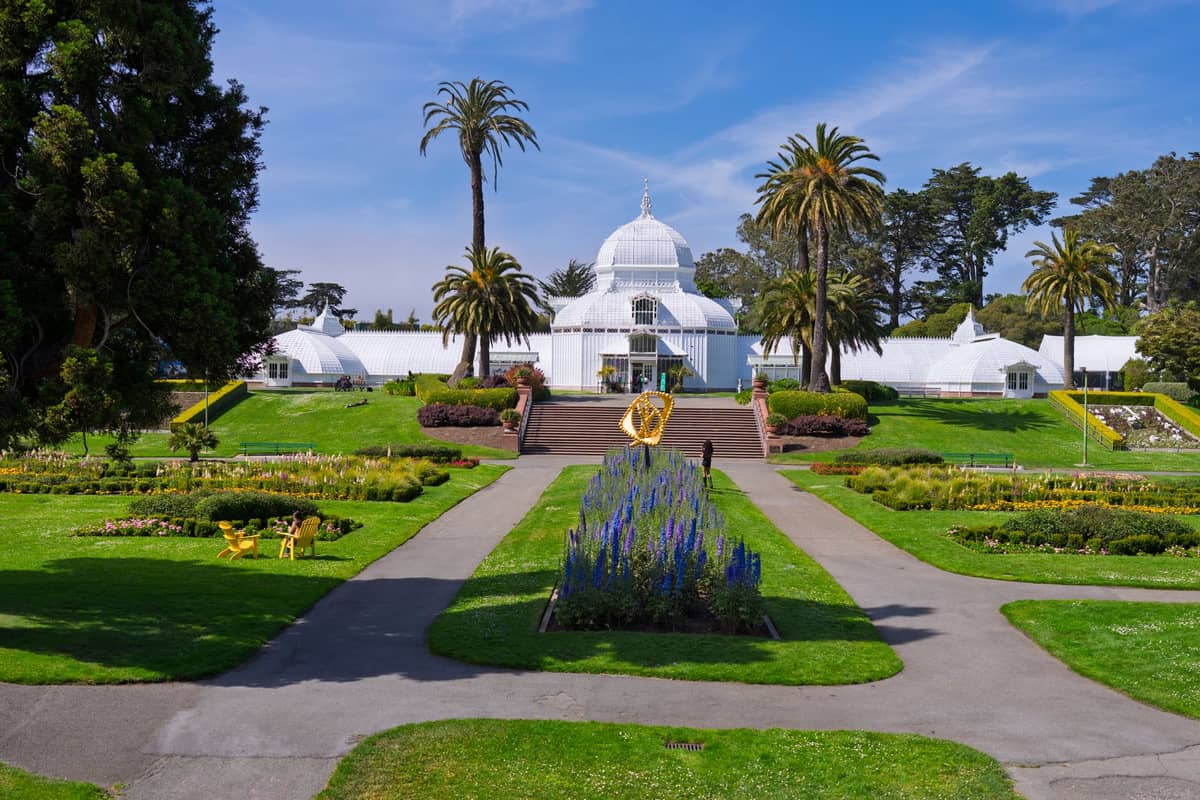
The Garden of Fragrance was designed specifically with visually impaired visitors in mind, with raised beds and labeled plants selected for scent and texture. Even visitors without visual impairments find it unusually engaging. It sits near the Arthur L. Menzies Garden of California Native Plants, which is worth visiting in spring when native wildflowers are at peak bloom. For a full picture of the park's botanical offerings, the nearby Conservatory of Flowers is only a short walk away and covers tropical species in a Victorian-era greenhouse setting.
Seasonality: When the Garden Changes Character
San Francisco's mild Mediterranean climate means the garden is never truly dormant and rarely looks bare. But specific seasons bring specific rewards. Spring, roughly March through May, is the most conventionally beautiful period: magnolias bloom early, followed by cherries, then native wildflowers in the California section. The garden's cherry trees attract visitors who are unaware that San Francisco has its own understated cherry blossom season, smaller than events in other cities but without the crowds.
Summer in San Francisco often surprises visitors. June and July bring the marine layer and morning fog, which keeps temperatures in the low-to-mid 60s Fahrenheit. The botanical garden in summer fog has a particular atmosphere: cool, quiet, slightly eerie in the best sense, with moisture on the leaves and muted light. By September and October, which are statistically the warmest and clearest months in San Francisco, the garden becomes more open and sun-lit, and the fragrance garden is at its most aromatic.
Non-resident adult admission is often lower in winter than in peak months (confirm current rates at gggp.org), and the garden's winter garden section, which focuses on plants that bloom or show strong structure in the cold months, justifies a visit from November through January. Crowds drop significantly after October.
ℹ️ Good to know
Opening hours shift seasonally. From the second Sunday in March through September, last entry is 6pm. February through the second Saturday in March, and October through the first Saturday in November, last entry is 5pm. From the first Sunday in November through January, last entry is 4pm. The garden closes one hour after the last entry time in each season. Check current hours before visiting.
Practical Logistics: Getting There, Getting Around
The main entrance is at 9th Avenue and Lincoln Way, on the eastern edge of Golden Gate Park. From downtown, the Muni N-Judah light rail line runs through the Sunset District and stops at 9th Avenue and Irving Street, about a 5–10 minute walk from the entrance. Muni bus line 44 also stops near the park. If you are coming from further afield, the N-Judah is the most reliable option.
Street parking is available on 9th Avenue and surrounding streets, though weekend availability is limited. Cycling is a practical alternative: dedicated bike lanes on several streets approach the park, and bike racks are available near the entrance.
The paths inside the garden are paved or compacted gravel and largely flat, making most sections accessible with a stroller or wheelchair. Some of the wilder trail areas, including sections of the Redwood Trail, involve uneven surfaces. Visitors who need specific accommodations are encouraged to contact the garden at info@gggp.org or +1 415-661-1316 x412 at least five business days before their visit.
Wear layers. Even on clear San Francisco days, the garden's tree canopy keeps temperatures a few degrees cooler than the surrounding streets, and mornings can be genuinely chilly. Closed-toe shoes are practical given the damp paths.
Photography Notes and Honest Limitations
The garden is one of the more photogenic places in San Francisco, but its visual character is subtle rather than dramatic. It rewards patience and macro-level attention: dew on leaves, the texture of bark, the architectural quality of a cycad frond. Wide-angle shots of expansive flower fields are not really what this place offers. The best photography happens in the first two hours after opening, when the light is soft and diffuse.
Tripods are generally permitted but should not block narrow paths. Drone use is not permitted inside the garden.
If dramatic, Instagrammable landscapes are your primary goal, the Twin Peaks viewpoint or the Golden Gate Bridge will serve you better. The botanical garden is more rewarding for visitors who find satisfaction in close observation and quiet atmosphere rather than iconic panoramas.
⚠️ What to skip
Picnicking is not permitted inside the garden. The Great Meadow in Golden Gate Park just outside the entrance is a reasonable alternative for a post-visit lunch.
Insider Tips
- The free 7:30–9am window is not widely advertised. Arrive at opening on a weekday and you may have entire sections of the garden to yourself for the first 30 minutes.
- The second Tuesday of every month is free for all visitors regardless of residency — a useful option if you cannot make the early morning window.
- Parking for the garden is primarily at the Music Concourse Garage off Martin Luther King Jr. Drive, across from the garden; on weekend afternoons this garage and nearby street parking fill up. Arrive before 10am or take transit.
- Plant labels throughout the garden include detailed species information; bring your phone charged if you want to look up unfamiliar plants or take notes.
- If you are visiting in spring, ask at the entrance kiosk which sections are currently at peak bloom. Staff track this actively and can save you time navigating to the best areas.
Who Is San Francisco Botanical Garden For?
- Plant enthusiasts and gardeners who want to see rare species from temperate climates around the world
- Photographers looking for quiet, detail-rich subjects in natural light
- Families with young children who want outdoor space that is safe, navigable, and genuinely interesting
- Visitors who want a slow, quiet morning before hitting busier attractions later in the day
- Travelers on a budget, particularly San Francisco residents (free year-round) and anyone who can make the 7:30–9am free entry window
Nearby Attractions
Other things to see while in Golden Gate Park:
- California Academy of Sciences
The California Academy of Sciences packs a four-story rainforest, a deep-sea aquarium, and a planetarium under a single grass-covered roof in Golden Gate Park. Founded in 1853 and rebuilt in 2008, it is one of the largest natural history museums in the western United States, and one of the few places in San Francisco where you can spend half a day without running out of things to look at.
- Conservatory of Flowers
Built in 1879, the Conservatory of Flowers is the oldest building in Golden Gate Park and one of the finest surviving Victorian wood-and-glass greenhouses in the United States. Five climate-controlled galleries shelter rare tropical plants, towering palms, and flesh-eating specimens that most visitors won't find anywhere else in San Francisco.
- de Young Museum
The M. H. de Young Memorial Museum is San Francisco's flagship fine art museum, set inside a striking copper-clad building by Herzog & de Meuron in the heart of Golden Gate Park. From American art to Oceanic textiles to world-class traveling exhibitions, the de Young rewards both a casual afternoon and a full-day deep dive.
- Dutch Windmill (Golden Gate Park)
Standing 75 feet tall at the northwest corner of Golden Gate Park, the Dutch Windmill is a piece of Victorian infrastructure that once pumped 30,000 gallons of water per hour to irrigate the park. Free to visit, open year-round with the exception of scheduled garden closures in May and October, and surrounded by seasonal tulip gardens, it rewards the curious traveler willing to venture to San Francisco's western edge.